Table of contents

Quick answer: Report AI marketing advisory on one page: the decision you want, the readiness verdict with its evidence, pilot before-and-after against pre-agreed thresholds, spend committed versus cancellable, the data and review-gate rules, and the stop condition.
Last verified: 2026-09-13
Lead with the decision, not the technology
A board does not need an explanation of how models work. It needs to know what you are asking it to approve, continue or kill. Put that request in the first sentence, then spend the page justifying it. The board's job is oversight of commitment and risk, not tool selection.
An AI marketing consultant who opens with capability slides invites the wrong conversation. Directors will start debating vendors, and the pilot evidence you assembled never gets read.

State the readiness verdict and what it rests on
Give one of three verdicts — ready, ready in part, not ready — and name the evidence: which workflows were inventoried, which data systems were mapped, which measurement defects were found. A verdict without evidence reads as opinion, and boards discount opinion quickly.
Where you found gaps in tracking, say so plainly: broken event configuration or misread conversion windows make any AI pilot unjudgeable. Those are conversion tracking and analytics fixes, and they belong in the report as prerequisites, not footnotes.
Show pilot results against thresholds set in advance
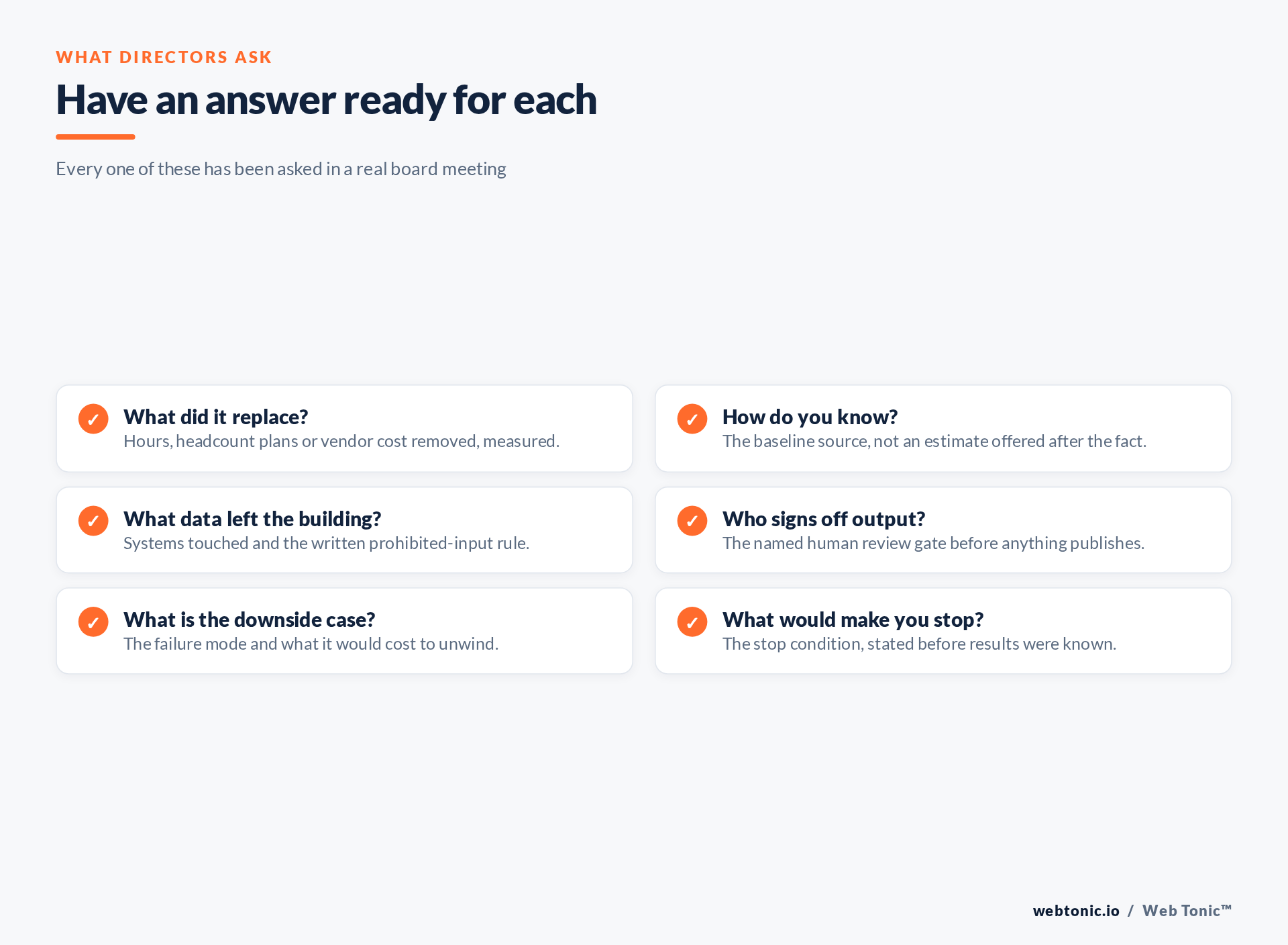
For each pilot, report the baseline, the result, and the threshold agreed before the pilot started. Hours per week, cost per asset, cost per qualified lead — whatever was recorded first. Retro-fitted success criteria are the fastest way to lose a board's trust for a year.
Small, honest numbers beat impressive ones with no provenance. "Brief turnaround fell from three days to one across eleven briefs" is defensible. "Productivity up 40%" is not, unless you can name the denominator.
Separate money spent from money committed
Boards care about optionality. Split the numbers into spent, committed, and cancellable, and name the notice period on any annual contract. If a pilot is running on month-to-month tooling, that is a governance strength worth stating.
Keep this reporting on the same footing as any other initiative in the marketing plan, and tie each pilot to one metric on the scorecard rather than inventing a parallel set of AI-only indicators.
| Report block | What it must contain | Failure signal |
|---|---|---|
| The ask | One sentence naming the decision required | The board asks "so what do you need from us?" |
| Readiness verdict | Ready, part-ready or not ready, plus the evidence | A maturity score with no method behind it |
| Pilot results | Baseline, result, pre-agreed threshold | Success criteria appear after the numbers |
| Spend | Spent, committed, cancellable, notice periods | One blended budget figure |
| Risk | Data rule, review gate, accountable owner | Risk raised for the first time in questions |
| Next quarter | Continue, stop or scale, with the stop condition | Only an expansion option is presented |
Put governance on the page, not in the appendix
Directors are accountable for how the company handles data and for what it publishes. Name the written prohibited-input rule, the human who approves machine-generated output, and the framework you are governing against — the NIST AI Risk Management Framework is a workable reference, and where the EU AI Act framework applies, say which uses are in scope.
Where customer data is involved, state the lawful basis under regimes such as GDPR. On published output, cite Google's guidance on people-first content: scale without a quality gate is a risk to organic visibility, not a saving.
Answer the AI-search question in one paragraph
Boards increasingly ask whether the company appears in AI assistant answers. Report it as coverage and citation of your own pages on the questions buyers ask, tracked over time — not as a single vanity number. Treat it as an extension of search work rather than a separate programme, and say plainly that the measurement discipline here is younger than paid or organic reporting.
If you have no baseline yet, say that too, and propose one for next quarter. A stated unknown is stronger than an invented figure.
What goes wrong
The failure mode: the update becomes a demo. Screenshots of impressive output, no baseline, no owner, no stop condition — and the board approves nothing while quietly losing confidence in the programme.
Second failure mode: risk arrives during questions rather than on the page. Once a director surfaces a data concern you did not raise, every number in the report gets re-examined.
Third: reporting activity instead of outcomes. Counts of pilots run, prompts written or tools evaluated tell a board nothing about whether the constraint moved. Structure and templates live in the help library; delivery sits under growth marketing.
Frequently Asked Questions
How long should the board update be?
One page, with an appendix nobody is required to read. If the argument needs six slides, the decision being requested is probably not clear yet.
What if the pilots underperformed?
Report it against the stop condition you set in advance and recommend stopping. A programme that can stop itself is one a board will fund again.
Which metrics belong in the update?
The before-and-after on each pilot's own baseline, plus the one scorecard metric it was meant to move. Avoid AI-only indicators that exist nowhere else in reporting.
Should the report include vendor detail?
Only spend, commitment length and notice period. Vendor architecture is management's call; the board's interest is cost, risk and reversibility.
Sources: NIST AI RMF; European Commission, AI Act framework; GDPR; GA4 events, Google Ads conversion windows, Google helpful content guidance; Board of directors, KPI, Marketing plan (Wikipedia). Verified 2026-09-13.