Table of contents

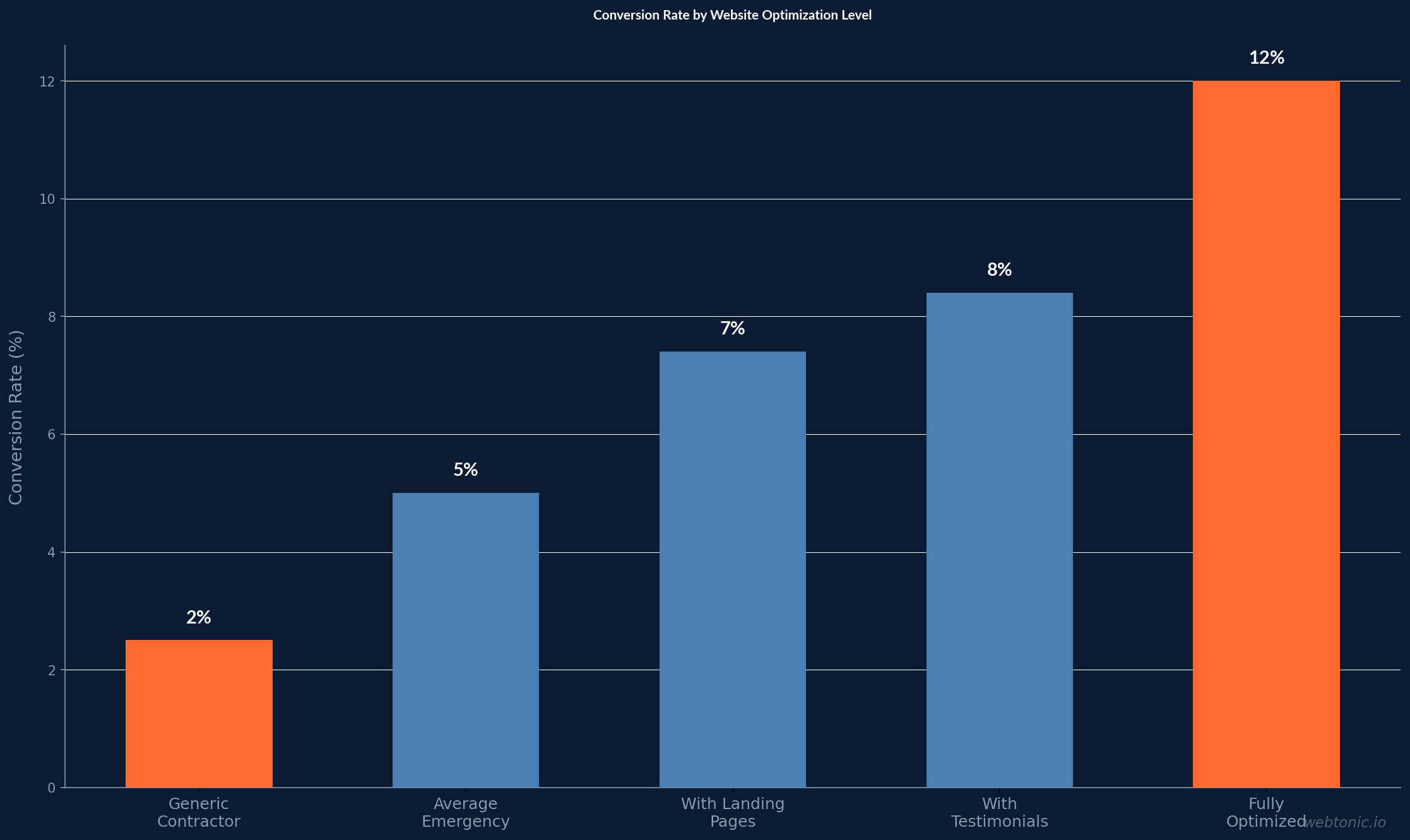
Disaster restoration companies that invest in modern web platforms like Webflow see 8–15% conversion rates on emergency traffic, compared to the industry median of just 2–3%. This article compiles the latest 2026 benchmarks on website performance, mobile optimization, and conversion patterns specific to the restoration sector.
Key Takeaways
- Emergency-optimized restoration websites reach 8–15% conversion rates on disaster traffic, versus 2–3% for average contractor sites
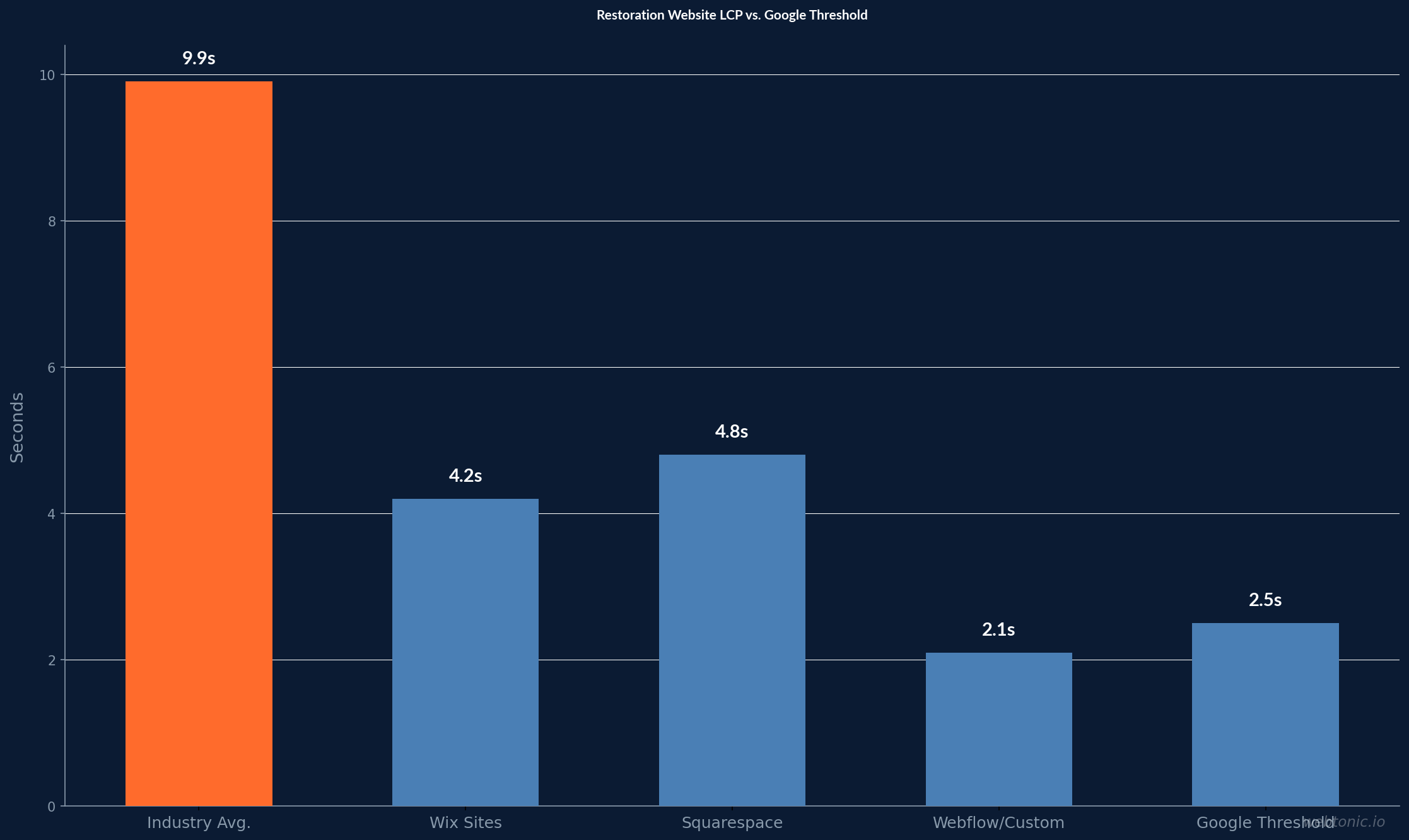
- Average restoration website LCP is 9.9 seconds — 7.4 seconds above Google's 2.5-second passing threshold
- 64% of emergency searches occur on mobile devices, and homeowners bounce after just 3 seconds of load time
- Location-specific landing pages are 2.3× more effective for restoration PPC, reducing cost per lead by 57%
- Dedicated landing pages convert 47% better than generic restoration websites
- 71% of restoration companies have no local SEO strategy, leaving significant digital market share uncaptured
- Companies responding within 5 minutes convert 80% more leads than those taking over an hour
Disaster Restoration Website Performance Benchmarks (2026)
Website speed and Core Web Vitals remain critical differentiators for restoration companies competing in high-intent emergency search markets. The gap between top performers and the industry average creates substantial competitive advantage for companies that optimize their web infrastructure.
| Metric | Industry Average | Top Performers | Google Threshold |
|---|---|---|---|
| LCP (Largest Contentful Paint) | 9.9 seconds | Under 2.5 seconds | 2.5 seconds |
| Mobile CWV Pass Rate | ~51% | 85%+ | All three metrics pass |
| Desktop-to-Mobile Speed Gap | 45% slower on mobile | Under 15% gap | N/A |
| Mobile Bounce Threshold | 3-second tolerance | Sub-2-second loads | 2.5s LCP |
| Page Builder CWV Pass (Wix) | 74% | N/A | All pass |
| Page Builder CWV Pass (Squarespace) | 70% | N/A | All pass |
| Custom-Built / Webflow CWV Pass | 85%+ | 95%+ | All pass |
According to Borah Labs, the average restoration website takes 9.9 seconds to render its main content, which is 7.4 seconds over Google's passing threshold. Modern platforms like Webflow give restoration companies direct control over performance optimization — every 1-second delay in mobile load time reduces conversions by up to 20% for emergency services.
Conversion Rate Benchmarks for Restoration Websites
Conversion rates in the disaster restoration space vary dramatically depending on traffic source, website architecture, and response time. Emergency-intent visitors convert at significantly higher rates than planned restoration inquiries, making the web platform choice critical for capturing high-value leads.
| Traffic Type | Conversion Rate | Key Driver |
|---|---|---|
| Emergency Services (Optimized) | 8–15% | Click-to-call, 24/7 dispatch flow |
| Emergency Services (Average) | 12–25% | High urgency, limited competition |
| Planned Restoration Projects | 3–8% | Before/after galleries, testimonials |
| Average Contractor Site | 2–3% | Generic template, slow response |
| Top 6% of Contractor Sites | 8–12% | Conversion architecture implemented |
| With Dedicated Landing Pages | +47% lift | Location-specific messaging |
| With Customer Testimonials | +34% lift | Social proof, trust signals |
Research from Pixlel confirms that emergency-optimized restoration sites reach 8–15% conversion rates on disaster traffic when built with proper conversion architecture. Marketing LTB data shows restoration businesses with dedicated landing pages convert 47% better than generic websites, and adding customer testimonials improves conversions by another 34%.
Mobile-First Design and Emergency Search Behavior
Mobile performance is non-negotiable for restoration companies. 64% of emergency searches happen on mobile devices, and homeowners dealing with flooding, fire damage, or mold will not wait for a slow-loading site. The data underscores why platforms offering clean, mobile-responsive templates and fast rendering — such as performance-optimized creative solutions — outperform legacy website builders for this vertical. The restoration sector faces unique mobile challenges because emergency users are often in high-stress situations with limited patience, making sub-second interactions critical for lead capture.
- Desktop-first sites load 45% slower on mobile networks, costing emergency leads to faster competitors (PushLeads)
- Restoration websites with LCP under 1.8 seconds convert 2.3× more calls than those above 3.5 seconds on mobile
- Homeowners bounce after just 3 seconds of mobile load time during emergency queries (FlashCrafter)
- Same-hour dispatch flows on mobile generate 3.7× more leads than standard contact forms (Avori Media)
- IICRC-certified companies close leads 1.5–2× faster than non-certified competitors when certification badges are prominently displayed on mobile
- 12–20% optimized conversion rates are achievable when mobile UX is properly engineered for emergency intent visitors
PPC Landing Page Performance for Restoration Companies
Location-specific landing pages built on flexible web platforms dramatically outperform generic service pages for paid search campaigns. Tygart Media's A/B testing data provides concrete evidence of how page architecture impacts cost efficiency and lead quality in restoration advertising. The ability to rapidly deploy and customize landing pages per city is one of the primary advantages of component-based design systems for restoration companies running geo-targeted campaigns.
| Landing Page Factor | Performance Impact | Source |
|---|---|---|
| Location-Specific Pages vs. Generic | 2.3× more effective | Tygart Media |
| CPL Reduction (Location Pages) | 57% lower ($62 vs. $143) | Tygart Media A/B Test |
| Before/After Gallery Inclusion | 70% more engagement | Marketing LTB |
| 5-Minute Response Time vs. 1 Hour | 80% more conversions | Restoration Marketers |
| Revenue Impact (SEO + Site Redesign) | $11.2K → $63K–84K/mo (5.6×) | Tygart Media |
| Total Leads (6-Month Case Study) | 477 leads, 28% less spend | Revity |
These numbers reinforce a clear pattern: restoration companies that build page-per-location architectures on modern CMS platforms see dramatically lower cost per lead. Webflow's component-based design system makes scaling location pages efficient — a critical advantage when 71% of restoration companies still have no local SEO strategy and the digital market remains wide open for well-structured competitors.
SEO and Digital Presence Statistics for Restoration Websites
The restoration industry's digital maturity gap creates significant opportunity for companies willing to invest in structured web platforms. Modern site builders with built-in SEO controls — clean URLs, automatic sitemap generation, schema markup support, and fast server-side rendering — address the most common technical deficits holding restoration websites back from ranking in organic search. The competitive landscape in restoration SEO remains surprisingly underdeveloped, with most companies still relying on outdated templates and generic pages that fail to capture local search demand.
- 71% of restoration companies have no local SEO strategy (Tygart Media)
- 64% haven't updated their Google Business Profile in 6+ months, missing critical local ranking signals
- 58% have no schema markup on their restoration websites at all
- AI Overviews now cover 60% of informational queries, and zero-click searches hit 80% — demanding answer-first page structures
- Service area pages that reference local landmarks and real project data rank significantly better than cookie-cutter templated pages
- 84% of consumers search online before contacting a restoration company (Marketing LTB)
- A documented case study shows 13 → 73 reviews driving a 3,800% lead increase when combined with optimized web presence
- 2026 will bring 16–18 more billion-dollar disasters based on trend acceleration, each creating regional search spikes that reward pre-positioned websites
Website Design Best Practices for Restoration Companies
Data from multiple restoration marketing case studies points to a consistent set of web design principles that separate high-converting sites from the industry average. These findings apply whether building on Webflow, WordPress, or custom platforms.
- Implement click-to-call as the primary CTA — phone-based leads dominate the restoration industry, with 85% of leads arriving by phone
- Build per-service, per-location page matrices — every service (water, fire, mold, storm, biohazard) multiplied by every location served creates a comprehensive landing page architecture
- Display IICRC certification badges prominently — only 35% of firms are certified, and certification visibility increases trust by 40%
- Add before/after project galleries — this feature alone boosts engagement by 70% and demonstrates real work quality to skeptical homeowners
- Optimize for sub-2-second LCP on mobile — sites under 1.8s LCP convert 2.3× more calls than those over 3.5s according to industry benchmarks
- Integrate live chat or 24/7 dispatch forms — disasters are not 9-to-5 events, and after-hours leads convert at premium rates
- Surface reviews and social proof above the fold — 91% of consumers rely on reviews, and 61% trust review-based decisions before contacting service providers
Restoration Websites vs. General Contractor Sites
The restoration vertical has unique characteristics — emergency-driven demand, 24/7 service requirements, and insurance-funded projects — that make modern web platforms particularly impactful compared to other home services sectors. The following comparison highlights where professional restoration sites built on platforms like Webflow diverge from the broader home services contractor average across key performance and infrastructure metrics.
| Metric | Restoration (Optimized) | General Contractor Avg. | Gap |
|---|---|---|---|
| Conversion Rate | 8–15% | 2–3% | 4–5× higher |
| LCP (Mobile) | Under 2.5s | 9.9s | 4× faster |
| Schema Markup Adoption | 60%+ (top tier) | 42% | +18 percentage points |
| Local SEO Strategy | Structured page matrix | 29% have any strategy | Significant |
| GBP Update Frequency | Monthly+ | 36% updated in 6 months | 3× more active |
| Cost Per Lead (PPC) | $62 (location pages) | $143 (generic) | 57% lower |
Frequently Asked Questions
Why do disaster restoration companies need a modern website platform like Webflow?
The restoration industry has a severe web performance gap — the average site takes 9.9 seconds to load its main content, well above Google's 2.5-second threshold. Modern platforms like Webflow deliver clean, semantic code, fast load times, and built-in mobile responsiveness that translates directly to higher conversion rates. Emergency-optimized sites built on performance-focused platforms reach 8–15% conversion rates versus the 2–3% industry average, and the component-based architecture makes scaling to hundreds of location pages manageable.
What conversion rates should restoration companies expect from their websites?
Emergency service pages typically convert at 12–25% when optimized for speed and click-to-call CTAs. Planned restoration projects convert at 3–8%. The top 6% of contractor websites achieve 8–12% conversion rates on general traffic through proper conversion architecture, including location-specific landing pages and prominently displayed trust signals such as IICRC badges and customer reviews.
How does mobile optimization impact restoration lead generation?
With 64% of emergency searches happening on mobile, mobile performance is the single biggest factor in restoration lead capture. Sites with LCP under 1.8 seconds convert 2.3× more phone calls than those above 3.5 seconds. Desktop-first designs load 45% slower on mobile networks, directly costing emergency leads to faster competitors with responsive mobile-first sites.
Do location-specific landing pages really improve restoration PPC performance?
Yes — A/B testing from Tygart Media shows location-specific landing pages are 2.3× more effective than generic service pages for restoration PPC campaigns. Cost per lead drops from $143 on generic pages to $62 on location-optimized pages, a 57% reduction that makes page-per-city architecture a high-ROI investment for multi-location restoration firms.
What website features most impact restoration company trustworthiness?
IICRC certification badges increase trust by 40% — only 35% of firms hold certification, making it a visible competitive differentiator. Customer reviews are the strongest trust signal, with 91% of consumers relying on them and documented cases showing review growth from 13 to 73 driving a 3,800% lead increase. Before/after galleries boost engagement by 70% and demonstrate tangible restoration work quality.
Sources
borahlabs.us/insights/water_damage
marketingltb.com — restoration marketing statistics
pixlel.com — restoration websites that convert
tygartmedia.com/restoration-seo-2026
tygartmedia.com — restoration marketing A/B tests
pushleads.com — website conversion optimization
flashcrafter.ai — restoration website builders
avorimedia.com — web design for water damage restoration
gorevity.com — flood and fire restoration case study
zipdo.co — branding statistics