



Table of contents

The disaster restoration industry generates over $210 billion in annual revenue, and a growing share of that commerce now flows through digital storefronts. Shopify powers 2.9 million live stores worldwide, including thousands in the home improvement and restoration supply segments. Here is what the data reveals about how restoration companies and their suppliers leverage Shopify in 2026.
Key Takeaways
- 2,898,351 live Shopify stores operate globally as of Q2 2026, up 11% year over year (Store Leads).
- 12,752 active Shopify stores compete in the Home Improvement segment, with 431 new stores launched in the past 30 days (BootLeads).
- 344,702 Shopify stores fall under the Home & Garden category, the second-largest segment on the platform (StoreInspect).
- $210 billion+ in annual revenue flows through the U.S. property restoration industry (911 Restoration FDD).
- 79% of all Shopify traffic comes from mobile devices, and 69% of purchases complete on mobile (ZIK Analytics).
- 41% of revenue in established Shopify stores comes from repeat customers (ZIK Analytics).
- $378.4 billion in gross merchandise volume (GMV) passed through Shopify in fiscal 2025, up 29.5% year over year (Digital Commerce 360).
Disaster Restoration E-Commerce Market Overview
| Metric | Value | Source |
|---|---|---|
| U.S. restoration industry revenue | $210 billion+ annually | 911 Restoration 2026 FDD |
| Global water damage restoration market | $85.3 billion (2025 est.) | HTF Market Insights |
| Average restoration job ticket | $3,000–$15,000+ | Snow Marketing Collective |
| Industry growth rate (CAGR) | 6.8% through 2030 | Precedence Research |
| Insurance-paid claims share | ~70% of residential jobs | Restoration Industry Association |
The restoration sector is considered one of the most recession-resistant segments in home services because water damage, fire damage, mold emergencies, and storm damage occur regardless of economic conditions. As the industry digitizes, both restoration contractors and equipment suppliers increasingly adopt e-commerce platforms like Shopify to sell products, book services, and manage customer relationships online.
Shopify Platform Statistics (2026)
| Shopify Metric | 2026 Data | Source |
|---|---|---|
| Total live stores | 2,898,351 | Store Leads |
| YoY store growth | +11% | Store Leads |
| Q1 2026 GMV | $100.7 billion | Shopify / GlobeNewswire |
| Full-year 2025 GMV | $378.4 billion | Digital Commerce 360 |
| Q1 2026 revenue | $3.17 billion (+34% YoY) | Shopify SEC Filing |
| Shopify Payments share | ~66% of platform GMV | Shopify Earnings |
| Mobile traffic share | 79% | ZIK Analytics |
| Mobile purchase share | 69% | ZIK Analytics |
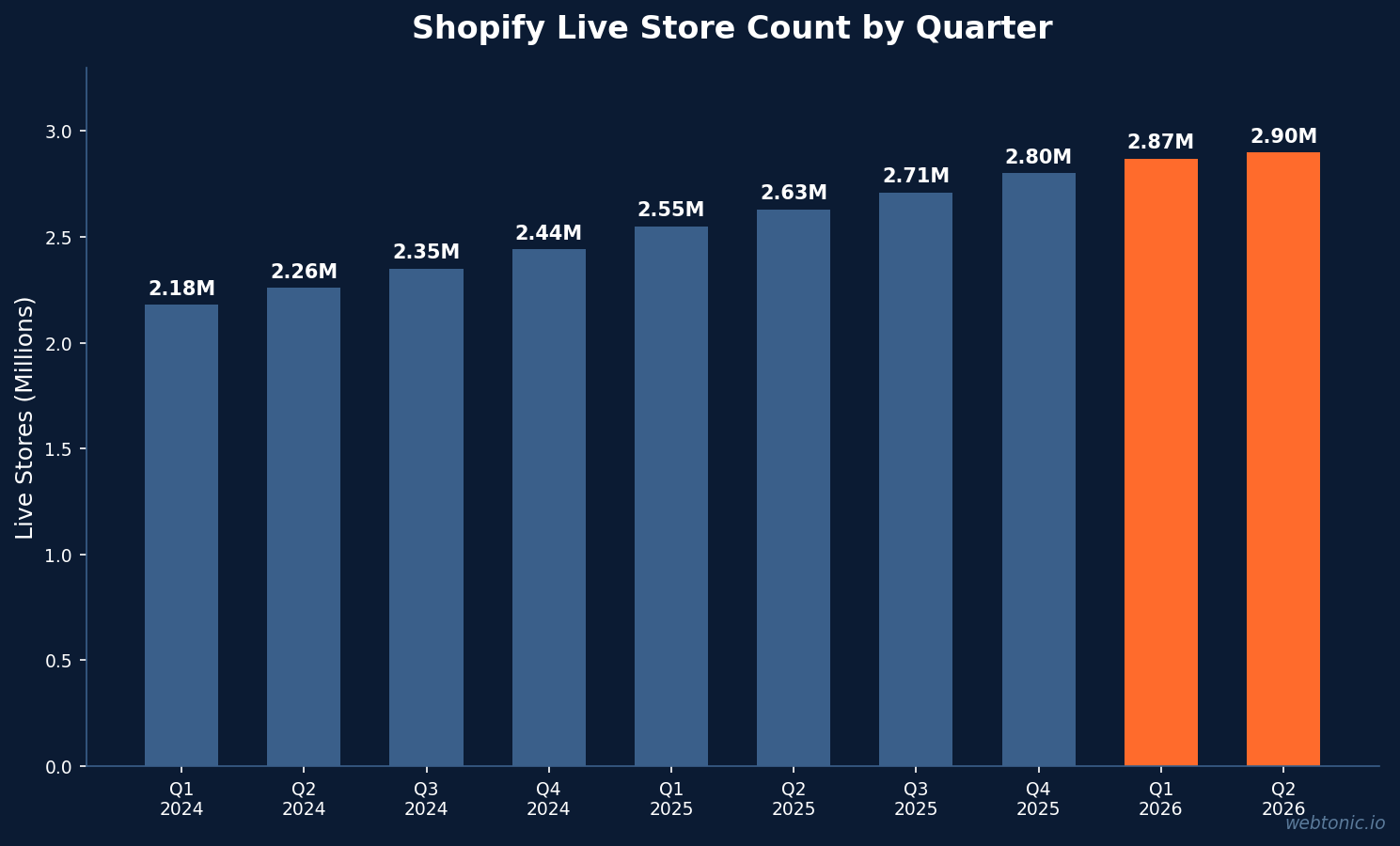
Shopify's Q1 2026 GMV crossed $100.7 billion, marking the third consecutive quarter above the $100 billion threshold. The platform's AI-driven order volume multiplied roughly 13-fold year over year, signaling a shift from indie merchant storefronts toward enterprise-grade commerce infrastructure.
Home Improvement and Restoration Supply Stores on Shopify
The home improvement and restoration supply niche on Shopify is smaller but growing steadily. Restoration contractors, equipment distributors, and product suppliers use these storefronts to sell dehumidifiers, air movers, moisture meters, protective equipment, and rebuild materials directly to other contractors or property owners.
| Category | Store Count | Share of Platform |
|---|---|---|
| Fashion & Apparel | ~224,300 | 24.5% |
| Home & Garden | 344,702 | 11.9% |
| Beauty & Fitness | ~99,900 | 10.9% |
| Home Improvement | 12,752 | ~0.4% |
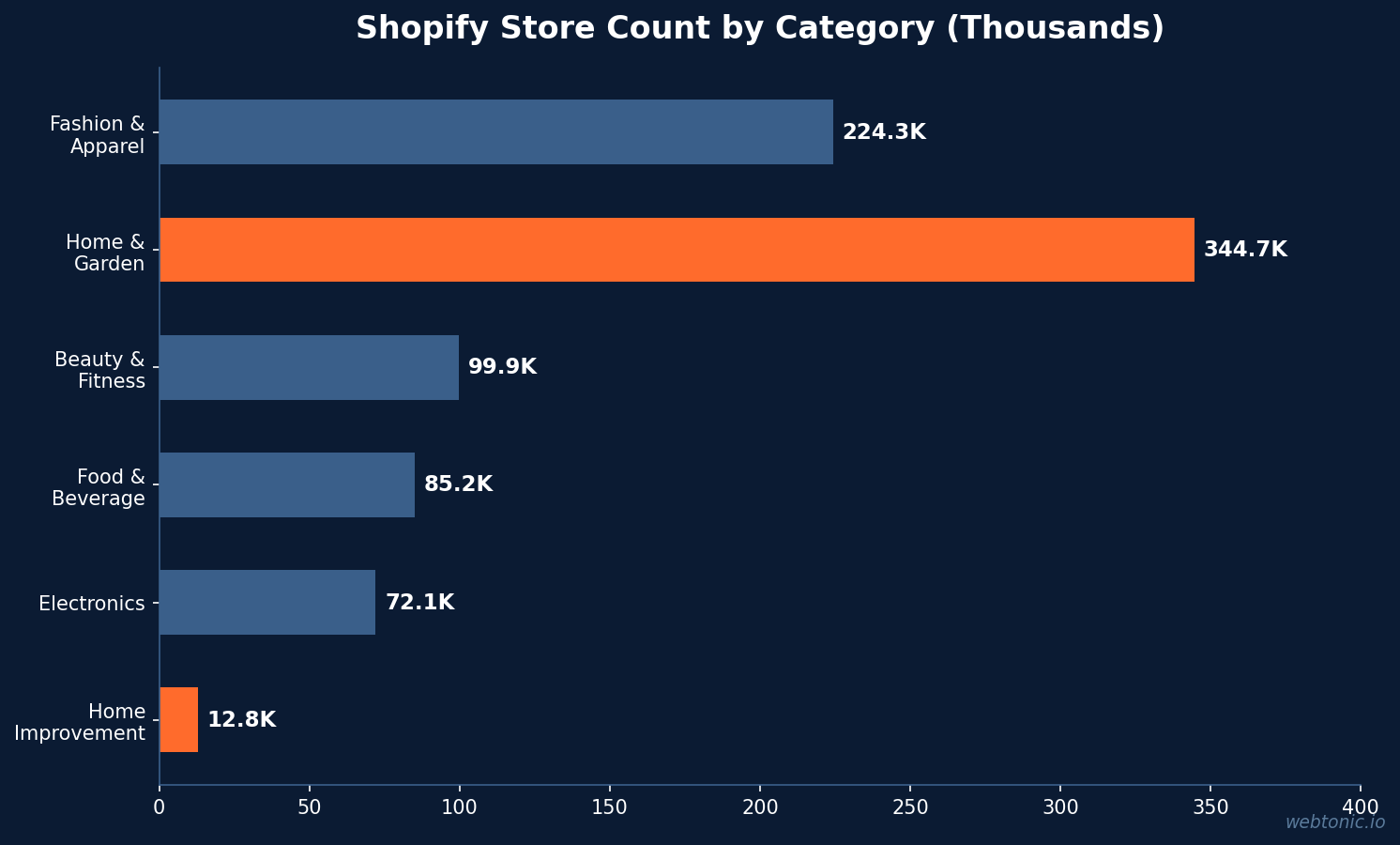
There are 12,752 active Shopify stores in the Home Improvement segment, with 431 new stores added in the past 30 days representing a 3% monthly growth rate. This is below the platform-wide average of 12% monthly growth, reflecting the niche nature of the restoration supply market (BootLeads).
Shopify Conversion and Performance Benchmarks
Restoration supply stores on Shopify face unique conversion challenges. Buyers often arrive during emergency situations seeking rapid fulfillment, which affects browsing and purchase behavior differently than typical e-commerce verticals.
| Performance Metric | Shopify Average | Home Services Range |
|---|---|---|
| Conversion rate | 1.4% (all industries) | 1.2%–2.1% |
| Average order value | $85 (median) | $150–$800+ |
| Cart abandonment rate | ~70% | 65%–75% |
| Repeat customer revenue share | 41% | 25%–40% |
| Average lifetime value | $72 | $200–$500+ (B2B) |
| Email cart recovery rate | Up to 9.6% | 8%–12% |
Stores offering bundles or subscription-based supply programs see their average order value increase by 20–30%. For restoration equipment distributors, bundling dehumidifiers with air movers and moisture meters mirrors the industry's standard package pricing model and drives higher cart values.
Technology Adoption and App Usage
The average Shopify store runs 5.2 detected apps, but the typical home improvement or restoration store tends to use fewer third-party tools. StoreInspect's analysis of 915,077 stores identified significant gaps in app adoption that represent both risk and opportunity for restoration suppliers:
- 98.5% of stores lack dedicated customer support apps
- 98.3% have no subscription management tools
- 98.2% lack analytics apps beyond Shopify's built-in dashboard
- 95.3% do not use review collection apps
- 70.7% lack email marketing integrations
For restoration supply stores specifically, data intelligence and analytics tools can help track equipment demand patterns tied to storm seasons, catastrophic events, and regional weather cycles.
Restoration Equipment and Supply E-Commerce Trends
The shift toward online purchasing for restoration equipment is driven by operational necessity. Distributors like Restoration Base, Stampede Supplies, and Air Chaser now sell LGR dehumidifiers, air scrubbers, moisture meters, and extraction equipment directly through Shopify-powered storefronts.
- Same-day pickup models combine e-commerce convenience with the emergency fulfillment speed restoration contractors require
- Starter package bundles (dehumidifier + air movers + air scrubber) typically range from $3,500 to $8,000 and represent the highest-value items sold through restoration Shopify stores
- Manufacturer-direct relationships with brands like Phoenix, Legend Brands, XPOWER, and Tramex are standard among top-performing stores
- 24/7 catastrophic event response lines differentiate restoration supply stores from general home improvement retailers
The franchise model also drives digital adoption. 911 Restoration, with under 150 active branches, provides franchisees with professionally maintained websites, CRM systems, and digital marketing support as part of the investment package ranging from $168,000 to $334,000.
Store Survival and Growth Challenges
Only 1 in 10 new Shopify stores remain active 90 days after launch, according to ZIK Analytics. The home improvement segment's 3% monthly growth rate compared to Shopify's 12% platform average suggests a more established and competitive landscape where new entrants face steeper barriers.
Key challenges for disaster restoration stores include:
- Seasonal demand volatility tied to weather events, hurricane seasons, and freeze cycles
- High-ticket, low-frequency purchases that make customer acquisition cost management critical
- B2B purchasing complexity including net-30 terms, volume pricing, and insurance documentation requirements
- Inventory management pressure during catastrophic events when demand can spike 300–500% within 48 hours
Top-performing Shopify stores in the restoration niche typically earn $2,000 to $10,000 per month, while the highest earners with strong growth marketing strategies generate $100,000+ monthly (ZIK Analytics).
Mobile Commerce and Checkout Optimization
With 79% of Shopify traffic arriving from mobile devices, restoration supply stores must prioritize mobile-first design. Shop Pay checkout speeds run up to 4x faster than standard options, directly improving conversion rates for time-sensitive restoration purchases.
Over 60% of Shopify merchants offer more than one payment option at checkout, including digital wallets and buy-now-pay-later (BNPL) programs. For high-ticket restoration equipment, BNPL options can reduce cart abandonment by making $3,000–$8,000 equipment packages more accessible to smaller restoration companies building their initial inventory.
Industry vs. Platform Comparison
| Metric | All Shopify | Home Improvement | Restoration Supply |
|---|---|---|---|
| Store count | 2,898,351 | 12,752 | ~500–800 (est.) |
| Monthly growth | 12% | 3% | 2%–4% |
| Median product count | 64 | 120–250 | 50–150 |
| Avg. product price | $50 | $75–$200 | $150–$2,000+ |
| Conversion rate | 1.4% | 1.2%–1.8% | 1.0%–2.5% |
Best Practices for Restoration Shopify Stores
- Bundle equipment packages matching IICRC S500 standards for water damage, fire, and mold remediation jobs to increase AOV by 20–30%
- Implement emergency fulfillment workflows with same-day pickup options and CAT response protocols
- Add review collection apps — 95.3% of stores lack them, yet reviews drive trust in high-ticket B2B purchases
- Use email recovery sequences to recapture the ~70% of abandoned carts, targeting up to 9.6% recovery rate
- Optimize for mobile checkout with Shop Pay and BNPL options given that 79% of traffic arrives on mobile
- Build seasonal inventory triggers aligned with hurricane, wildfire, and freeze seasons using data-driven demand forecasting
- Track customer lifetime value rather than single-transaction metrics — B2B restoration buyers average $200–$500+ in LTV
Shopify App Store and Data Protection for Restoration
The Shopify App Store hosts over 8,000 third-party applications, yet the majority of restoration supply stores underutilize available tools. Backup and data protection solutions like Rewind Backups safeguard critical store data including products, customers, and orders against accidental deletion or theme corruption. Cloud-based recovery tools ensure business continuity during high-volume disaster seasons when order processing and inventory management cannot afford downtime.
For restoration companies operating across multiple locations, ERP integrations like NetSuite streamline commerce operations by syncing inventory across warehouses in the U.S., Canada, and the United Kingdom. Shopify Support provides 24/7 assistance, and the platform's native Shopify app ecosystem includes specialized tools for B2B pricing tiers, wholesale catalogs, and volume discount structures that match how restoration business purchasing works.
The median Shopify store carries 64 products across 51 collections, with a median product price of $50. Restoration supply stores tend to maintain larger catalogs — typically 120 to 250 SKUs — with higher price points reflecting specialized equipment like LGR dehumidifiers ($1,200–$3,500), commercial air scrubbers ($800–$2,000), and professional moisture meters ($200–$600). The largest segment of stores (17.4%) carries just 1–10 products, while top restoration stores often stock hundreds of items across dehumidification, air movement, extraction, monitoring, and personal protection categories.
The cost structure for running a restoration Shopify store varies by scale. Basic plan stores pay $29/month, while established distributors on Advanced plans invest $299/month for features like third-party calculated shipping rates and advanced reporting. Payment processing through Shopify Payments runs 2.4%–2.9% plus $0.30 per transaction, with lower rates on higher-tier plans reducing the per-transaction cost for high-ticket equipment orders.
Related reading
- Webflow in the Disaster Restoration Industry: 2026 Statistics Roundup
- WordPress Usage in Disaster Restoration: Stats & Data
- WDR Shopify Stats & E-commerce Data
- Custom Web Development services at Web Tonic
Frequently Asked Questions
How many Shopify stores are in the home improvement segment?
There are 12,752 active Shopify stores in the Home Improvement category as of 2026, with 431 new stores added in the past 30 days. The broader Home & Garden category contains 344,702 stores. These figures come from BootLeads and StoreInspect tracking data.
What is the average Shopify conversion rate for home services?
The Shopify-wide average conversion rate is 1.4%, while home services and improvement stores typically convert between 1.2% and 2.1%. Stores using Shop Pay checkout see speeds up to 4x faster than standard options, which directly improves conversion rates for time-sensitive purchases.
How much does it cost to start a restoration supply Shopify store?
A basic Shopify plan starts at $29 per month, but restoration supply stores typically invest in higher-tier plans for B2B features. Initial inventory for a standard restoration equipment package ranges from $3,500 to $8,000. Full franchise models like 911 Restoration require investments of $168,000 to $334,000 including digital infrastructure.
What percentage of Shopify revenue comes from repeat customers?
Across established Shopify stores, 41% of total revenue comes from repeat customers. For B2B restoration supply stores, this figure can be higher because contractors purchase replacement parts, consumables, and upgraded equipment regularly throughout the year.
Is the restoration supply e-commerce market growing?
Yes. The U.S. property restoration industry generates over $210 billion annually and is growing at a 6.8% CAGR through 2030. The Home Improvement Shopify segment added 431 new stores in the past 30 days, and Shopify's total platform grew 11% year over year in Q2 2026.
Sources
storeleads.app/reports/shopify
storeinspect.com/report/state-of-shopify
bootleads.com/stores/shopify/niches/home-improvement
blog.99coupons.ai/shopify-statistics
zikanalytics.com/blog/shopify-statistics
911restorationfranchise.com
htfmarketinsights.com – water damage restoration market
snowmarketingcollective.com – Minutemen case study
stampedesupplies.com – water damage restoration supply
Web Tonic works across SEO and paid search, and you can book a consultation to talk through your own plan.


