



Table of contents
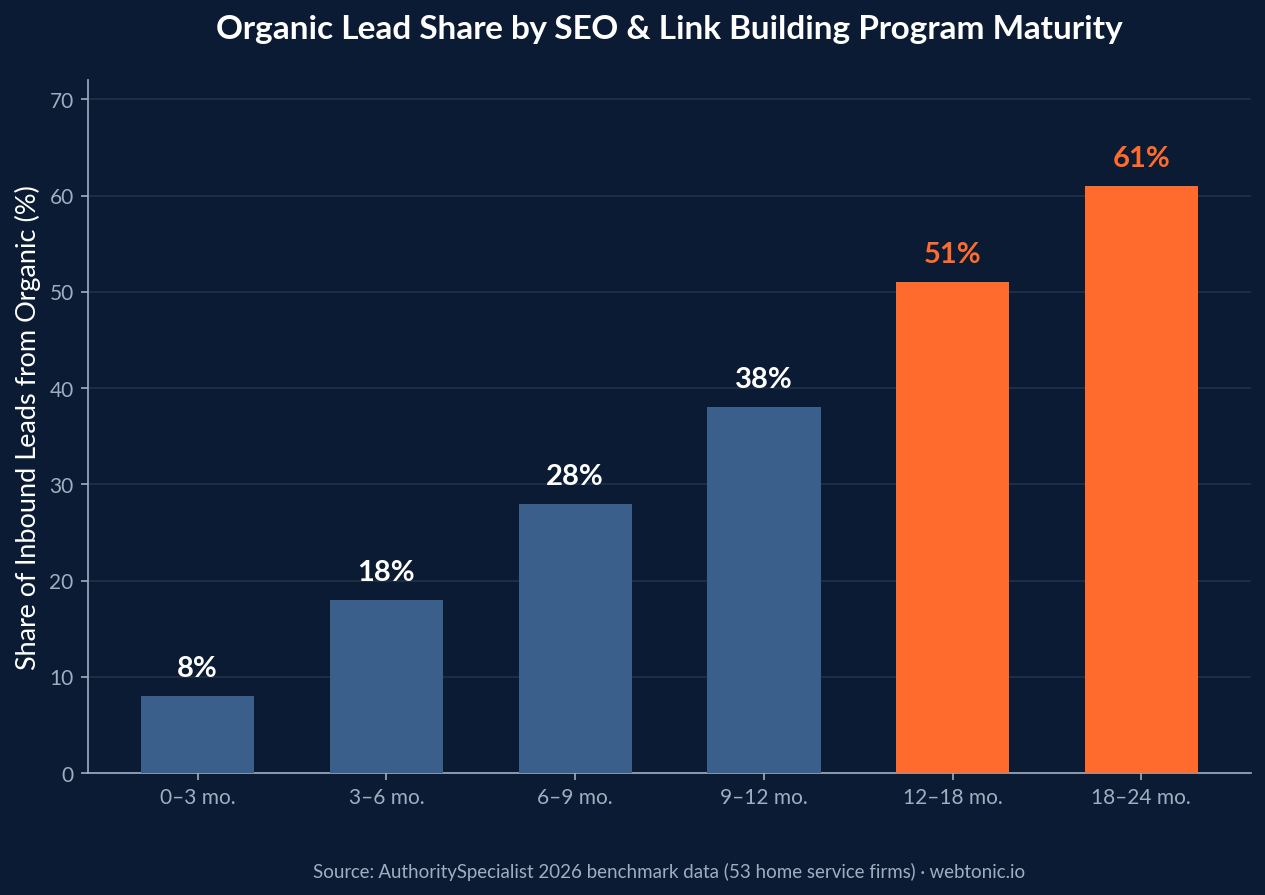
Disaster restoration companies that invest in strategic link building consistently outperform competitors in local search — earning 42–61% of their inbound leads from organic channels after 12+ months of sustained effort. Below are the data points that reveal why backlinks remain one of the highest-leverage SEO investments for restoration businesses in 2026.
Key Takeaways
- 42–61% of restoration leads come from organic search for firms with 12+ months of consistent link building and content programs.
- Multi-location restoration operators with location-specific pages convert visitors at 1.8× the rate of companies using a single generic service page.
- Firms with 20+ indexed service and FAQ pages outrank thinner competitors in 78% of head-to-head market comparisons.
- Water damage restoration PPC costs $100–$200 per click in saturated markets, making organic authority through link building the more sustainable acquisition channel.
- Review response programs produce a 14% local visibility lift, amplifying the impact of every backlink earned.
- Schema markup implementation drives 3× more AI Overview appearances in restoration-related queries.
- The U.S. water damage restoration market exceeds $12–$15 billion annually, with organic search capturing a growing share of customer acquisition.
Disaster Restoration Link Building Benchmarks at a Glance
| Metric | Benchmark | Source |
|---|---|---|
| Organic lead share (12+ mo. programs) | 42–61% | AuthoritySpecialist 2026 |
| Location-page conversion lift | 1.8× vs. generic page | AuthoritySpecialist 2026 |
| Content depth advantage (20+ pages) | 78% win rate | AuthoritySpecialist 2026 |
| Review response visibility lift | +14% | Tygart Media A/B test |
| Schema markup AI Overview lift | 3× appearances | Tygart Media A/B test |
| GBP weekly posting impression lift | +21% vs. monthly | Tygart Media 12-week test |
| Avg. residential water damage job | $3,000–$12,000 | AuthoritySpecialist 2026 |
| PPC cost per click (saturated markets) | $100–$200 | AuthoritySpecialist 2026 |
Why Link Building Matters for Restoration Companies
The economics of disaster restoration make link building uniquely valuable. With average residential water damage jobs ranging from $3,000 to $12,000 and commercial losses running multiples higher, even a single additional organic lead per month can justify an entire SEO and link building program. A restoration company spending $1,500 per month on SEO that closes one incremental $4,000 job is already cash-flow positive — before accounting for repeat referrals and reviews that compound over time.
Compare that to PPC advertising, where water damage restoration clicks cost $100–$200 each in saturated U.S. markets like Houston, Miami, and Chicago. Link building creates compounding organic authority: once a restoration site earns strong backlinks, those ranking benefits persist without per-click costs. According to AuthoritySpecialist, restoration companies that invest in SEO typically see compounding returns as domain authority builds over 6–12 months.
The U.S. water damage restoration market is valued at roughly $12–$15 billion in annual revenue, driven by aging housing stock, more frequent extreme weather events, and expanding commercial restoration work. For restoration businesses across North America, the United Kingdom, and emerging markets in the Middle East and Africa, building online authority through backlinks is becoming the primary competitive differentiator in organic search.
Backlink Sources That Drive Restoration Rankings
Not all backlinks carry equal weight for restoration companies. Local and industry-relevant links outperform generic directory submissions because Google recognizes geographic and topical alignment. Below are the highest-value link sources for restoration businesses, ordered by impact.
| Link Source | Value Signal | Acquisition Method |
|---|---|---|
| IICRC member directories | Industry authority + certification trust | Maintain active IICRC membership |
| Insurance agency resource pages | Local relevance + referral traffic | Partner outreach, co-branded content |
| Chamber of commerce listings | Local trust + NAP consistency | Annual membership registration |
| Property management firm directories | Commercial referral authority | Vendor approval process |
| Local media coverage | High DA + geographic relevance | Storm response PR, expert commentary |
| Municipal emergency service directories | Government trust signals | Emergency response partnership |
| Trade association websites (RIA, BBB) | Industry credibility | Membership + profile optimization |
| Supplier and manufacturer profiles | Trade relevance | Approved installer programs |
According to ProTradeHQ, the best backlinks for local contractors come from "boring places" — suppliers, manufacturers, chambers, trade groups, and referral partners. One link from a local insurance agency can generate more emergency calls than ten generic directory links because the referral traffic is pre-qualified and the link signal is contextually relevant.
Domain Authority and Content Depth Benchmarks
Domain authority (measured by tools like Ahrefs Domain Rating or Moz DA) serves as a proxy for accumulated trust signals built through backlinks. According to AuthoritySpecialist's 2026 benchmark data from 53 home service firms:
- Service businesses need a domain rating above the competitive floor for their specific market to rank consistently.
- Firms with 20+ indexed service and FAQ pages outrank thinner sites in 78% of head-to-head comparisons.
- Multi-location operators with dedicated location pages convert organic visitors at 1.8× the rate of firms relying on a single generic service page.
- Service category pages tend to rank faster than highly competitive location pages in saturated markets.
- Firms with 2+ years of domain history see faster ranking movement within 3–5 months versus new sites.
For data-driven restoration marketers, these benchmarks highlight the importance of building both backlink authority and topical depth simultaneously. Link building without content depth leaves rankings vulnerable; content depth without backlinks means pages never gain enough authority to rank.
Link Building ROI: Organic vs. Paid Acquisition
The return on investment for link building in disaster restoration becomes clear when you compare the unit economics of organic versus paid channels.
| Channel | Cost per Lead | Compounding Effect | Lead Quality |
|---|---|---|---|
| Organic (SEO + link building) | $45–$120 (avg. after 12 mo.) | Yes — authority compounds | High-intent, pre-qualified |
| Google Ads (PPC) | $150–$350 | None — stops when budget stops | Mixed intent |
| Local Services Ads | $65–$180 per lead | None | High-intent, Google-screened |
| Directory listings | $80–$250 | Minimal | Variable |
According to Tygart Media's restoration marketing channel comparison, SEO and link building offer the only truly compounding acquisition channel for restoration companies. Every month of PPC requires the same spend for the same clicks — there is no cumulative benefit. In contrast, backlinks earned today continue to support rankings for years.
The restoration services market analysis across the United States, Canada, the United Kingdom, and growing markets in Latin America and the Asia Pacific region consistently shows that companies with strong organic foundations weather seasonal demand volatility better than PPC-dependent competitors.
Google Business Profile and Link Amplification
Backlinks and Google Business Profile (GBP) optimization are not separate strategies — they amplify each other. Tygart Media's controlled A/B tests across restoration companies produced striking results:
- Review response programs generated a 14% local visibility lift in a 31-day test across 8 restoration companies (p=0.04).
- Schema markup implementation drove 3× more AI Overview appearances in a 90-day controlled test — a significant finding as Google's Gemini-powered search features expand.
- Weekly GBP posting outperformed monthly posting by +21% impressions, +57% clicks, and +89% calls over 12 weeks across 18 restoration companies.
- Weekly posters versus sporadic posters saw +80% impressions, +169% clicks, and +386% more calls.
These results demonstrate that link building works best when combined with active GBP management. Using Google Search Console alongside Google Keyword Planner helps restoration companies identify which backlink-driven pages are gaining traction and where to focus acquisition efforts next.

Technical Foundations That Maximize Link Value
Even the strongest backlink profile produces diminished returns if the receiving site has technical problems. According to Borah Labs' 2026 water damage website benchmark study, the average restoration page takes 9.9 seconds to render its main content — more than 7 seconds over Google's passing threshold of 2.5 seconds for Largest Contentful Paint (LCP).
For restoration businesses investing in link building, addressing technical foundations first ensures that earned authority translates into rankings:
- SSL certification is table stakes — Google confirmed HTTPS and SSL certification as ranking signals, and unsecured restoration sites lose trust with both search engines and potential customers.
- Mobile optimization matters disproportionately for restoration searches because emergency queries overwhelmingly originate from smartphones.
- Page speed below 2.5s LCP prevents Core Web Vitals from dragging down positions that backlinks are pushing up.
- CMS configuration (WordPress, Squarespace, or custom) must allow clean URL structures and proper internal linking for link equity distribution.
The restoration services market analysis shows robust growth globally. In France and Germany, the restoration industry follows similar digital marketing patterns, with link building increasingly critical for visibility in local search across the European Union. The Asia Pacific region — particularly Australia and Japan — is seeing rapid adoption of SEO-driven restoration marketing, while markets in Latin America and Africa are still dominated by referral-based acquisition. For restoration businesses using Google Keyword Planner and PPC data to inform their link building strategy, understanding these regional differences helps prioritize content creation and outreach targets.
The intersection of IoT-enabled property monitoring systems and restoration services is also creating new link building opportunities. As smart home flood detectors and mold remediation alert systems become standard, restoration companies that produce authoritative content about these technologies earn natural editorial backlinks from home improvement and insurance publications.
Link Building Strategy by Restoration Service Type
| Service | Primary Link Sources | Content Angle | Competitive Intensity |
|---|---|---|---|
| Water damage restoration | Insurance agencies, plumbers, property managers | Emergency response guides, cost calculators | Very high |
| Fire damage restoration | Fire departments, insurance adjusters, local media | Recovery timelines, safety checklists | High |
| Mold remediation | Health departments, home inspectors, real estate agents | Health impact data, prevention protocols | Moderate |
| Storm damage | Weather services, emergency management, municipal sites | Seasonal preparedness, insurance claim guides | Seasonal spikes |
| Biohazard cleanup | Law enforcement, healthcare facilities, compliance bodies | Regulatory compliance, certification requirements | Low–moderate |
Each restoration service category offers distinct link building angles. Water damage restoration faces the highest competition in search (and the highest PPC costs), making organic authority through targeted backlinks especially valuable. Mold remediation content — particularly pieces linking health outcomes to indoor air quality data — earns natural backlinks from health and real estate publications at a higher rate than general restoration content.
Best Practices for Restoration Link Building
- Prioritize local and industry-relevant links over volume. One link from a local insurance agency or IICRC directory outweighs dozens of generic submissions.
- Create linkable assets around insurance and cost data. Restoration cost calculators, insurance claim guides, and seasonal damage prevention checklists earn natural editorial links.
- Leverage storm events for PR outreach. Local media actively seek expert commentary during disaster events — have press materials ready before storm season.
- Build supplier and manufacturer relationships. Approved installer profiles on manufacturer sites provide high-relevance backlinks with referral traffic potential.
- Maintain active IICRC and RIA memberships. These directory links carry significant industry authority and are easy to acquire through membership.
- Combine link building with GBP optimization. Backlinks amplify local pack rankings when GBP signals (reviews, posts, photos) are also strong.
- Monitor with Google Search Console and Google Analytics. Track which pages receive backlinks, measure organic traffic growth, and identify link-driven ranking improvements.
- Invest in content depth — target 20+ indexed pages. According to benchmark data, topical depth is the most consistent performance predictor across home service SEO campaigns.
Related reading
- Water Damage Restoration Link Building Statistics (2026)
- White Hat Link Building: What It Is & How to Use It
- Inbound vs Outbound Links: 2026 Link Building Statistics
- Link Building Services services at Web Tonic
Frequently Asked Questions
How many backlinks does a restoration company need to rank locally?
There is no universal number — it depends on market competitiveness. According to AuthoritySpecialist's 2026 data, restoration companies need a domain rating above the competitive floor for their specific market. In less competitive mid-size cities, 15–30 quality local backlinks may be sufficient. In saturated metros like Houston or Miami, firms may need 50–100+ referring domains with strong local and industry relevance.
How long does link building take to produce results for restoration companies?
Most restoration SEO campaigns require 4–6 months before organic rankings generate consistent inbound call volume, with the Map Pack being the primary conversion driver. Companies with 2+ years of existing domain history see faster ranking movement — typically within 3–5 months. New domains should budget 6–12 months of sustained effort before expecting significant organic lead flow.
Are directory links still valuable for restoration SEO?
Yes, but with caveats. Industry-specific directories like IICRC, BBB, Angi, and HomeAdvisor provide legitimate trust signals and NAP consistency that support local rankings. Generic link directories with no editorial standards provide little value and may trigger Google penalties. Focus on directories that drive actual referral traffic alongside their SEO benefit.
What is the biggest link building mistake restoration companies make?
Buying links from link farms or low-quality private blog networks. Google's algorithms are increasingly effective at identifying manipulative link patterns, and restoration companies caught using these tactics risk manual penalties that can take months to recover from. The safer, more effective approach is earning links through real business relationships, local community involvement, and authoritative content creation.
How does link building interact with PPC for restoration companies?
Link building and PPC serve different roles. PPC provides immediate lead volume but offers no compounding benefit — costs remain constant or increase. Link building creates compounding organic authority where leads arrive without per-click costs. According to Tygart Media, the most effective restoration marketing strategies use PPC for immediate lead generation while building organic authority through link building for long-term cost reduction.
Sources
authorityspecialist.com/industry/home/services/seo-statistics
authorityspecialist.com/industry/home/water-damage-restoration/seo-statistics
authorityspecialist.com/industry/home/water-damage-restoration
tygartmedia.com/restoration-marketing-ab-tests
tygartmedia.com/seo-for-restoration-companies
tygartmedia.com/restoration-marketing-channels-comparison
protradehq.com/marketing/contractor-backlink-strategy
borahlabs.us/insights/water_damage
marketingltb.com/blog/statistics/restoration-marketing-statistics


