Table of contents
US direct-to-consumer ecommerce sales reached USD 239.75 billion in 2025, holding at 19.2% of total US retail ecommerce, and EMARKETER now forecasts that share plateauing through 2028 rather than climbing further. The channel has not stalled; it has matured, and 2026 is the year the unit economics stopped being optional homework.
Key Takeaways
- US D2C ecommerce hit USD 239.75 billion in 2025.
- That is 19.2% of total US retail ecommerce.
- EMARKETER expects that share to plateau through 2028.
- Brands lose USD 29 on the average new customer's first order.
- That loss is up 222% from USD 9 in 2013.
- A repeat sale now nets USD 39, up 36% from USD 28.
- Median public DTC operating margin was -2.4% in FY2025.
- Median gross margin held near 47% over the same period.
- Sub-USD 1 million brands pay roughly USD 95 to acquire a customer.
- The USD 5-20 million tier pays about USD 75, the worst mid-market squeeze.
- USD 100 million-plus brands get CAC down to about USD 55.
- Cold Meta acquisition runs as low as -22% contribution margin.
- Email and SMS retention marketing runs as high as +77%.
- Internet ad prices are up 30.4% since December 2022.
- Deposco's network GMV growth decelerated from 15.4% to 13.4% in a single quarter.
- Parcel inflation hit 12.8% year over year in the same quarter.
- Bootstrapped DTC brands run a 5.8-point gross margin edge over VC-backed peers.
- Gen Z's path to purchase is shifting away from paid search discovery.
How big is the direct-to-consumer channel in 2026
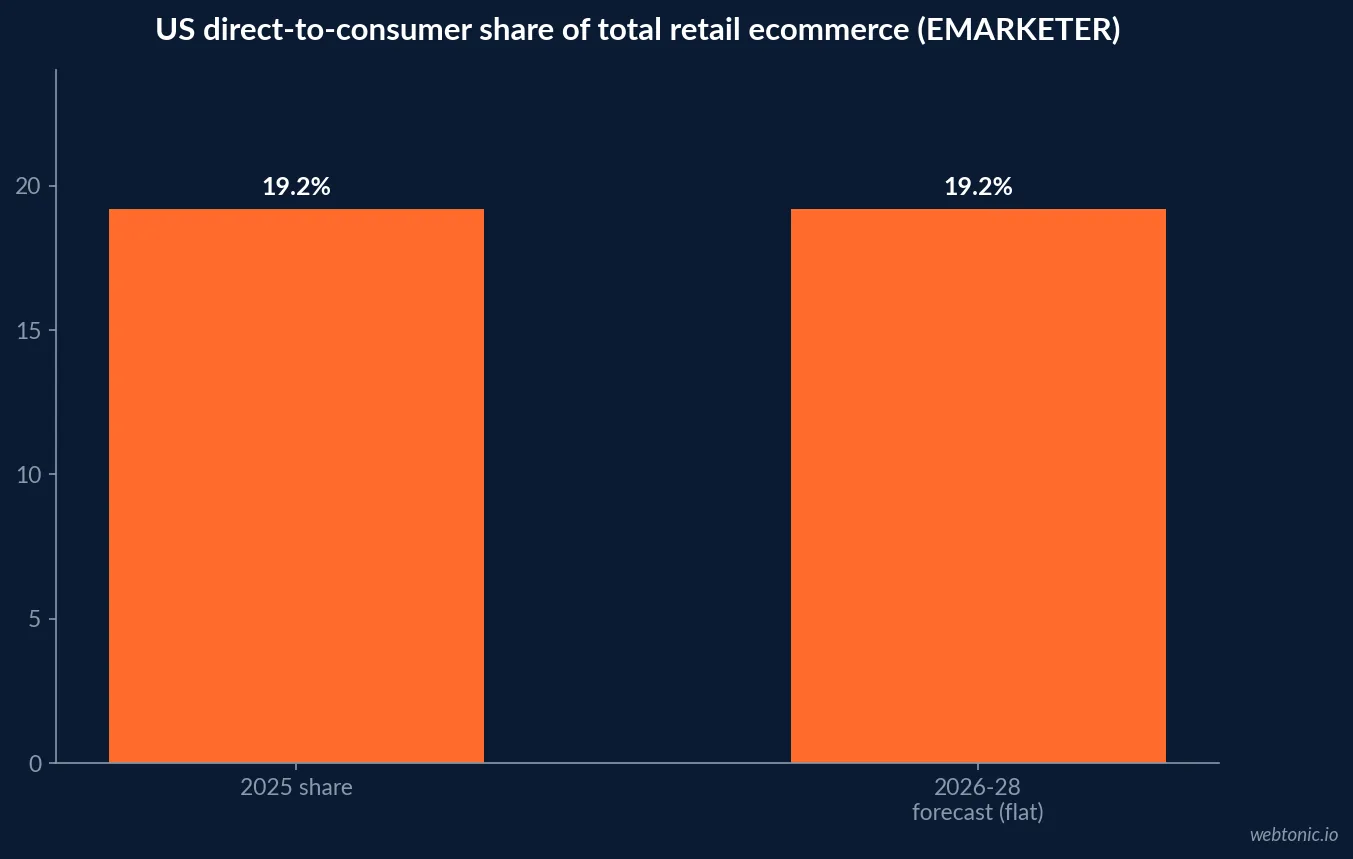
EMARKETER put US direct-to-consumer ecommerce sales at USD 239.75 billion in 2025, or 19.2% of total US retail ecommerce. That figure has been climbing in dollars for years, but its share of retail ecommerce has stopped moving, and EMARKETER's own follow-up analysis expects that plateau to hold through 2028 rather than resume its earlier climb.
That distinction matters more than the headline number. A channel that grows in dollars while its share of the pie holds flat is not shrinking, but it is also not winning new territory from marketplaces and retail media the way it did during the pandemic years.
| Metric (2025-2026) | Figure | Source | What it signals |
|---|---|---|---|
| US D2C ecommerce sales, 2025 | USD 239.75 billion | EMARKETER | A mature, dollar-growing channel |
| Share of US retail ecommerce | 19.2% | EMARKETER | Plateaued, not expanding further |
| Forecast share through 2028 | Flat near 19% | EMARKETER | No further share gains expected |
| Median DTC operating margin, FY2025 | -2.4% | Eightx (public filings) | Growth without profit for many |
| Median DTC gross margin, FY2025 | ~47% | Eightx (public filings) | The product margin is fine |
Why growth in dollars is not translating to profit
Eightx's panel of public DTC and CPG filings puts the median operating margin for public DTC brands at -2.4% in FY2025, even as median gross margin held near 47%. The loss is not happening at the product level. It is happening in the space between the product and the customer's inbox: acquisition, logistics and the general and administrative costs of running a brand that has to look bigger than it is.
Capital structure widens the gap further. Eightx's 12-filing panel found bootstrapped DTC brands running 57.2% gross margin against 51.4% for VC-backed peers, a 5.8-point spread that has not closed with five years of post-IPO data to look at.
What it actually costs to get a new customer
SimplicityDX reports that ecommerce brands now lose an average of USD 29 on a newly acquired customer's first purchase, up 222% from USD 9 in 2013. A repeat sale, by contrast, now nets USD 39, up 36% from USD 28 over the same period. The math has not changed direction, it has just gotten starker: the first order is a marketing expense, and the second order is where the business actually makes money.
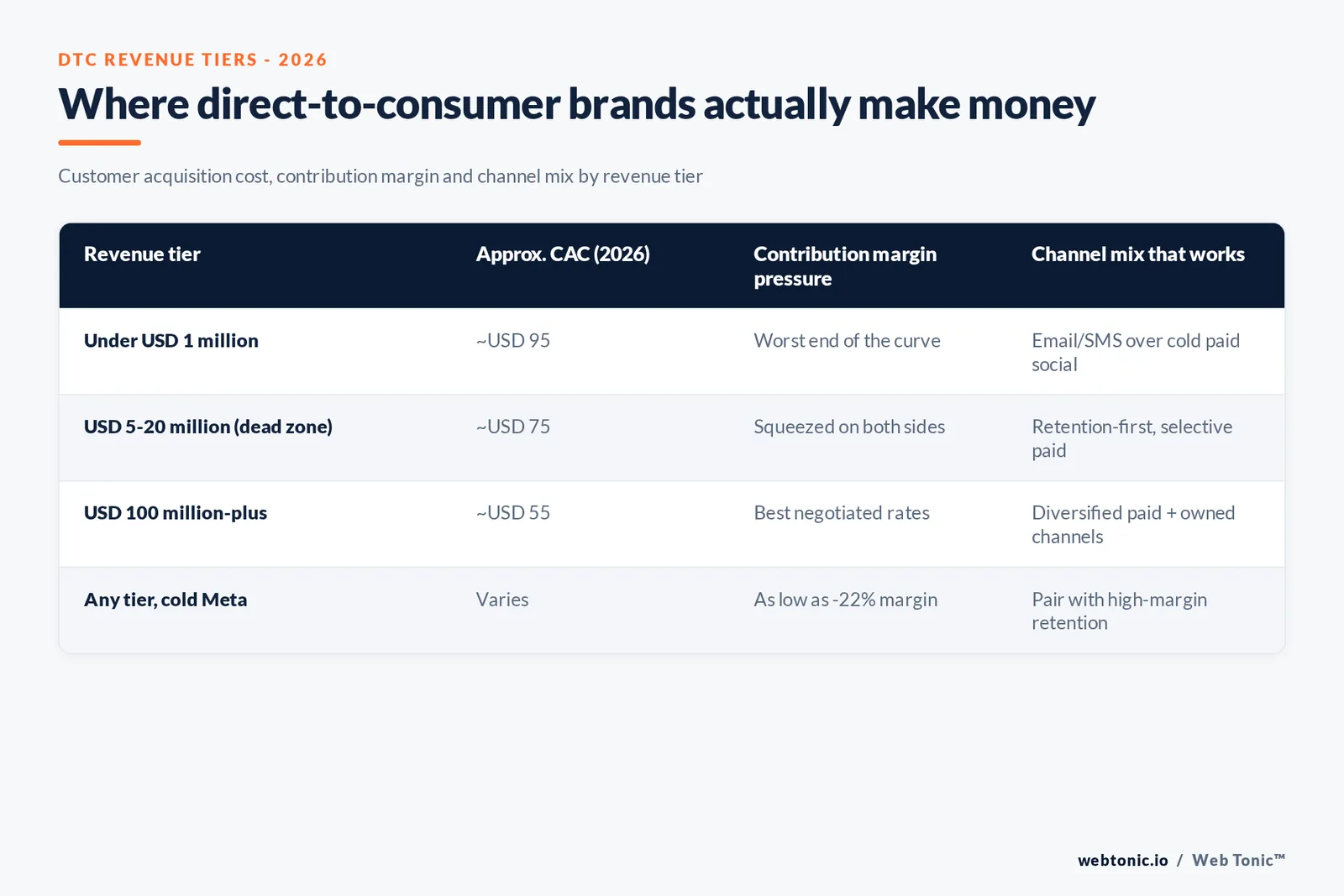
Eightx's CAC-by-revenue-stage data shows the pain is not evenly spread. It follows a U-shape, worst in the middle rather than at either end.
| Revenue stage | Approx. CAC (2026) | Source | Why this tier struggles |
|---|---|---|---|
| Under USD 1 million | ~USD 95 | Eightx | No volume to negotiate media rates |
| USD 1-5 million | ~USD 75-95 | Eightx | Scaling spend faster than retention systems |
| USD 5-20 million (dead zone) | ~USD 75 | Eightx | Too big for niche targeting, too small for scale discounts |
| USD 100 million-plus | ~USD 55 | Eightx | Negotiated rates and owned-channel mix |
Which channels are actually profitable
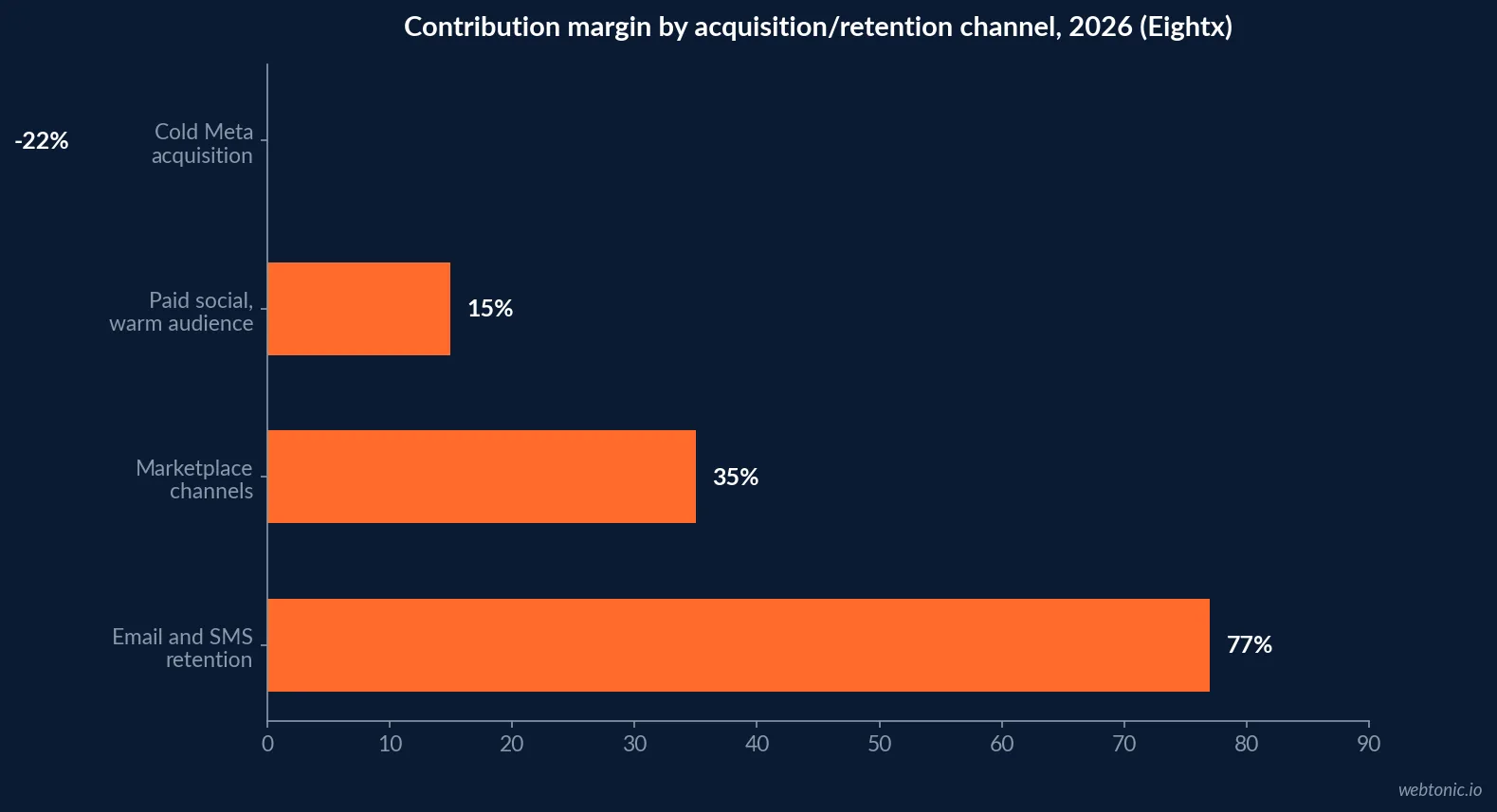
Eightx's fully-loaded contribution margin analysis puts cold Meta acquisition as low as -22% and email/SMS retention marketing as high as +77%, with internet ad prices up 30.4% since December 2022 squeezing the acquisition side further. Payback periods vary by model too: marketplaces recover CAC in 1 to 3 months, subscription businesses in 3 to 9, and standard DTC in 6 to 12.
That spread is the practical argument for treating paid acquisition and lifecycle marketing as two different budgets with two different jobs, not one line that gets cut evenly when a quarter goes soft.
| Acquisition/retention lever | Contribution margin (2026) | CAC payback | Source |
|---|---|---|---|
| Cold Meta acquisition | as low as -22% | 6-12 months (DTC model) | Eightx |
| Paid social, warm audiences | mixed, mid-range | 3-9 months (subscription) | Eightx |
| Marketplace channels | moderate, fee-adjusted | 1-3 months | Eightx |
| Email and SMS retention | as high as +77% | immediate on repeat orders | Eightx |
The supply-side pressure operators are absorbing
Deposco's Commerce Signal, built on live order, inventory and parcel data from more than 4,900 brands moving USD 84 billion in GMV, found network GMV growth for the typical operator decelerating from 15.4% in early Q2 2026 to 13.4% by quarter's end, while parcel inflation rose from 4.1% to 12.8% year over year across the same 13 weeks. Order volume kept climbing (4.0% to 8.8% growth) even as dollar growth slowed, meaning shoppers are buying more units at lower spend per order.
Inventory discipline is the other half of the picture: network median days-on-hand fell to 89.3 days, down from a 111.5-day peak in early 2025, as operators chose to run leaner rather than carry financing costs on stock.
Where discovery is heading next
EMARKETER's Gen Z Path to Purchase 2026 research tracks how younger shoppers increasingly discover new brands through generative AI tools and social search rather than paid search or display advertising, shifting weight toward structured product data, reviews and AI-visible content. Brands still running acquisition budgets as if 2021's playbook holds are fighting the wrong channel mix for where their next customer actually starts looking.
The FAQ on D2C profitability that EMARKETER published in February 2026 is blunt about the shift: D2C is "no longer a business model identity," it is a strategic channel inside a diversified commerce mix, alongside wholesale, marketplaces and retail media. Brand-building content and creative are what carry a channel through a plateau like this one, which is why our performance creative work is scoped around retention messaging as much as acquisition creative.
| 2026 D2C priority (EMARKETER) | Why it matters now | Operator action |
|---|---|---|
| Integrate D2C into omnichannel | Standalone D2C growth has plateaued | Fund wholesale/marketplace alongside owned site |
| Prioritize brand equity with Gen Z | Performance tactics only drive trial | Invest in content and community, not just ads |
| Build first-party data | Cheaper repeat orders beat costly first orders | Grow email/SMS lists at checkout |
| Optimize for AI-driven discovery | Discovery is shifting from SEO to AI search | Structured data and rich product content |
| Focus on profitable growth | Growth-at-any-cost era is over | Price acquisition against contribution margin, not GMV |
The retention infrastructure behind the repeat-purchase economics
Recharge's Subscription Trend Report 2026, built on data across 20,000 brands processing more than USD 30 billion in recurring revenue, found subscribers placing nearly 3x more orders than one-time shoppers, subscription checkouts up 16% against one-time purchases, same-day cancels down 35%, and first-order discounts up 18% as brands lean harder on incentives to convert that first sale into a subscription relationship.
Klaviyo's 2026 email marketing benchmarks, drawn from more than 183,000 Klaviyo customers, exist precisely because the SimplicityDX numbers above make owned-channel retention the highest-leverage lever most DTC brands have: a list a brand owns does not carry a per-message CAC the way a paid acquisition channel does.
| Retention lever (2026) | Reported figure | Source | Why it offsets rising CAC |
|---|---|---|---|
| Subscriber order volume vs one-time | ~3x more orders | Recharge (20,000 brands) | Converts CAC into repeat revenue |
| Subscription checkout share | Up 16% YoY | Recharge | Growing share of a fixed traffic base |
| Same-day subscription cancels | Down 35% YoY | Recharge | Stronger day-one commitment |
| First-order discount usage | Up 18% YoY | Recharge | Brands buying the first order to earn the tenth |
| Email benchmark sample size | 183,000+ customers | Klaviyo | The scale behind owned-channel norms |
What this means for a 2026 growth plan
The honest framing for a board update is that direct-to-consumer sales are still rising in absolute dollars, but the channel is no longer a source of easy share gains, and every incremental dollar of paid acquisition now competes against retention economics that are objectively better. A plan built entirely on scaling cold-audience paid social in 2026 is fighting the CAC curve, not riding it.
If acquisition and retention are being planned as one undifferentiated budget line, that is usually the first place to split. Our growth marketing practice builds channel mixes around contribution margin rather than blended CAC for exactly this reason, and a conversation with our team is the fastest way to see where a specific brand's numbers sit against these 2026 benchmarks.
Frequently Asked Questions
Is direct-to-consumer ecommerce still growing in 2026?
In dollars, yes. EMARKETER puts US D2C ecommerce sales at USD 239.75 billion in 2025, 19.2% of total US retail ecommerce, and projects the channel plateauing near that share through 2028 rather than climbing further. Growth has not stopped; it has shifted from expanding share to expanding revenue inside a fixed share, which is a materially harder game to win.
Why do direct-to-consumer brands keep losing money even as sales rise?
Because acquisition and fulfillment costs are rising faster than revenue for a large share of operators. Eightx's panel of public DTC filings shows a median operating margin of -2.4% in FY2025 even with gross margin holding near 47%, and SimplicityDX finds brands now lose USD 29 on the average new customer's first order, up 222% from USD 9 in 2013. The product is profitable. Getting the customer to it is not.
What does it cost to acquire a direct-to-consumer customer in 2026?
It depends heavily on revenue stage, not just vertical. Eightx's CAC-by-stage data shows a U-shape: roughly USD 95 at sub-USD 1M brands, easing only slightly through the USD 1M-5M range, worst again in the USD 5M-20M dead zone at about USD 75, and finally dropping to about USD 55 at USD 100M-plus scale. Brands stuck in the middle carry the worst economics of the entire curve.
Which acquisition channels are actually profitable for DTC brands right now?
Fully-loaded contribution margin analysis from Eightx puts cold Meta acquisition as low as -22% and email/SMS retention marketing as high as +77%, with paid social sitting in between depending on creative fatigue and audience saturation. The practical read is that a DTC brand cannot treat paid acquisition and retention marketing as the same budget line; one funds growth, the other funds survival.
Is Gen Z the reason DTC brands are betting on discovery over performance ads?
Largely, yes. EMARKETER's Gen Z Path to Purchase research tracks how younger shoppers now discover brands through generative AI tools and social search rather than paid search or display, which is why 2026 DTC strategy documents increasingly prioritize structured product data and AI-mediated discoverability alongside, not instead of, paid acquisition.
Sources
EMARKETER - D2C Ecommerce 2025
EMARKETER - FAQ on direct-to-consumer commerce, 2026
EMARKETER - Gen Z Path to Purchase 2026
Eightx - The State of DTC Profitability 2026
SimplicityDX - Brands losing a record USD 29 for each new customer acquired
Deposco - Commerce Signal, quarterly US fulfillment intelligence
Recharge - Subscription Trend Report 2026
Klaviyo - 2026 email marketing benchmarks by industry