Table of contents
A single 2025 pixel lawsuit settlement reached up to USD 7 million, and Google now treats cosmetic surgery as a restricted advertising category. This page separates what a dermatology or plastic surgery clinic is still allowed to track from what recent settlements and platform policy now block, using primary 2025-2026 sources rather than a generic marketing-analytics checklist.
Key Takeaways
- A 2025 hospital pixel settlement reached up to USD 7 million.
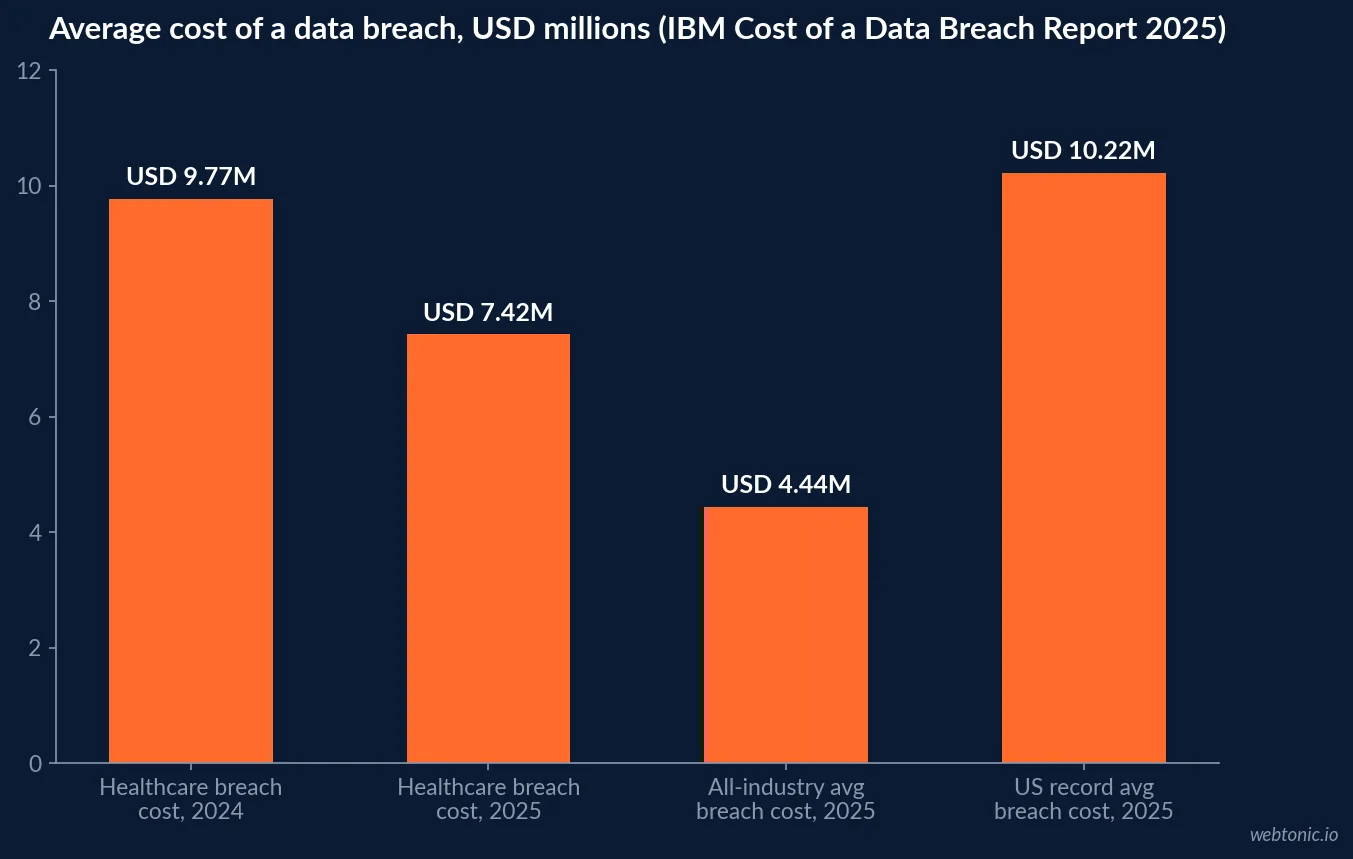
- Healthcare breaches averaged USD 7.42 million in 2025.
- That is down from USD 9.77 million in 2024, but still the costliest industry.
- US breach costs hit a record USD 10.22 million average in 2025.
- Healthcare has topped the cost list for 14 straight years.
- Google lists cosmetic surgery under its Health sensitive-interest category.
- Advertiser-curated audiences, including remarketing, are blocked for that category.
- Roughly 57 healthcare breaches a month were reported to OCR through 2025.
- Healthcare breach counts fell 4.3% year over year in 2025.
- Plastic surgery procedure volume rose 7% in 2025.
- Eyelid surgery volume rose 19% in a single year.
- Breast augmentation and implant revision rose 11%.
- Dermatology converts at 25.33% on search ads, the top healthcare vertical.
- 94% of cosmetic-procedure patients use rating and review sites to choose a provider.
- Nearly half of patients say a provider's social presence affects booking.
- Non-invasive treatments are 80% of facial plastic surgery volume.
- More than half of facial plastic surgeons report rising virtual-consult use.
- The lawsuit alleged disclosure could reveal cancer, pregnancy or addiction care.
Why a marketing pixel became a HIPAA problem
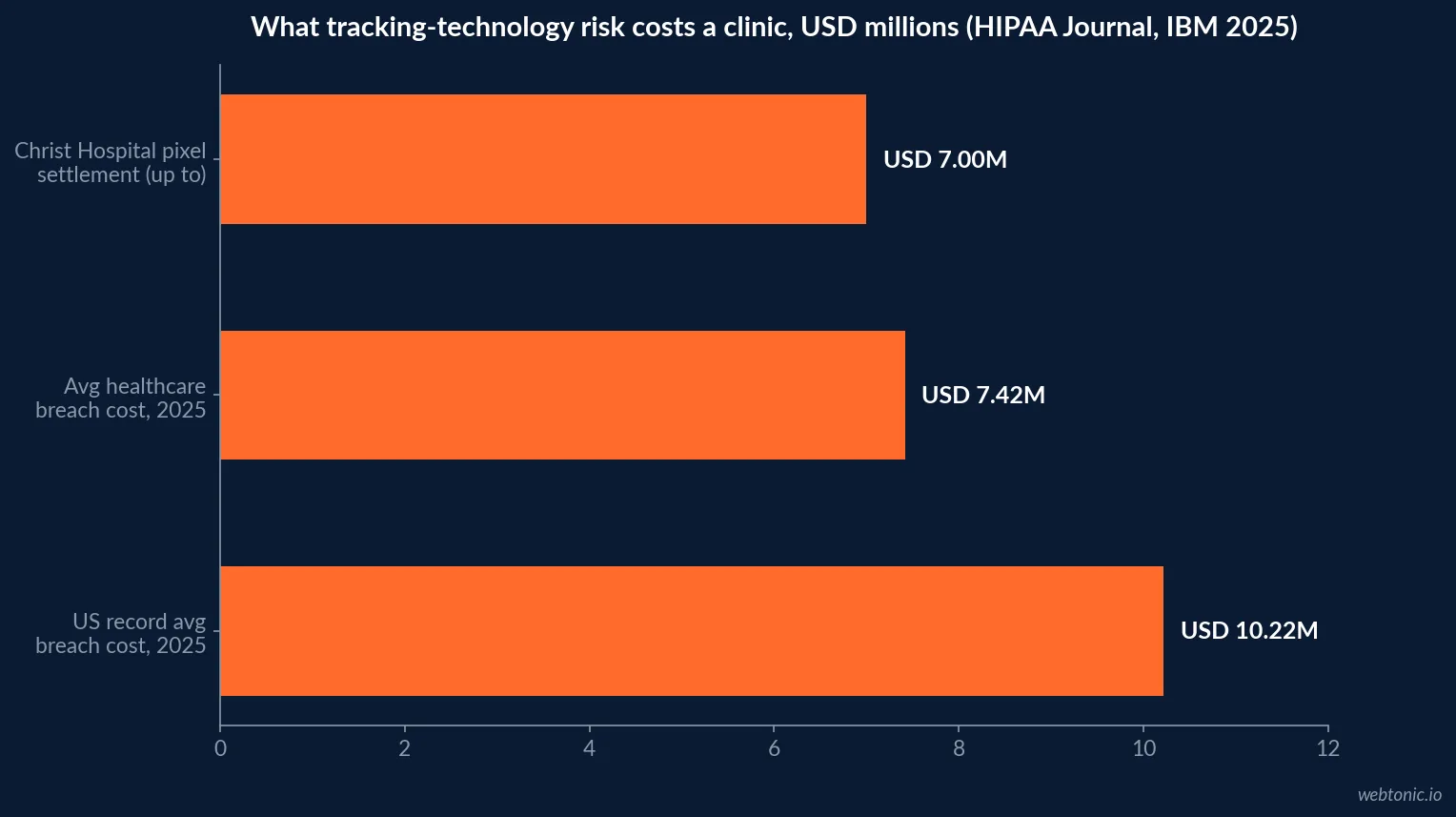
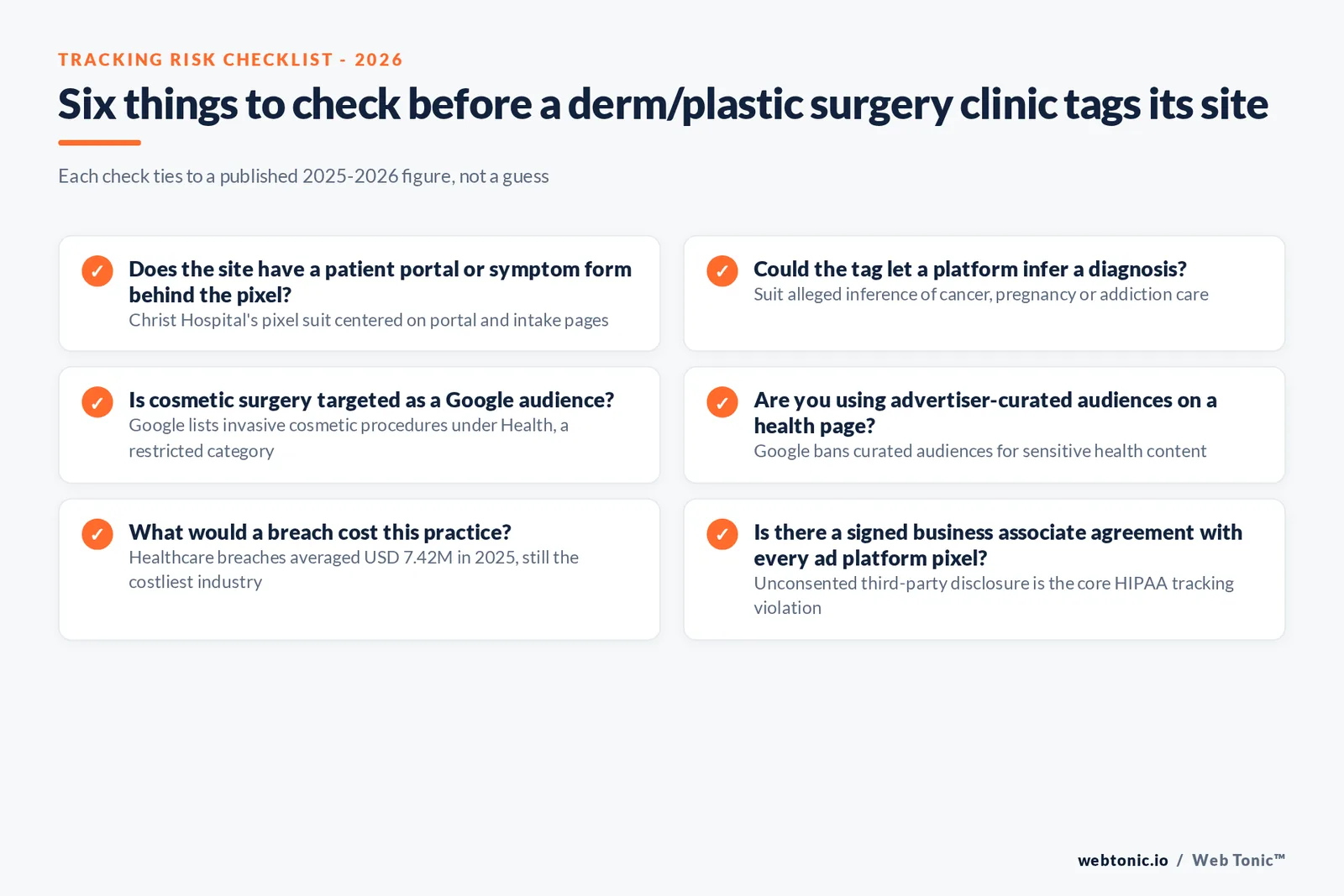
The trigger is not analytics itself, it is what a tag can let a third party infer. In The Christ Hospital's 2025 settlement, three consolidated lawsuits alleged that pixels, web beacons and cookies on the hospital's patient portal and appointment pages sent data to Meta and Google that could let those platforms reasonably infer a patient was being treated for cancer, pregnancy or addiction. The hospital agreed to pay up to USD 7 million to resolve the consolidated action.
The same wave of litigation reached Children's Hospital Medical Center of Akron in 2025, and a California jury separately found Meta liable in one of the few such cases to go to trial. None of these cases turned on standard, anonymous marketing analytics on a public service page; every one turned on a tag sitting on a login-gated portal, symptom intake form, or appointment flow.
| Cost figure (2025) | Amount | Source | What it measures |
|---|---|---|---|
| Healthcare avg breach cost | USD 7.42 million | IBM Cost of a Data Breach Report | Down from USD 9.77M in 2024, still costliest industry |
| Healthcare breach cost, 14-yr streak | Highest of all sectors studied | IBM 2025 | 14th consecutive year as the costliest industry |
| US average breach cost, 2025 | USD 10.22 million | IBM 2025 | Record high across all US industries |
| Christ Hospital pixel settlement | Up to USD 7 million | HIPAA Journal, 2025 | Resolves consolidated MyChart/portal pixel suit |
| Healthcare breach volume, 2025 | Down 4.3% year over year | HIPAA Journal 2025 Data Breach Report | Fewer reported incidents, not lower per-incident cost |
What the OCR guidance actually targets
HHS's Office for Civil Rights bulletin on online tracking technologies, first issued in 2022 and revised in March 2024, treats a tracking tool as a potential HIPAA disclosure whenever the page it sits on could let a vendor connect an identifiable visitor to health information - including an appointment request, a symptom description, or a specific procedure page visited while logged in. The guidance does not ban analytics tools outright; it turns the question into where the tag sits and what it can see, not whether the tag exists.
For a dermatology or plastic surgery practice that is a meaningful distinction: a standard analytics tag on a public "our services" page carries a different risk profile than the same tag on a patient portal, an online symptom form, or a post-procedure follow-up page.
| Page type | Typical tag | OCR tracking-guidance risk | Practical read |
|---|---|---|---|
| Public service/procedure page | Analytics, ad pixel | Lower - no identity + condition link established | Standard tagging is broadly workable |
| Appointment request form | Ad pixel with form-fill event | Elevated - can link identity to intent to seek care | Avoid third-party ad pixels on the form itself |
| Patient portal / MyChart-style login | Any third-party tag | High - the exact fact pattern in the 2025 settlements | Keep third-party marketing tags off portals entirely |
| Post-op or symptom intake form | Analytics with free-text fields | High - free text can name a condition or drug | Strip free-text fields from any tagged form |
Google Ads now treats cosmetic surgery as restricted
Separately from HIPAA, Google's own Health in personalized advertising policy lists "invasive medical procedures, including cosmetic surgery, surgical procedures, or injections" as a sensitive interest category. Predefined Google audiences remain available for these categories, but advertiser-curated audiences cannot be used - and that category explicitly includes remarketing lists built from your own site visitors, customer match uploads, and lookalike/similar segments built on top of them.
That single restriction is the practical reason a derm or plastic surgery account cannot retarget the way a home-services or e-commerce account can: the tracking pixel may still fire, but the audience it would normally build cannot legally be targeted back.
| Targeting feature | Usable for cosmetic surgery ads? | Source | What it means for tracking |
|---|---|---|---|
| Predefined Google audiences | Yes | Google Ads Health policy | Sensitive signals are pre-excluded |
| Advertiser-curated audiences (remarketing) | No | Google Ads Health policy | Your own tracked visitors cannot be re-targeted |
| Customer match uploads | No | Google Ads Health policy | CRM-based audiences are blocked in this category |
| Lookalike/similar segments built from the above | No | Google Ads Health policy | Downstream audiences inherit the restriction |
| Contextual/keyword targeting | Yes | Google Ads Health policy | Unaffected - keeps search reach intact |
What is still safe, and productive, to track
Aggregate demand signals remain both legal and useful. ASPS's 2025 procedural data shows overall plastic surgery volume up 7% for the year, with eyelid surgery up 19% and breast augmentation and implant revision up 11% - exactly the kind of category-level, de-identified trend a clinic can pull from its own page-view and appointment-type analytics without ever tying it to an individual visitor.
Call tracking numbers, form-submission counts stripped of free-text fields, and review-and-rating velocity are the three signals that carry the least regulatory exposure while still telling a practice manager which service lines are moving.
| Metric to track | Compliance exposure | Where the demand signal comes from | 2025-2026 reference point |
|---|---|---|---|
| Category-level procedure demand | Low - aggregate, de-identified | On-site page views by service line | ASPS: eyelid surgery +19%, breast aug +11% (2025) |
| Call-tracking volume | Low, if numbers route without content capture | Rotating tracked phone numbers | Standard practice across LocaliQ's healthcare accounts |
| Form submissions (structured fields only) | Moderate - avoid free text | Booking/contact forms | Free-text symptom fields raise OCR exposure |
| Review and rating velocity | Low - public, opt-in content | Google/third-party review platforms | 94% of patients use review sites to choose a provider (ASDS 2025) |
| Portal/patient-login analytics | High - avoid third-party tags entirely | MyChart-style portals | Core fact pattern in 2025 pixel settlements |
The demand side: why the incentive to over-track exists
ASDS's 2025 Consumer Survey found 70% of respondents considering a cosmetic procedure, with 94% using rating and review sites to pick a provider and nearly half saying a provider's social media presence affects whether they book. On the surgical side, AAFPRS's 2026 annual survey reports non-invasive treatments at 80% of all procedure volume and more than half of surgeons seeing rising use of virtual consultations and digital follow-up.
That demand is exactly why clinics reach for aggressive retargeting and portal analytics in the first place - and exactly why the compliance guardrails above matter more here than in most other verticals our data and analytics practice works in.
Where the highest-converting specialty fits in
LocaliQ's 2026 healthcare search advertising benchmarks, covering more than 3,500 campaigns, put dermatology at a 25.33% search-ad conversion rate - the highest of the sixteen healthcare specialties measured, and up 54% year over year. Plastic and cosmetic surgery converts lower, at 8.52%, but improved 38% year over year. Neither figure required aggressive individual-level tracking to produce; both come from the same aggregate, account-level reporting Google Ads already exposes without portal pixels.
Read against our own cross-industry conversion rate data, dermatology's 25.33% stands out as unusually high, which argues for simpler, compliant measurement rather than heavier tracking to chase a number the specialty already delivers organically.
| Specialty | Search ad CVR (2026) | YoY change | Source |
|---|---|---|---|
| Dermatology | 25.33% | +54% | LocaliQ 2026 healthcare benchmarks |
| Plastic & Cosmetic Surgery | 8.52% | +38% | LocaliQ 2026 healthcare benchmarks |
| Healthcare average (16 specialties) | 8.09% | Flat YoY | LocaliQ 2026 healthcare benchmarks |
| Oral-Maxillofacial Surgery | 11.60% | n/a | LocaliQ 2026 healthcare benchmarks |
What changed in OCR's 2024 revision, and why it matters
The rules did not stay static. Per Health Law Advisor's analysis of the March 2024 revision, OCR partially walked back its original December 2022 position: the updated guidance now recognizes that collecting information like an IP address alongside a visit to an unauthenticated page listing health conditions is not, by itself, always enough to constitute protected health information. That softened the blanket "any tracker on any health-adjacent page is a violation" reading, while leaving the core rule intact for authenticated, portal-style pages - which is exactly where the 2025 settlements were fought. The primary settlement document itself, filed in In re The Christ Hospital Pixel Litigation, confirms the claims centered on portal, appointment-request and nurse-navigator pages specifically, not the hospital's general marketing site.
For a dermatology or plastic surgery practice, the practical read is: a public procedure page with a standard analytics tag is on firmer ground after the 2024 revision than it was under the original 2022 guidance, but nothing changed for portals, intake forms, or any authenticated page.
| OCR guidance version | Key position | Practical effect on a clinic site |
|---|---|---|
| Original, December 2022 | Broad reading: tracking near any health content risks PHI disclosure | Drove aggressive removal of all third-party tags site-wide |
| Revised, March 2024 | IP + unauthenticated health-topic page is not automatically PHI | Public marketing pages can keep standard analytics tags |
| Unchanged across both versions | Authenticated portal/intake pages carry the highest risk | Third-party ad pixels still do not belong on portals |
HIPAA is not the only exposure: state consumer health data laws
HIPAA only applies to covered entities and their business associates, but several plastic surgery and medical spa practices sit outside that definition entirely, and state law has moved to fill the gap. Washington's My Health My Data Act, effective 2023, covers any "consumer health data" and, per the Washington Attorney General's own guidance, makes any violation a per se violation of the state's Consumer Protection Act - enforceable not only by the Attorney General but through a private right of action brought by an individual consumer. A tracking pixel that captures a booking for a cosmetic procedure can qualify as consumer health data under that law regardless of whether the practice is a HIPAA-covered entity at all.
The practical takeaway: "we are not a covered entity" is no longer a complete answer for a dermatology or plastic surgery practice's tracking exposure once patients or prospects in states with consumer health data laws are part of the audience.
A compliant measurement stack for these two specialties
In practice that means: keep Google Analytics and a conversion-tracking pixel on public marketing pages, remove any third-party ad pixel from the portal, appointment-confirmation and post-op pages, strip free-text fields from tracked forms, and lean on category-level demand data (procedure-page views, call volume, review velocity) rather than individual visitor journeys for reporting. Where remarketing budget would normally go, redirect it to contextual and keyword targeting, which stays fully available under Google's own policy.
If your current stack cannot answer "which pages have a third-party pixel and what can it see," start there before adding another tool - talk to us about an audit that separates compliant, aggregate measurement from the identity-level tracking driving 2025's settlements.
Frequently Asked Questions
Is Google Analytics or a Meta Pixel illegal on a dermatology or plastic surgery site?
Neither tool is illegal by itself. The risk is what the tag can infer and where it sits. HHS's Office for Civil Rights bulletin on online tracking technologies treats any tool that could let a third party connect a visitor to a specific condition or procedure as a potential HIPAA disclosure, and 2025 settlements such as The Christ Hospital's up-to-USD-7-million pixel case turned on pixels placed on patient portals and intake forms, not on public marketing pages. A public-facing service page with a standard analytics tag is a different risk profile than a symptom-search or appointment-booking flow with the same tag.
Can a clinic still run Google Ads for cosmetic procedures?
Yes, but not with every targeting option. Google's own policy lists invasive medical procedures, including cosmetic surgery, under its Health sensitive-interest category. Predefined Google audiences remain usable, but advertiser-curated audiences, including remarketing lists built from your own site visitors, are blocked for that category. That single rule is why a derm or plastic surgery clinic cannot retarget site visitors the way a home-services or retail account can.
What should tracking and analytics actually measure instead?
Aggregate, non-portal signals: call tracking numbers, form-submission counts without free-text symptom fields, review and rating velocity, and procedure-category demand at the page level rather than the visitor level. ASPS's 2025 data shows procedure volumes moving by double digits in a single year - eyelid surgery up 19% and breast augmentation and implant revision up 11% - which is exactly the kind of aggregate, de-identified trend a clinic can track on-site without touching an individual patient record.
How much does a tracking-related data incident actually cost?
IBM's 2025 Cost of a Data Breach Report puts the average healthcare breach at USD 7.42 million, still the costliest industry studied for a 14th straight year even after falling from USD 9.77 million in 2024. In the same report the US recorded its highest-ever average breach cost across all industries, at USD 10.22 million. A single pixel settlement, such as Christ Hospital's up-to-USD-7-million resolution, sits inside that same order of magnitude.
Does a signed business associate agreement fix the tracking problem?
It fixes the legal basis for a specific tool, not the underlying design. OCR's guidance and the pixel lawsuits both turn on whether the page could disclose that someone was seeking care for a condition; a BAA with Meta or Google does not change what data left the page. The more durable fix is keeping identity-level tracking off patient-facing forms and portals entirely and measuring at the aggregate, page level instead.
Sources
HIPAA Journal - The Christ Hospital pixel litigation settlement, 2025
HIPAA Journal - Children's Hospital Medical Center of Akron pixel settlement, 2025
HIPAA Journal - Average cost of a healthcare data breach, 2025 (IBM report)
HIPAA Journal - 2025 Healthcare Data Breach Report
Google Ads Help - Health in personalized advertising policy
American Society of Plastic Surgeons - 2025 plastic surgery by the numbers
American Society for Dermatologic Surgery - 2025 Consumer Survey on Cosmetic Dermatologic Procedures
AAFPRS - 2025 Annual Survey trends in facial plastic surgery
LocaliQ - Healthcare search ads benchmarks for 16 specialties, 2026
Health Law Advisor (Epstein Becker Green) - Revised OCR tracking technology guidance, March 2024
In re The Christ Hospital Pixel Litigation - Settlement Agreement
Washington State Attorney General - My Health My Data Act guidance