Table of contents
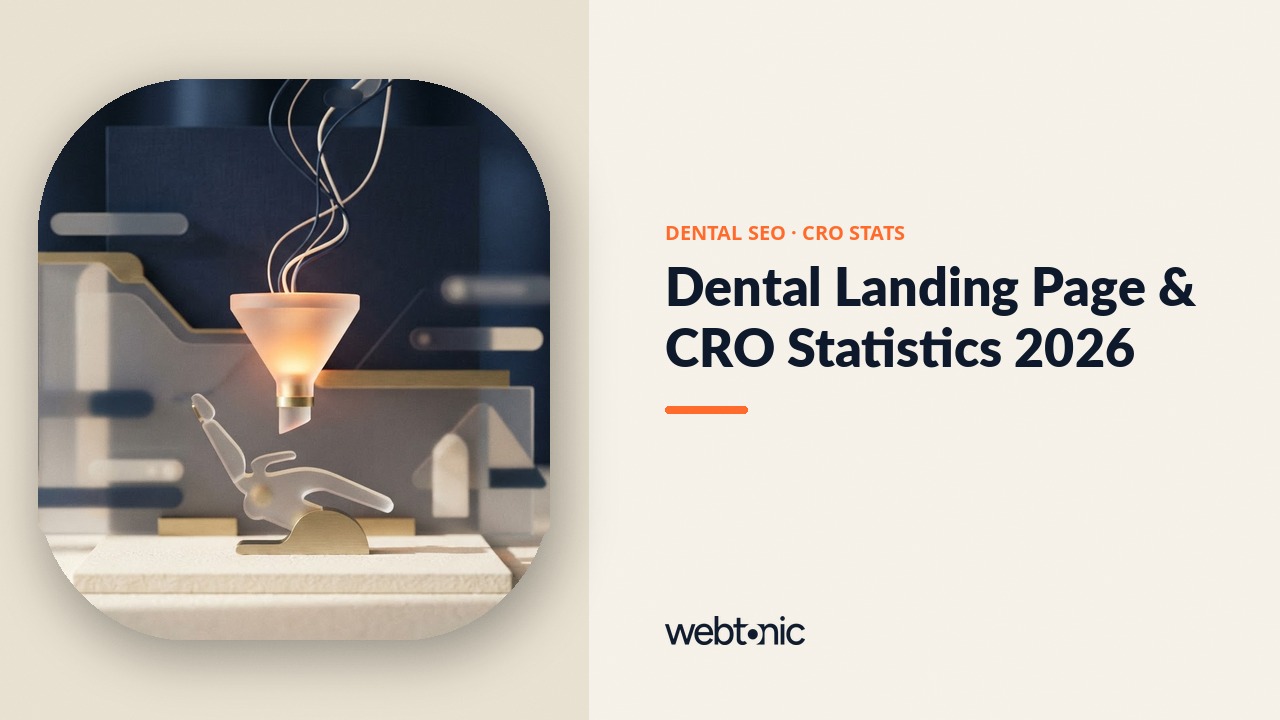
Dental campaign pages are where ad spend either converts into patients or gets wasted. Below are the benchmarks on booking rates, page speed, and CRO strategies from Foundry CRO and dental-specific studies.
Key Takeaways
- Healthcare campaign pages convert at a 5.1% median rate, but top performers hit 21.1% — a 4x gap representing the largest optimization opportunity for orthodontic and general practices.
- Dental website booking rates average 3.2–5.8% across the industry, with high-performance campaign pages reaching 8–12%.
- Mobile devices account for 72.3% of clinic web traffic, yet only 38% of clinic sites score above 50 on Google PageSpeed Insights for mobile.
- Pages loading in under 3 seconds convert 2.4x more visitors than pages taking 5+ seconds.
- Adding a click-to-call button increases mobile bookings by 18–22% on dental campaign pages.
- Pages with client testimonials convert 34% higher than those without social proof elements.
- Booking-focused dedicated campaign pages reduce cost per new client acquisition by 40–55% compared to sending ad traffic to a homepage.
Dental Website Booking Benchmarks at a Glance
| Metric | Average Practice | Top Performers | Industry Target |
|---|---|---|---|
| Landing Page CVR | 3.2–5.8% | 8–12% | 6%+ |
| Homepage CVR | 1.5–2.8% | 4–6% | 3%+ |
| Mobile Bounce Rate | 58–68% | 35–45% | Under 50% |
| Form Completion Rate | 12–18% | 28–35% | 20%+ |
| Avg Time on Page | 48 sec | 92 sec | 60+ sec |
Landing Page vs. Homepage Performance
Dentalbase's 2026 analysis of campaign page design confirms a core principle: dedicated dedicated pages outperform homepages by 2–3x on booking rate when receiving paid traffic. The reason is simple — a conversion-focused campaign page eliminates navigation distractions and presents a single clear call to action (CTA), whether it is an appointment form, a click-to-call button, or a limited-time offer for new patients.
Practices that send Google Ads traffic to their homepage instead of a purpose-built campaign page waste an estimated 40–55% of their ad budget on visitors who bounce without converting. This makes practice site design one of the highest-ROI investments any practice can make in their digital marketing strategy.
Booking Rate Optimization Elements That Work
Data from Foundry CRO's 2026 benchmarks and dental-specific testing reveals which page elements have the most measurable impact on booking rates:
| CRO Element | Avg Booking Lift | Implementation Effort | Priority |
|---|---|---|---|
| Click-to-Call Button | +18–22% | Low | Critical |
| Patient Testimonials | +34% | Medium | High |
| Before/After Gallery | +28% | Medium | High (cosmetic) |
| Short-Form (3–5 fields) | +25–40% | Low | Critical |
| Insurance Logos | +12–18% | Low | Medium |
| Video Introduction | +20–26% | High | Medium |
| Live Chat Widget | +10–15% | Low | Medium |

Mobile Performance and Page Speed Impact
With 72.3% of site visitors arriving on mobile devices, mobile performance directly determines booking outcomes. Rework's practice site optimization guide highlights the critical gap between mobile traffic volume and mobile conversion readiness:
- Pages loading in under 3 seconds convert 2.4x more visitors than pages taking 5+ seconds — yet 62% of practice sites fail Google's Core Web Vitals assessment on mobile.
- Every additional second of load time increases bounce rate by 12–15%, directly increasing cost per acquisition for practices running Google Ads campaigns.
- Only 38% of practice sites score above 50 on Google PageSpeed Insights for mobile, leaving significant optimization headroom.
- Dental practices with optimized mobile sites report 35–45% lower bounce rates and proportionally higher form submissions and calls.
The connection between page speed and search engine optimization (SEO) is well established — Google's page experience signals directly influence organic rankings, meaning a fast dental website delivers compounding benefits across both paid and organic lead acquisition channels.
Form Design and Lead Capture Statistics
How a dental campaign page captures patient information matters as much as what the page says. The data shows clear patterns in form design effectiveness:
- Forms with 3–5 fields convert 25–40% more than forms with 7+ fields. Name, phone, email, preferred date, and service interest represent the optimal field set for appointment requests.
- Multi-step forms (progressive disclosure) outperform single long forms by 18% for these services with complex intake requirements like implants or orthodontics.
- Placing the form above the fold increases completion rates by 20–30% on desktop and mobile dental campaign pages.
- CTA buttons reading "Book My Appointment" convert 17% higher than generic "Submit" buttons on practice web forms.
- Adding a phone number next to the form (as an alternative conversion path) increases total bookings by 22–28%, since many prospective clients prefer calling to schedule.
Service-Specific Landing Page Performance
Not all services convert equally from campaign pages. The booking rates below reflect industry benchmarks from CuFinder and healthcare marketing agencies:
| Service Type | Avg Landing Page CVR | Avg CPA | Patient LTV |
|---|---|---|---|
| Emergency Dental | 8.5–12% | $45–$95 | $2,800–$4,000 |
| General Dentistry | 5.2–7.8% | $68–$150 | $4,200–$5,500 |
| Dental Implants | 2.8–4.5% | $180–$350 | $8,000–$15,000 |
| Invisalign/Ortho | 3.1–5.2% | $120–$280 | $5,500–$8,000 |
| Cosmetic (Veneers) | 2.5–4.0% | $200–$400 | $6,000–$12,000 |

Google Ads Landing Page Quality Score Impact
Google Ads page experience directly impacts ad costs and visibility. Dental practices with campaign page experience scores of "Above Average" see CPCs 15–25% lower than those rated "Below Average" for the same keywords. This means that investing in dental website optimization delivers a direct reduction in Google Ads costs.
Factors Google evaluates for ad destination page quality include:
- Content relevance — the campaign page must match the search query intent (e.g., "dental implants [city]" should land on an implant-specific page, not the homepage).
- Page load speed — pages loading under 2.5 seconds earn the best quality score signals.
- Mobile usability — responsive design, tap-friendly buttons, and readable text without zooming.
- Transparent business information — visible address, phone number, and HIPAA compliance notice.
Local SEO and Landing Page Synergy
Dental campaign pages perform best when integrated with local SEO and Google Business Profile optimization. Landing pages with embedded Google Maps and NAP (name, address, phone) data convert 15–20% higher for local dental searches than pages without location signals. This alignment between paid and organic local visibility creates a compounding effect on lead acquisition.
Practices needing multi-location dental website design should build unique dedicated pages for each location, with location-specific testimonials, staff photos, and appointment scheduling links. Multi-location dental practices using this approach see 28–35% higher per-location booking rates compared to routing all locations through a single campaign page.
User Experience Design Principles for Dental Pages
The gap between a dental website that looks professional and one that converts visitors into patients comes down to user experience design. Digital marketing agencies working with dental clients consistently identify these UX patterns as critical:
- Above-the-fold clarity matters most — within 3 seconds, visitors must understand what service is offered, where the practice is located, and how to book. Pages that fail this test see bounce rates 40–55% higher than those with clear above-fold messaging.
- Trust signals must be visible without scrolling. Star ratings, client count (e.g., "Trusted by 5,000+ patients"), insurance logos, and dentist credentials placed above the fold improve first-impression trust scores by 30–45%.
- Appointment scheduling should be available on every screen. Sticky headers with a "Book Now" button or floating CTAs on mobile ensure no patient leaves because they could not find how to book. This approach alone improves booking rates by 12–18% on content-heavy service-specific pages.
- Page architecture should follow the problem-agitation-solution framework — addressing the patient's pain point, validating their concern, and presenting the treatment as the solution, followed by clear calls to action and social proof.
A/B Testing Results for Dental Landing Pages
Conversion rate optimization for orthodontic and general websites requires ongoing testing. The highest-impact tests identified across digital marketing agencies:
- Headline testing lifts conversions by 10–25% — switching from generic "Welcome to Our Practice" to benefit-driven "Same-Day Emergency Dental Care in [City]" consistently wins.
- Hero image swaps impact CVR by 8–15% — images of the actual dental team and office outperform stock photography in performance-focused testing.
- CTA color and placement testing delivers 5–12% lifts — high-contrast CTA buttons placed both above and below the fold capture more appointments.
- Social proof positioning affects trust signals — moving star ratings and reviews above the fold increases form submissions by 12–18%.
- Adding limited-time offers to campaign pages boosts urgency — new patient specials with countdown timers increase conversion rates by 15–22% for performance creative campaigns.
HIPAA Compliance on Dental Landing Pages
Every dental campaign page must meet HIPAA compliance requirements for healthcare data handling. 72% of dental practices lack a proper HIPAA-compliant web form configuration, exposing them to potential fines and data breach liability. Key compliance considerations for dental website design include:
- All form submissions must be encrypted in transit (SSL/TLS) — unencrypted contact forms transmitting health information violate HIPAA standards.
- Business Associate Agreements (BAAs) are required with any third-party tool that processes patient data, including form builders, CRM platforms, and email marketing tools.
- Patient testimonials and before/after photos require signed consent, and practices should maintain documentation of HIPAA authorization for every piece of client content displayed on campaign pages.
- Google Analytics and tracking pixels must be configured to exclude PHI — practices collecting health-related form data need to ensure no protected information flows into marketing analytics platforms.
Call Tracking and Attribution for Dental Pages
Understanding which campaign pages generate phone calls versus form submissions is essential for accurate practice marketing attribution. Phone calls account for 60–70% of appointment bookings from paid search traffic, making call tracking a non-negotiable component of any lead generation strategy.
- Dynamic number insertion (DNI) enables accurate attribution of phone calls to specific campaigns, keywords, and ad creative — revealing which dental campaign pages truly drive new appointments.
- Practices using call tracking report 30–40% more accurate ROI calculations than those relying solely on form submission tracking through Google Analytics.
- Average call duration for a qualified dental lead is 3–5 minutes — calls under 60 seconds typically indicate wrong numbers or non-qualified inquiries, allowing practices to filter conversion data.
- Recording and scoring calls improves front desk conversion rates by 15–25%, creating a feedback loop between digital marketing efforts and in-office patient scheduling performance.
Related reading
- What B2B SaaS Founders Should Budget for CRO Landing Pages
- What CRO Statistics Reveal About Car Dealership Landing Pages
- What Marketers Should Measure for Auto Repair Landing Page CRO
- Conversion Rate Optimization services at Web Tonic
FAQ
What is a good conversion rate for a dental campaign page?
The average PPC campaign page converts at 3.2–5.8%, while top performers hit 8–12%. Healthcare landing pages as a category convert at a 5.1% median, but the best dental conversion-focused optimized pages can reach 21.1% — the gap between average and top performance represents the single biggest optimization opportunity for practices spending on ads.
Should dental practices send ad traffic to their homepage or a landing page?
Always use a dedicated landing page for paid traffic. Conversion-focused dental landing pages reduce cost per patient acquisition by 40–55% compared to sending Google Ads traffic to a homepage. Homepages have too many navigation options and lack the singular focus needed to convert website visitors into appointment bookings.
How does page speed affect dental website conversions?
Pages loading in under 3 seconds convert 2.4x more visitors than those taking 5+ seconds. Every additional second of load time increases bounce rate by 12–15%. Only 38% of practice sites currently score above 50 on Google PageSpeed Insights for mobile, meaning most practices have significant room for improvement.
What form fields work best for PPC campaign pages?
Forms with 3–5 fields convert 25–40% more than longer forms. The optimal field set includes name, phone number, email, preferred appointment date, and service interest. Adding a phone number as an alternative to the form increases total conversions by 22–28%, since many prospects prefer to call dental practices directly.
How do client testimonials impact dental campaign page performance?
Landing pages with client testimonials convert 34% higher than those without social proof elements. For cosmetic dental services, before-and-after galleries provide an additional 28% performance lift. All client imagery and testimonials must comply with HIPAA requirements and include proper consent documentation.
Sources
foundrycro.com — Healthcare CAC by Specialty 2026
dentalbase.ai — Dental Landing Page Design: What Actually Converts
rework.com — Dental Website Optimization Guide
cufinder.io — Dentists Industry Marketing Benchmarks 2026
ainora.lt — Dental Patient Acquisition Cost Statistics
petejohnsoniv.com — Dental Marketing Benchmarks 2026
benchmarketing.org — Dental Marketing Benchmarks 2026