Table of contents

Webflow powers approximately 1.2% of all CMS-based websites in 2026, and dental practices switching from WordPress to Webflow report PageSpeed improvements from 38 to 95+ and conversion rate lifts from 0.5% to 4.8%. With 50.8% of dental websites still running on WordPress and average dental site performance lagging far behind benchmarks, the CMS choice directly impacts patient acquisition and organic search rankings.
Key Takeaways
- Webflow holds 1.2% CMS market share, having doubled from 0.4% since 2021 — the fastest-growing modern CMS by relative growth rate.
- 50.8% of dental websites run on WordPress, with jQuery detected on 54.6% across 1,037 dental sites analyzed in the U.S.
- Average dental website PageSpeed is 42/100 on Lighthouse mobile, with only 28% scoring "Good" on Core Web Vitals.
- Dental Webflow case studies show PageSpeed jumps from 38 to 95+ and conversion rate lifts from 0.5% to 4.8%.
- Average dental website conversion rate is 3–5%, with top performers reaching 13–15% through optimized design and UX.
- 68.5% of dental website traffic comes from mobile, yet 72% of dental sites have mobile bounce rates over 50%.
- 81% of dental practices have at least one conversion problem on their website, from missing online booking to slow page loads.
Webflow Market Share and Growth Statistics
Webflow has reached approximately 1.2% of all CMS-based websites (around 0.8% of all sites including non-CMS), having doubled its market share from 0.4% in 2021 (Sales-Hacking). According to W3Techs, Webflow usage continues to grow steadily, though it remains far behind WordPress's 59.2% CMS dominance and Shopify's 7.6% share.
Among small businesses specifically, Webflow holds 1.1% market share compared to WordPress at 43.6%, Wix at 9.5%, and Squarespace at 4.1% (Elevate Web Design). The CMS market continues consolidating around WordPress and Shopify for general use, but Webflow captures a growing share of design-forward professional services websites — including dental practices that prioritize visual branding and performance.
| CMS Platform | Overall Share | Small Business | Growth Trend |
|---|---|---|---|
| WordPress | 59.2% | 43.6% | Declining slowly (-1.8% YoY) |
| Shopify | 7.6% | 4.0% | Growing (e-commerce focus) |
| Wix | 5.5% | 9.5% | Stable, strong in SMB |
| Squarespace | 3.4% | 4.1% | Stable, 11× growth since launch |
| Webflow | 1.2% | 1.1% | Doubling every 3–4 years |
Sources: W3Techs, CMS Conference, Elevate Web Design
Dental Website Performance Benchmarks
The average dental website scores just 42/100 on Google Lighthouse mobile performance, with only 28% of dental sites achieving "Good" Core Web Vitals scores — well below the 66.5% pass rate for local medical sites overall (Borah Labs, based on 1,037 U.S. dental sites). This performance gap has direct consequences for search rankings, as Google's page experience signals increasingly favor sites with faster load times and better interactivity scores in local pack results.
Key performance metrics from the Borah Labs dental dataset reveal significant technical gaps that affect both user experience and search engine visibility:
| Performance Metric | Dental Average | Good Target | Gap |
|---|---|---|---|
| Lighthouse Mobile | 42/100 | 90+ | -48 points |
| LCP | 3.5–5.0s | <2.5s | 1.0–2.5s over |
| FCP | 3.68s | <1.8s | 1.88s over |
| CWV Pass Rate | 28% | 100% | 72% failing |
| Viewport Configured | 85.8% | 100% | 14.2% missing |
| Mobile Bounce Rate | 61.2% | <45% | 16.2% over |
Sources: Borah Labs, CUFinder
Webflow vs. WordPress for Dental Websites
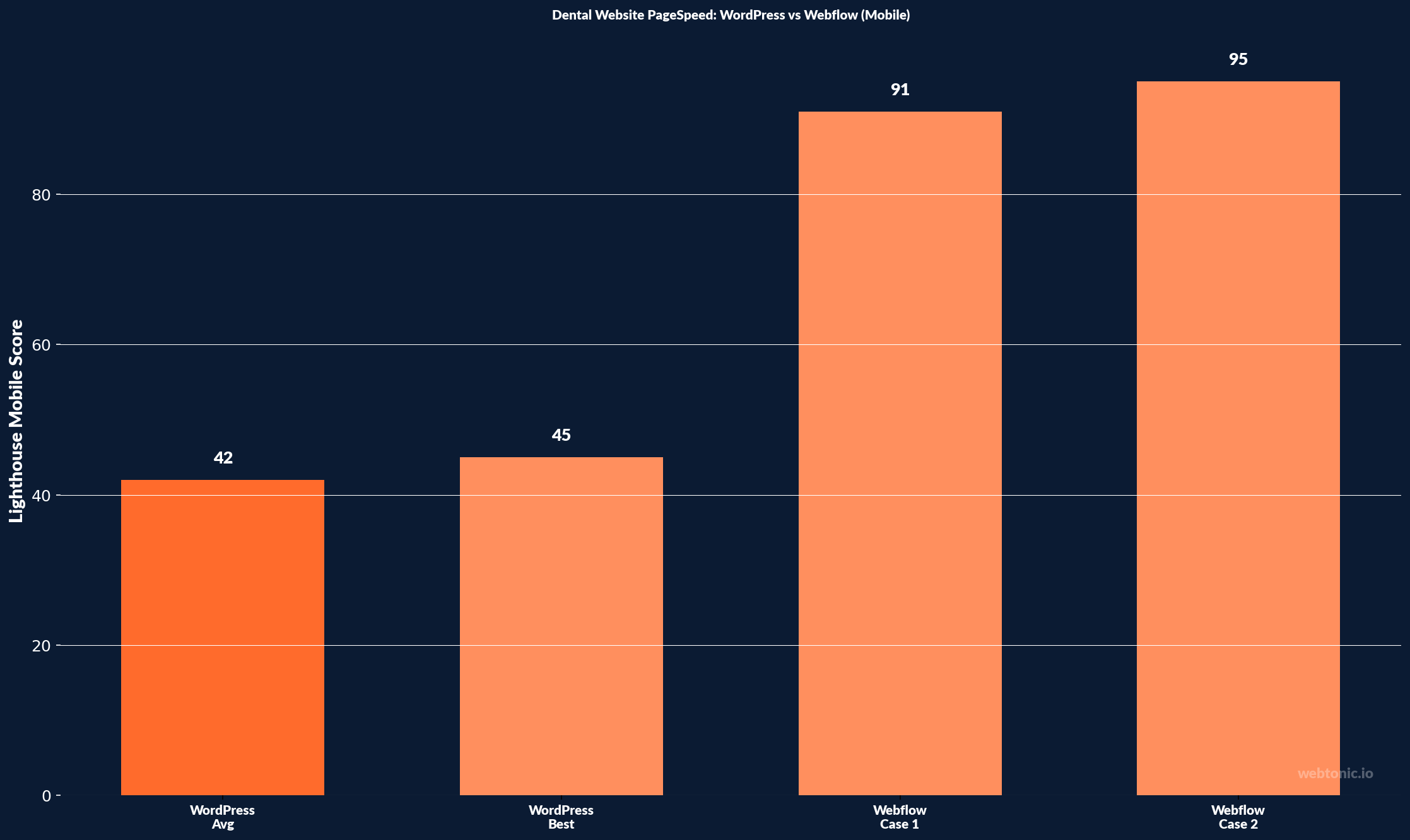
Dental practices migrating from WordPress to Webflow report dramatic performance improvements. A documented case study by Webflow Developers showed a dental practice going from a PageSpeed score of 38 and 0.5% conversion rate on WordPress to 95+ PageSpeed and 4.8% conversion rate on Webflow — with organic traffic increasing 312% within 6 months of migration.
Another case study (Webstallion) documented a dental site improving from 45 to 91 mobile Performance, 81 to 100 Accessibility, and 73 to 100 Best Practices after migrating to Webflow. CLS (Cumulative Layout Shift) dropped to 0.005 — well within Google's 0.1 "good" threshold for page experience ranking signals.
These improvements are not unique to specific implementations. Webflow's architecture inherently eliminates many WordPress performance bottlenecks: no server-side PHP processing on each page load, no database queries for static content, automatic image optimization with WebP delivery, and zero plugin-related security vulnerabilities that require constant patching.
| Feature | WordPress (Typical Dental) | Webflow (Case Studies) |
|---|---|---|
| Mobile PageSpeed | 38–45 | 91–95+ |
| Conversion Rate | 0.5–2% | 4.8% |
| Security Vulnerabilities | 11+ (plugin-dependent) | 0 (managed hosting) |
| Maintenance | Weekly plugin updates | Minimal (auto-updates) |
| SSL/Sitemap | Manual setup | Automatic |
| CLS Score | Often >0.1 | 0.005 or lower |
Dental Website Conversion and UX Statistics
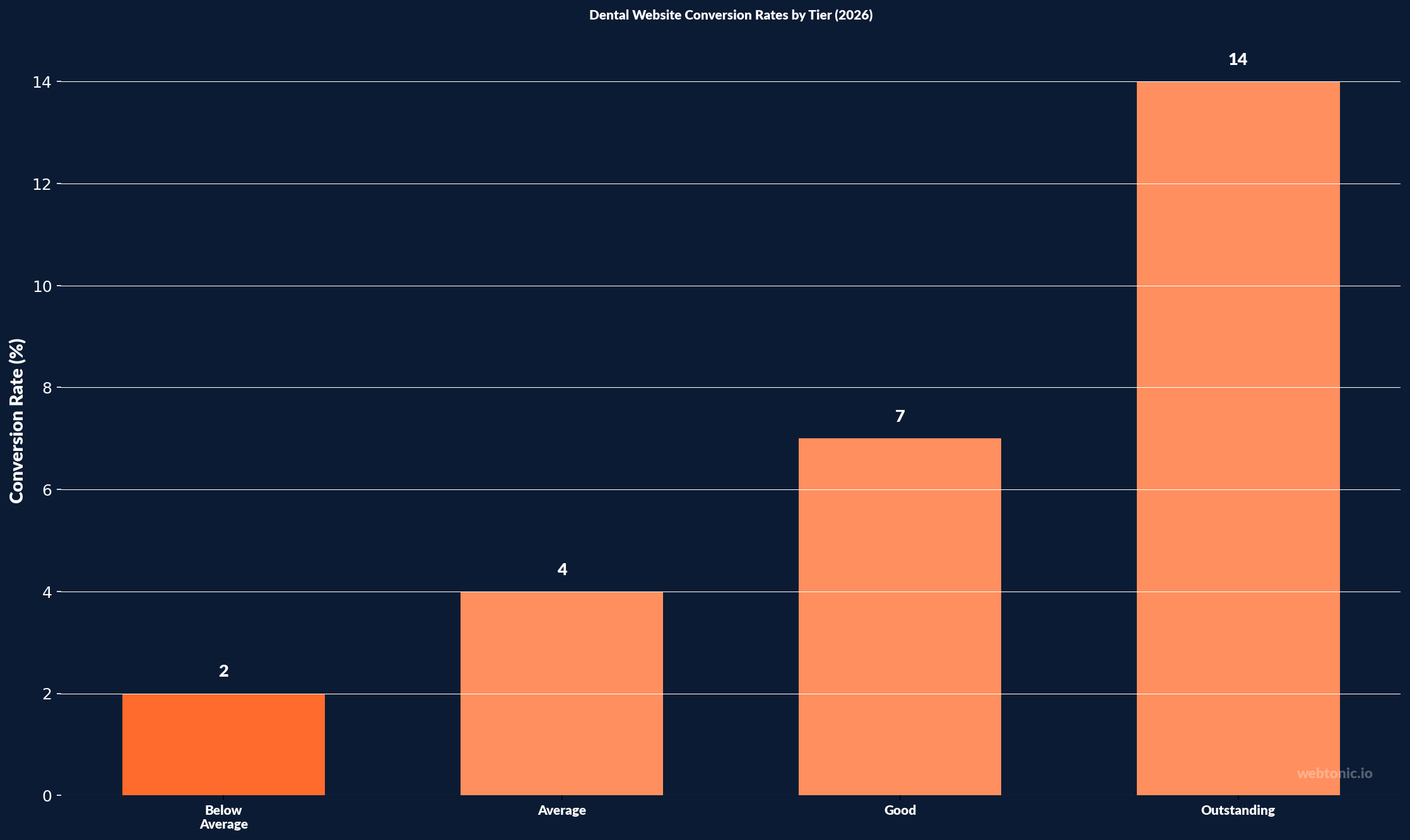
The average dental website converts at 3–5%, with good performance at 6–8% and outstanding performers reaching 13–15% through optimized design and conversion rate optimization (Dental Marketing Guy). Landing page-specific conversion rates are significantly higher at 12.5%, while call-only ads convert at 18.2% (CUFinder).
81% of dental practices have at least one conversion problem on their website path from "interested visitor" to "booked patient" (ClinicEdge Studio, based on 6,554 practice audits). The most common issues that block conversions include:
- Only 26% of dental practices offer online booking — yet 60% of patients prefer online scheduling over phone calls (Click-Vision).
- 22% don't display patient reviews on their site, missing a critical trust signal for prospective patients evaluating practices.
- 12% lack mobile-responsive contact forms, despite 68.5% of all dental website traffic arriving from mobile devices.
A 1-second delay in page load time reduces conversions by up to 7% — for a busy dental practice processing 30+ new patient inquiries monthly, slow sites can cost 2–3 patients per month in lost bookings. Google's own research shows that as load time increases from 1 to 3 seconds, bounce probability rises by 32%, making site speed a direct revenue lever for dental practices investing in online patient acquisition.
Mobile Performance and Traffic Statistics
68.5% of dental website traffic comes from mobile devices (CUFinder), yet 72% of dental websites have mobile bounce rates exceeding 50% (Zipdo). The average dental mobile bounce rate sits at 61.2%, compared to 55.4% overall — a gap that directly translates to lost patient inquiries every month.
Mobile-first design platforms like Webflow address this gap through responsive layouts, optimized image delivery (automatic WebP conversion and lazy loading), and consistently faster load times across mobile network conditions. Dental practices with mobile-optimized sites see 48.2% of their organic traffic convert to engagement actions (page views, clicks, form fills) compared to 32% on non-optimized sites (CUFinder).
Pages per session for dental sites average 2.4, suggesting most visitors check 2–3 pages (typically homepage, services, and contact/booking) before making a decision. Fast-loading Webflow sites retain visitors through this full decision journey without frustrating delays, while slow WordPress sites often lose potential patients after the first page load times out or delivers a poor mobile layout experience.
Dental CMS Technology Stack Analysis
WordPress dominates the dental website market at 50.8%, according to Borah Labs' analysis of 1,037 U.S. dental sites. PHP powers 52.1% of analyzed dental sites, and jQuery is detected on 54.6% — indicating that most dental WordPress installations rely on older technology stacks that contribute to slower performance scores, higher security exposure, and increased maintenance burden for practice owners.
However, platform choice matters less than configuration quality — Borah Labs notes that well-tuned WordPress sites can outperform poorly built custom builds routinely. The performance gap between WordPress and Webflow narrows significantly when WordPress sites invest in proper managed hosting (WP Engine, Kinsta), server-side caching, CDN deployment, and professional image optimization — though few dental practices make that level of ongoing technical investment without a dedicated web development partner. For most dental offices managing their own website without technical staff, Webflow's out-of-the-box defaults deliver measurably better performance than a typical self-managed WordPress installation with default hosting and commonly used page builder plugins that add significant render-blocking JavaScript to every page load.
Best Practices for Dental Webflow Websites
- Target 90+ mobile PageSpeed score — most dental WordPress sites score 38–45, so Webflow's default performance already provides a competitive advantage in local search rankings where page experience signals influence visibility.
- Include online booking on every page — only 26% of dental practices offer it, yet 60% of patients prefer online scheduling. Webflow integrates natively with booking tools like Calendly, NexHealth, and RevenueWell through embed components.
- Display patient reviews prominently — 22% of dental sites miss this critical trust signal. Use Webflow's CMS collections to auto-pull and display Google or Yelp reviews in styled card layouts.
- Optimize for Core Web Vitals — with only 28% of dental sites passing CWV, achieving "Good" scores on LCP, FID, and CLS provides a measurable SEO ranking advantage over local competitors in the dental space.
- Use Webflow's built-in responsive design to address the 61.2% mobile bounce rate — ensure tap targets are 48px+ minimum, fonts are 16px base size, and contact forms are thumb-friendly for mobile users.
- Implement structured data (LocalBusiness + DentalClinic schema) for enhanced search visibility — schema markup can increase CTR by up to 40% in local search results and knowledge panel displays.
- Keep image payloads under 500 KB per page — Webflow's image optimization with automatic WebP delivery and responsive srcset handles this natively, unlike many WordPress configurations that require multiple performance plugins to achieve comparable results.
Frequently Asked Questions
What percentage of dental websites use Webflow?
Webflow powers approximately 1.1–1.2% of all small business and healthcare websites, including dental practices. WordPress dominates dental sites at 50.8%, followed by Wix, Squarespace, and custom-built solutions. Webflow adoption is growing fastest among design-forward, multi-location, and cosmetic-focused dental practices that prioritize brand experience.
Is Webflow better than WordPress for dental websites?
For performance and security, documented case studies show Webflow dental sites scoring 91–95+ on mobile PageSpeed versus WordPress averages of 38–45. Webflow eliminates plugin vulnerabilities (11+ found in one WordPress dental case). WordPress offers more SEO plugin flexibility and a larger developer ecosystem, but Webflow provides better out-of-the-box speed, design control, and lower ongoing maintenance.
What is the average conversion rate for dental websites?
Average dental website conversion rate is 3–5%, with good performance at 6–8% and outstanding at 13–15%. Landing page-specific conversion rates reach 12.5%. The biggest conversion barriers are missing online booking (74% of dental sites lack it), absent patient reviews (22%), and slow mobile load times above 3 seconds.
How does website speed affect dental patient acquisition?
A 1-second delay in page load time reduces conversions by up to 7%. With 68.5% of dental traffic on mobile and average dental mobile bounce rates at 61.2%, speed directly impacts patient acquisition volume. Dental sites achieving LCP under 2.5 seconds convert at 2–3× the rate of slower competitors in the same market.
How much does a Webflow dental website cost?
Webflow hosting plans range from $14–$39 per month for CMS-enabled sites, with custom dental website design and development typically costing $3,000–$15,000 for the initial build. This compares favorably to WordPress total cost of ownership when factoring in premium hosting ($30–$100/month), security plugins, developer maintenance hours, and ongoing plugin compatibility updates.
Sources
w3techs.com
borahlabs.us
clinicedgestudio.com
cufinder.io
webflow-developers.com
webstallion.com.au
elevatewebdesign.ca
dentalmarketingguy.co
zipdo.co
click-vision.com