Table of contents

Dental practices that invest in video marketing generate 40% more website conversions and attract significantly more new patients than those relying on static content alone. Below are the benchmarks, platform data, and ROI metrics shaping dental video strategy in 2026.
Key Takeaways
- 40% higher conversion rate on dental websites that feature video content compared to static-only sites
- 80% of patients say they trust a dentist more after watching social media content with patient stories
- 127,000 views generated across platforms by one practice using just ten 60–90 second educational clips
- 15% of YouTube viewers convert into booked patients for dental channels with consistent uploads
- $0.50–$1.50 CPC on dental YouTube Ads with a 1.4% average click-through rate
- 25% of dental practices currently use YouTube Ads, while only 20% maintain an active channel
- 60% of top-performing dental clips are under 60 seconds, favoring short-form educational and testimonial formats
Dental Video Marketing at a Glance
| Metric | Value | Context |
|---|---|---|
| Website conversion lift (video vs. static) | +40% | Practices with embedded video see higher appointment bookings |
| Patient trust increase (video testimonials) | 80% | Patients trust dentists more after viewing social media patient stories |
| YouTube channel adoption | 20% of practices | Only one in five dental clinics maintains an active YouTube channel |
| YouTube Ads adoption | 25% of practices | Quarter of dental practices run paid YouTube campaigns |
| YouTube Ads avg. CPC | $0.50–$1.50 | Lower than search ads; strong for awareness campaigns |
| YouTube Ads CTR | 1.4% | Dental-specific benchmark across YouTube ad placements |
| Organic views share (YouTube) | 80% | Majority of dental YouTube views come from organic search |
| Ideal clip length | Under 60 seconds | 60% of top-performing dental clips are short-form |
Video Content Types That Drive Patient Acquisition
Not all dental video content performs equally. Patient testimonial videos consistently outperform other formats in building trust and driving first-visit bookings. One implementation study found that a single practice recording ten short educational clips with a smartphone generated 127,000 combined views across YouTube, Facebook, and Instagram within six months. The standout performer — a "What to Expect During Root Canal" explainer — accounted for over 40,000 views on its own, demonstrating the power of addressing common patient questions through video.
Beyond testimonials, procedure walkthroughs, office tours, and team introductions round out the most effective content mix. Social media posts that include patient images receive measurably higher engagement than text-only or stock-photo posts. The key is authenticity: patients respond to real people and real settings far more than polished corporate production.
| Video Type | Primary Goal | Performance Signal |
|---|---|---|
| Patient testimonials | Build trust, reduce anxiety | 80% of viewers report higher dentist trust |
| Procedure explainers | Educate, answer common patient questions | Highest organic YouTube view counts |
| Office tours | Showcase environment, reduce first-visit fear | Strong local search visibility signals |
| Team introductions | Humanize the practice | Higher social media engagement rates |
| Before-and-after showcases | Demonstrate cosmetic results | Strong conversion for elective procedures |
| FAQ / myth-busting | Address objections proactively | Reduces patient inquiry-to-booking friction |
YouTube Performance Benchmarks for Dental Practices
YouTube remains the dominant long-form video platform for dental marketing, yet adoption lags behind other channels. Only 20% of dental practices maintain a YouTube channel, and those that do average 10–15 video uploads per month. The reward for consistency is significant: 80% of dental YouTube views come from organic search, meaning properly titled and tagged clips continue attracting potential patients long after publication.
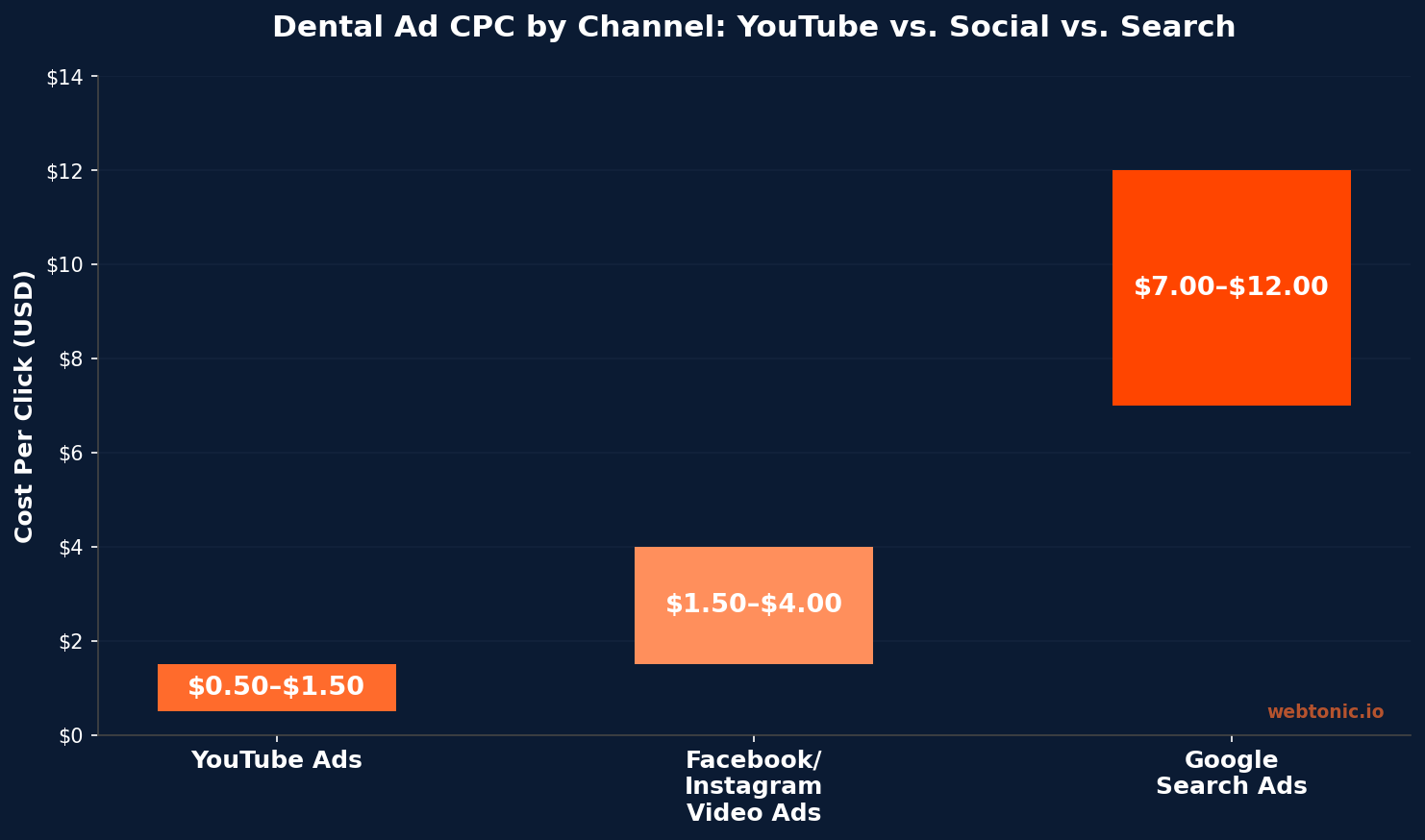
Among the 25% of practices running YouTube Ads, the average cost per click sits between $0.50 and $1.50 — substantially lower than Google Search Ads, where dental CPCs often exceed $7.00. YouTube Ads deliver a 1.4% click-through rate, and 70% of viewers fall within the 25–54 age demographic, aligning well with the prime patient acquisition window. Crucially, 15% of YouTube viewers for dental channels ultimately convert into booked patients, a strong signal that video builds both trust and intent.
Social Media Video Marketing Metrics
Video content on social media platforms drives measurably stronger engagement for dental practices compared to static posts. Facebook and Instagram remain the primary distribution channels, with short-form Reels and Stories generating the highest reach. Practices that share patient story content see an 80% trust uplift among viewers, translating directly into higher inquiry rates.
The emerging format to watch is short-form vertical video. Clips under 60 seconds consistently outperform longer content in terms of completion rates and shares. Dental practices that repurpose a single procedure walkthrough into a YouTube explainer, an Instagram Reel, and a Facebook Story effectively triple their content output without tripling production costs. Cross-posting with platform-native captions and CTAs — such as "Book a consultation" or "Learn more about this treatment" — converts passive viewers into active leads.
ROI and Patient Acquisition Economics
The financial case for dental video marketing rests on two pillars: lower cost per lead and higher conversion quality. Practices allocating budget to video report a 40% improvement in website conversion rates, which directly reduces the effective cost per new patient. When the average dental patient lifetime value sits between $10,000 and $25,000 (accounting for ongoing hygiene visits, restorative work, and referrals), even a modest increase in acquisition efficiency delivers outsized returns.
YouTube Ads in particular offer a cost-efficient awareness channel at $0.50–$1.50 CPC — roughly 5–10× cheaper than dental Google Search Ads. The tradeoff is intent: YouTube reaches patients earlier in their decision journey, building familiarity before the high-intent search moment. Practices that combine YouTube awareness campaigns with Google Ads bottom-of-funnel capture report the strongest overall patient acquisition metrics.
| Channel | Avg. CPC | Intent Level | Conversion Window |
|---|---|---|---|
| YouTube Ads | $0.50–$1.50 | Awareness / consideration | 2–8 weeks |
| Google Search Ads | $7.00–$12.00 | High intent | Same day–1 week |
| Facebook/Instagram Video Ads | $1.50–$4.00 | Mid-funnel consideration | 1–4 weeks |
| Organic YouTube | $0 (production cost only) | Research / education | Ongoing / evergreen |
Google Business Profile and Local Search Visibility
Video content directly supports local SEO performance for dental practices. Google Business Profile listings that include video see higher engagement rates, and Google increasingly prioritizes video-rich results in local search and Google Maps queries. Practices that upload office tour or patient testimonial clips to their GBP listing create additional touchpoints during the "dentist near me" search journey.
The connection between video and local search visibility is reinforced by YouTube's integration with the broader Google ecosystem. Properly optimized dental YouTube videos — with location-specific titles, descriptions, and tags — surface in both YouTube search and Google organic results, effectively doubling the practice's search footprint. For practices already investing in growth marketing, adding video to their local presence is one of the highest-leverage moves available.
Production Best Practices for Dental Clinics
High production value is not a prerequisite for effective dental video marketing. The implementation case study that generated 127,000 views used nothing more than a smartphone, natural clinic lighting, and basic editing. What matters more than polish is consistency, authenticity, and answering the questions patients actually ask.
- Keep clips under 60 seconds for social media; 2–5 minutes for YouTube procedure explainers
- Film in the actual treatment room — patients want to see the real environment, not a studio
- Include clear CTAs — "Call to book" or a link to the online scheduling page in every video description
- Optimize titles, descriptions, and tags with location + procedure keywords for search visibility
- Repurpose one shoot into multiple formats — a 3-minute YouTube video becomes a 30-second Reel, a Stories clip, and a GBP post
- Post consistently — dental YouTube channels averaging 10–15 uploads per month see the strongest organic growth
- Feature real patients (with consent) — testimonial clips outperform scripted content
Dental Video Marketing vs. Industry Averages
| Metric | Dental | All Industries | Delta |
|---|---|---|---|
| Website conversion lift (video) | +40% | +34% | +6 pp |
| YouTube Ads CTR | 1.4% | 0.65% | +0.75 pp |
| YouTube Ads CPC | $0.50–$1.50 | $0.10–$0.30 | Higher (niche audience) |
| YouTube channel adoption | 20% | ~45% (SMBs) | −25 pp |
| Organic view share | 80% | ~55% | +25 pp |
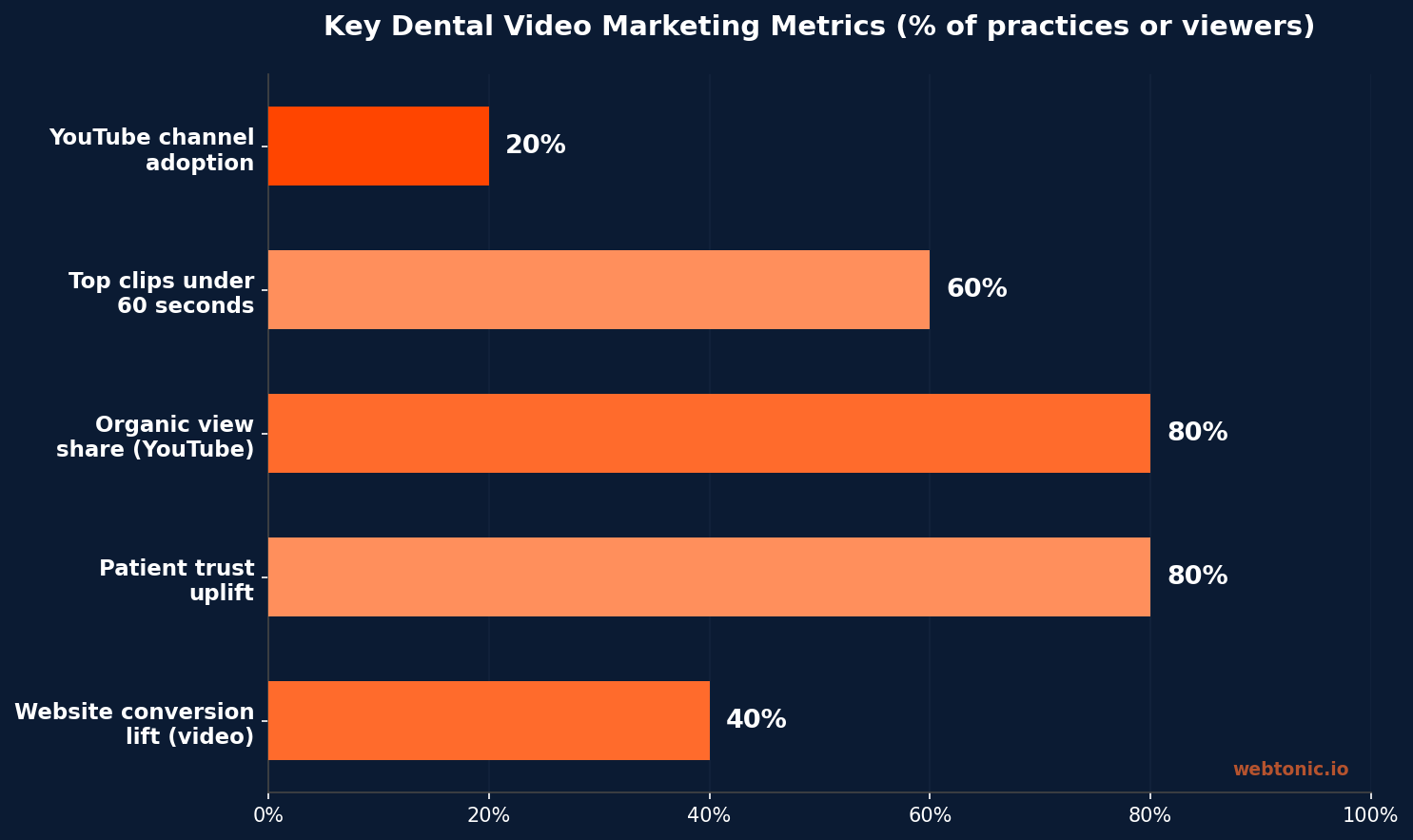
Dental video marketing significantly outperforms industry averages on CTR and organic discovery, reflecting the fact that patients actively search for dental procedure information on YouTube. The gap in channel adoption (20% vs. ~45%) represents a substantial opportunity: practices that start now face less competition for dental-specific search queries. The higher CPC relative to all-industry averages is offset by the niche targeting advantage and the high lifetime value of each dental patient.
Emerging Trends Shaping Dental Video in 2026
Several developments are accelerating the shift toward video-first dental marketing strategies:
- AI-powered video editing tools — platforms like Gemini-integrated editors reduce post-production time by 50–70%, making consistent publishing realistic even for small practices
- Short-form vertical dominance — Instagram Reels and YouTube Shorts now drive more discovery than traditional horizontal video for local services
- Voice and visual search integration — Google's multimodal search increasingly surfaces video results for dental queries, rewarding practices with indexed YouTube content
- Interactive video consultations — virtual consultations via video are becoming a standard patient acquisition funnel step, replacing the traditional phone inquiry for certain demographics
- Personalized retargeting — practices using Meta Ads can retarget viewers who watched 50%+ of a video with booking-focused follow-up ads, tightening the conversion funnel
Related reading
- What Retail Marketers Should Budget for Home Renovation Video
- The Complete Automotive Video Marketing Statistics Report (2026)
- Beauty & Skincare Video Marketing Statistics: 75+ Data Points for 2026
- Branding services at Web Tonic
Frequently Asked Questions
How much does dental video marketing cost?
Production costs vary widely. A smartphone-filmed testimonial can cost under $50 per clip, while professionally produced practice overview videos range from $500–$2,000. YouTube Ads run $0.50–$1.50 per click, and social media video ads on Facebook and Instagram typically cost $1.50–$4.00 CPC. The key variable is whether the practice handles production in-house or outsources to a creative agency.
What types of dental videos get the most engagement?
Patient testimonial videos and procedure explainers consistently drive the highest engagement. A single well-titled explainer video can generate tens of thousands of organic YouTube views. Short-form content under 60 seconds performs best on Instagram and Facebook, while YouTube audiences engage more with 2–5 minute educational clips that address common patient questions.
Do dental YouTube Ads actually generate patients?
Yes. 15% of dental YouTube viewers ultimately convert into booked patients, and YouTube Ads reach a prime demographic (70% of viewers aged 25–54). While the conversion window is longer than Google Search Ads (2–8 weeks vs. same-day), YouTube builds the brand familiarity that makes later search ads more effective.
How often should a dental practice post videos?
Dental YouTube channels that publish 10–15 clips per month see the strongest organic growth, but even 2–4 videos per month establishes consistency. The priority is regularity over volume — a practice that posts one quality video weekly will outperform one that publishes a batch then goes silent for months.
Is video marketing worth it for a small dental practice?
Particularly so. Small practices benefit disproportionately because only 20% of dental clinics maintain a YouTube channel, meaning competition for dental video search terms is low. The 40% conversion rate lift on video-equipped websites applies regardless of practice size, and smartphone production keeps costs minimal.
Sources
Zipdo — 100+ Dental Marketing Statistics: 2026 Research Report
Dental Marketing Guy — Video Marketing for Dentists 2026 Implementation Guide
Benchmarketing.org — Dental Industry Marketing Benchmarks
Pete Johnson IV — Dental Marketing Benchmarks 2026
HIP Creative — Facebook and Instagram Ads for Dental Practices
Identity Dental — 2026 Dental Marketing Visibility Report
DentalBase.ai — Creating High-Performing Dental Social Media Ads
Ainora — Dental Patient Acquisition Cost Statistics