Table of contents

No published study prices a home renovation retailer's video budget as a line item, so this page sizes one from Wyzowl's 2026 video marketing survey, Google's own search data on "how-to" video demand, and the project-spend figures Houzz reports for the category itself. The video decision should track the size of the purchase it supports, not a generic share of the media plan.
Key Takeaways
- 91% of businesses use video as a marketing tool in Wyzowl's 2026 survey, back to a joint all-time high.
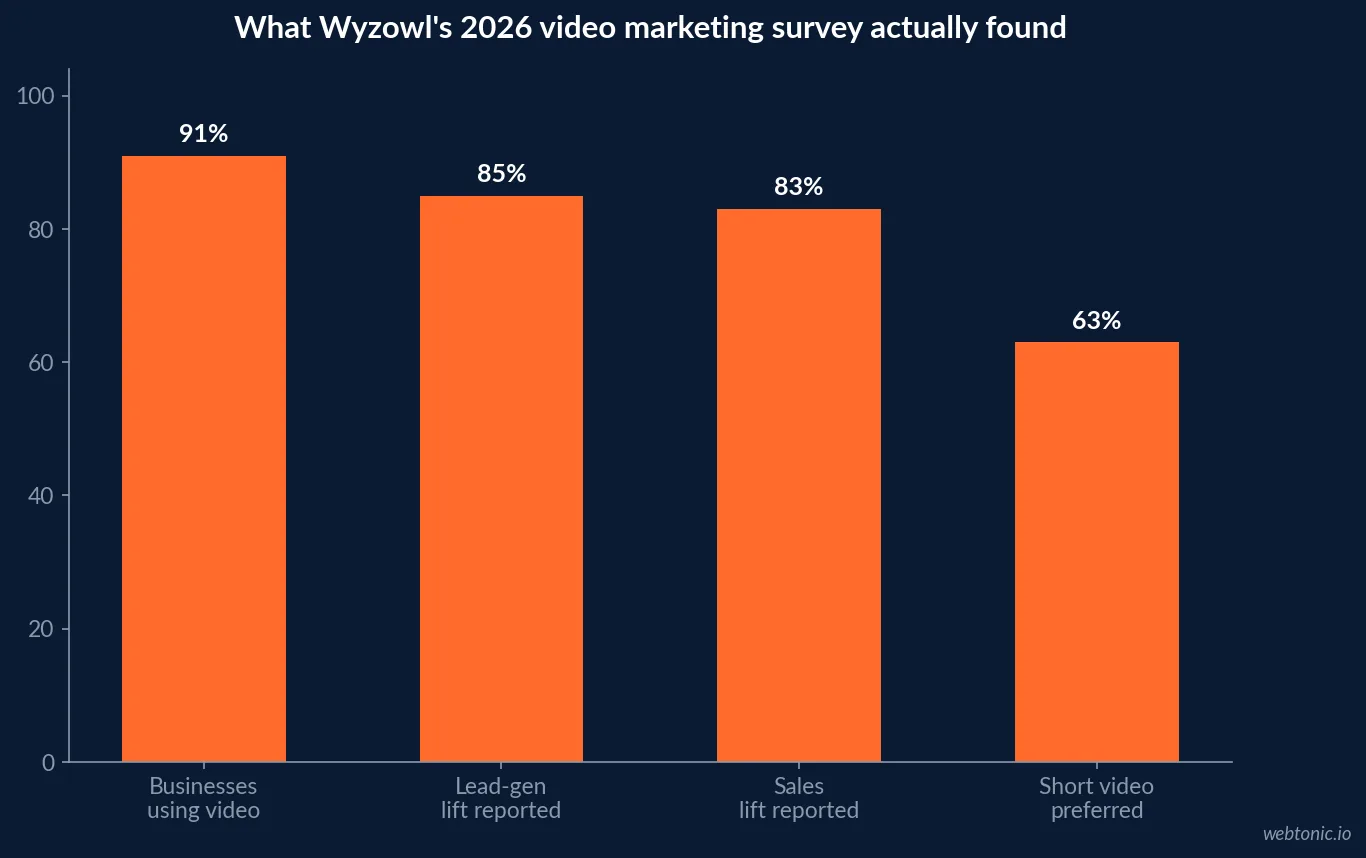
- 85% of video marketers say video has helped them generate leads, and 83% say it has directly increased sales.
- 82% report video has increased web traffic and 82% say it keeps visitors on the site longer.
- 71% of marketers say 30 seconds to 2 minutes is the most effective length.
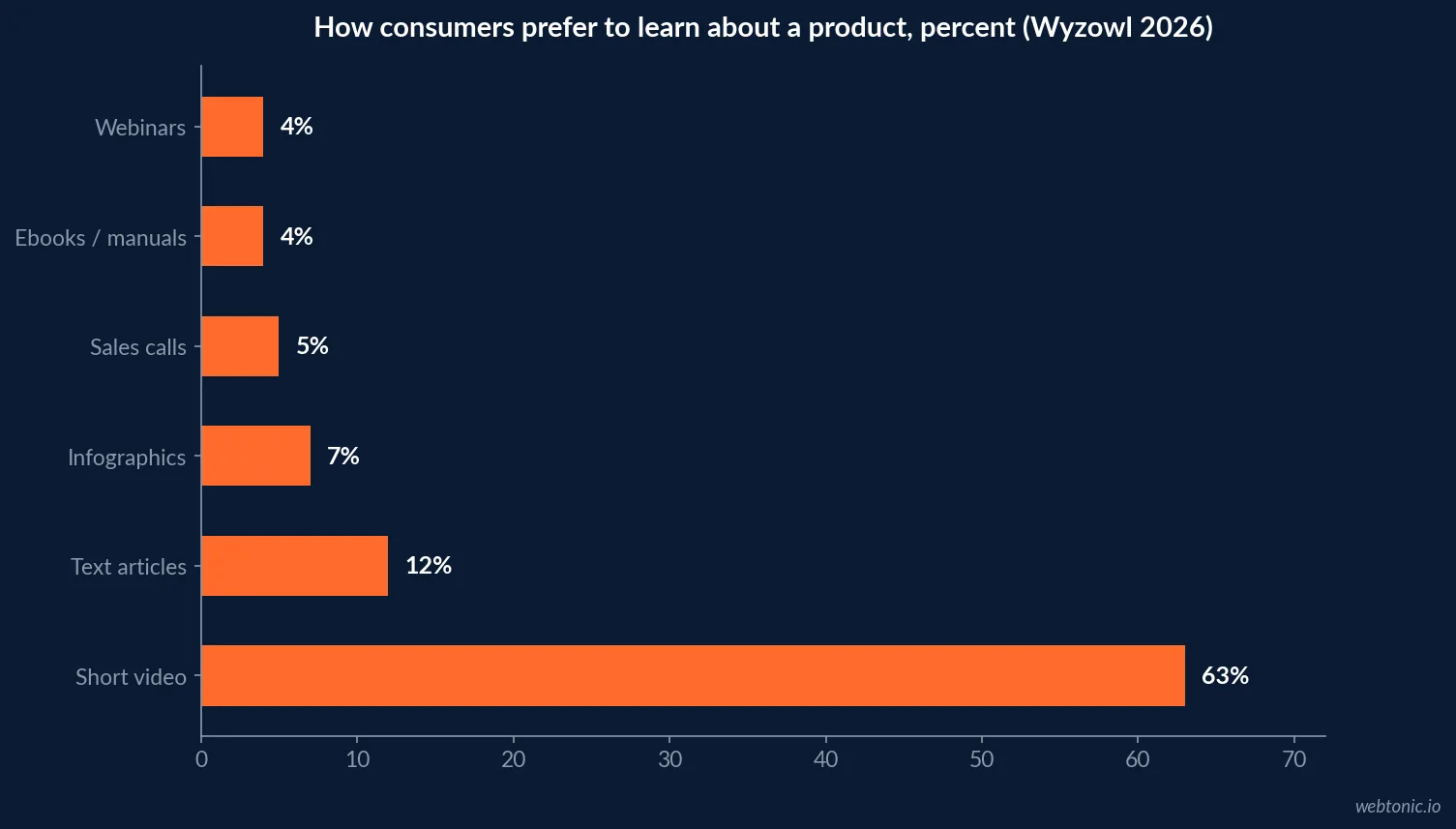
- 63% of consumers prefer to learn about a product through a short video, versus 12% for text articles.
- 85% of consumers say a video has convinced them to buy a product or service.
- 96% of people have watched an explainer video to learn about a product or service.
- Median US renovation spend is USD 20,000, and the top 10% of projects run USD 150,000 or more (Houzz, 2026 study).
- How-to searches on YouTube grow 70% year over year, per Google's own micro-moments research.
- Home Depot launched its TikTok channel in July 2022 and leans on outside creators.
- Lowe's runs an internal "Team TikTok" of associates producing video across business verticals.
- The home improvement products market is worth USD 526.5 billion (2025), the addressable audience behind any video budget.
| Metric | 2026 figure | Source |
|---|---|---|
| Businesses using video marketing | 91% | Wyzowl |
| Video marketers reporting a lead-gen lift | 85% | Wyzowl |
| Video marketers reporting a sales lift | 83% | Wyzowl |
| Consumers who prefer to learn via short video | 63% | Wyzowl |
| Median US renovation project spend | USD 20,000 | Houzz & Home Study 2026 |
| Top 10% of renovation projects | USD 150,000+ | Houzz & Home Study 2026 |
Why the budget question has no off-the-shelf answer
Wyzowl's 2026 Video Marketing Statistics report, now in its 12th consecutive year and based on 266 respondents surveyed in late 2025, measures video adoption and ROI across all industries, not by retail category, and no renovation-specific video-spend study exists publicly. What the survey does establish is that video is not optional anymore: 91% of businesses use it, and 93% of marketers say it is an important part of their overall strategy. The budget question, then, is really a production-mix and length question, not a use-it-or-not question.
Sizing the budget against the purchase, not the channel
The 2026 US Houzz & Home Study reports median renovation spend held at USD 20,000 in 2025, while the top 10% of projects reached USD 150,000 or more, up 7% from USD 140,000 the year before. That is the purchase a piece of product or installation video is trying to move a shopper toward. Wyzowl's data shows 85% of video marketers report a lead-gen lift and 83% report a direct sales lift; against a five-figure average ticket, the video production cost that earns even one additional converted lead a month typically pays for itself, which is the math that should set the budget floor rather than an arbitrary percentage of ad spend.
Length matters as much as volume. 71% of video marketers in the same survey say videos between 30 seconds and 2 minutes convert best, and 63% of consumers say they would rather learn about a product through a short video than through text (12%), ebooks (4%), infographics (7%), sales calls (5%) or webinars (4%). That argues for a library of short, SKU- or project-specific clips over a single long-form hero video.
| Video use case | Marketers reporting a lift | Best-fit format for renovation retail |
|---|---|---|
| Lead generation | 85% | Product-in-use / installation walkthrough |
| Direct sales increase | 83% | Before-and-after project reveal |
| Web traffic increase | 82% | Short social clips (30s–2min) |
| Dwell time on site | 82% | Embedded product demo on the PDP |
| Brand awareness | 93% | Creator or associate-made content |
| Reduced support queries | 57% | How-to / troubleshooting series |
What kind of video actually gets made, and by whom
Wyzowl's 2026 survey also breaks down production choices worth copying for a retail video program. Live action video is the most common format, made by 51% of video marketers, ahead of animated (23%) and screen-recorded (19%) formats. Production stays largely in-house: 59% of marketers create video themselves, while just 10% rely exclusively on outside vendors and the remaining 32% mix both. On use case, 69% of video marketers say social media video is their single most common output, ahead of explainer videos (68%), testimonial videos (57%) and product demos (39%) — a mix that maps directly onto a renovation retailer's need for both inspiration content and product-specific proof.
| Video format / use case | Share of video marketers using it | Category |
|---|---|---|
| Live action video | 51% | Format |
| Animated video | 23% | Format |
| Screen-recorded video | 19% | Format |
| Social media video | 69% | Use case |
| Explainer video | 68% | Use case |
| Testimonial video | 57% | Use case |
| Product demo video | 39% | Use case |
Sizing the budget against what homeowners actually spend
Angi's 2025 State of Home Spending Report puts average annual home-project spend at USD 12,472, up 3.5% from USD 12,050 in 2024, with households completing an average of ten projects in 2025 versus nine in 2024. Spend varies sharply by generation: Angi's data shows Millennials leading at USD 14,199 a year, ahead of Generation X at USD 12,956 and Baby Boomers at USD 12,454. A retailer building video content aimed at Millennial buyers — the highest-spending generation and the one most likely to discover product video on social platforms — has a direct, sourced reason to weight budget there first.
| Generation | Average annual home-project spend, 2025 (Angi) |
|---|---|
| Millennials | USD 14,199 |
| Generation X | USD 12,956 |
| Baby Boomers | USD 12,454 |
| All households (average) | USD 12,472 |
Google's own data on why "how-to" video demand exists at all
Google's "I-want-to-do" micro-moments research found that "how to" searches on YouTube were growing 70% year over year, with more than 100 million hours of how-to content watched in the period it measured, and that 70% of millennial YouTube users had watched the platform specifically to learn how to do something new. That research is not renovation- specific and is several years old at its core data point, but the underlying behavior — searching YouTube before starting a home project — is exactly the intent a renovation retailer's video library should be built to intercept, and nothing in more recent retail reporting contradicts it.
What Home Depot and Lowe's actually do, in their own words
Neither big-box retailer publishes a video budget figure, but both describe a production model worth copying. Home Depot launched its TikTok presence in July 2022 and has run creator partnerships since, per Business Insider's reporting, and its marketing leadership told Fortune in 2026 that it prioritizes creators "who understand the category, feel native to the brand, and can speak credibly to both DIY shoppers and, at times, pros." Lowe's corporate newsroom describes an internal "Team TikTok" made up of its own associates producing content across different verticals of the business, rather than routing every video through an outside studio.
Six decisions the data actually supports
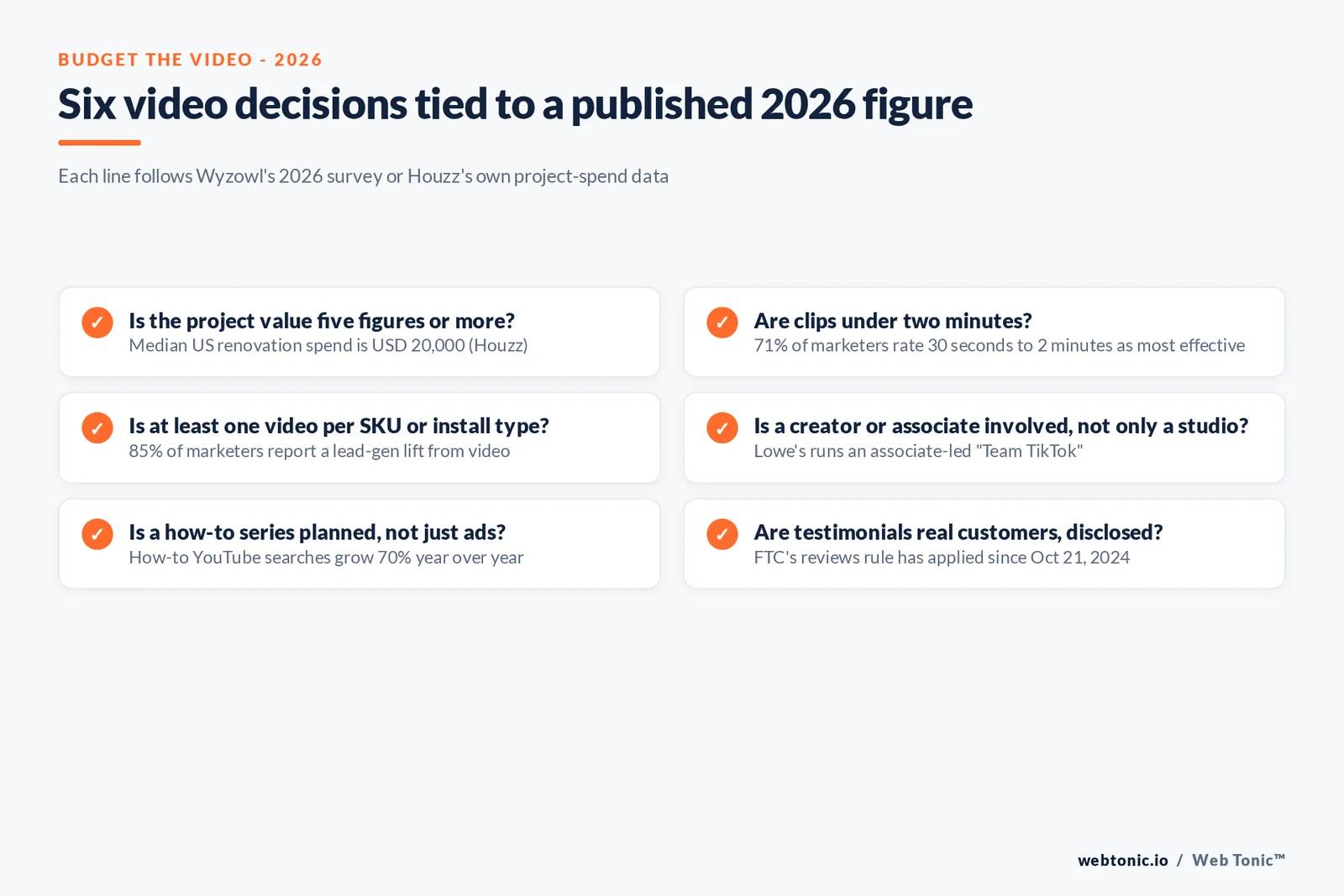
- Set the budget floor against project value, not ad spend. A USD 20,000 median project justifies real production cost per SKU or install type.
- Default to 30 seconds to 2 minutes. 71% of marketers rate that length as most effective.
- Mix creator and in-house content. 59% of all video marketers create video themselves, but 42% use external vendors in some capacity — both retailers examined here do the same.
- Prioritize the PDP over the homepage. 82% of marketers report video increases dwell time, which compounds directly on a product page.
- Build a how-to library, not just ads. Google's own research on how-to search demand predates most retailers' video strategy and still holds.
- Keep testimonials real and disclosed. The FTC's reviews and testimonials rule has applied to this kind of content since October 21, 2024.
What this model assumes, and what it does not
This budget model assumes a retailer already has product-level detail (SKU specs, install steps, warranty terms) ready to film, and that it can produce at least a short library in-house or with a mixed creator model, consistent with the 59%-in-house / 32%-mixed split Wyzowl reports across all industries. It does not assume a single hero brand video will substitute for that library, and it does not assume TikTok or Instagram organic reach alone will replace paid distribution of that content — those are separate budget lines covered elsewhere in this series.
Two different buyers need two different video libraries
HIRI's 2025 market data shows the professional side of the home improvement market growing 4.6%, more than three times the 1.3% growth on the consumer DIY side. Those two buyers do not want the same video. A DIY homeowner responds to the short, inspirational and before-and-after content Wyzowl's data favors; a Pro contractor buying on account terms wants a product spec sheet delivered as video — install tolerances, warranty terms, load ratings — because they are re-selling that information to their own customer. Budgeting one video library for both audiences under-serves the faster-growing Pro segment specifically.
| Buyer | 2025 segment growth (HIRI) | Video content that fits |
|---|---|---|
| DIY homeowner | 1.3% | Inspiration, before/after, short social clips |
| Pro / trade contractor | 4.6% | Spec-sheet video, install tolerances, warranty terms |
Where this fits Web Tonic's own creative work
Web Tonic's performance creative team builds this exact short-form, product-specific video mix for retail and home-services clients; see how the paid channel that usually carries this video is priced in the Facebook Ads pricing breakdown, how conversion rate itself is benchmarked on the conversion rate statistics page, and how a creative-and-video partner should be vetted on the best Facebook Ads agencies page.
Frequently Asked Questions
How much should a home renovation retailer budget for video?
No study prices this deliverable directly, so the honest approach is to size it against project spend, not against a flat marketing-budget percentage. Houzz's 2026 US Houzz & Home Study puts median renovation spend at USD 20,000, with the top 10% of projects reaching USD 150,000 or more. A retailer selling into that range is justified in producing project-level video (before/after, product-in-use, installation walkthroughs) because Wyzowl's 2026 survey finds 85% of video marketers say video has helped them generate leads and 83% say it has directly increased sales — against a considered purchase, that lift is worth a real budget line.
Is video worth it if 91% of businesses already do it?
Adoption being high is not the same as differentiation being gone. Wyzowl's 2026 data shows video use back at 91% after a slight 2025 dip, but the same survey finds 51% of video marketers still mostly produce live-action video against 23% animated and 19% screen-recorded, meaning most competitors are still making the same kind of video. For a renovation retailer, differentiating with installation-accurate, product-specific footage (not generic lifestyle b-roll) is the actual opportunity, not the format itself.
What length of video actually works for a renovation purchase?
Wyzowl's 2026 survey finds 71% of video marketers believe videos between 30 seconds and 2 minutes are most effective, and 63% of consumers say they would most like to learn about a product or service through a short video, ahead of text articles (12%), ebooks (4%) or webinars (4%). For a renovation retailer, that argues for a library of short, project-specific clips (one per product or installation step) over a single long-form brand video.
Do Home Depot and Lowe's confirm this with their own strategy?
Both retailers describe leaning on creator and associate-made video rather than only studio production. Home Depot launched its TikTok channel in July 2022 and has partnered with outside creators to reach younger shoppers, per Business Insider's coverage, and its own executives describe prioritizing creators who "feel native to the brand" in Fortune's 2026 reporting on its marketing strategy. Lowe's corporate newsroom describes an internal "Team TikTok" of associates producing video content across verticals of the business, rather than outsourcing it entirely.
How does the FTC's 2024 reviews rule touch video testimonials?
Directly. The FTC's Rule on the Use of Consumer Reviews and Testimonials (16 CFR Part 465), enforceable since October 21, 2024, prohibits creating or disseminating a testimonial the marketer knew or should have known misrepresented an actual customer's experience. A homeowner testimonial video used in renovation retail marketing needs to be a real customer's real project, disclosed as such, not a scripted actor reading a review.
Sources
Wyzowl — Video Marketing Statistics 2026
Houzz & Home — 2026 US Renovation Trends Study (PDF)
Angi — 2025 State of Home Spending Pulse Report
Google / Think with Google — "I-want-to-do" micro-moments research
Business Insider — Home Depot's TikTok strategy
Fortune — Inside Home Depot's marketing and creator strategy
Lowe's Corporate Newsroom — Team TikTok
HIRI — U.S. Size of the Home Improvement Products Market, 2025 Q3
Federal Trade Commission — Final rule banning fake reviews and testimonials