Table of contents
No published study benchmarks podcast or audio advertising for dental practices in 2026, so this page separates two data sets: cross-industry listener data, labelled as such, and dental patient data from the ADA. The patient listener is reachable; what the ad may say is tightly limited.
Key Takeaways
- 76% of weekly podcast consumers say they acted after hearing a podcast ad (Edison, 2025-26).
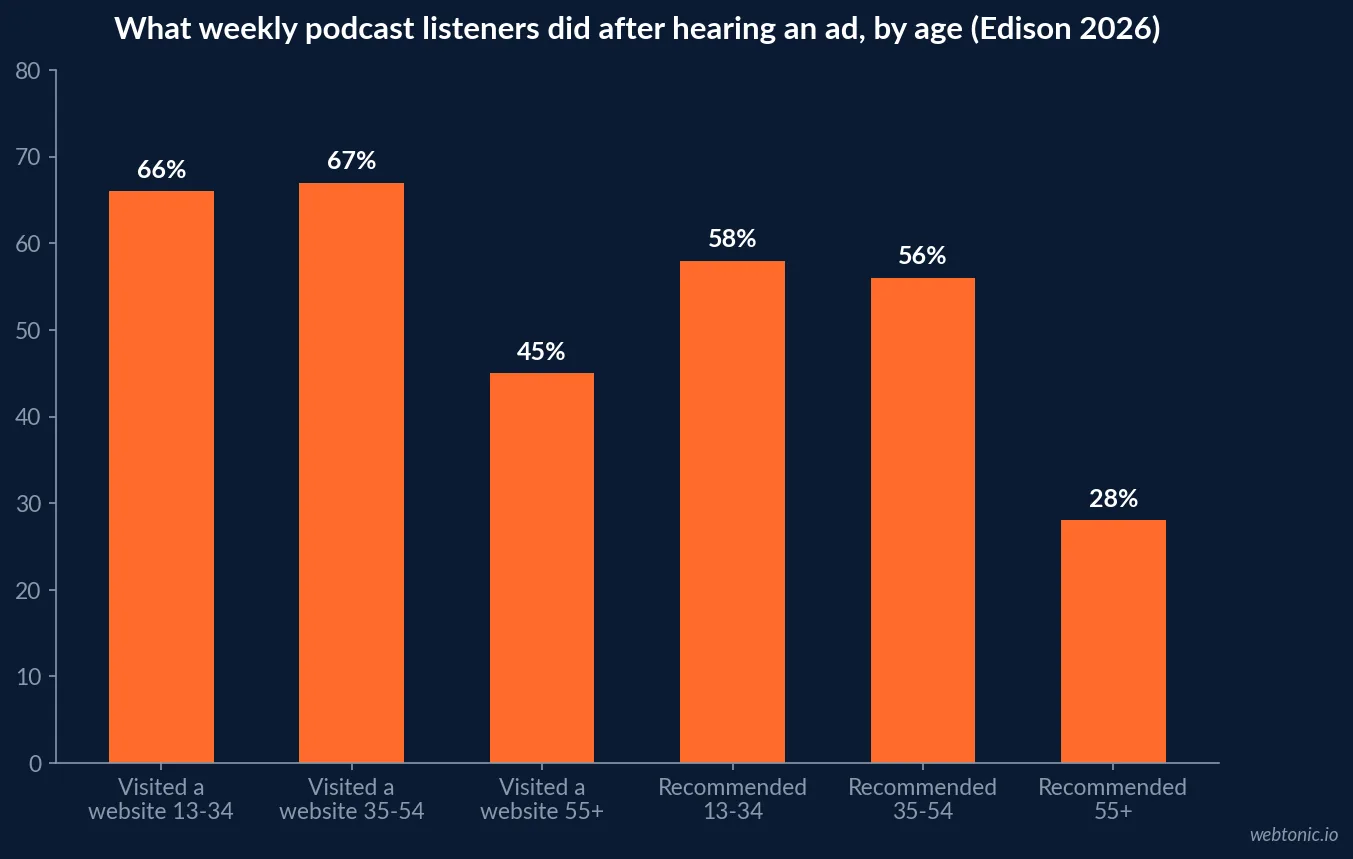
- 67% of listeners aged 35-54 visited a company website after a podcast ad; 45% of those 55+.
- 58% of Americans 12+ consumed a podcast in the last month (Infinite Dial 2026).
- Health and Wellness took 3.5% of 2023 US podcast ad revenue; Pharmaceuticals 3.4% (IAB/PwC).
- Health and Fitness shows averaged a USD 24 CPM in September 2024 (Libsyn Ads, vendor).
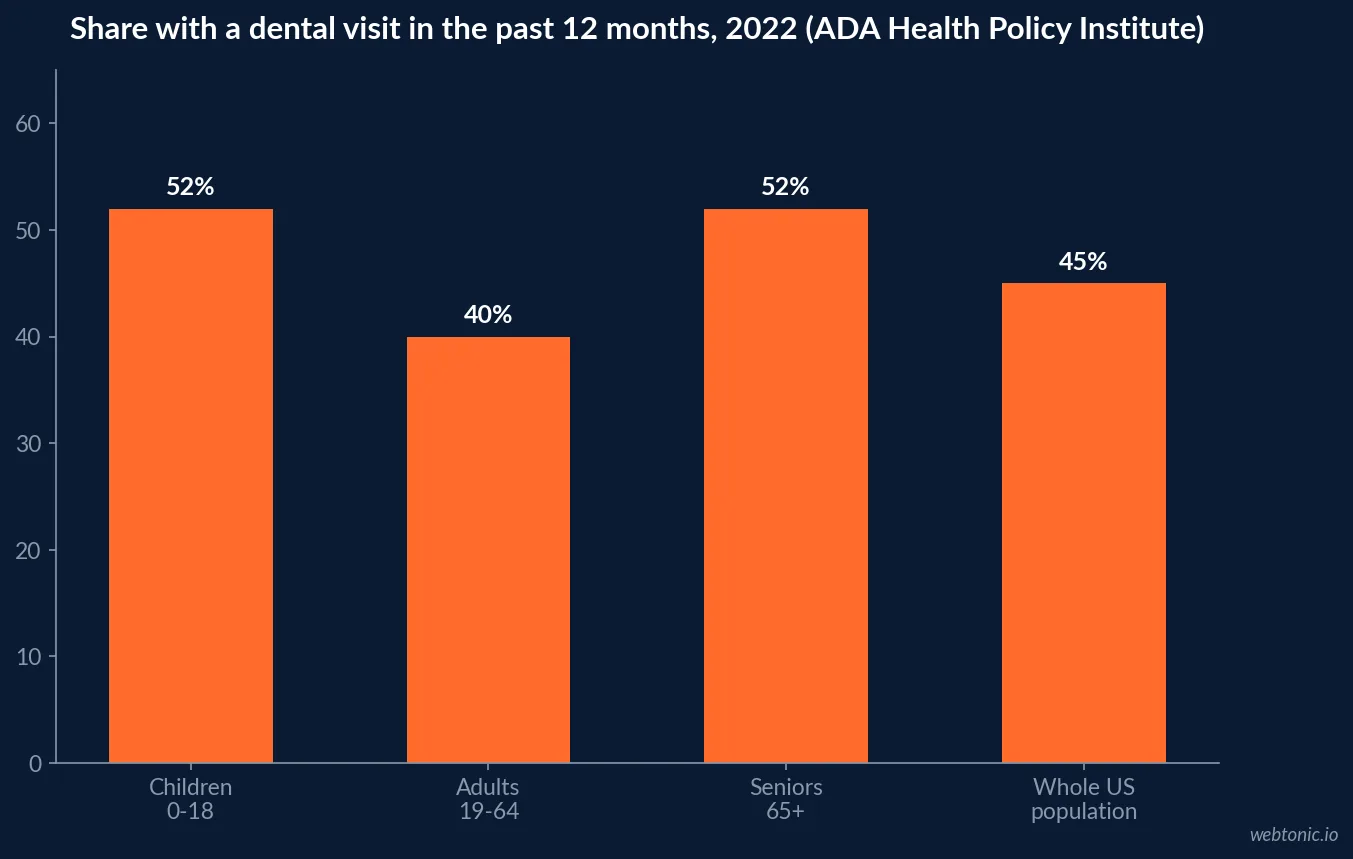
- Only 40% of US adults aged 19-64 had a dental visit in 2022 (ADA Health Policy Institute).
- US dental care spending reached USD 189 billion in 2024 (ADA HPI).
- HIPAA requires patient authorization before protected health information is used for marketing.
- No dental-specific podcast CPM, CPL, CTR or ROI has been published.
Dental Podcast and Audio Benchmarks at a Glance
The first four rows describe the podcast audience and market across all industries. The last two are dental demand figures. No row is a dental podcast benchmark.
| Metric | Figure | Scope and year | Source |
|---|---|---|---|
| Weekly listeners who acted on a podcast ad | 76% | US weekly consumers 13+, Q2 2025-Q1 2026 | Edison Podcast Consumer 2026 |
| Monthly podcast consumers | 58% (167 million) | US 12+, January 2026 | Edison Infinite Dial 2026 |
| US podcast ad revenue | USD 2.9 billion | 2025, +17.6% | IAB/PwC |
| Health and Fitness show CPM | USD 24 | September 2024, vendor | Libsyn Ads |
| Adults 19-64 with a dental visit | 40% | US, 2022 | ADA Health Policy Institute |
| National dental care expenditure | USD 189 billion | US, 2024 | ADA Health Policy Institute |
Why No Dental Podcast Benchmark Exists
Revenue studies report advertiser categories, not specialties. The IAB/PwC FY2023 podcast study put Health and Wellness at 3.5% and Pharmaceuticals at 3.4% of 2023 US podcast ad revenue; dentistry is not separated. Rate reports sort CPMs by show genre, so a Health and Fitness CPM tells you what wellness-show inventory cost, not what a practice would pay or earn. Any "dental podcast ROI" figure without a named dataset should be treated as unsourced.
Vendor trackers confirm how thin the category data is. Magellan AI's Q4 2025 benchmark (vendor) analysed 94,422 episodes and reported podcast ad spend up 32% year over year, 1,482 first-time advertisers and average ad load of 8.82% of runtime, yet it names shaving, not dentistry, as the fastest-growing line. That leaves a practice with two honest inputs: the cross-industry listener data below, and its own booking records once a test runs. Plan the first flight as a measurement exercise, with a fixed number of episodes, one offer and one tracked phone line, so the practice ends the test with a dental figure of its own rather than a borrowed one.
Who the Patient Listener Is
The audience spans the ages dental practices recruit. According to The Infinite Dial 2026 (2,050 Americans 12+, January 2026), 68% of 35-54-year-olds consume podcasts monthly, and Edison's Podcast Consumer 2026 puts the figure at 64% of 12-34-year-olds and 44% of those 55+. Weekly reach is 45% of Americans 12+, or about 130 million people.
| Audience segment | Monthly podcast consumption | Source and year | Dental service it maps to |
|---|---|---|---|
| Age 12-34 | 64% | Edison, 2026 | Aligners, whitening, first adult check-ups |
| Age 35-54 | 68% | Edison, 2026 | Family dentistry, crowns, implants consults |
| Age 55+ | 44% | Edison, 2026 | Implants, dentures, periodontal care |
| Black Americans | 63% | Edison, 2026 | Community-focused practice messaging |
| Latino Americans | 60% | Edison, 2026 | Spanish-language or bilingual host reads |
What Listeners Do After a Podcast Ad
Edison Podcast Metrics, covering Q2 2025 to Q1 2026, found 76% of weekly podcast consumers 13+ have acted after hearing a podcast ad. By age, 66% of 13-34s and 67% of 35-54s visited a company website, against 45% of those 55+. Recommending a product ran at 58%, 56% and 28%. The data is self-reported and cross-industry; it supports testing, not a forecast of booked appointments.
Tone matters too. In the same report, 56% of weekly listeners said they are much more likely to pay attention to an ad that makes them laugh, and 52% to an ad that is honest and transparent. For a dental practice, the second figure is the one to build around.
| An ad that... | Much more likely to pay attention | Somewhat more likely | No effect | Dental script note |
|---|---|---|---|---|
| Makes you laugh | 56% | 31% | 13% | Light tone suits check-up reminders, not clinical claims |
| Is unique and different | 51% | 35% | 14% | Name something only your practice offers |
| Is honest and transparent | 52% | 30% | 18% | State fees policy and plans accepted plainly |
Those three rows come from Edison Podcast Metrics, Q2 2025 to Q1 2026, among US weekly podcast consumers 13+. They describe attention, not bookings. They do suggest why the compliance rules below and good creative point the same way: an honest, plain script is both the safer ad and the one more listeners say they notice. A practice that promises "a perfect smile in one visit" risks an FTC substantiation problem and gives away the transparency that listeners reward; one that names its hours, the insurance plans it takes and a clear next step avoids both problems.
Listening habits add another planning fact. Edison's Share of Ear data puts daily audio time for Americans 13+ at 3 hours 57 minutes, and podcasts take 16% of ad-supported audio time across all listeners and 51% among daily podcast listeners. A dental practice buying a handful of episodes is therefore reaching a committed audience, but a small share of total listening, which is why frequency across several episodes matters more than one expensive read.
Dental Demand: The Patients Audio Could Reach
The ADA Health Policy Institute reports that 45% of the US population had a dental visit in 2022. The rate was 52% for children and for seniors, but only 40% for working-age adults 19-64, the same group podcasts reach best. National dental care expenditure was USD 189 billion in 2024, and consumer dental spending was up 4% as of January 2026.
| ADA HPI finding | Figure | Year | Audio reading |
|---|---|---|---|
| Whole population with a dental visit | 45% | 2022 | More than half of listeners are lapsed or new patients |
| Adults 19-64 with a dental visit | 40% | 2022 | The core podcast age band is the least-served |
| Children and seniors with a visit | 52% | 2022 | Family and senior shows reach steadier patients |
| Medicaid adults with a visit | 18% | 2022 | vs 57% with private insurance; say which plans you take |
| National dental expenditure | USD 189 billion | 2024 | Large market; audio is a small slice of it |
Rate Cards and Entry Points for a Dental Test
These are third-party figures only. Libsyn Ads' marketplace (vendor) lists a typical 30-second spot at USD 10 to 50 CPM; its September 2024 report put the 60-second average at USD 21.37 and Health and Fitness shows at USD 24. Spotify's Ad Studio help centre sets the minimum lifetime budget at roughly the equivalent of USD 250, and self-serve spots run 30 seconds or less.
| Route | Published figure | Issuer (label) | Dental fit |
|---|---|---|---|
| Host read on a health or wellness show | USD 24 CPM, Sep 2024 | Libsyn Ads (vendor) | Cosmetic or aligner consults |
| Average 60-second host read | USD 21.37 CPM, Sep 2024 | Libsyn Ads (vendor) | Local family-practice sponsorship |
| 30-second spot range | USD 10-50 CPM | Libsyn Ads (vendor) | New-patient reminder |
| Spotify self-serve audio | About USD 250 lifetime minimum | Spotify, platform page | Radius-targeted test near the practice |
Compliance Before Creative: Rules for Dental Audio Ads
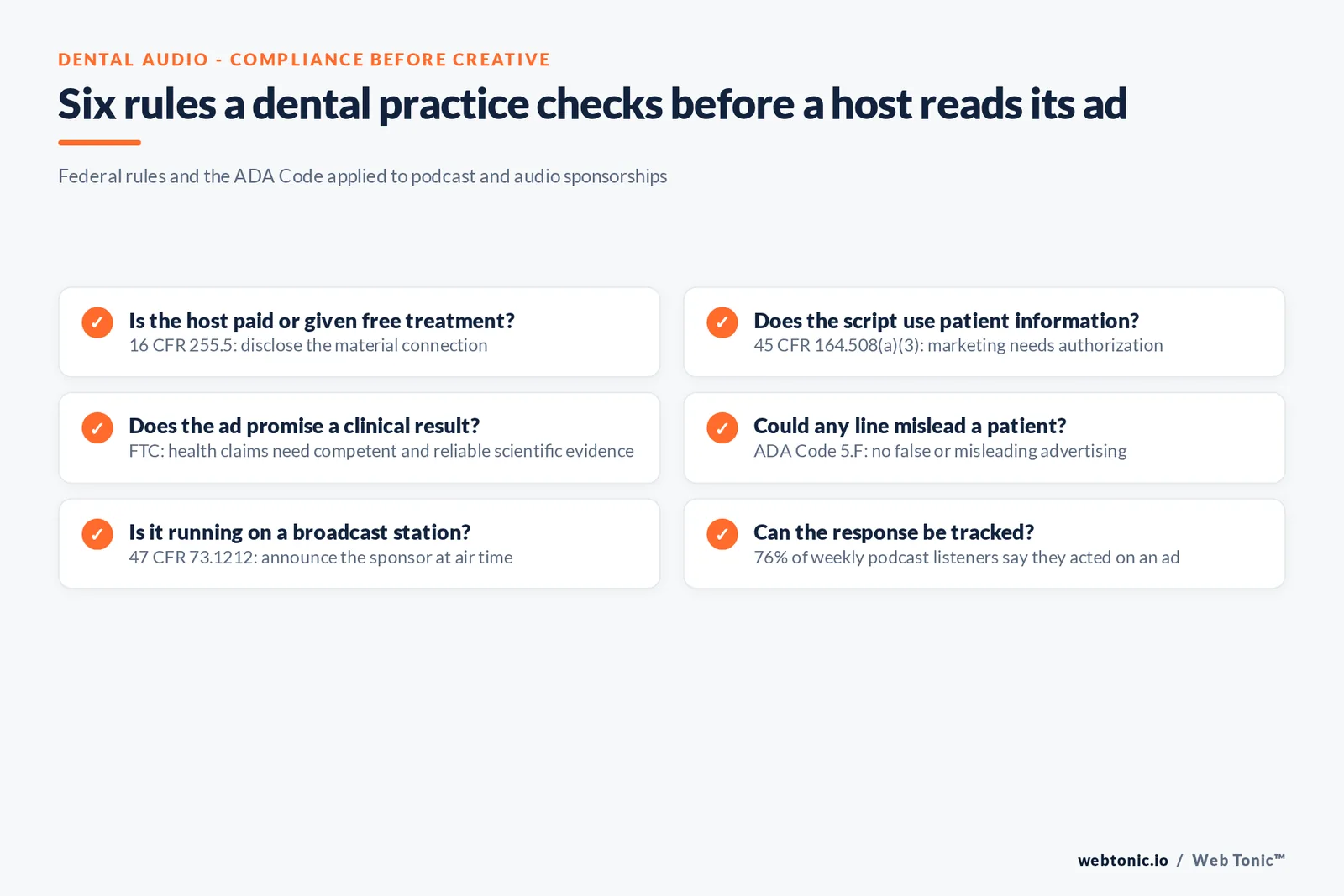
Four rule sets apply to a dental host read, and none has an audio exception.
- Endorsements: the FTC's 16 CFR 255.5 requires a material connection, including free or discounted treatment given to a host, to be disclosed clearly and conspicuously.
- Patient information: 45 CFR 164.508(a)(3) requires an authorization for any use or disclosure of protected health information for marketing, apart from face-to-face communication and nominal gifts.
- Health claims: the FTC Health Products Compliance Guidance says health-benefit claims generally need competent and reliable scientific evidence.
- Professional ethics: the ADA Code, section 5.F, bars advertising that is false or misleading in any material respect.
Host-Read Trust and What It Allows
Nielsen's podcast ad effectiveness work found host-read ads reached a 71% brand recall rate and that ads of 60 seconds or more produced 40% higher purchase-intent lift. For a practice, that trust is the reason to be careful: a host describing "my new smile" is an endorsement, so it needs disclosure, and the result described must be one the practice can substantiate.
Measuring Dental Audio Without a Benchmark
- Use a dedicated booking link or phone line per show; never ask callers for health details on a tracking form.
- Count new-patient bookings by source against the prior quarter.
- Use offers that do not imply clinical outcomes, such as a named consultation.
- Keep scripts, disclosures and any patient authorizations on file.
For adjacent channels, see our dental SMS marketing statistics, dental influencer and UGC statistics and advertising statistics, or contact us about a tracked audio test.
Broadcast Radio for Practices
If the audio buy is on a broadcast station rather than a podcast, 47 CFR 73.1212 requires the station to announce at air time that the matter is sponsored and by whom. Radio still carries most ad-supported listening: Edison's Share of Ear put radio at 62% of ad-supported audio time in Q3 2025, against 20% for podcasts.
Frequently Asked Questions
Is there a podcast advertising benchmark for dental practices?
No. No association, research firm or platform publishes a dental-specific podcast CPM, cost per new patient, click-through rate or return. The nearest published data is category-level: in the IAB/PwC FY2023 study, Health and Wellness took 3.5% of US podcast ad revenue and Pharmaceuticals 3.4%. Libsyn Ads reported Health and Fitness shows at a USD 24 CPM in September 2024, which is a show genre, not a dental rate.
Do podcast listeners act on ads?
Edison Podcast Metrics (Q2 2025 to Q1 2026) found 76% of weekly podcast consumers 13+ say they have acted after hearing a podcast ad, including visiting a website or using a promo code. Visiting a company website was reported by 66% of listeners aged 13-34, 67% of those 35-54 and 45% of those 55+. These are self-reported and cross-industry.
Can a dentist use patient stories in a podcast ad?
Only with care. Under HIPAA, 45 CFR 164.508(a)(3) requires a covered entity to obtain an authorization for any use or disclosure of protected health information for marketing, with narrow exceptions. A patient testimonial read on air also falls under the FTC Endorsement Guides, and any claimed result must not be false or misleading under the ADA Code of Ethics, section 5.F.
Do dental health claims in audio ads need evidence?
Yes. The FTC's Health Products Compliance Guidance says claims about the health benefits or safety of health-related products generally require competent and reliable scientific evidence. That applies to a whitening or aligner claim read by a host just as it does to print.
What is the smallest audio test a dental practice can run?
Spotify's Ad Studio help centre puts the minimum lifetime budget at roughly the equivalent of USD 250. Host reads on individual shows are sold per thousand downloads; Libsyn Ads' marketplace (vendor) lists a typical 30-second spot at USD 10 to 50 CPM.
Sources
Edison Research - The Podcast Consumer 2026
Edison Research - The Infinite Dial 2026
IAB/PwC - Internet Advertising Revenue Report, full year 2025
IAB/PwC - US Podcast Advertising Revenue Study, FY2023
Libsyn Ads - September 2024 podcast ad rates (vendor)
Spotify Advertising - Ad Studio help centre
ADA Health Policy Institute - The dental care market
ADA - Code of Ethics, veracity (5.F)
eCFR - 16 CFR Part 255, FTC Endorsement Guides
eCFR - 45 CFR 164.508, HIPAA authorizations
FTC - Health Products Compliance Guidance
Nielsen - Podcast audiences broaden (2021)