Table of contents
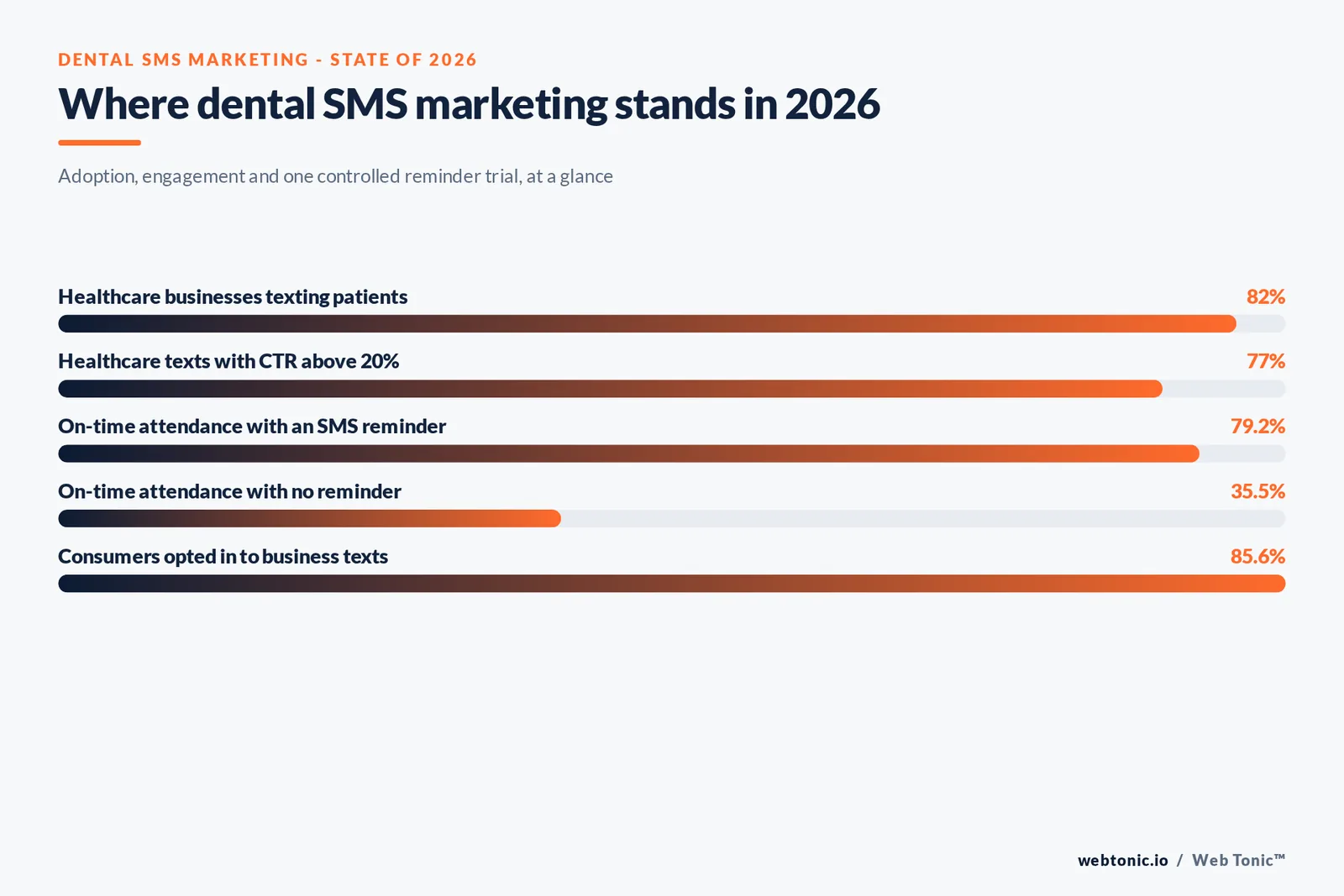
82% of healthcare businesses now text patients, and a 2012 peer-reviewed dental clinic trial (International Dental Journal) found SMS reminders lifted on-time attendance from 35.5% to 79.2%. That is where dental SMS marketing stands heading into 2026 - high adoption, a real clinical result behind the reminder use case, and a compliance layer (HIPAA) most other trades do not carry.
Key Takeaways
- 82% of healthcare businesses text customers in 2026 (SimpleTexting).
- 77% of healthcare businesses report a CTR above 20% on marketing texts.
- One 2012 dental-clinic trial lifted on-time attendance from 35.5% to 79.2% with SMS reminders.
- 206 patients took part in that controlled trial (India, International Dental Journal, 2012).
- 75.3% of all businesses used SMS marketing at the start of 2026.
- 96% of texting businesses call their digital marketing successful, versus 82.8% of non-texters.
- Appointment/reservation reminders are a top reason consumers opt in to business texts.
- 85.6% of consumers are opted in to business texts in 2026.
- Weave's dental platform starts at USD 199 a month, per its own pricing page.
- HIPAA's Privacy Rule permits appointment-reminder texting under 45 CFR 164.
- Finance (89%) and technology (88%) lead healthcare (82%) in SMS adoption.
- Healthcare is a top-3 industry consumers opt in to, per SimpleTexting.
Adoption: healthcare is a top-tier texting industry, not a laggard
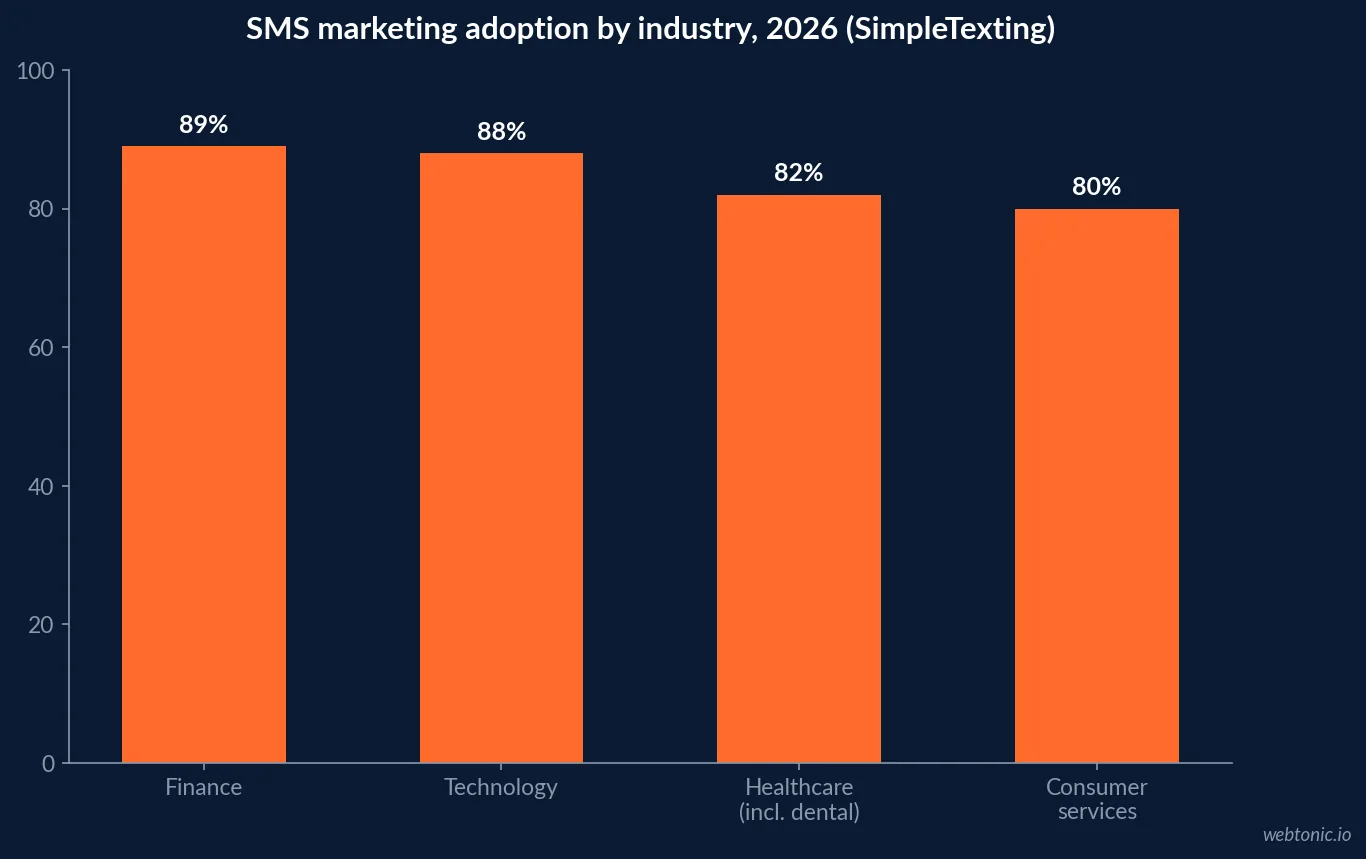
SimpleTexting's 2026 survey of 400 SMS marketers found overall business SMS adoption at 75.3%, up from 66% a year earlier. Broken out by industry, healthcare sits at 82% adoption - behind only finance (89%) and technology (88%), and ahead of consumer services (80%). Healthcare (which includes dental) also appears among the top industries consumers say they actively subscribe to business texts from.
| Industry | Share of businesses texting customers (2026) | Source |
|---|---|---|
| Finance | 89% | SimpleTexting (400 marketers) |
| Technology | 88% | SimpleTexting |
| Healthcare (incl. dental) | 82% | SimpleTexting |
| Consumer services | 80% | SimpleTexting |
| All businesses, blended | 75.3% | SimpleTexting |
Click-through: healthcare texts get opened and acted on
Adoption is only half the read - engagement is the other. SimpleTexting's same 2026 survey found 77% of healthcare businesses report an average SMS click-through rate above 20%, trailing finance's 80% but ahead of education's 71%. Across all industries, the largest single band of businesses (37%) reports a CTR between 21% and 35%.
| Industry | Share reporting CTR above 20% (2026) | Source |
|---|---|---|
| Finance | 80% | SimpleTexting |
| Healthcare (incl. dental) | 77% | SimpleTexting |
| Education | 71% | SimpleTexting |
| All businesses, blended | 66.2% | SimpleTexting |
The clinical case for reminder texting
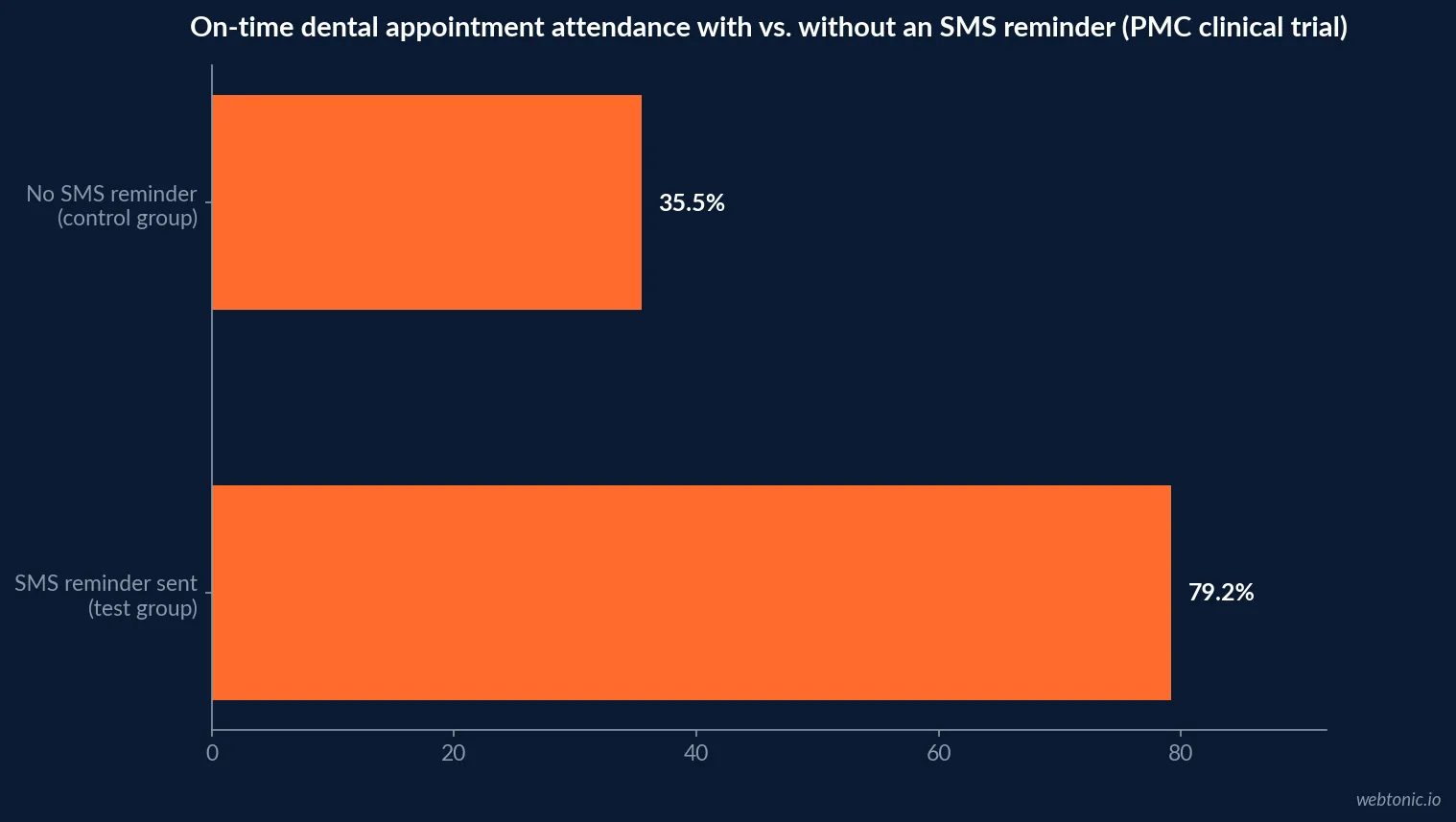
The strongest evidence for the core dental use case - appointment reminders - is not a marketing survey but a controlled clinical trial. Researchers at the ITS Centre for Dental Studies and Research in Ghaziabad, India, split 206 patients across Prosthodontics, Endodontics, Orthodontics and Paedodontics departments into a test group (SMS reminder sent) and a control group (no reminder). On-time attendance was 79.2% in the reminder group versus 35.5% in the control - published via PubMed Central. That is a single-site trial, not a national benchmark, but it is a controlled comparison rather than a self-reported marketing claim.
| Group | On-time attendance | Sample | Source |
|---|---|---|---|
| SMS reminder sent (test group) | 79.2% | 96 patients | PMC-published clinical trial (ITS-CDSR, India) |
| No reminder (control group) | 35.5% | 110 patients | Same trial |
| Attendance lift, reminder vs. control | +43.7 pp | 206 patients total | Same trial |
Why patients opt in, and what they expect back
SimpleTexting's consumer survey (1,000 U.S. consumers) found appointment and reservation reminders among the top reasons people subscribe to business texts at all, alongside shipment tracking and promotions - a direct match for what a dental practice sends most. Overall opt-in has grown from 61.8% in 2021 to 85.6% in 2026, and 74% of consumers check a text notification within five minutes of receiving it, which is the practical argument for texting over a phone-tag reminder call.
| Consumer behavior (2026) | Figure | Source |
|---|---|---|
| Consumers opted in to business texts | 85.6% | SimpleTexting (1,000 consumers) |
| Opt-in rate in 2021, for comparison | 61.8% | SimpleTexting |
| Check a text within 5 minutes | 74% | SimpleTexting |
| Top subscribe reason: appointment/reservation reminders | Named top reason | SimpleTexting |
What dental-specific SMS software costs
Unlike the generic vendors used by trades, dental practices have a purpose-built option. Weave's own pricing page lists a base plan starting at USD 199 a month, with add-on bundles - Coordinate and Attract - priced at roughly USD 149 a month each, and higher Pro/Elite/Ultimate tiers that raise the bulk-texting allotment from 1,500 to 15,000 messages a month along with online scheduling and digital intake forms. Exact Elite/Ultimate pricing is quote-only.
| Weave tier (own pricing page) | Monthly cost | Bulk texts included | Notes |
|---|---|---|---|
| Base plan | USD 199/mo | 1,500 messages | VOIP phones, appointment reminders, two-way texting |
| Pro | Quote-based | 3,000 messages | Adds online scheduling, digital forms |
| Elite | Quote-based | Higher allotment | Most popular tier, per Weave's own page |
| Ultimate | Quote-based | 15,000 messages | Up to 15 phones, 1:1 training, premium analytics |
The HIPAA layer that other trades do not carry
Dental practices are covered entities, so appointment-reminder texts sit under HIPAA's Privacy Rule (45 CFR 164), not just the TCPA/CTIA rules that apply to every business text. The rule permits communicating with patients about their care, including by phone or text, provided the practice reasonably safeguards the information disclosed - for example, keeping a reminder to a name, time and confirmation prompt rather than diagnosis or treatment detail, and accommodating a patient's request for an alternate contact method or channel.
On the general SMS consent question - relevant to any dental marketing text beyond pure appointment logistics - the FCC's stricter 2023 one-to-one consent order was vacated by the 11th Circuit in Insurance Marketing Coalition Limited v. FCC on January 24, 2025; ordinary TCPA opt-in consent remains the standard.
Recall and retention, not just new-patient acquisition
Most of the adoption and click-through data above describes marketing texts broadly, but the highest-value dental use case is recall - bringing a lapsed patient back for a six-month cleaning. SimpleTexting's survey did not isolate a dental recall figure, so this page does not invent one; the honest read is that the same 82% adoption and 77% CTR figures apply, since a recall text and an appointment reminder are functionally the same message type from the patient's side.
| Message type | Purpose | Relevant benchmark | Source |
|---|---|---|---|
| Appointment reminder | Reduce no-shows for a scheduled visit | 79.2% vs. 35.5% on-time attendance | PMC clinical trial |
| Recall / recare | Re-engage a lapsed patient | 82% healthcare adoption, 77% CTR>20% (proxy) | SimpleTexting, 2026 |
| Post-treatment follow-up | Confirm recovery, request a review | Not separately benchmarked | n/a |
What this page does not claim
No published 2026 study isolates a dental-specific SMS marketing click-through rate, revenue-per-text, or recall-specific conversion figure - the healthcare-wide numbers above are the closest available proxy, and the attendance trial is from one hospital's dental departments in India, not a U.S. multi-site study. Treat every figure on this page as labelled: a healthcare-wide benchmark, a single-site clinical trial, or a vendor's own published price, never a dental-marketing-industry average that does not exist.
Reading the trial result carefully
The 79.2% versus 35.5% attendance figures come from a single hospital-based dental teaching center, not a randomized national sample, and the sample itself was modest at 206 patients split roughly 96 to 110 across a test and control group. That is enough to show a large, statistically meaningful gap inside that setting, but a U.S. private practice operating under different scheduling norms, patient demographics and reminder wording should expect a lift in the same direction, not necessarily the same magnitude. Treat 43.7 percentage points as a ceiling case, not a guaranteed result.
The same caution applies to the vendor-reported adoption and click-through figures: SimpleTexting surveyed 400 SMS marketers and 1,000 consumers across all industries, then broke healthcare out as one segment. A dental-only sub-sample was not published, so "healthcare" is the finest-grained figure available and dental should be read as sitting somewhere inside that healthcare band, not necessarily at its exact center.
The HIPAA-adjacent decision most practices skip
Beyond the reminder-content question, practices adopting a texting platform should confirm whether that vendor will sign a Business Associate Agreement (BAA) if any protected health information beyond a bare appointment time will pass through the platform - most general-purpose SMS marketing tools (SimpleTexting, EZ Texting, Textedly) are not built as HIPAA-covered messaging systems, while dental-specific platforms like Weave market themselves around healthcare compliance. That distinction, not price alone, is the reason a dental practice often ends up on purpose-built software rather than a general SMS vendor.
What to watch through the rest of 2026
Two figures on this page are worth re-checking as the year progresses: SimpleTexting's industry-adoption breakdown (last measured in a January 2026 survey window, so a mid-year refresh could move the 82% healthcare figure), and Klaviyo's move from credit-based to per-message dollar pricing starting July 2026, which changes how a practice using Klaviyo for combined email/SMS should read its own SMS spend line. Neither changes the clinical case for reminder texting, which rests on the controlled trial rather than a vendor survey. Practices evaluating vendors this year should re-confirm current pricing directly on each vendor's own page rather than relying on a snapshot, since SMS platform pricing has shifted mid-year before.
Where dental SMS marketing stands, in one read
Adoption and engagement both outperform the average industry, a controlled trial backs the core reminder use case with a real attendance lift, purpose-built dental software exists at a published starting price, and the compliance bar is one layer higher than most trades because of HIPAA. See Web Tonic's growth marketing services, the customer retention statistics hub for adjacent recall and retention benchmarks, and Web Tonic's contact page to discuss a patient communications program.
Frequently Asked Questions
How many dental and healthcare practices use SMS marketing in 2026?
SimpleTexting's 2026 survey of 400 SMS marketers found 82% of businesses in healthcare send texts to customers, the third-highest adoption rate behind finance (89%) and technology (88%). Healthcare also ranks among the top three industries consumers say they subscribe to business texts from, alongside e-commerce/retail and finance.
Do SMS appointment reminders actually reduce no-shows?
The best-controlled evidence is a peer-reviewed trial at a dental teaching hospital (ITS Centre for Dental Studies and Research, India), published via PubMed Central: patients who received an SMS reminder attended on time 79.2% of the time versus 35.5% for a no-reminder control group - a large, statistically significant gap in one clinical setting. It is one hospital's data, not a guarantee, but it is a controlled comparison rather than a marketing claim.
What SMS click-through rate should a dental practice expect?
SimpleTexting's 2026 data breaks this out by industry: 77% of businesses in healthcare report an average text click-through rate above 20%, close behind finance at 80% and ahead of education at 71%. That is a healthcare-wide figure, not dental-specific, but it is the closest vendor-sourced benchmark available for the vertical.
Is texting patients about appointments a HIPAA issue?
HIPAA's Privacy Rule (45 CFR 164) permits covered entities to communicate about care, including appointment reminders, provided the practice reasonably safeguards the information disclosed - for example, limiting a text to a name, time and confirmation request rather than diagnosis or treatment detail, and honoring any patient request for an alternate communication method. Rules and platform-specific safeguards vary; consult compliance counsel before templating clinical detail into a text.
What does dental-specific texting software cost?
Weave, built for dental, publishes its own pricing starting at USD 199 a month for its base plan, with add-on bundles (coordinate, attract) at roughly USD 149 a month each and higher Pro/Elite/Ultimate tiers adding bulk texting allotments up to 15,000 messages a month. That is Weave's own published starting price - exact Elite-tier pricing requires a quote.
Sources
SimpleTexting - SMS Marketing Statistics 2026 (1,000 consumers, 400 marketers)
PubMed Central - SMS Reminder Effect on Dental Clinic Attendance (ITS-CDSR, India)
Weave - Pricing for Healthcare Practices (Dental)
Klaviyo - Mobile Messaging Per-Message Pricing FAQ (2026)
eCFR - 45 CFR 164.510, HIPAA Uses and Disclosures
eCFR - 47 CFR 64.1200, Delivery Restrictions
CTIA - Messaging Principles and Best Practices
11th Circuit - Insurance Marketing Coalition Ltd. v. FCC, No. 24-10277 (Jan. 24, 2025)