Table of contents

Dental influencer and UGC marketing in 2026 is shaped less by creator rates than by rules: 88% of dentists receive online reviews, and every patient story used in marketing needs signed HIPAA authorization. No study publishes a dental influencer benchmark, so cross-industry figures are labelled throughout.
Key Takeaways
- 88% of surveyed dentists receive online patient reviews (ADA Health Policy Institute).
- 39% of dentists say HIPAA stops them replying to those reviews.
- 84% of the public trust online reviews to help them decide, per the ADA.
- One practice paid a USD 50,000 civil penalty for disclosing patient details in a review reply.
- HIPAA 45 CFR 164.508(a)(3) requires authorization for any marketing use of patient information.
- 16 CFR 255.5 requires disclosure of free or discounted treatment given to an endorser.
- Health and Fitness creator searches grew 76% on Collabstr (2026, cross-industry niche).
- 81% of enterprise marketers say repurposed creator content beats brand assets (Linqia 2026).
- 74% of consumers only care about reviews from the last three months (BrightLocal 2026).
- No dental-specific influencer engagement rate, CPM or ROI has been published.
Dental patient content: the data and the rules at a glance
For a practice, the most reliable numbers are about reviews and regulation, not creators. The table separates dental figures from cross-industry ones, and the rest of the page keeps that split so an all-industry creator figure is never read as a dental result.
| Item | Figure or rule | Scope | Source |
|---|---|---|---|
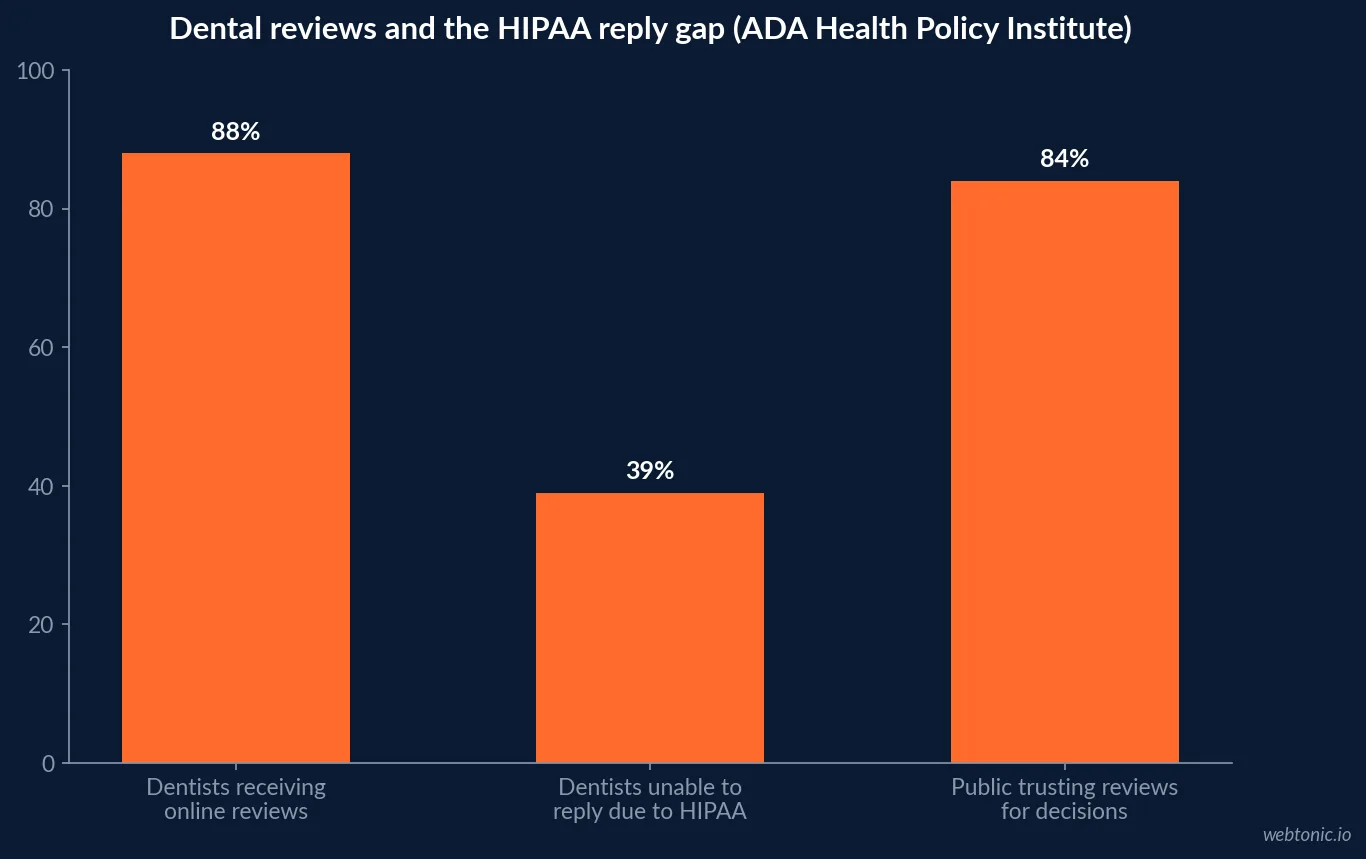
| Dentists receiving online reviews | 88% | Dental | ADA Health Policy Institute |
| Dentists unable to reply due to HIPAA | 39% | Dental | ADA Health Policy Institute |
| Marketing use of patient information | Written authorization | Covered entities | 45 CFR 164.508 |
| Paid or discounted endorsers | Disclose clearly | All advertisers | 16 CFR 255.5 |
| Repurposed creator content beats brand assets | 81% | Cross-industry | Linqia 2026 |
Reviews are the patient content dentists already have
The ADA's guide to managing online reviews reports that 88% of dentists in an ADA Health Policy Institute survey received online patient reviews and 39% said they were unable to respond because of HIPAA. The same page says 84% of the public trust online reviews to help them make decisions, and it cites a North Carolina practice that paid a USD 50,000 civil penalty for describing a patient's experience in a reply.
BrightLocal's 2026 Local Consumer Review Survey explains why that reply gap matters across all local businesses: 89% of consumers expect owners to respond, 19% expect a same-day reply and 81% expect one within a week. A dentist can meet that expectation with a reply that thanks the reviewer and invites contact offline without confirming they are a patient.
| Review reply scenario | HIPAA risk | Safer pattern |
|---|---|---|
| Thanking a five-star reviewer by treatment | High - confirms a patient relationship | Thank them without naming care |
| Correcting a negative review with chart details | High - penalty precedent | Invite a private call |
| Generic reply to every review | Low | Same template, personalised tone |
| Asking patients for reviews after visits | Low if no PHI shared | Ask all patients, not only happy ones |
HIPAA: authorization before any patient story
The Privacy Rule at 45 CFR 164.508 says a covered entity must obtain an authorization for any use or disclosure of protected health information for marketing, with exceptions only for a face-to-face communication or a promotional gift of nominal value. If the marketing involves financial remuneration from a third party, the authorization must state that. In practice that covers smile photos, treatment videos, patient-tagged posts reposted by the practice and a patient's clip boosted as an ad.
| Patient content type | Protected health information? | What the practice needs |
|---|---|---|
| Before-and-after smile photos | Yes | Signed marketing authorization |
| Named patient video testimonial | Yes | Signed marketing authorization |
| Patient's own unprompted post | Posted by the patient | Authorization before the practice reuses it |
| De-identified educational content | No, if truly de-identified | No authorization; avoid identifiers |
| Staff or dentist explainer video | No | Standard advertising rules |
What a valid patient authorization must contain
A consent line buried in new-patient paperwork is unlikely to be enough. Section 164.508(c) lists the core elements a valid authorization must contain, plus required statements such as the patient's right to revoke it in writing. The table maps each element to a dental marketing example.
| Core element (45 CFR 164.508(c)) | Dental marketing example |
|---|---|
| Specific description of the information | Before-and-after photos of veneer treatment |
| Who may make the disclosure | The practice and its marketing staff |
| Who may receive it | Instagram, Facebook, the practice website, paid ad audiences |
| Purpose of each use | Promotional posts and paid advertising |
| Expiration date or event | A fixed date, e.g. two years from signing |
| Signature and date | Patient, or personal representative with authority stated |
The same section requires a statement of the right to revoke in writing and how to do it. When the practice takes a post down after a revocation, any boosted version of the same content has to stop too, which is a practical reason to keep a register of where each authorized asset runs.
FTC endorsement rules for dental creators
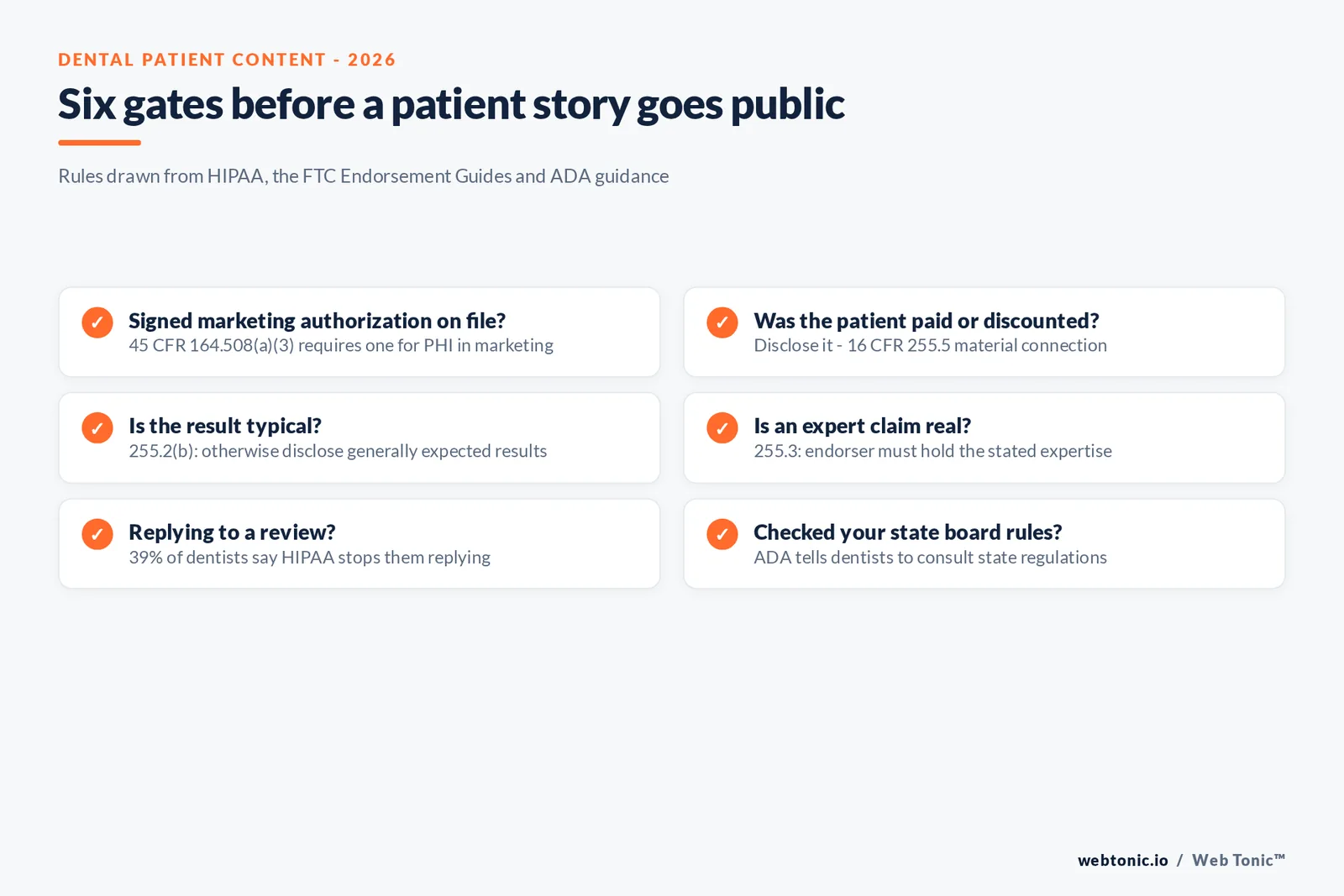
The FTC's Endorsement Guides apply to every paid or incentivized dental endorsement. Section 255.5 requires clear disclosure of a material connection - a free whitening, a discounted aligner case or a fee. Section 255.2 says a patient's result in an ad will be read as typical, so the practice needs substantiation or a clear disclosure of the generally expected result. Section 255.3 requires an endorser presented as an expert to actually hold that expertise. The FTC's Q&A on the Endorsement Guides also covers incentivized reviews, and its Health Products Compliance Guidance sets out how health claims need competent and reliable scientific evidence.
What the ADA tells dentists about advertising
The ADA's advertising guidance states that endorsements and testimonials must represent the endorser's actual opinion and experience, that endorsers must clearly disclose any material connection with the practice, and that a promised outcome that cannot be delivered to every patient can be deceptive. It tells dentists to consult their state's regulations and administrative rules. The ADA Code of Ethics section on veracity adds that no dentist shall advertise in any form of communication, including social media, in a manner that is false or misleading in any material respect.
Creator data that exists, labelled cross-industry
Collabstr's 2026 Influencer Marketing Report, drawn from more than 21,000 collaborations on its marketplace, does not have a dental niche. The closest signals are indirect: Health and Fitness is the third-fastest-growing niche by search at 76%, and Beauty is the most affordable niche at USD 210 per engagement. Across all niches 80% of engagements cost under USD 300 and the average UGC campaign costs USD 197.
| Collabstr 2026 signal | Figure | Relevance to dental |
|---|---|---|
| Health and Fitness search growth | +76% | Adjacent wellness audience |
| Beauty average per engagement | USD 210 | Cosmetic dentistry overlaps |
| Average UGC campaign | USD 197 | Patient-style content without creator reach |
| Engagements under USD 300 | 80% | Small tests are the norm |
| UGC share of engagements | 35% | Up from 15% a year earlier |
Who the creators are
Most creators a practice could hire are small operators. Goldman Sachs research on the creator economy counts about 50 million creators worldwide, of whom only about 4% earn more than USD 100,000 a year, and puts brand deals at about 70% of creator revenue. Collabstr's marketplace is 80% female creators and the United States accounts for 66% of its collaborations. For a dental practice, that points to local micro-creators rather than national names, and to a brief that spells out HIPAA and FTC duties because most creators have no compliance team.
| Creator-market signal | Figure | Source |
|---|---|---|
| Creators worldwide | About 50 million | Goldman Sachs |
| Creators earning over USD 100,000 a year | About 4% | Goldman Sachs |
| Share of creator revenue from brand deals | About 70% | Goldman Sachs |
| Creator economy size projected for 2027 | USD 480 billion | Goldman Sachs |
| Female share of Collabstr creators | 80% | Collabstr 2026 |
| US share of Collabstr collaborations | 66% | Collabstr 2026 |
How brands reuse creator content
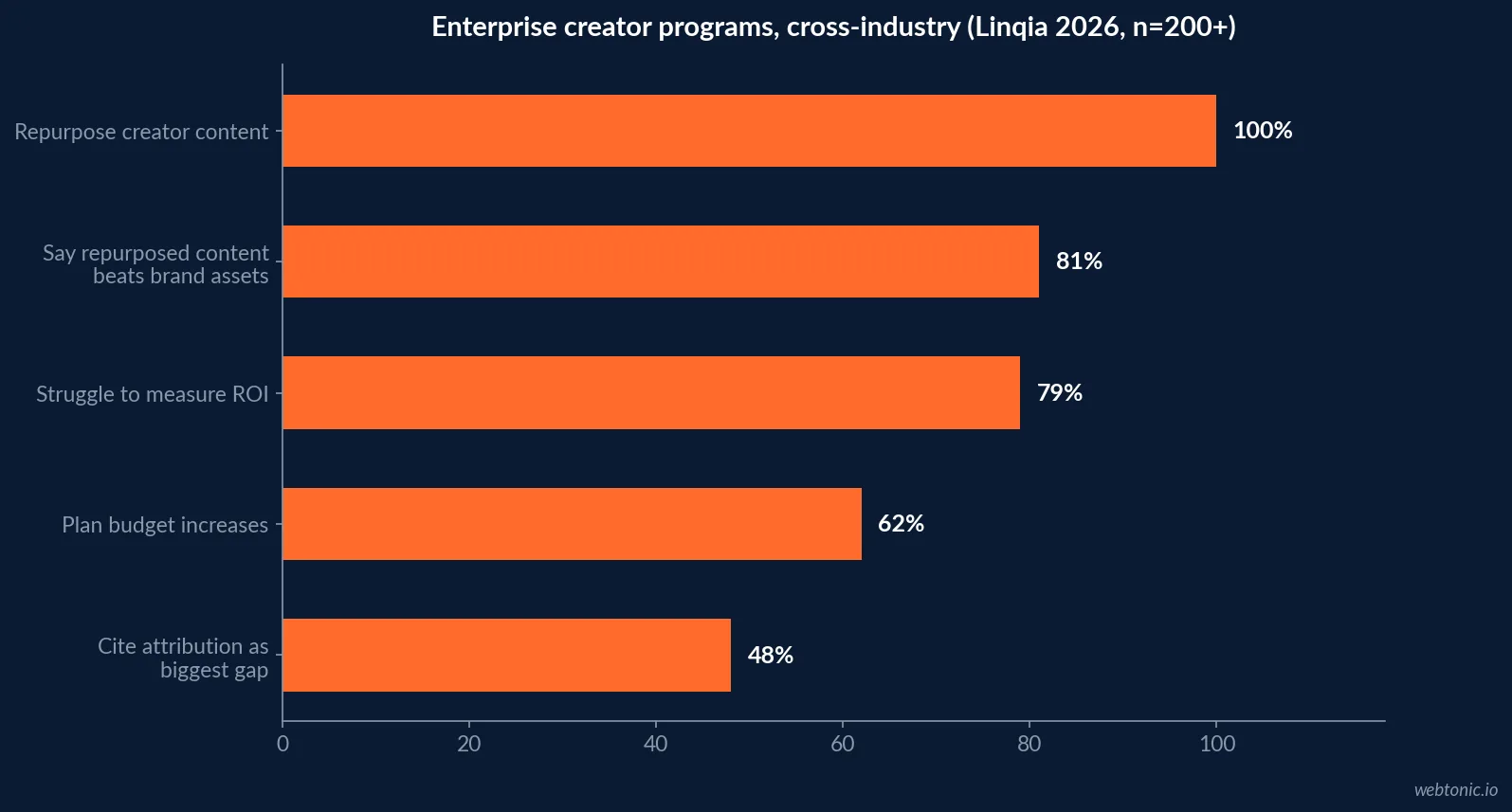
Linqia's 2026 State of Influencer Marketing, fielded to over 200 enterprise marketers, found 100% repurpose influencer content beyond the creator's page and 81% say it outperforms brand-created assets, while 79% struggle to measure ROI. For a dental group, repurposing is exactly where HIPAA and FTC duties follow the content: a clip authorized for one Instagram post needs an authorization that covers its use as a paid ad or on the website.
Video explainers without patient data
The lowest-risk dental creator content is the dentist explaining a procedure. YouTube's 2026 Creator Partnerships announcement says 78% of viewers see YouTube as having the most trusted creators for product recommendations and 40% of a video's views arrive more than a month after it goes live. Those are YouTube's own figures across categories, but they fit evergreen dental topics such as implant recovery or aligner care that carry no patient information.
A compliant patient-content workflow
- Collect a HIPAA marketing authorization before any photo, name or story is used.
- Scope the authorization to every channel, including paid ads and the website.
- Disclose free or discounted treatment in the post itself.
- Add expected-result context to any dramatic before-and-after.
- Reply to reviews without patient details - 39% of dentists hold back entirely.
- Check the state dental board rules, as the ADA advises.
For cross-industry creator benchmarks see our influencer and UGC marketing statistics; reminder and recall texting is covered in our dental SMS marketing data. Our performance creative team produces dentist-led explainer ads for Meta and short-form placements.
Frequently Asked Questions
Can a dentist post patient testimonials or smile photos on social media?
Only with a valid written authorization. Under the HIPAA Privacy Rule, 45 CFR 164.508(a)(3), a covered entity must obtain an authorization for any use or disclosure of protected health information for marketing, with narrow exceptions for face-to-face communications and promotional gifts of nominal value. A before-and-after photo or a named patient story is protected health information, so the signed authorization comes before the post.
Can a dental practice reply to an online review?
Carefully. The ADA reports that 39% of dentists in an ADA Health Policy Institute survey said they were unable to respond to reviews because of HIPAA, and cites a North Carolina practice that paid a USD 50,000 civil penalty after detailing a patient's experience in a reply. A generic reply that confirms no patient information is the safe pattern.
Do dental influencers have to disclose they were paid?
Yes. The FTC Endorsement Guides at 16 CFR Part 255 require clear and conspicuous disclosure of any material connection, including free or discounted treatment. The ADA's own advertising guidance repeats that endorsers must clearly disclose any material connection with the dental practice.
Is there a benchmark for dental influencer engagement or ROI?
No. None of the major 2026 creator datasets breaks out dentistry. The nearest published figures are cross-industry: Collabstr's marketplace puts Health and Fitness among the fastest-growing niches at 76% search growth, and Linqia's enterprise survey finds 81% of marketers say repurposed creator content outperforms brand assets. Those are not dental results.
Can a patient testimonial promise a result like a whiter smile?
Not as a typical result unless the practice can support it. Under 16 CFR 255.2, a consumer endorsement is read as representing what patients will generally achieve, so the practice needs substantiation or must clearly disclose the generally expected result. The ADA Code of Ethics also bars advertising that is false or misleading in any material respect.
Sources
ADA - Protect your practice's reputation (online reviews)
ADA - Advertising: legal and ethical considerations
ADA - Code of Ethics, Principle of Veracity
eCFR - 45 CFR 164.508, Uses and disclosures requiring an authorization
eCFR - 16 CFR Part 255
FTC - Endorsement Guides: What People Are Asking
FTC - Health Products Compliance Guidance
Collabstr - 2026 Influencer Marketing Report
Linqia - 2026 State of Influencer Marketing
YouTube Blog - Creator Partnerships, NewFronts 2026
BrightLocal - Local Consumer Review Survey 2026
Goldman Sachs - The creator economy could approach half a trillion dollars by 2027