Table of contents

64% of automotive businesses never ask an answered phone lead to buy or book an appointment, even though 45% of those leads are already qualified enough to convert on the call. No CRO study splits car dealerships from powersports dealers, so this page reads both against the same cross-automotive datasets and labels every cross-industry figure as exactly that.
Key Takeaways
- 58% of automotive calls are answered by a person, rising to 70% for calls over 30 seconds (Invoca, 2026).
- 53% of answered calls are genuine leads, and 45% of those convert on the call (Invoca, 2026).
- 64% of automotive businesses never ask the lead to buy or book (Invoca, 2026).
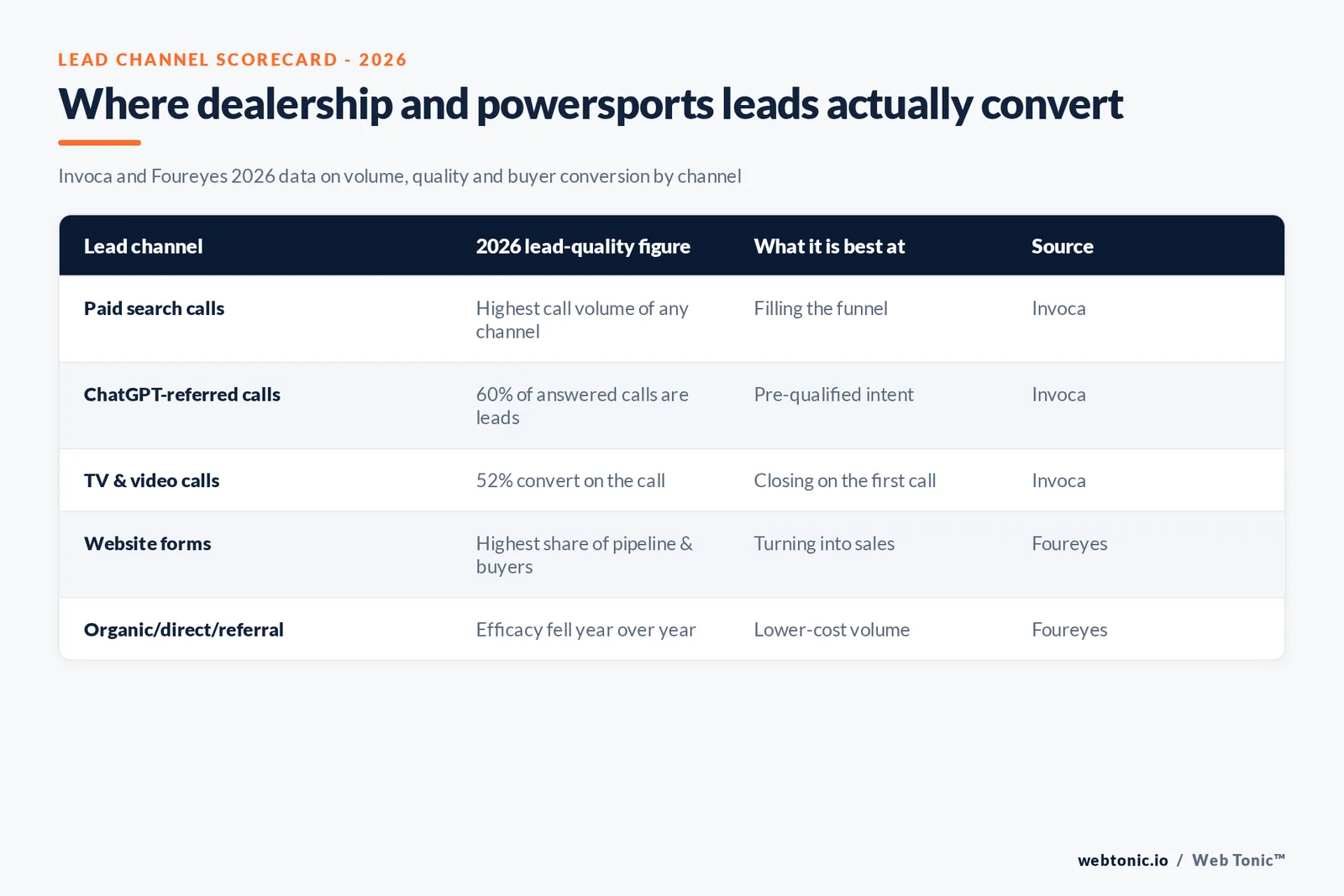
- ChatGPT-referred calls convert leads at the highest rate of any channel, 60% (Invoca, 2026).
- TV and video calls convert at 52%, the highest close rate by channel (Invoca, 2026).
- 55% of answered phone leads are for service, not sales, at OEMs and dealers (Invoca, 2026).
- 42.7% of qualified leads were mishandled in 2025 (Foureyes, 2026 report).
- 15.2% of qualified leads were never logged to the CRM, up from 10.6% in 2020 (Foureyes).
- 62.8% of leads waited over 24 hours for a salesperson follow-up (Foureyes).
- 11.7% of all sales leads ended up buying, up from 10.2% the prior year (Foureyes).
- 61.2% of buyers close within three days of their first inquiry (Foureyes).
- Median landing page conversion rate is 6.6% cross-industry (Unbounce).
- Auto and industrial parts landing pages convert at 5.1%, the closest available benchmark for both cars and powersports (Unbounce).
- 83% of landing page visits happen on mobile, yet desktop converts about 8% better (Unbounce).
- Automotive — For Sale paid search lands a 6.01% conversion rate (WordStream, 2026).
| Conversion stage (2026, cross-automotive) | Metric | Source |
|---|---|---|
| Calls answered by a person | 58% | Invoca |
| Answered calls that are leads | 53% | Invoca |
| Leads that convert on the call | 45% | Invoca |
| Businesses that never ask for the close | 64% | Invoca |
| Qualified leads mishandled | 42.7% | Foureyes |
| Sales leads that end up buying | 11.7% | Foureyes |
The call is answered, then the ask never happens
The Invoca Automotive Lead Conversion Benchmarks Report 2026 analyzed automotive call data across OEMs, dealers, parts retailers and service centers. The headline sequence: 58% of calls are answered by a person at all (rising to 65% for calls over 15 seconds and 70% for calls over 30 seconds, thresholds that filter out misdials), 53% of those answered calls are genuine leads, and 45% of leads convert on the call. Then the report's most consequential finding: 64% of automotive businesses don't ask the lead to buy or book an appointment at all. The conversion infrastructure works up to the moment someone has to close.

Channel changes who converts, and by how much
Invoca's channel breakdown shows real variance in both lead quality and close rate. ChatGPT-referred calls post the highest phone lead rate of any channel at 60%, about five points above display ads at 55%, evidence that someone who researched a purchase through an AI assistant and then picked up the phone is well into the buying journey. But that lead quality doesn't fully carry through to the close: ChatGPT-referred calls convert at 40%, while TV and video calls convert at the highest rate of any channel, 52%. Department mix also matters: among answered leads at OEMs and dealers, 55% are for service, with sales and parts splitting the rest at 22% and 23%.
| Metric by lead source (2026) | Highest performer | Figure | Notable comparison |
|---|---|---|---|
| Phone lead rate by channel | ChatGPT-referred calls | 60% | Display ads, 55% |
| Phone conversion rate by channel | TV & Video | 52% | ChatGPT-referred calls, 40% |
| Phone leads by department | Service | 55% | Sales 22%, Parts 23% |
| Answer rate by call length | Calls over 30 seconds | 70% | All inbound calls, 58% |

Leads that survive the call still get lost afterward
The 2026 Automotive Dealer Benchmarks Report from Foureyes, built on 1.4 billion dealer website visits and 22,900+ dealership sites over 2025, tracks what happens once a lead is real. 42.7% of qualified leads were mishandled, and 15.2% were never logged to the CRM at all, a figure that has climbed every year since 2020 (10.6%, 11.7%, 12.4%, 13.1%, 14.1%, 15.2%). Separately, 62.8% of sales leads waited more than 24 hours for a salesperson to follow up after returning to the site, an improvement from roughly 65% the year before but still the majority of leads.
| CRM/follow-up metric (Foureyes, 2026) | 2025 figure | 5-year trend |
|---|---|---|
| Qualified leads never logged to CRM | 15.2% | Up every year since 10.6% in 2020 |
| Leads without 24-hour follow-up | 62.8% | Down from ~65%, still the majority |
| Sales leads that end up buying | 11.7% | Up from 10.2% the prior year |
| Buyers closing within 3 days of first inquiry | 61.2% | Up from 60% the prior year |
Forms out-convert calls on the metric that matters
Calls generate the largest raw volume of dealership leads, but Foureyes' data is explicit that website form submissions produced the highest share of leads that became pipeline and actual buyers. Paid channels drove the highest proportion of total sales leads and, for the first year in the dataset, also the highest rate of leads that eventually bought. That combination, call volume from paid and phone, buyer conversion from forms, is the practical argument for running both channels on the same landing page rather than choosing one over the other.
The device gap no dealership template has closed
Unbounce's Conversion Benchmark Report, drawn from over 57 million conversions and 41,000 landing pages, puts the median landing page conversion rate at 6.6% across all industries sampled, with the closest automotive-adjacent category, auto and industrial parts, converting at 5.1%. No dedicated dataset isolates powersports landing pages, so 5.1% is the cross-industry figure both verticals should benchmark against until a segment-specific study exists. The device split compounds the gap: 83% of landing page visits happen on mobile, yet desktop converts roughly 8% better than mobile across the sample, which means the majority device is also the weaker-converting one on most legacy inventory templates.
| Landing page metric (cross-industry, Unbounce) | Figure | What it means for dealer pages |
|---|---|---|
| Median conversion rate, all industries | 6.6% | Baseline reference point |
| Auto & industrial parts conversion rate | 5.1% | Closest available automotive proxy |
| Share of landing page visits on mobile | 83% | Mobile-first design is not optional |
| Desktop vs. mobile conversion gap | ~8% higher on desktop | Mobile forms need the bigger fix |
| Automotive — For Sale paid search CVR | 6.01% | WordStream, ad-driven traffic only |
Where powersports pages fit into the same conversion math
No CRO vendor publishes a standalone powersports landing page study, so the honest approach is the same one used elsewhere on this page: apply the cross-automotive figures and say so plainly rather than inventing a powersports-specific conversion rate. Two structural facts still apply directly. First, a motorcycle, ATV or marine purchase is, like a car purchase, a considered buy researched across multiple sessions and devices, so the same desktop-over-mobile conversion gap Unbounce measures should be expected to hold. Second, Invoca's call-conversion data is sampled across "OEMs, dealers, parts retailers, and service centers" without excluding powersports brands, which means the 58% answer-rate and 64% no-ask figures already include at least some powersports call volume inside the blended automotive average, even without a published breakout.
Until a powersports-specific CRO study exists, the safest planning assumption is to treat the automotive-wide figures on this page as a floor, not a ceiling: a smaller, more specialized buyer pool searching by model name typically arrives more qualified than the average car shopper, which argues for testing a higher conversion target on a powersports landing page rather than defaulting to the blended 5.1% cross-automotive median.
Speed is a conversion variable before a single form field loads
Before a dealership or powersports landing page can convert a visitor, it has to finish loading for them. Google's own Milliseconds Make Millions study, which analyzed mobile site data from 37 retail, travel, luxury and lead-generation brands across Europe and the US, found that a mere 0.1-second improvement in mobile load time lifted retail conversions by 8.4% and travel conversions by 10.1%, with luxury sites seeing an 8% increase in page views per session. The same research reports that 70% of consumers say page speed affects their willingness to buy, and 10% cite a slow download as the specific reason they abandoned a purchase. Neither figure is automotive-specific, but a considered, high-ticket purchase, a vehicle or a powersports unit, is exactly the kind of transaction where a frustrated mobile visitor has the least patience to retry.
| Speed-to-conversion finding (Think with Google) | Figure | Applies to |
|---|---|---|
| Conversion lift from a 0.1s mobile speed gain | +8.4% | Retail sites |
| Conversion lift from a 0.1s mobile speed gain | +10.1% | Travel/lead-gen sites |
| Page views per session lift from the same 0.1s gain | +8% | Luxury sites |
| Consumers who say speed affects willingness to buy | 70% | Cross-industry |
| Consumers citing slow load as their abandonment reason | 10% | Cross-industry |
What the data argues for on the page itself
Three changes follow directly. First, add an explicit ask, a click-to-call button paired with a scripted close, since the gap Invoca measures is behavioral, not technical: 64% of businesses simply never ask. Second, route every form and chat submission into the CRM automatically rather than relying on manual entry, given that 15.2% of qualified leads never make it there at all. Third, rebuild the mobile form experience first, since 83% of the traffic already arrives there and it is the weaker converter today. Our data and analytics practice builds the lead-logging and attribution layer that closes the CRM gap directly, and our guide to whether paid social pays off covers the channel side of the same funnel, and our performance creative team builds the mobile-first page layouts this data argues for.
Frequently Asked Questions
What is a good landing page conversion rate for a car dealership?
Unbounce's Conversion Benchmark Report, built from over 57 million conversions and 41,000 landing pages, puts the median landing page conversion rate at 6.6% across all industries, with the auto and industrial parts segment converting at 5.1%, meaning the average dealership page is running slightly behind the cross-industry median. No dedicated study isolates powersports landing pages, so treat 5.1% as the closest available cross-automotive benchmark for both car and powersports pages until a segment-specific dataset exists.
Why do so many answered dealership calls never turn into a sale?
Because the close is often never attempted. Invoca's 2026 Automotive Lead Conversion Benchmarks Report, built on an AI analysis of automotive call data, finds that 58% of calls are answered by a person, 53% of those are genuine leads, and 45% of leads convert on the call itself, yet 64% of automotive businesses don't ask the lead to buy or book an appointment at all. The bottleneck sits after the phone is picked up, not before.
How many dealership leads simply disappear before a salesperson follows up?
A meaningful share. Foureyes' 2026 Automotive Dealer Benchmarks Report, drawn from 1.4 billion dealer website visits across 22,900+ dealership sites, finds 42.7% of qualified leads were mishandled in some way, and 15.2% were never logged to the CRM at all, the sixth straight year that figure has grown (10.6% in 2020 to 15.2% in 2025). Separately, 62.8% of sales leads didn't hear back from a salesperson within 24 hours of returning to the dealer's site.
Do forms or phone calls produce more actual car buyers?
Forms, once a lead is real. Foureyes' data shows calls generate the most total leads by volume, but website form submissions produced the highest share of leads that became pipeline and actual buyers. Overall, 11.7% of all sales leads ended up buying, up from 10.2% the prior year, and among buyers, 61.2% close within three days of their first website inquiry across any channel.
Does mobile or desktop convert better on a dealership or powersports landing page?
Desktop, and by a meaningful margin. Unbounce's data shows 83% of landing page visits happen on mobile, yet desktop converts about 8% better than mobile across the full cross-industry sample. That gap widens further for pages that were never rebuilt mobile-first, which describes a large share of legacy dealer and powersports inventory templates.
Sources
Invoca — The Invoca Automotive Lead Conversion Benchmarks Report 2026
Foureyes — 2026 Automotive Dealer Benchmarks Report
Unbounce — Conversion Benchmark Report
Unbounce — What's a Good Conversion Rate? (Based on 41,000 Landing Pages)
WordStream — 2026 Google Ads Benchmarks
Think with Google — Milliseconds Make Millions