Table of contents
Dental treatment cannot be sold through Google Shopping, because Google treats it as a service; the channel is open only to retail oral-care products such as whitening kits, brushes and aligner cases. Those products also sit under Google's healthcare listing rules, so the eligibility check has two layers.
Key Takeaways
- US national dental expenditure was USD 189 billion in 2024 (ADA Health Policy Institute).
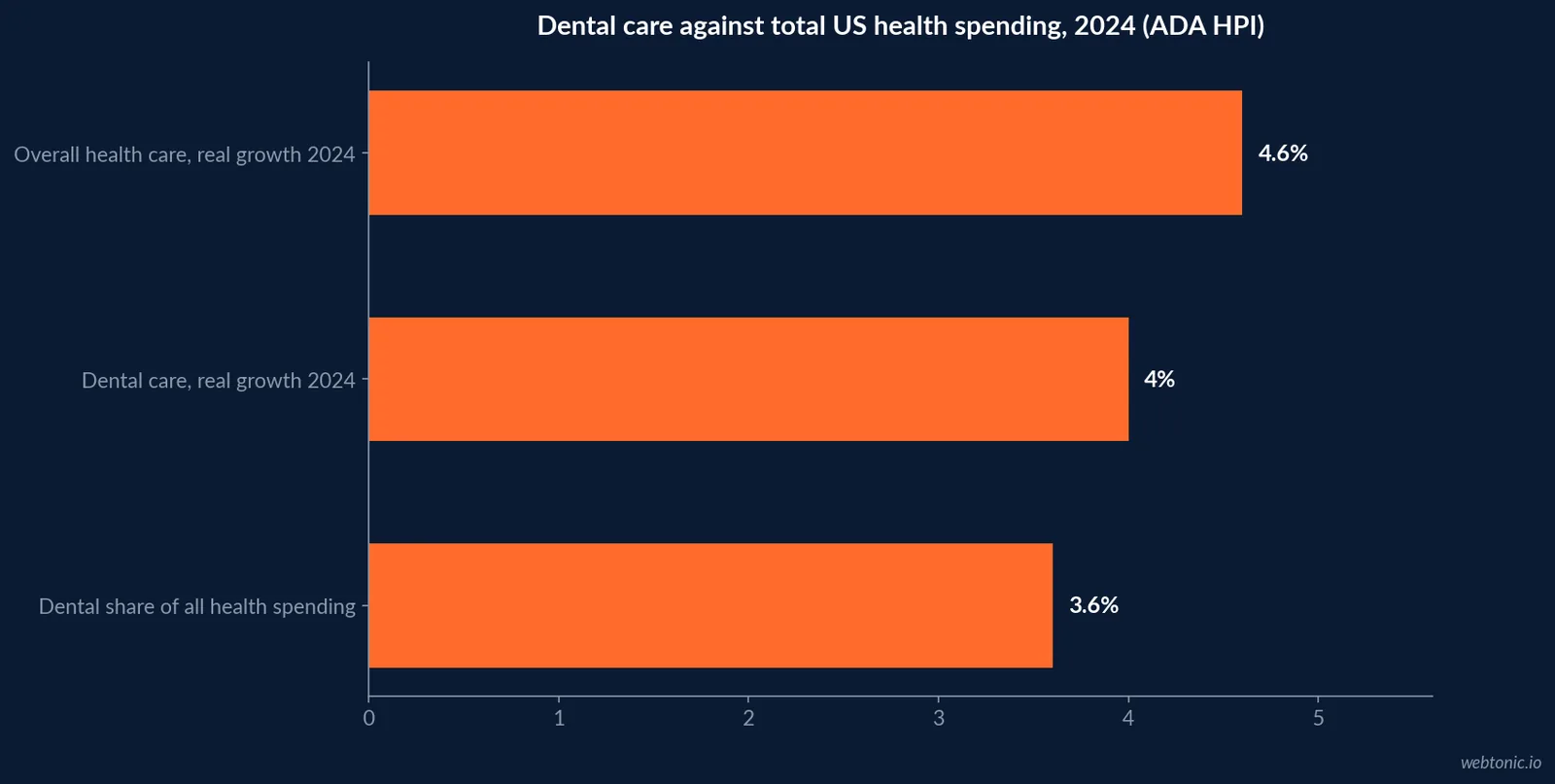
- Dental spending grew USD 7 billion, or 4%, after inflation in 2024.
- Dental care was 3.6% of total US health expenditure, unchanged from 2023.
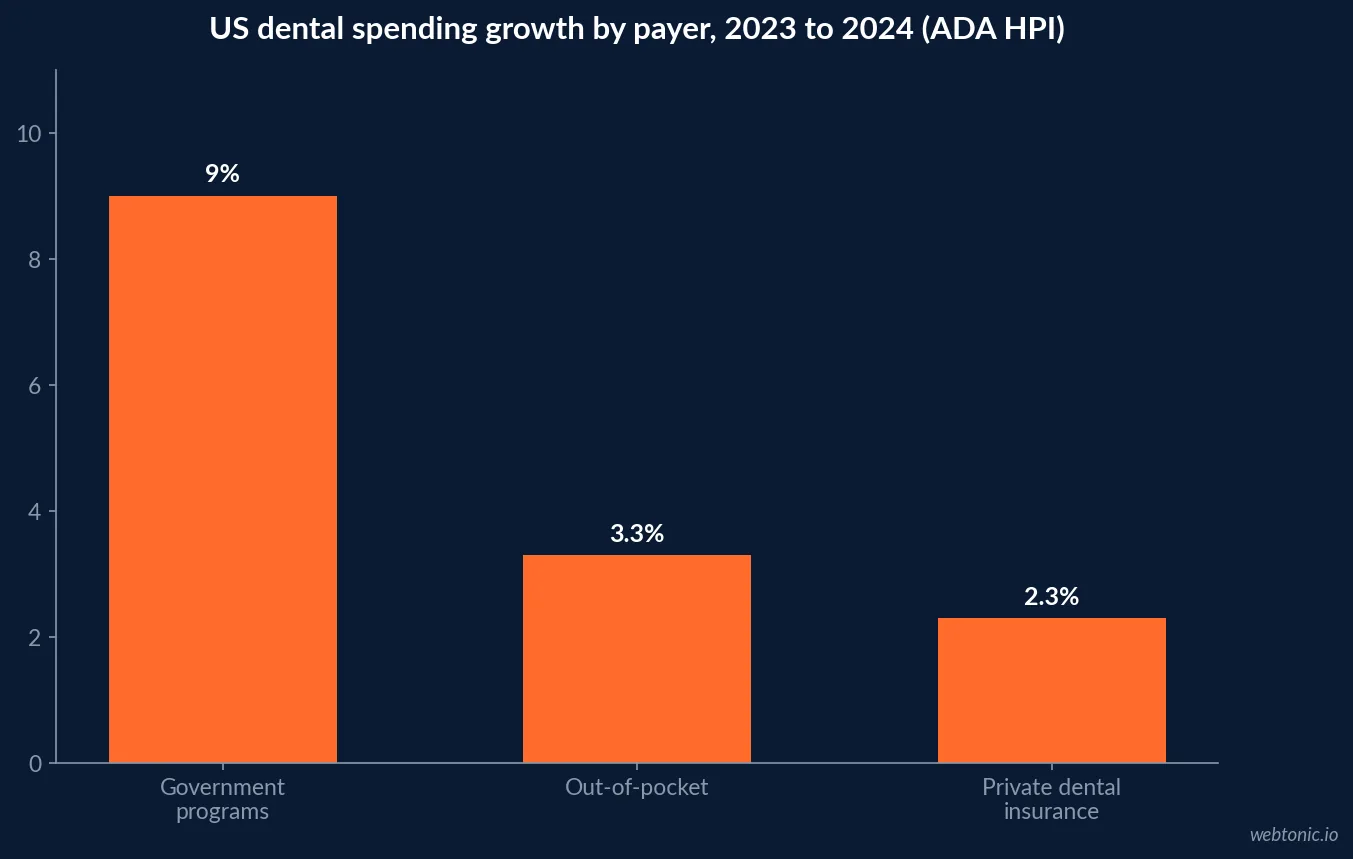
- Out-of-pocket dental spending rose 3.3%; private insurance 2.3%; government programs 9%.
- UK listings bar whitening products above 6% hydrogen peroxide (Google Merchant Center).
- Google warns at least 7 days before suspending an account for unsupported content.
- 7% of Shopping feed items were rejected for data errors in a 15,000-store study (2022).
- US e-commerce hit USD 340.2 billion in Q2 2026, 17.1% of retail (Census).
- Google Shopping investment grew 18% year over year in Q2 2026 (Tinuiti via SEJ).
Why dental treatment is off the table
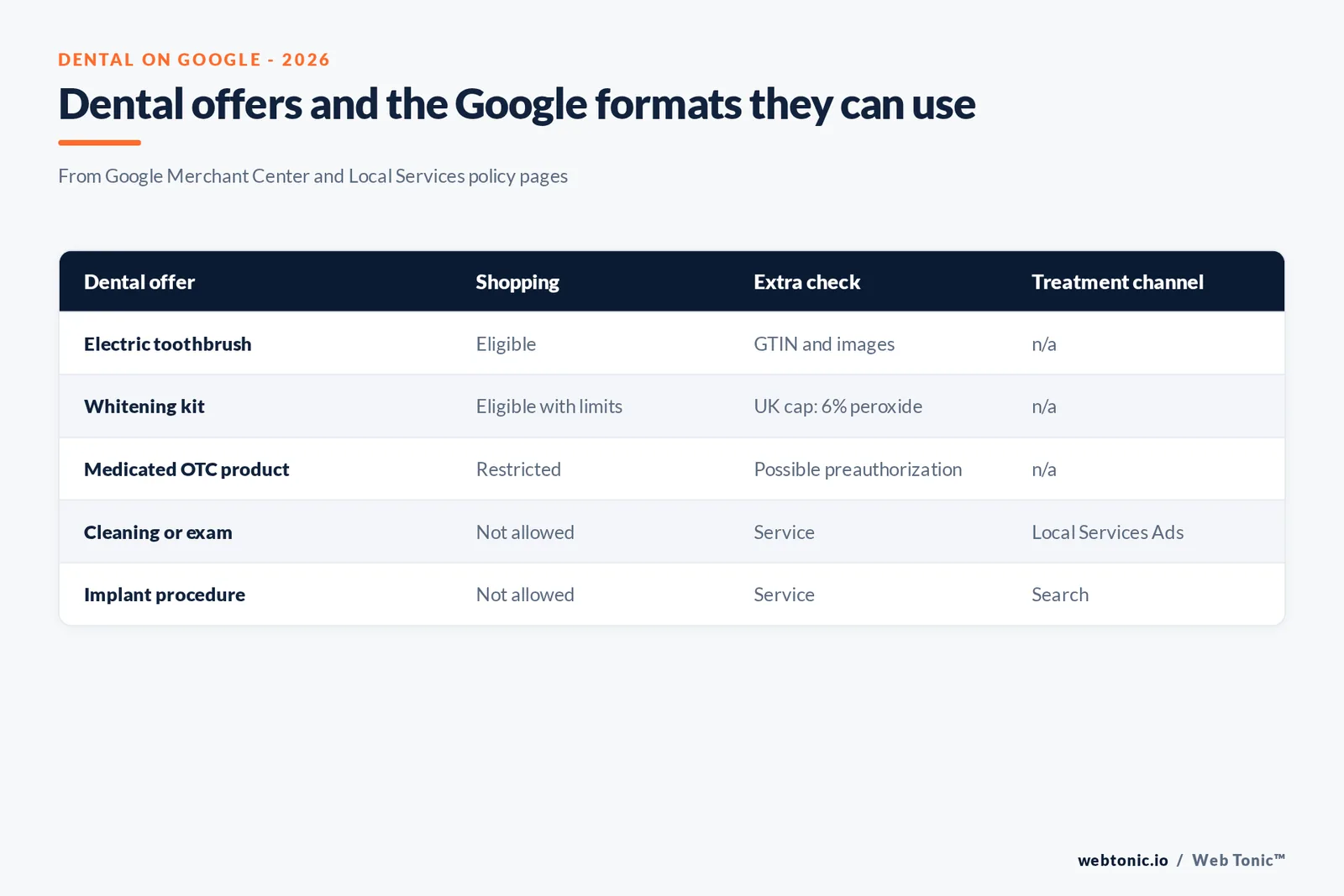
Google's Unsupported Shopping content policy excludes "labor, time, effort, expertise, or actions, which do not result in ownership of a tangible product", including "any services sold bundled with physical goods." The only medical carve-outs on that page concern prescription drugs from certified US online pharmacies and at-home lab test kits, neither of which covers dental procedures. An exam, a crown, an implant or chair-side whitening cannot be listed, and bundling a take-home kit with an in-office session does not change that.
| Dental offer | Listable? | Reason | Channel that fits |
|---|---|---|---|
| Take-home whitening kit sold online | Yes, subject to healthcare rules | Tangible product | Shopping ads, free listings |
| Electric toothbrush or water flosser | Yes | Tangible product | Shopping ads |
| Aligner retainers and cases | Yes, if sold as products | Tangible product | Shopping ads |
| In-office whitening session | No | Service | Search, Local Services Ads |
| Implant or crown procedure | No | Service | Search, Local Services Ads |
The second layer: Google's healthcare rules
Retail dental products still pass through Google's Shopping ads policies on healthcare and medicines. Google says it restricts over-the-counter medication, prescription drugs, unapproved pharmaceuticals and supplements, and that "depending on the content you're listing and the countries where your listings appear, you may need to apply for preauthorization with Google." The detailed healthcare and medicines page includes a dental-specific line: in the United Kingdom, Google does not allow teeth whitening products that contain more than 6% hydrogen peroxide or chemicals that emit it.
Practical reading: a toothbrush is simple; a whitening gel needs its concentration checked against each target country; a fluoride product sold as a medicine may need the healthcare path.
| Product type | Google policy layer | Key check | Risk level |
|---|---|---|---|
| Manual and electric toothbrushes | Standard Shopping policies | Accurate title, GTIN, images | Low |
| Whitening strips and gels | Healthcare and medicines | Peroxide concentration by country (UK cap 6%) | Medium |
| Medicated rinses or OTC products | Healthcare and medicines | Possible preauthorization | Medium to high |
| Prescription-strength fluoride | Prescription drug rules | Usually not listable for a practice | High |
| Treatment packages | Unsupported content: services | Not listable | Not eligible |
How big the dental market is, and how little of it is retail
The ADA Health Policy Institute reports national dental expenditure of USD 189 billion in 2024, an inflation-adjusted increase of USD 7 billion or 4%, against 4.6% growth for overall health care. Dental held at 3.6% of total health expenditure. Private dental insurance spending rose 2.3%, out-of-pocket spending 3.3%, and government programs 9%, largely due to Medicare.
That spending is for care delivered by dental offices, which is the part Shopping cannot touch. The retail oral-care shelf is a separate market, dominated by consumer-goods brands and retailers rather than practices.
| ADA HPI metric (2024) | Value | What it means for Shopping |
|---|---|---|
| National dental expenditure | USD 189 billion | Mostly treatment, not listable |
| Real growth vs 2023 | USD 7 billion, +4% | Demand for care keeps rising |
| Share of total health spending | 3.6% | Stable slice of health care |
| Out-of-pocket spending growth | +3.3% | Patients paying more directly |
| Government program spending growth | +9% | Driven largely by Medicare |
Retail product clicks: what makes an oral-care listing show
For brands and retailers selling oral-care products, Google's product data optimisation tips say that providing a GTIN helps Google understand exactly what is listed, so ads and free listings "can appear in more places on Google". The GTIN is assigned by the brand owner through GS1, which is why practices reselling a manufacturer's whitening kit should use the manufacturer's barcode rather than invent a SKU. Google also advises putting key details at the front of the title because titles are truncated in most ad formats: strength, count and flavour matter more than the practice name.
The cross-industry error rate is a warning. The DataFeedWatch Feed Marketing Report 2022 found 7% of Google Shopping feed items rejected for data errors across more than 15,000 stores, and 16.66% of advertised products out of stock.
Compliance beyond Google: endorsements and patient data
Two US rules follow dental product marketing into Shopping. The FTC's Guides on endorsements, 16 CFR Part 255 say advertisers may be liable for a deceptive endorsement even when the endorser is not, and require disclosure of unexpected material connections (section 255.5). A "dentist recommended" claim on a product a practice profits from needs that connection made clear. Separately, HIPAA's Privacy Rule at 45 CFR Part 164 says a covered entity "must obtain an authorization for any use or disclosure of protected health information for marketing", with narrow exceptions. Uploading patient lists to build Shopping or remarketing audiences is where practices run into it. Neither rule is Shopping-specific, but both apply the moment a practice markets its own products to its own patients.
| Rule | Citation | What it requires | Shopping scenario |
|---|---|---|---|
| Endorsement liability | 16 CFR 255 | Advertiser liable for deceptive endorsements | Dentist-recommended product claims |
| Material connections | 16 CFR 255.5 | Disclose unexpected connections | Practice sells a product it endorses |
| Marketing authorization | 45 CFR 164.508 | Patient authorization for PHI in marketing | Patient lists as ad audiences |
| UK whitening cap | Google healthcare policy | No products above 6% hydrogen peroxide | UK-targeted whitening listings |
| Unsupported services | Google Merchant Center | No services or service bundles | Treatment packages |
Building the oral-care feed field by field
Oral-care catalogs are small but detail-heavy: the same whitening system comes in several strengths, tray counts and flavours, and brushes come with different head types and replacement packs. Google's product data specification treats each purchasable variant as its own item, which means each needs its own ID, price, availability and, where the manufacturer assigned one, its own GTIN. Practices that resell a brand's products often skip that step and list one "whitening kit" with a price range, which is exactly the kind of listing that fails to match a specific search.
Images carry a policy risk as well as a performance one. Before-and-after photos are a staple of dental marketing, but a product image should show the product; treatment results belong on a landing page where claims can be qualified and, if a dentist endorses the product, the material connection disclosed.
| Feed field | Oral-care example | Common practice mistake | Better value |
|---|---|---|---|
| id / variant | Kit, 10% gel, 14 trays | One item for all strengths | One item per strength and count |
| title | Brand + product + strength + count | Practice name first | Strength and count at the start |
| gtin | Manufacturer barcode | Internal SKU used instead | The brand owner's GS1 number |
| image_link | Product on plain background | Before-and-after smile photo | Packshot of the product |
| availability | In stock at checkout | Listed while only sold in chair | Only items buyers can check out |
Should a practice sell products online at all?
For most practices, the honest answer is that Shopping is a side channel. The ADA data puts the money in treatment, the policy keeps treatment out of Shopping, and the retail shelf is crowded with national brands whose catalogs, prices and review counts a single practice cannot match. The cases where it makes sense are narrower: a group practice with its own branded whitening or aligner-care line, a practice already shipping replacement trays and retainers to patients, or a dental retailer rather than a clinic. In those cases the decision rests on margin per product and on whether the team can keep the feed accurate, since the 2022 feed study found 16.66% of advertised catalog products out of stock at the time it was measured. If neither condition holds, the budget belongs in Local Services Ads and Search, where the practice sells what it actually does.
Online retail and the 2026 Shopping auction
The Census Bureau put US retail e-commerce at USD 340.2 billion in Q2 2026, up 12.2% year over year and 17.1% of retail sales. In paid search, Search Engine Journal reports Tinuiti's Q2 2026 data showing Google Shopping investment up 18% and search CPCs up about 1%, after Google search clicks rose 13% in Q4 2025 and 14% in Q1 2026. Tinuiti also reports Amazon at 0% US Shopping impression share against the median retailer. These figures cover Tinuiti's retail clients; no public study reports a dental Shopping CTR or ROAS.
Where dental practices should advertise treatment
Dentist is a US category in Google's Local Services Ads, where practices pay per lead; note that Google says booking leads are not available for health care verticals. Search covers the rest. See our dental Google Ads statistics and the Google Ads pricing guide.
A launch list for a dental product feed
- Separate products from treatment; only tangible items enter the feed.
- Check each whitening product's peroxide level by country; the UK cap is 6%.
- Confirm whether any item needs healthcare preauthorization before launch.
- Use manufacturer GTINs and lead titles with strength and count.
- Disclose material connections in endorsement claims under 16 CFR 255.5.
- Keep patient data out of audiences without HIPAA marketing authorization.
Other dental marketing data
For patient-acquisition channels, see our dental CTV statistics and dental influencer and UGC statistics.
Frequently Asked Questions
Can a dental practice advertise cleanings or implants on Google Shopping?
No. Google's Unsupported Shopping content policy disallows labor, time, effort, expertise or actions that do not result in ownership of a tangible product. A cleaning, an implant procedure or an in-office whitening session is a service. Practices use Local Services Ads, where Dentist is a listed US category, and Search.
Can a dental practice sell whitening kits or electric toothbrushes through Shopping?
Yes, if it sells them as products with a price and an online checkout (or in-store purchase for local listings), and the items meet Google's healthcare and medicines rules for the target country. In the UK, for example, Google does not allow teeth whitening products containing more than 6% hydrogen peroxide.
Do dental products need Google preauthorization?
Some healthcare content does. Google says that depending on the content and the countries targeted, merchants may need to apply for preauthorization before advertising healthcare-related content, and it restricts over-the-counter medication and prescription drugs. Everyday oral-care items are generally not in those restricted groups, but check each product.
How large is the US dental market?
The ADA Health Policy Institute reports national dental expenditure of USD 189 billion in 2024, up USD 7 billion or 4% after inflation, and 3.6% of total health spending. Most of that is treatment, which Shopping cannot sell.
Is there a benchmark CTR or ROAS for dental Shopping ads?
No public source reports one. Cross-retail data from Tinuiti's Q2 2026 benchmark, as reported by Search Engine Journal, shows Google Shopping investment up 18% year over year, but that is not a dental figure.
Sources
Google Merchant Center - Unsupported Shopping content
Google - Shopping ads policies
Google - Healthcare and medicines
ADA HPI - National dental expenditures 2024
eCFR - 16 CFR Part 255
eCFR - 45 CFR Part 164
DataFeedWatch - Feed Marketing Report 2022
US Census - Quarterly e-commerce Q2 2026
Tinuiti - Digital Ads Benchmark Q2 2026
Search Engine Journal - Q2 2026 paid search
GS1 US - What is a GTIN