Table of contents

Dental connected TV budgets start at a published USD 500 floor, and the cross-industry money is moving toward streaming, but no dataset tracks dental CTV spend or results. This page separates what the platforms publish, where the broader budget is heading and what ADA data says about the patients a practice is trying to reach.
Key Takeaways
- Roku requires a USD 500 minimum lifetime budget per campaign.
- MNTN advertises small-business entry from USD 2,000; Amazon recommends USD 10K self-service.
- Amazon managed streaming TV has a USD 50K campaign minimum.
- 85% of small spenders invested in CTV in 2026, up from 60% in 2024 (IAB).
- CTV ad spend is projected to grow 11% in 2026.
- The average streaming 30-second CPM fell 16.7% in 2024 (Tatari).
- US dental care spending reached USD 189 billion in 2024 (ADA).
- 46% of Americans visited a dentist in 2023.
Dental CTV budget figures at a glance
The table sorts every budget figure on this page by type. Platform floors come from the platforms' own pages; spend direction comes from the IAB; nothing here is a dental-specific rate or a quote.
| Budget figure | Value | Type | Issuer |
|---|---|---|---|
| Roku Ads Manager lifetime minimum | USD 500 | Platform floor | Roku |
| MNTN small-business entry | USD 2,000 | Vendor claim | MNTN |
| Amazon self-service streaming TV | USD 10K recommended | Platform guidance | Amazon Ads |
| Amazon managed streaming TV | USD 50K minimum | Platform floor | Amazon Ads |
| CTV ad spend growth, 2026 | 11% | Cross-industry projection | IAB |
| Small spenders investing in CTV | 85% (60% in 2024) | Cross-industry survey | IAB |
The published floors, platform by platform
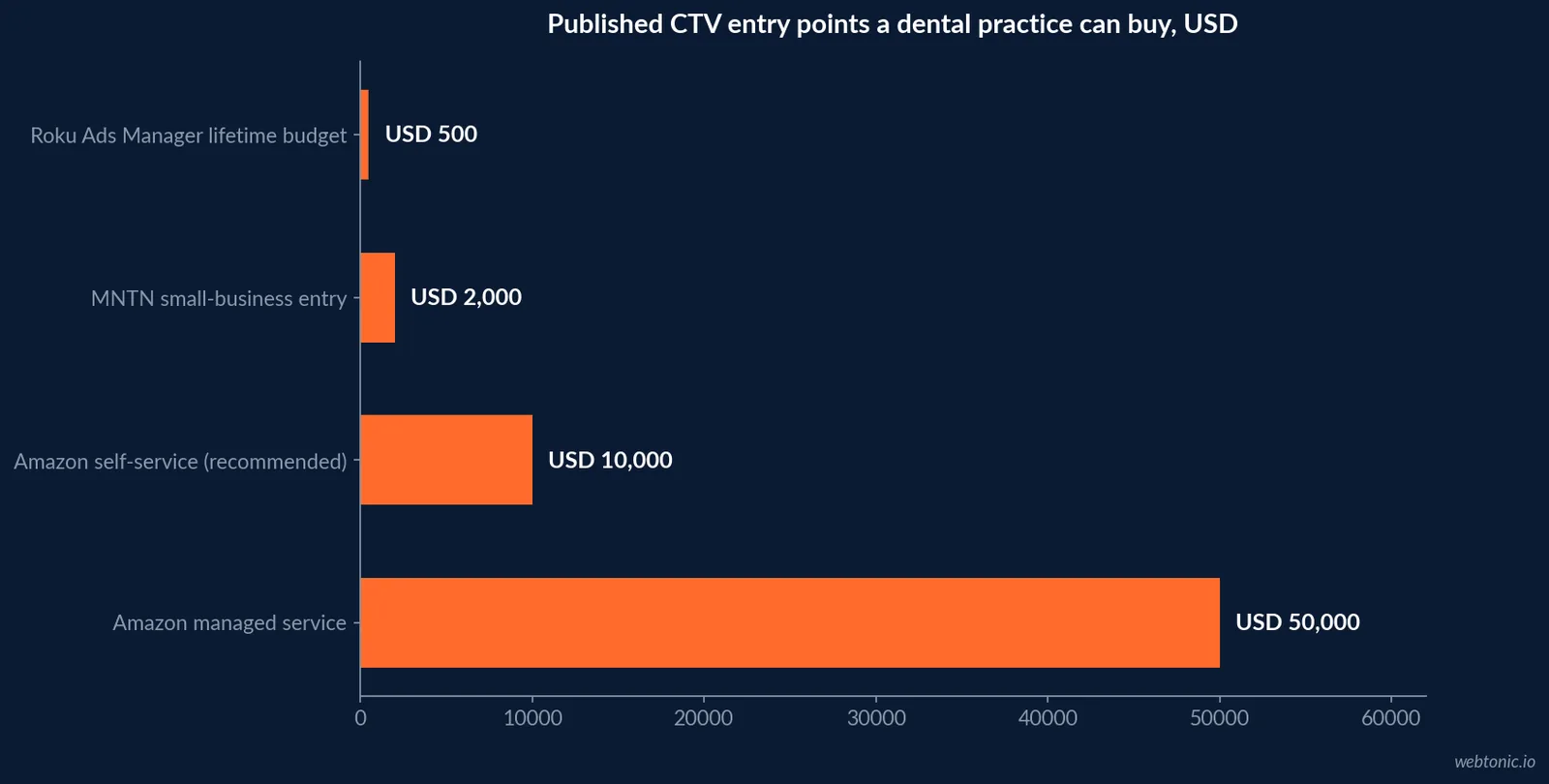
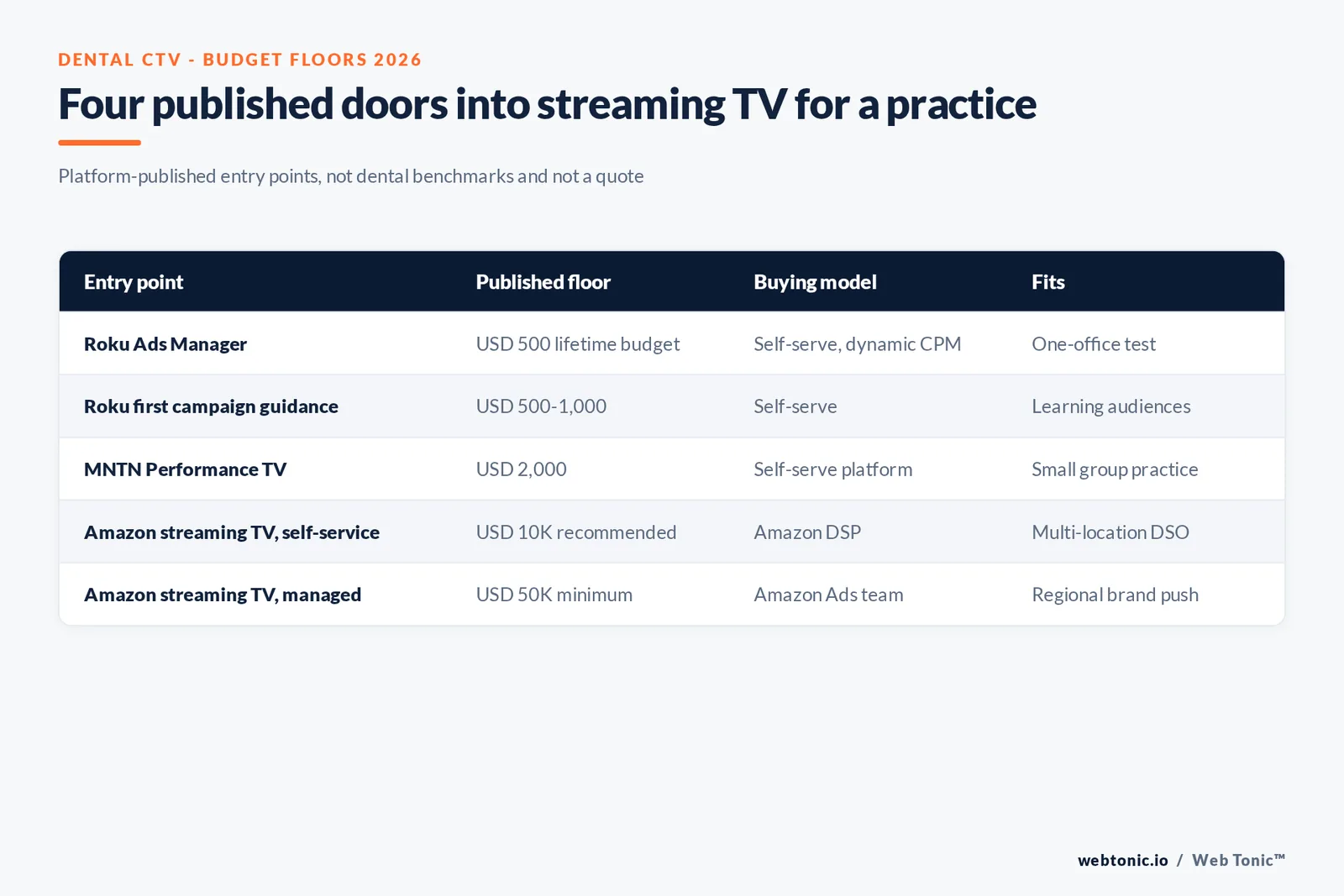
Roku's Ads Manager help centre says lifetime budgets are required on all campaigns and must be USD 500 or more, billed only on delivery. Its cost guide adds that USD 500 to 1,000 is enough for most first-time advertisers and that pricing is a dynamic CPM with an optional maximum bid. MNTN, a vendor, markets entry from USD 2,000. Amazon Ads gives a USD 10K recommended minimum for self-service packages and a USD 50K minimum for managed service.
The range spans two orders of magnitude, which maps neatly onto practice size: a single office can test at the bottom, while a dental service organisation's regional push sits at the Amazon managed tier.
Where CTV budgets are heading overall
The IAB's May 2026 release projects US digital video ad spend above USD 80 billion in 2026, up 11%, with CTV growing 11% and social video 13%. Its full 2026 report puts digital video at an estimated 61% of TV/video spend in 2026 and finds the share of small spenders investing in CTV up from 60% in 2024 to 85%, crediting self-serve platforms.
That is the strongest published signal of direction for a small advertiser such as a practice. It is a cross-industry survey; dental is not broken out.
Which budgets CTV is replacing
The same IAB report asked buyers raising CTV spend where the money would come from (base 149): 54% said linear TV, 40% print and radio, 38% incremental budget and 21% paid search. For a practice, that frames CTV as a replacement for local broadcast, radio or mailers more often than as an addition to search, but the survey describes national buyers.
| Funding source for more CTV (IAB 2026) | Share of buyers | Dental equivalent to review |
|---|---|---|
| Linear TV | 54% | Local broadcast or cable spots |
| Print and radio | 40% | Mailers, local radio, community print |
| Incremental budget | 38% | New marketing money |
| Digital audio and podcasts | 23% | Streaming audio spots |
| Paid search | 21% | Search ads for high-intent patients |
What the budget buys: CPM direction
Tatari, a TV buying vendor, reports in its 2025 planning guide that the average streaming CPM for a 30-second spot fell 16.7% in 2024. Its 2019-2023 client analysis put streaming CPMs around USD 9.50 against USD 2.50 for linear, with its direct deals often 66% below programmatic prices. None of these is a dental CPM; they indicate that a fixed practice budget buys somewhat more streaming reach than it did two years ago.
How far each floor budget stretches
A floor is only meaningful once it is turned into impressions. No dental CPM is published, so the table below uses one clearly labelled reference, Tatari's USD 9.50 streaming CPM from its 2019-2023 client data, and simply divides. Treat the output as illustrative arithmetic, not a forecast: real delivered CPMs vary with the platform, the size of the service area, the household segment chosen and how many other local advertisers are bidding.
The useful read-out is scale. At the Roku floor a practice buys tens of thousands of impressions, enough to test a creative and a geography but not enough to cover a metro with repeated exposure. At the Amazon managed tier the same arithmetic runs into the millions, which is a regional brand campaign rather than a test.
| Published budget | Impressions at a USD 9.50 reference CPM | What that scale suits |
|---|---|---|
| USD 500 (Roku floor) | About 52,600 | One office, one creative, one area |
| USD 1,000 (top of Roku first-test range) | About 105,300 | Two creatives or two areas |
| USD 2,000 (MNTN entry) | About 210,500 | Small group practice test |
| USD 10,000 (Amazon self-service) | About 1,052,600 | Multi-location service organisation |
| USD 50,000 (Amazon managed) | About 5,263,200 | Regional brand campaign |
The patient demand a practice budget is chasing
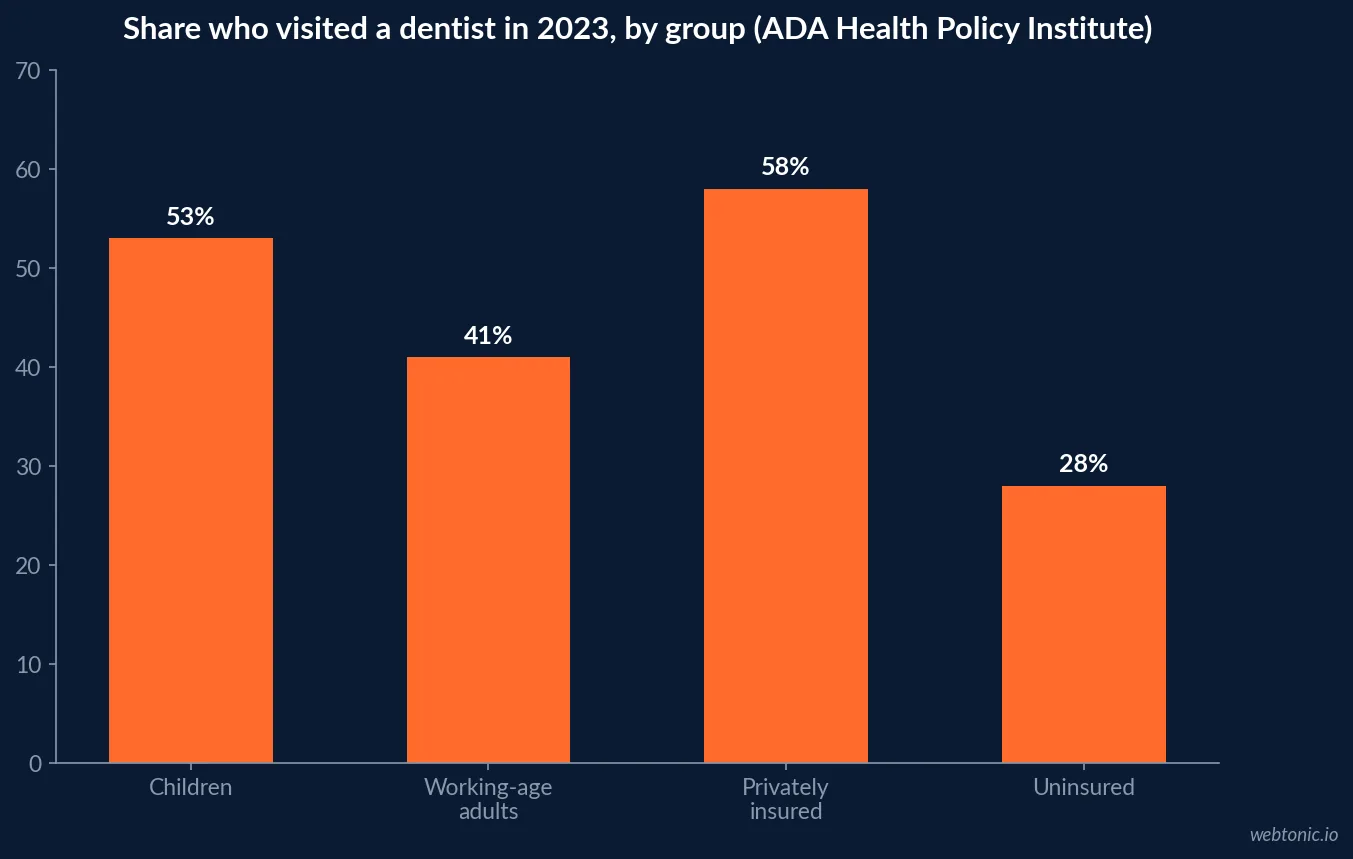
The ADA Health Policy Institute's dental care market data put national dental expenditures at USD 189 billion in 2024, up 3.6% in real terms, with consumer dental spending up 4% in January 2026 year on year and out-of-pocket payments the largest source. Its 2026 trends report finds 46% of the population visited a dentist in 2023, up from 45%.
The gaps are where a broad-reach channel could matter: only 41% of working-age adults and 28% of the uninsured visited, against 58% of the privately insured.
| ADA dental demand indicator | Figure | Year |
|---|---|---|
| National dental expenditures | USD 189 billion (up 3.6%) | 2024 |
| Consumer dental spending change | Up 4% year on year | January 2026 |
| Population with a dental visit | 46% | 2023 |
| Working-age adults with a visit | 41% | 2023 |
| Privately insured vs uninsured visit rate | 58% vs 28% | 2023 |
| Professionally active dentists | 205,088 (60.0 per 100,000) | 2025 |
Competition: how many practices share the market
The ADA's workforce data counts 205,088 professionally active dentists in 2025, or 60.0 per 100,000 people, with ratios varying by state. In a dense metro, several practices may be bidding for the same household segments on the same platforms, which pushes delivered CPMs above the floor. A practice's real budget question is therefore local: how many competitors are already on streaming in its ZIP codes.
Compliance costs that sit inside the budget
Two federal rules shape dental TV creative and targeting. The FTC's Health Products Compliance Guidance requires health-benefit claims to rest on competent and reliable scientific evidence, and the Endorsement Guides, 16 CFR Part 255, require disclosure of material connections with endorsers, including paid patient testimonials. On targeting, 45 CFR 164.508 requires an authorization for any use or disclosure of protected health information for marketing, with narrow exceptions.
In budget terms, that means legal review of scripts and of any audience built from patient records is a line item, not an afterthought.
| Rule | What it requires | Where it lands in the budget |
|---|---|---|
| FTC Health Products Compliance Guidance | Competent and reliable scientific evidence for health claims | Script review before production |
| FTC Endorsement Guides, 16 CFR 255 | Disclosure of material connections with endorsers | On-screen disclosure in testimonial spots |
| HIPAA, 45 CFR 164.508 | Authorization before using patient information for marketing | Counsel review of any patient-list audience |
| Platform ad policies | Each platform's own health-ad rules | Approval time before launch |
What no dataset shows for dentistry
It is worth being plain about the limits. No public source reports how many dental practices advertise on connected TV, what they spend, what CPM they pay, what completion rate their spots achieve or what a new patient acquired through streaming TV costs. Any page quoting a dental CTV cost per patient without naming a dataset, its sample and its year is presenting an estimate as a benchmark.
What can be said with evidence is narrower and still useful. The entry floors are public and low, the cross-industry budget trend points toward streaming, streaming CPMs eased in 2024 in one vendor's data, and the patient base has clear gaps among working-age and uninsured adults. The rest has to come from a practice's own test, which is why the measurement plan matters more than the size of the first budget.
Sizing the first dental flight
With streaming at 49.0% of US TV time in July 2026 according to Nielsen's Gauge, the audience is there; the unknown is whether it books appointments. A sensible first flight uses a platform floor, a defined service area and a measurement plan that compares new-patient calls and bookings from exposed ZIP codes against a matched holdout.
- Start at the published floor: USD 500 on Roku Ads Manager.
- Scale only on measured bookings, not completion rate.
- Target by geography and non-health household data, not patient lists without HIPAA review.
- Record delivered CPM and reach so the next budget is set on your own numbers.
- Clear every claim and testimonial against FTC rules first.
Our data intelligence team designs the holdout, and our performance creative team builds compliant spots. For context see the connected TV advertising statistics hub and our dental SMS marketing statistics for appointment follow-up.
Frequently Asked Questions
What is the smallest budget a dental practice can run CTV on?
The lowest published floor on the platforms reviewed here is Roku Ads Manager, which requires a lifetime budget of USD 500 or more per campaign; Roku says USD 500 to 1,000 is enough for most first-time advertisers. MNTN advertises entry from USD 2,000, and Amazon recommends USD 10,000 for self-service streaming TV. These are platform floors, not dental benchmarks.
Are dental CTV budgets growing?
No source tracks dental CTV spend. The cross-industry direction is up: the IAB projects CTV ad spend growth of 11% in 2026 and reports that the share of small spenders investing in CTV rose from 60% in 2024 to 85% in 2026. Whether dental practices follow that trend is not measured.
Where do advertisers find the money for CTV?
In the IAB's 2026 survey of buyers increasing CTV spend (n=149), 54% said they would take it from linear TV, 40% from print and radio and 38% from incremental budget. Dental practices that already run local TV or print face the same choice.
Can a dental office use patient data to target TV ads?
Only with care. Under HIPAA, 45 CFR 164.508 requires a covered entity to obtain an authorization for any use or disclosure of protected health information for marketing, with narrow exceptions. Uploading patient lists to an ad platform for targeting should be reviewed by counsel before it is done.
What claims can a dental TV ad make?
The FTC's Health Products Compliance Guidance says health-benefit claims need competent and reliable scientific evidence, and the Endorsement Guides (16 CFR Part 255) require disclosure of material connections with anyone endorsing the practice, including paid patients or influencers.
Sources
Roku Ads Manager - campaign budget and schedule
Roku - How much does it cost to advertise on Roku
Amazon Ads - Streaming TV ads
MNTN - Go Big small-business program
IAB - US digital video ad spend to surpass USD 80B in 2026
IAB - 2026 Digital Video Ad Spend and Strategy full report
Tatari - How to budget and plan for TV in 2025
Tatari - What is driving down linear CPMs
ADA Health Policy Institute - The dental care market
ADA HPI - National trends in dental care use, 2026
ADA HPI - Dentist workforce
FTC - Health Products Compliance Guidance
eCFR - 16 CFR Part 255, Endorsement Guides
eCFR - 45 CFR 164.508, HIPAA authorizations
Nielsen - The Gauge, July 2026