Table of contents
The honest 2026 answer to "what should we budget for data-driven marketing" is a set of line items, not one number. Gartner's 2026 CMO Spend Survey and The CMO Survey's 2026 Highlights Report give real percentages for martech, labor, training and AI maturity - and they do not agree with the usual "spend more on data" advice.
Key Takeaways
- Martech now averages 19.4% of marketing budget, down from 26.6% in 2021.
- 62% of CMOs still planned to invest more in martech despite the falling share.
- Marketing labor's share rose to 24.5% of budget, up from 21.9% a year earlier.
- 56% of CMOs increased consumption-based martech spend; only 9% cut it.
- Only 9% of CMOs call their AI/data processes fully optimised.
- Lack of internal talent is the #1 barrier for 19% of CMOs, top-three for 38%.
- Lack of integrated marketing data ranks second, #1 for 13%, top-three for 30%.
- Marketing budgets sit at 9.0% of company revenue in 2026, per The CMO Survey.
- That is 9.6% of total company budgets, the same report finds.
- Overall marketing spend grew just 1.7%, the smallest rise since 2021.
- Training now takes 3.8% of marketing spend, down from a 5.8% pre-pandemic peak.
- Marketing headcount growth slowed more than 50% year over year.
- No marketing-technology activity scores above 5 of 7 on self-rated performance.
- Digital marketing activities are outsourced roughly one-third of the time on average.
- 84% of marketers still run generic campaigns despite 75% AI adoption.
- 78% say they need more personalization than they can produce.
- High performers are 1.7x more likely to use customer data for relevant experiences.
- AI use in marketing has more than tripled since 2022.
Start from the shrinking martech line, not the AI headline
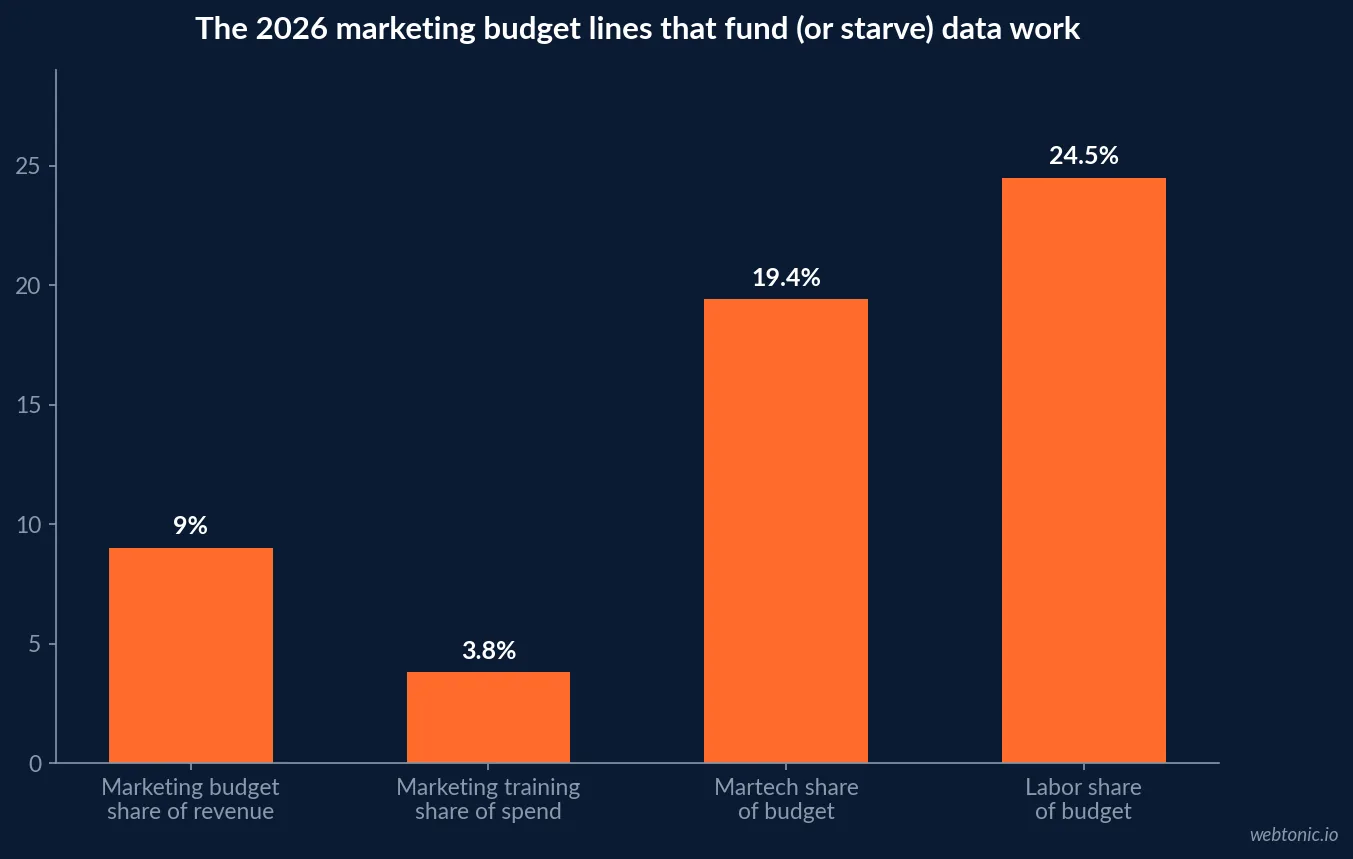
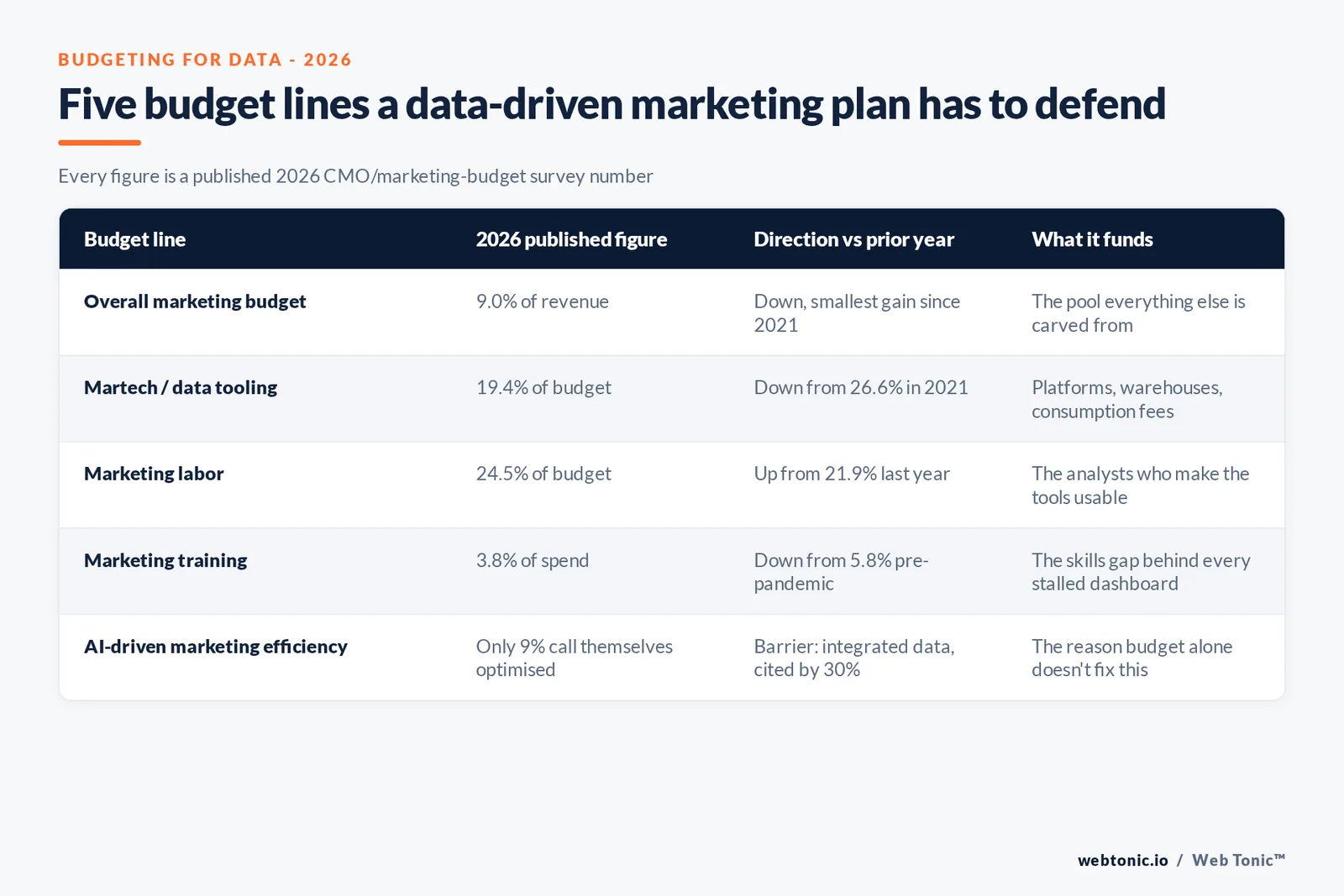
The number that should anchor a 2026 data-driven marketing budget is not an AI adoption rate. It is Gartner's finding, reported through Chief Marketer's coverage of the 2026 Gartner CMO Spend Survey of 401 CMOs, that the mean share of marketing budget allocated to martech has hit a five-year low of 19.4%, down from 26.6% in 2021. That is a real cut to the tooling line, even as 62% of the same CMOs planned to invest more in martech.
The two facts are not a contradiction once you see where the money went instead.
| Budget line (2026) | Published figure | Direction vs prior period | Source |
|---|---|---|---|
| Martech share of marketing budget | 19.4% | Down from 26.6% in 2021 | Gartner CMO Spend Survey |
| Marketing labor share of budget | 24.5% | Up from 21.9% last year | Gartner CMO Spend Survey |
| Overall marketing budget | 9.0% of revenue | Lowest in several years | The CMO Survey 2026 |
| Marketing budget vs company budget | 9.6% of total budget | Down slightly | The CMO Survey 2026 |
| Marketing spend growth, year over year | 1.7% | Smallest since 2021 | The CMO Survey 2026 |
Where the martech cut actually went
Gartner's survey points to a pricing shift, not a spending freeze. 56% of CMOs increased how much of their martech budget runs on consumption-based (usage-priced) models, against just 9% who decreased that allocation. Usage pricing looks cheaper on the line item that says "martech," but it moves the real cost into overage fees and into the labor needed to manage it: 41% of organizations have already built real-time usage controls or are building them, and 24% are overhauling systems specifically to cap usage.
Budget the oversight, not just the subscription. A consumption model without a named owner watching the meter is not a savings plan.
| Consumption-pricing signal (2026) | Share of organizations | What it implies for budgeting |
|---|---|---|
| Increased consumption-based martech allocation | 56% | License-line savings are often illusory |
| Decreased consumption-based allocation | 9% | Most orgs are moving the other way |
| Built or building real-time usage controls | 41% | Oversight is now a budget line of its own |
| Overhauling systems to reduce usage | 24% | Rework cost sits beside the subscription cost |
The maturity gap that a bigger budget alone will not close
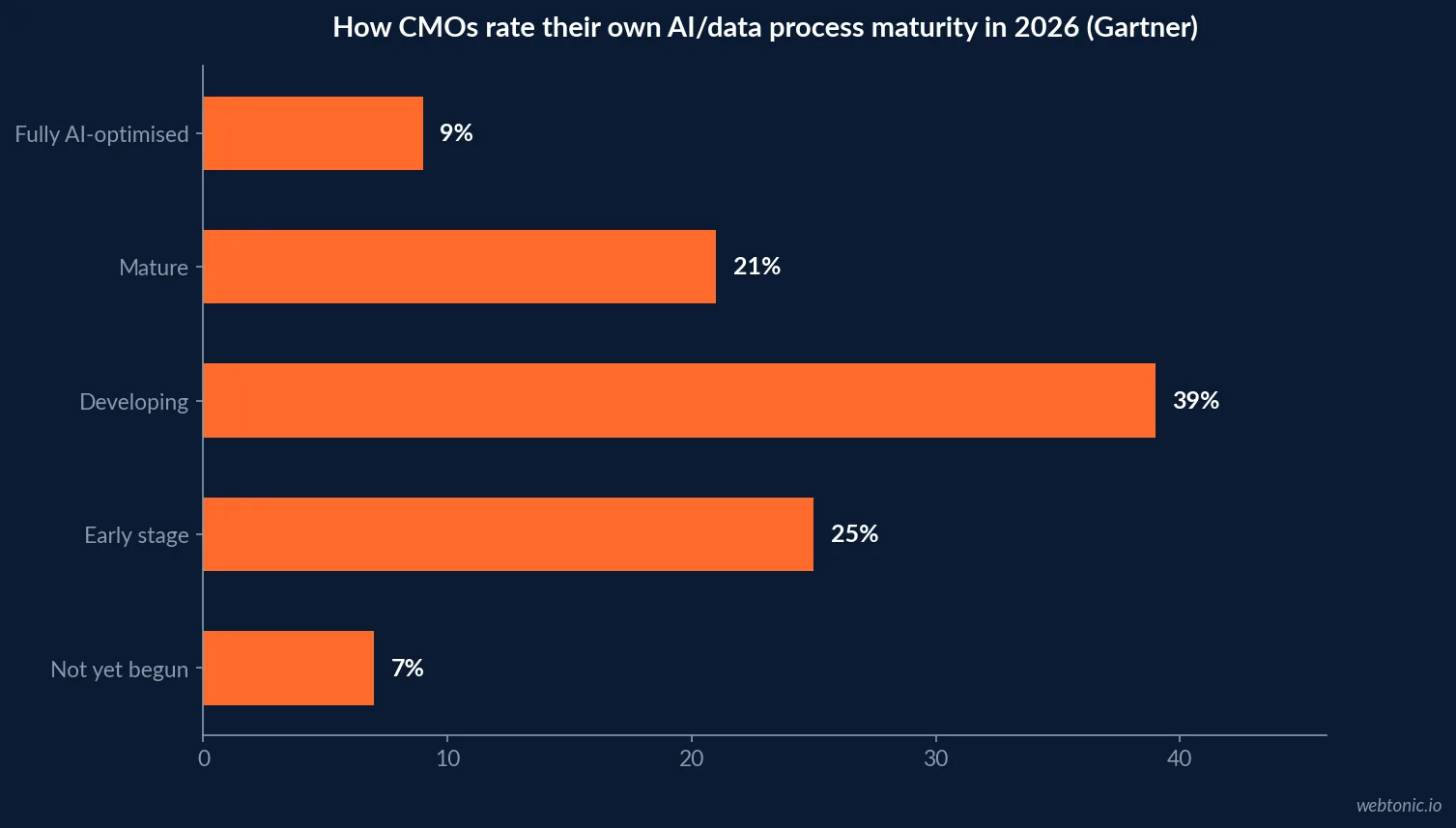
Money is not the blocker most CMOs name. Asked to rate their organization's internal readiness to implement and scale AI for marketing productivity, only 9% called themselves fully optimised (Gartner's "AI strategists"), another 21% called themselves mature, 39% said developing, 25% early stage, and 7% had not yet begun. That leaves roughly two-thirds of marketing organizations below "mature" no matter what they spend this year.
The stated barriers back this up directly: a lack of internal talent was the number-one obstacle for 19% of CMOs and a top-three obstacle for 38%. A lack of integrated marketing data came second - number one for 13%, top-three for 30%. Neither is fixed by a bigger software line.
| AI/data maturity stage (2026, Gartner) | Share of CMOs | Practical read |
|---|---|---|
| Fully optimised ('AI strategists') | 9% | The bar almost no one has cleared |
| Mature | 21% | Close, but still short of scaled ROI |
| Developing | 39% | The largest single group - process before tooling |
| Early stage | 25% | Budget should fund basics, not experiments |
| Not yet begun | 7% | A tooling purchase here is premature |
The line most budgets skip: training
The CMO Survey's 2026 Highlights and Insights Report, sponsored by Duke University's Fuqua School of Business, Deloitte and the American Marketing Association, puts marketing training at just 3.8% of marketing spend, down from a pre-pandemic high of 5.8%. That fall lands at the same time marketing headcount growth has declined more than 50% year over year - fewer new people, and less budget to bring the people already on the team up to speed on the tools finance did approve.
The Survey is blunt about the consequence: no marketing-technology activity, including "integrating marketing technologies into our customer funnel" and "generating ROI from marketing technologies," scores above 5 on a 7-point performance scale, anywhere in the dataset.
| Capability signal (2026, The CMO Survey) | Figure | What it means for the budget |
|---|---|---|
| Training share of marketing spend | 3.8% | Down from 5.8% pre-pandemic; add it back deliberately |
| Marketing headcount growth vs last year | Down 50%+ | Fewer people to absorb new tooling |
| Highest self-rated martech activity score | Below 5 of 7 | No martech program rates itself strong |
| CMO-CFO partnership rating on ROI cases | 4.5 of 7 | Barely moved in four years |
Why "buy vs build vs outsource" is itself a budget question
The CMO Survey also tracks how much of digital marketing activity companies hand to outside partners: 28-31% for B2B product and services firms, and closer to 44-48% for B2C product and services firms, figures that have stayed roughly stable since 2022. Outsourcing is not a data-budget line by itself, but it changes who owns the integration work Gartner's CMOs flagged as their number-two barrier - and it is worth pricing against the in-house headcount alternative before either gets approved. Our data and analytics practice is built around exactly that build-vs-buy calculation.
| Segment (2026, The CMO Survey) | Share of digital marketing outsourced | Trend since 2022 |
|---|---|---|
| B2B product firms | 28% | Roughly stable |
| B2B services firms | 25% | Roughly stable |
| B2C product firms | 48% | Slightly up |
| B2C services firms | 44% | Up from 34% in 2022 |
The personalization gap a data budget is actually meant to close
Salesforce's Tenth Edition State of Marketing report, based on nearly 4,500 marketers, is the clearest evidence that tooling spend and personalization outcomes have decoupled: 75% of marketers have adopted AI, yet 84% confess to running generic, one-way campaigns anyway. 78% say they need more personalized content than they can currently produce, and the report names siloed data, poor data quality and privacy regulations as the barriers - not budget size. High performers are 1.7x more likely to use customer data to build relevant experiences, which is the actual differentiator a data budget should be bought to close.
| Personalization signal (2026, Salesforce) | Figure | Budget implication |
|---|---|---|
| Marketers who have adopted AI | 75% | Adoption alone is not the constraint |
| Marketers still running generic campaigns | 84% | The execution gap is data, not AI access |
| Marketers needing more personalization than they can produce | 78% | Content ops, not more tools |
| High performers' relative use of customer data | 1.7x | Fund the data pipeline before the campaign |
A defensible budget shape for 2026
Put together, the published data argues for a specific shape rather than a single "data budget" percentage: hold martech spend near the current 19.4% benchmark rather than cutting it further, move the freed money that used to sit in per-seat licenses toward the 24.5% labor line that now runs those tools, restore training toward its pre-pandemic 5.8% share instead of the current 3.8%, and name an owner for integration and data quality before adding a new platform. None of that requires a bigger topline marketing budget - The CMO Survey's 9.0% of revenue figure is falling, not rising, and the money has to come from reallocation inside that shrinking pool.
If you want a second opinion on where your own split sits against these benchmarks, talk to us, or see how paid channels factor into the same budget conversation in our breakdown of what Google Ads actually costs in 2026.
What this means if you are building next year's plan now
Treat every number above as a floor to check your own budget against, not a target to hit exactly. A company well below 19% martech share and well below 24% labor share is likely under-resourced for the data work it claims to be doing; a company far above both without a maturity self-assessment is likely buying tools its team cannot yet use. The Forrester research on marketing measurement echoes the same point from the analytics side: technology adoption is consistently outpacing organizational readiness, which is a people and process problem dressed up as a budget problem.
Frequently Asked Questions
How much of the marketing budget should go to data and martech in 2026?
There is no single right number, but the 2026 Gartner CMO Spend Survey of 401 CMOs found the mean martech share of marketing budget has fallen to 19.4%, down from 26.6% in 2021, even though 62% of CMOs planned to invest more in the category. Read that as a floor, not a target: teams spending well below 19% of budget on data tooling are running on inherited licenses, not on a plan.
Why is the martech share of budget falling while spend on labor rises?
Gartner's data shows marketing labor's share of budget climbed from 21.9% to 24.5% in the same year martech fell. The likely explanation in the same survey is a shift toward consumption-based, usage-priced tools: 56% of CMOs increased their consumption-based martech allocation and only 9% decreased it, which lowers the license line while raising the people line needed to run and interpret what those tools produce.
What is the actual barrier to getting value from a data budget, if not money?
Talent and data integration, by a wide margin. Gartner's CMOs named a lack of internal talent as their top barrier to AI-driven marketing efficiency (19% ranked it first, 38% put it in their top three), and a lack of integrated marketing data came second (13% first, 30% top three). A bigger tooling budget without headcount or integration behind it does not close either gap.
How much should be set aside for training, not just tools?
The CMO Survey's 2026 benchmark shows training now sits at just 3.8% of marketing spend, down from a pre-pandemic high of 5.8%, even as marketing headcount growth has slowed more than 50% year over year. That combination - fewer new hires, less training per person - is a specific, budgetable gap most data-driven marketing plans never itemise.
Does more personalization spend automatically fix the data problem?
No. Salesforce's Tenth Edition State of Marketing (nearly 4,500 marketers) found 84% still run generic campaigns despite 75% having adopted AI, and 78% say they need more personalized content than they can currently produce. The blocker they cite is siloed data and poor data quality - a data-governance line item, not a media-spend line item.
Sources
Chief Marketer - Gartner 2026 CMO Spend Survey coverage
The CMO Survey - Highlights and Insights Report 2026
Deloitte - The CMO Survey program page
Salesforce - Tenth Edition State of Marketing (2026)
HubSpot - 2026 State of Marketing report
Forrester - AI moves marketing measurement from insights to action