Table of contents
CRM adoption crossed 73% of US businesses in 2024 and kept climbing, which makes "should we use a CRM" the wrong question for 2026. The benchmark that separates winners from laggards now sits one layer down: what is actually inside the CRM, and whether the data in it is clean enough to trust.
Key Takeaways
- 73% of businesses use CRM software (Freshworks, 2024).
- 71% of small businesses (500 or fewer employees) run a CRM.
- 94% of tech companies use a CRM - the highest adoption of any sector.
- 97% of CRM users met or exceeded their sales goals last year.
- CRM users are 86% more likely to exceed sales goals than non-users.
- Most businesses saw revenue increase 21% to 30% after implementing a CRM.
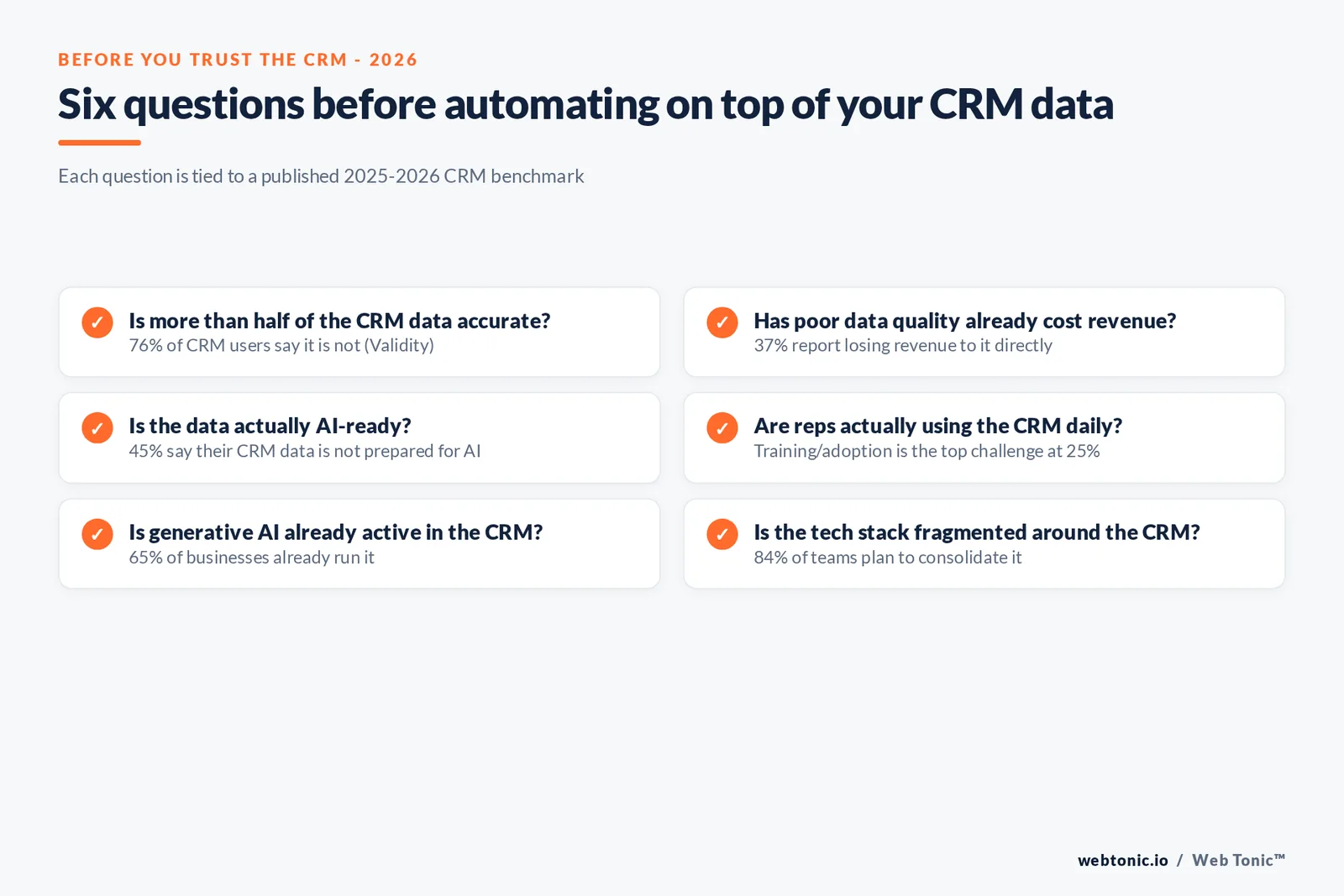
- 65% of businesses run a CRM with generative AI features.
- AI-CRM adopters are 83% more likely to exceed their sales goals.
- CRM software saves employees 5 to 10 hours a week on average.
- 76% say less than half of their CRM data is accurate and complete (Validity).
- 37% report losing revenue directly because of poor CRM data quality.
- 45% say their CRM data is not prepared for AI use cases.
- 94% of sales leaders with AI agents call them essential to targets (Salesforce).
- 51% of sales leaders say tech silos still slow their AI rollout.
- 4,050 sales professionals surveyed across 22 countries for that finding.
- 25% name training and adoption as their top CRM implementation challenge.
Adoption is no longer the interesting number
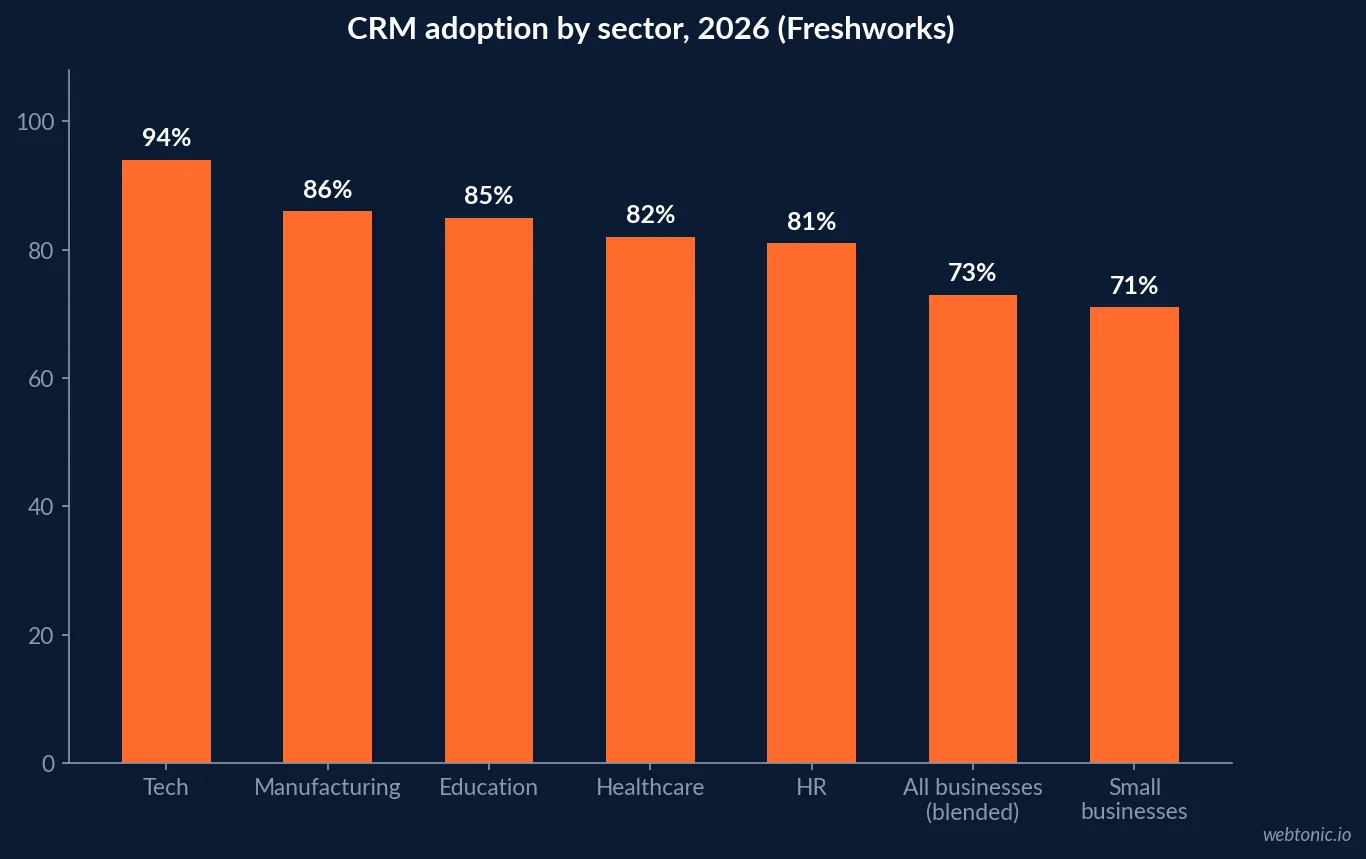
Freshworks' April 2024 survey of 600 US business owners and professionals in sales, customer service, IT and marketing found 73% of businesses use CRM software, with adoption already at 71% among small businesses of 500 employees or fewer. A decade of cloud pricing pushed CRM down-market fast enough that "do you have a CRM" stopped being a useful qualifying question for most vendor conversations.
The number worth tracking in 2026 is not whether a business has a CRM, but what condition its data is in and whether the team actually uses the features it is paying for.
| Sector (2026) | Reported CRM adoption | Source |
|---|---|---|
| Technology | 94% | Freshworks |
| Manufacturing | 86% | Freshworks |
| Education | 85% | Freshworks |
| Healthcare | 82% | Freshworks |
| Human resources | 81% | Freshworks |
| All businesses (blended) | 73% | Freshworks |
| Small businesses (≤500 employees) | 71% | Freshworks |
What CRM users report versus non-users
The Freshworks survey's starkest comparison sits between businesses that use a CRM and those that do not. 97% of CRM users met or exceeded their sales goals in the past year, against only 3% falling short, and CRM users are 86% more likely to exceed sales goals than non-users. Most respondents also reported sales revenue growth of 21% to 30% after implementation, and 81% plan to increase their CRM budget over the next year, with over a third planning an increase of 11% to 20%.
Self-reported survey data cannot separate cause from selection bias on its own - businesses disciplined enough to run a CRM well may also be disciplined in other ways. The size and consistency of the gap across every question in the survey is still the strongest available signal.
| Outcome (self-reported) | CRM users | Comparison | Source |
|---|---|---|---|
| Met or exceeded sales goals | 97% | vs. 3% falling short | Freshworks |
| More likely to exceed sales goals vs. non-users | 86% more likely | - | Freshworks |
| Sales revenue increase after implementation | 21-30% | Most businesses surveyed | Freshworks |
| Planning to increase CRM budget next year | 81% | 34% by 11-20% | Freshworks |
| Rate their customer service as exceptional/very good | 86% (CRM users) | vs. 73% of non-users | Freshworks |
| Report higher customer retention since CRM adoption | 93% | 44% saw retention rise 10-29% | Freshworks |
Where the productivity actually comes from
CRM software saves the average team 5 to 10 hours per week, and 94% of businesses report a productivity increase since adopting a platform, with 44% reporting a gain of 10% to 29%. Respondents credit three mechanisms: automating repetitive tasks (50%), centralizing customer data for easy access (46%), and streamlining communication with prospects and customers (41%). Average sales cycles also shorten by 8 to 14 days, and 91% of businesses report lower customer acquisition costs post-CRM, with nearly half seeing an 11% to 20% reduction.
AI inside the CRM is now mainstream, not experimental
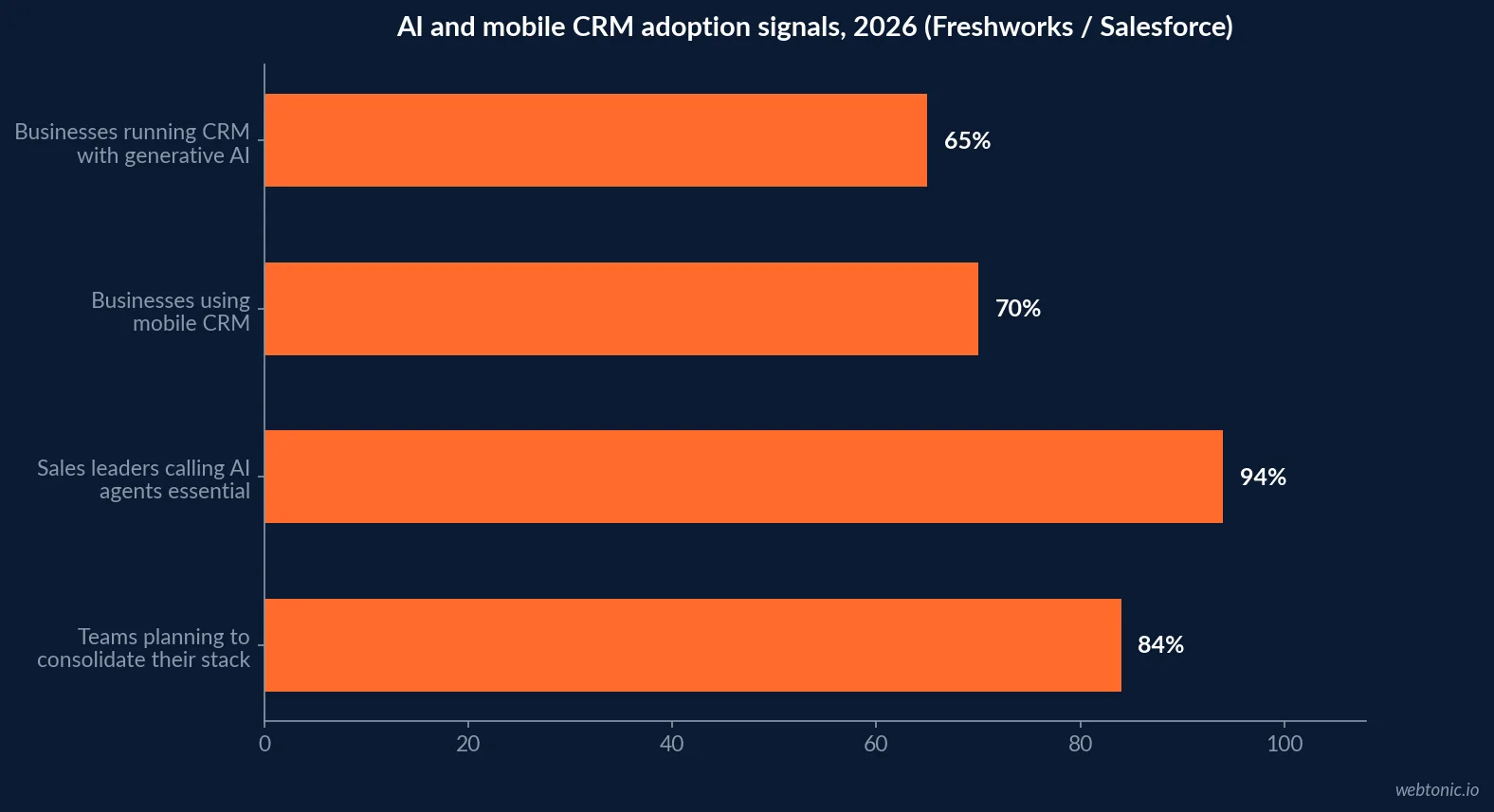
65% of businesses in the Freshworks survey run a CRM with generative AI features already active, and those adopters are 83% more likely to exceed their sales goals and 34% more likely to report exceptional customer service than non-adopters. 51% of respondents name generative AI as the single biggest CRM trend of the year. Mobile CRM usage sits at 70%, and mobile-CRM users are 150% more likely to hit their sales targets than desktop-only users.
The sales-leadership view backs this up from a different angle. Salesforce's 2026 State of Sales report, surveying 4,050 sales professionals across 22 countries, found 94% of sales leaders with AI agents already call them essential to hitting targets, and roughly nine in ten sales teams use agents or expect to within two years. The same report finds 84% of teams without an all-in-one platform plan to consolidate their tech stack, and 51% say tech silos are still slowing their AI rollout.
| AI / mobile signal (2026) | Figure | Source |
|---|---|---|
| Businesses running CRM with generative AI | 65% | Freshworks |
| AI-CRM adopters more likely to exceed sales goals | 83% more likely | Freshworks |
| Businesses using mobile CRM | 70% | Freshworks |
| Mobile CRM users more likely to hit targets | 150% more likely | Freshworks |
| Sales leaders with AI agents calling them essential | 94% | Salesforce State of Sales 2026 |
| Teams without an all-in-one platform planning to consolidate | 84% | Salesforce State of Sales 2026 |
The data-quality gap sitting under all of it
Every productivity and AI figure above assumes the underlying customer record is trustworthy, and 2026 evidence says that assumption is shaky. Validity's survey of 602 CRM users and administrators found 76% saying less than half of their organization's CRM data is accurate and complete, and 37% reporting lost revenue directly tied to poor data quality. 45% of respondents said their CRM data is not prepared for AI use cases at all, even as 29% of VP-level respondents feel pressure to use AI as a substitute for hiring.
That is the real fault line for 2026: businesses running AI features on top of unreliable records are automating a bad dataset faster, not fixing it.
| Data-quality finding (Validity, 2025) | Figure |
|---|---|
| Say <50% of their CRM data is accurate and complete | 76% |
| Report lost revenue tied to poor data quality | 37% |
| Say their CRM data is not AI-ready | 45% |
| Recognize CRM data as core to operations, despite the above | 90% |
| VP-level respondents feeling pressure to use AI in place of hiring | 29% |
Why teams still struggle to roll a CRM out
Adoption at the company level does not mean adoption at the desk level. Freshworks respondents named training and user adoption (25%) as their top implementation challenge, followed by integration with other tools and systems (19%). On the reason side, 35% implemented a CRM primarily to improve customer service, 24% to increase sales revenue, and 14% for other motivations - a reminder that "CRM ROI" is being measured against three different original goals depending on who is answering.
| Primary reason for adopting a CRM | Share of respondents |
|---|---|
| Improve customer service | 35% |
| Increase sales revenue | 24% |
| Other stated reasons | 14% |
| (Top implementation challenge: training/adoption) | 25% |
| (Second challenge: integration with existing tools) | 19% |
What "good" looks like once the CRM is in place
Businesses that use a CRM well rate their own customer service at 86% exceptional or very good, compared with 73% of businesses without one. 93% of CRM users report higher customer retention since adoption, with 44% seeing retention climb 10 to 29 percentage points. Across every benefit question in the survey, users named increased sales revenue (57-58%), improved customer satisfaction or retention (53%), and higher-quality customer service (49%) as the top three payoffs, in that order.
What sales leaders say about the stack around the CRM
HubSpot's State of Sales in 2026 report, based on surveys and interviews with 1,000-plus sales and revenue professionals across B2B and B2C, finds that 94% of sales teams already use AI somewhere in their workflow - almost always layered on top of the CRM rather than replacing it. Combined with Salesforce's finding that 84% of teams without an all-in-one platform plan to consolidate their tech stack, the direction for 2026 is fewer point tools bolted onto the CRM and more capability pulled inside the system of record itself.
CRM as the system of record for retention, not just pipeline
The CRM is also where retention and expansion get measured, and that measurement increasingly sets the terms of the sales conversation. Cust's 2026 dataset of 105 public B2B SaaS companies, sourced from SEC filings, puts median net revenue retention at 122%, and Benchmarkit's CY-2025 benchmarks put median gross revenue retention at 84%. Neither number exists without a CRM (or an adjacent revenue-operations system) recording the underlying account activity accurately - which loops back to the 76% data-quality gap above as the real constraint on trusting either figure.
Loyalty measurement sits one layer above retention math. Bain & Company's NPS Prism benchmarking service surveys more than 20,000 consumers per industry across 10-plus industries to separate relationship-level loyalty from single-episode satisfaction - a distinction most CRM dashboards do not make natively, which is why dedicated NPS programs still exist alongside CRM reporting rather than being replaced by it.
How to read these numbers for your own program
Adoption benchmarks are table stakes; the AI and data-quality benchmarks are where 2026 CRM programs actually separate. Audit the record before layering AI on top of it, budget for the training line that 25% of businesses under-resourced, and measure CAC and retention before and after rollout rather than trusting a single satisfaction score. Our data and analytics practice builds that before/after measurement layer, and our growth marketing practice can connect CRM lifecycle stages back to paid acquisition once the data is trustworthy. See our guide to building a paid strategy that a clean CRM can actually attribute, or talk to us about the audit.
Frequently Asked Questions
What percentage of businesses use a CRM in 2026?
Freshworks' 2024 survey of 600 US business owners and professionals found 73% of businesses use CRM software, including 71% of small businesses with 500 or fewer employees. Adoption is highest in tech at 94%, followed by manufacturing at 86%, education at 85%, healthcare at 82% and human resources at 81%. CRM adoption is no longer a large-company advantage - the gap between enterprise and SMB usage has narrowed to single digits in several sectors.
Does using a CRM actually improve sales results?
The Freshworks survey reports that 97% of CRM-using businesses met or exceeded their sales goals in the past year, versus only 3% falling short, and that CRM users are 86% more likely to exceed sales goals than non-users. Most surveyed businesses also saw sales revenue increase 21% to 30% after implementation. Correlation is not the same as proof of causation for every business, but the self-reported gap between users and non-users is large and consistent across the survey's questions.
How much CRM data is actually usable?
Validity's State of CRM Data Management in 2025 report, surveying 602 CRM users and administrators, found 76% saying less than half their organization's CRM data is accurate and complete, and 37% reporting lost revenue directly tied to poor data quality. Separately, 45% of respondents said their CRM data is not prepared for AI use cases, even though many teams are already deploying AI features on top of it.
How many CRM users have adopted AI features?
Freshworks found 65% of surveyed businesses use a CRM system with generative AI features, and that adopters are 83% more likely to exceed their sales goals than non-adopters. Salesforce's 2026 State of Sales report, surveying 4,050 sales professionals across 22 countries, found 94% of sales leaders with AI agents already in place call them essential to hitting targets, while 51% say tech silos are still slowing their AI rollout.
What is the biggest reason CRM implementations struggle?
In the Freshworks survey, 25% of respondents named training and user adoption as the top challenge, followed by 19% citing integration with other tools and systems. Validity's data-quality findings point to a second, less visible failure mode: a CRM that is fully adopted by staff but still holds unreliable records will not deliver the productivity or AI gains the vendor case study promised.
Sources
Freshworks - CRM statistics, 2024 survey of 600 US business professionals
Validity - The State of CRM Data Management in 2025
Salesforce - State of Sales Report, 2026 (7th edition)
HubSpot - The State of Sales in 2026
Zendesk - CX Trends 2026 report
Cust - 2026 State of Customer Success, SaaS retention benchmarks
Benchmarkit - CY-2025 B2B SaaS performance metrics benchmarks
Bain & Company - NPS Prism benchmarking