Table of contents

Three research firms cannot agree on how big the CDP market is in 2026, and Gartner just dropped four established vendors from its Magic Quadrant in the same year. Neither fact makes the category smaller. Both make a single market-size slide or a single vendor logo a bad basis for a budget request - this page builds one from the range and the vendor movement instead.
Key Takeaways
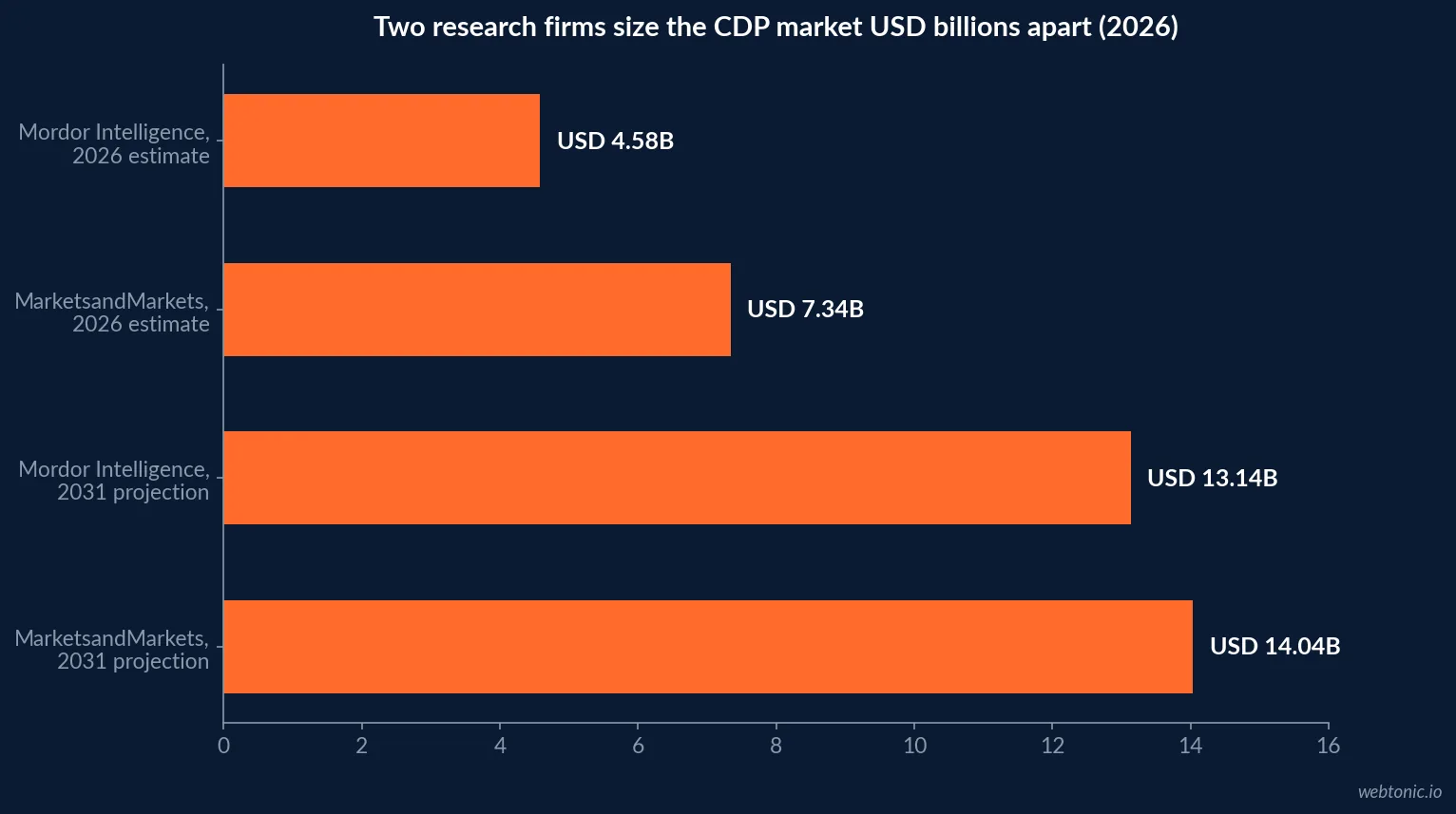
- MarketsandMarkets sizes the 2026 CDP market at USD 7.34 billion.
- Mordor Intelligence sizes the same 2026 market at USD 4.58 billion.
- Both estimates converge closer by 2031, at USD 14.04 billion and USD 13.14 billion.
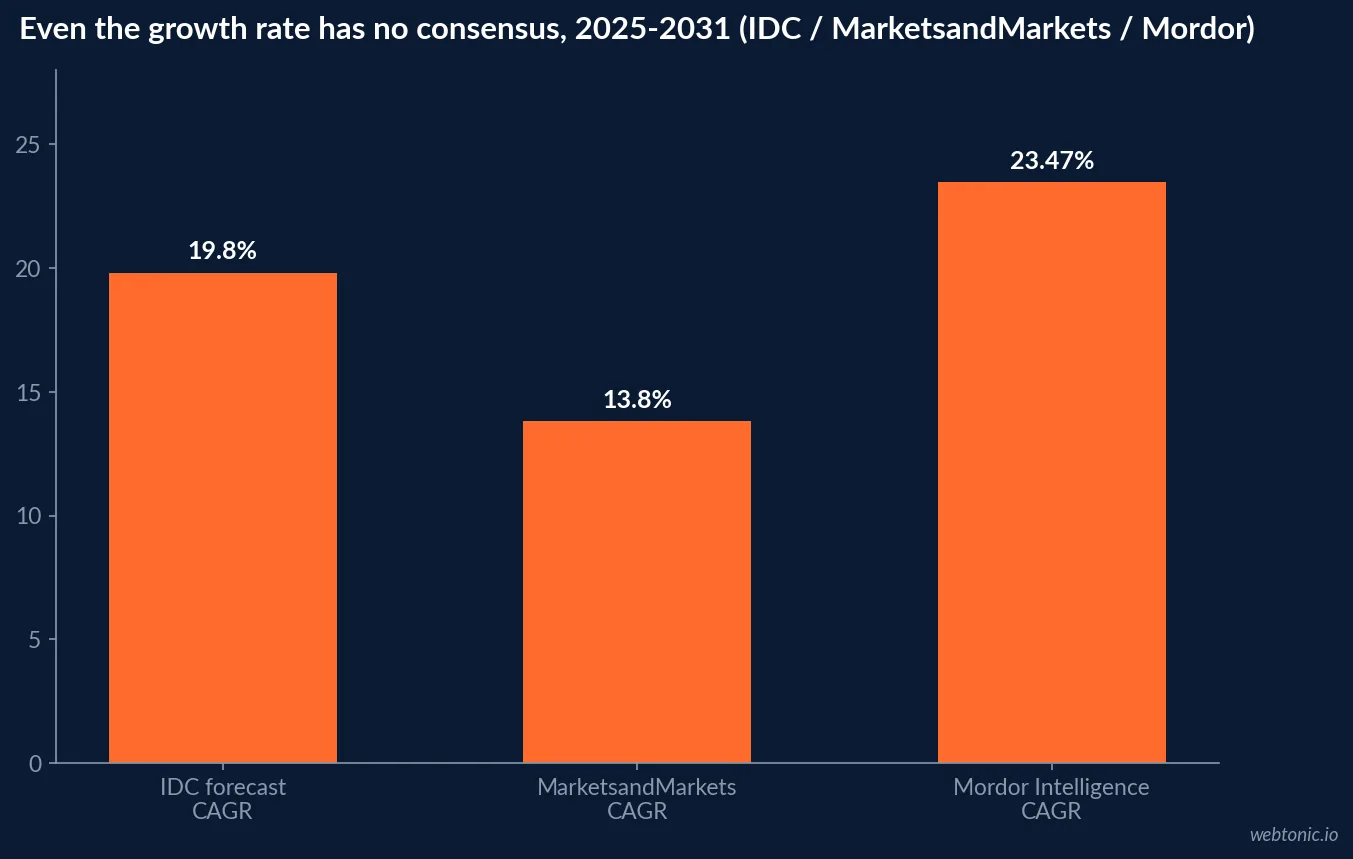
- IDC forecasts 19.8% CAGR for the CDP market, 2025 to 2029.
- MarketsandMarkets projects a lower 13.8% CAGR through 2031.
- Mordor Intelligence projects a higher 23.47% CAGR over a similar window.
- Salesforce is the sole Leader in Gartner's 2026 Magic Quadrant for CDPs.
- Three new vendors joined the quadrant: Hightouch, Oracle and Uniphore.
- Tealium dropped from Leader to Challenger in a single year.
- Adobe holds the sole Visionary position, unchanged.
- The Niche Player field shrank to three vendors: BlueConic, Amperity and Twilio.
- Four vendors dropped off the quadrant entirely: ActionIQ, Redpoint Global, mParticle and Zeta Global.
- Gartner cites updated customer-count and contract-value criteria for those exits.
- Agentic and generative AI are named as the primary 2026-2029 demand drivers by IDC.
- The market is described as splitting into platformization versus agentification.
Why the market-size number in a vendor deck cannot be trusted alone
Ask three research firms how big the customer data platform market is in 2026 and you get three different answers, and the gap is not rounding error. MarketsandMarkets sizes the 2026 market at USD 7.34 billion, reaching USD 14.04 billion by 2031 at a 13.8% CAGR. Mordor Intelligence puts the same 2026 market at USD 4.58 billion, reaching USD 13.14 billion by 2031 at a 23.47% CAGR - a starting estimate 38% smaller than MarketsandMarkets', that still ends up in a similar place six years later.
Whichever number appears in a vendor's pitch deck, it was chosen because it is the largest available estimate. Build your own budget case on the range, not the number a salesperson selected.
| Research firm | 2026 market size | 2031 projection | CAGR |
|---|---|---|---|
| MarketsandMarkets | USD 7.34 billion | USD 14.04 billion | 13.8% |
| Mordor Intelligence | USD 4.58 billion | USD 13.14 billion | 23.47% |
| IDC (worldwide software forecast) | Not directly comparable | 2025-2029 window | 19.8% |
What all three forecasts agree on
IDC's Worldwide Customer Data Platform Applications Software Forecast projects a 19.8% CAGR from 2025 to 2029, and names the same driver both other firms implicitly agree on: agentic and generative AI use cases are pulling demand forward, because, in IDC research director Tapan Patel's framing, CDPs are evolving into "a customer data orchestration hub that powers both human-led and AI-led autonomous decisions at every customer touch point."
That is the useful budgeting signal underneath the disagreement: none of the three firms models flat or declining demand. The disagreement is entirely about the base and the pace, not the direction.
The 2026 Magic Quadrant reshuffle, and what it signals
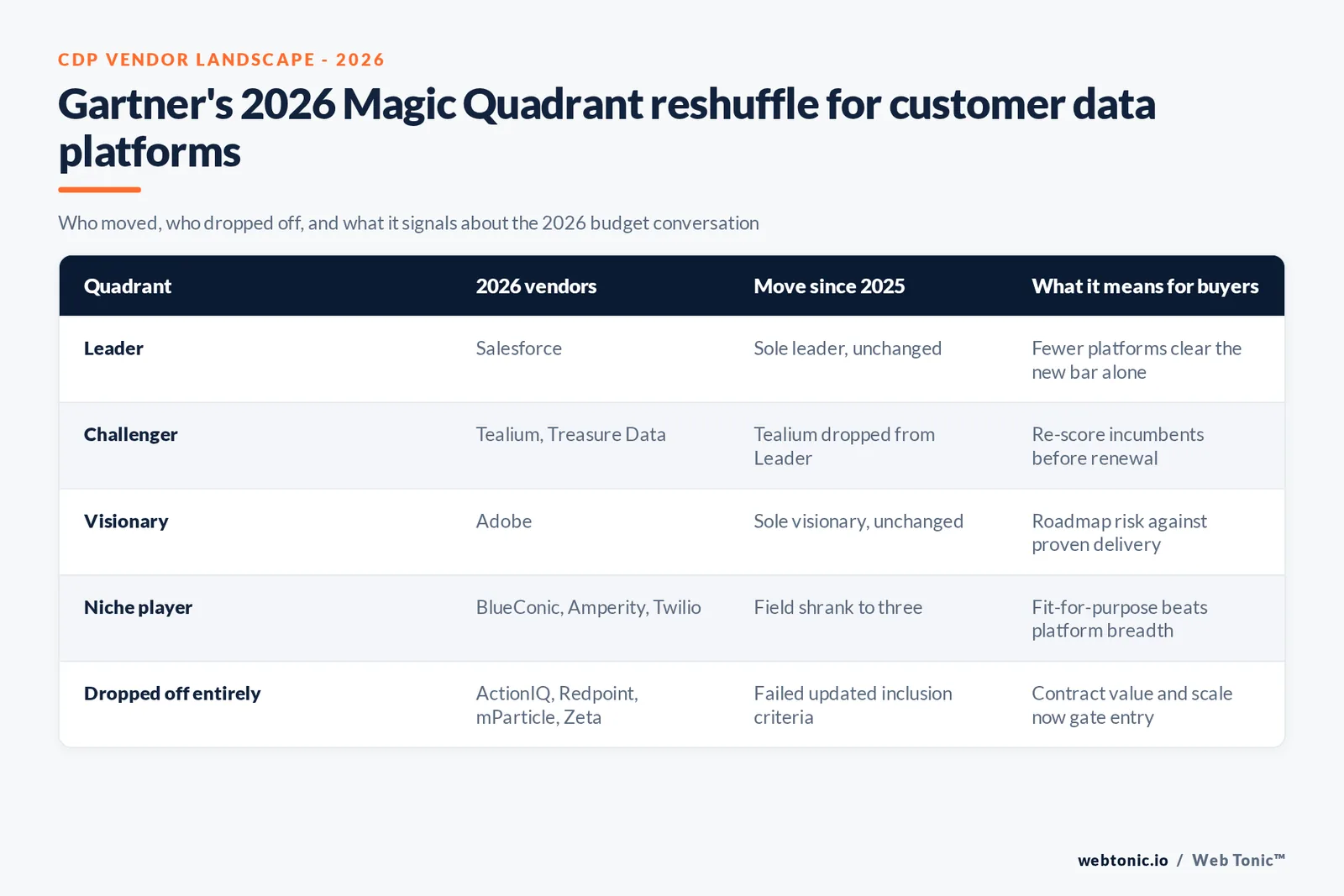
While the market-size firms disagree on scale, Gartner's 2026 Magic Quadrant for Customer Data Platforms shows a category consolidating hard. Salesforce remains the sole Leader. Hightouch, Oracle and Uniphore joined as new entrants. Tealium dropped from Leader to Challenger, joining Treasure Data in that quadrant. Adobe holds the sole Visionary position. The Niche Player field shrank to just BlueConic, Amperity and Twilio.
Most telling: ActionIQ, Redpoint Global, mParticle and Zeta Global dropped off the quadrant entirely. Gartner attributes this to updated inclusion criteria around customer count and contract value - not necessarily product failure, but a rising bar for independent evaluation that these four no longer clear.
| Quadrant position (2026) | Vendors | Change from 2025 | What it signals to a buyer |
|---|---|---|---|
| Leader | Salesforce | Sole leader, unchanged | The safest default, also the most scrutinized on price |
| Challenger | Tealium, Treasure Data | Tealium dropped from Leader | Re-evaluate before an automatic renewal |
| Visionary | Adobe | Sole visionary, unchanged | Roadmap ambition, verify delivery track record |
| Niche Player | BlueConic, Amperity, Twilio | Field shrank from a larger set | Best fit for a narrow, defined use case |
| Dropped off entirely | ActionIQ, Redpoint Global, mParticle, Zeta Global | Failed 2026 inclusion criteria | Do not assume continuity with 2025 positioning |
Platformization versus agentification: the split that matters for budgeting
Gartner's own 2026 framing, as read by CX Today's coverage, describes the CDP category splitting into two directions: platformization, where broad cross-functional platforms consolidate marketing, sales, service and commerce data into one system, and agentification, where narrower tools optimize specifically for AI-agent-driven activation. The Leader and Visionary quadrants skew toward the first; several Niche Players compete on the second.
The budgeting consequence: a team evaluating "a CDP" in the abstract is really choosing between two different categories of tool with different total costs of ownership. Naming which one you actually need before requesting quotes avoids the most common CDP budgeting mistake - buying platform breadth for a single-use-case problem.
| Buying scenario | Better-fit quadrant | Why | Budget risk if mismatched |
|---|---|---|---|
| One clear activation use case (e.g. lifecycle email) | Niche Player | Narrower scope, faster time to value | Overpaying for unused platform breadth |
| Cross-functional data unification across teams | Leader or Visionary | Built for multi-team governance | A niche tool becomes another data silo |
| AI-agent-driven personalization at the center | Agentification-focused vendors | Purpose-built for that workflow | A platformization-first tool bolts AI on late |
| Enterprise-scale governance and compliance needs | Leader (Salesforce) or Challenger | Track record at contract-value scale | A dropped-off vendor may lack support depth |
The implementation timeline the vendor's quote will not include
The market-size and quadrant numbers above describe the software category. They say nothing about how long a specific implementation takes, which is where most CDP budgets actually blow through their first-year estimate. Alium Research's 2026 buyer-interview study, built from hundreds of verified interviews with marketing, data and IT leaders who selected and operated a CDP, found enterprise packaged platforms pitched at a quarter or two typically take roughly one year to reach real usability - and almost none of that gap is the software installing. The delay lives in data validation, legacy-system integration and a long parallel run.
The same research rated Hightouch, a warehouse-native tool, at 7.9 out of 10 for onboarding ease - the easiest in its corpus, because it reads from a warehouse the buyer already runs rather than requiring a new replication step - against 6.3 out of 10 for Adobe Real-Time CDP, the packaged incumbent most associated with legacy integration pain in the same study. That is a direct, evidence-based reason a warehouse-native or composable approach can budget as a faster path to value than a platform pitch alone would suggest.
| Implementation factor | What buyers report (Alium Research 2026) | Budget implication |
|---|---|---|
| Pitched timeline for packaged CDPs | A quarter or two | This is the number in the vendor's proposal |
| Actual typical timeline | About one year | Budget the gap as data and integration work, not software delay |
| Hightouch onboarding rating | 7.9 / 10, easiest in the corpus | Warehouse-native tools skip a replication step |
| Adobe Real-Time CDP onboarding rating | 6.3 / 10, hardest in the corpus | Legacy integration and SDK sprawl drive the gap |
What the CDP Institute's own community is reporting
The CDP Institute's January 2026 Industry Update, the 18th edition of a semi-annual report tracking the category since 2013, describes a market of "modest growth, persistent concentration, and increasing structural differentiation as AI becomes embedded across platforms" - language consistent with Gartner's consolidation signal even though the two organizations track the market from different angles. The Institute's companion 2025 Member Survey is titled, tellingly, "Unified Data, Uneven Outcomes" - unified customer data has become common among CDP adopters, but consistent business outcomes from it have not.
That "uneven outcomes" framing is a useful budget caveat in its own right: buying the platform is necessary but not sufficient, and a chunk of the implementation budget needs to go to the use-case and governance work that turns unified data into a business outcome.
A defensible way to size a 2026 CDP budget
Given the disagreement on market size, the useful move is to stop asking "how big is the market" and start asking three narrower questions instead. First, which Gartner quadrant actually matches your use case - platformization or agentification - since that determines the realistic vendor shortlist. Second, has your current or shortlisted vendor moved quadrant position in the last year, since Tealium's drop shows even Leaders are not guaranteed to stay there. Third, budget separately for the implementation and governance work the CDP Institute's own survey flags as the actual gap, not just the license fee.
Our data and analytics practice scopes that implementation layer before a platform purchase, and our growth marketing team can help define which activation use case should drive the vendor shortlist in the first place.
| Source consulted | What it covers | 2026 figure used here |
|---|---|---|
| MarketsandMarkets | CDP market size and CAGR | USD 7.34B in 2026, 13.8% CAGR |
| Mordor Intelligence | CDP market size and CAGR | USD 4.58B in 2026, 23.47% CAGR |
| IDC | Worldwide CDP software forecast | 19.8% CAGR, 2025-2029 |
| Gartner (via CX Today) | Vendor landscape, Magic Quadrant | 4 vendors dropped off entirely |
| Alium Research | Buyer-reported implementation timelines | ~1 year actual vs. a quarter or two pitched |
What to ask a CDP vendor before signing
Ask for their current Magic Quadrant position and whether it changed in the last cycle, not just their position when the sales relationship started. Ask which of the two 2026 directions - platformization or agentification - their roadmap actually optimizes for. And ask what percentage of their existing customers report the specific outcome you are buying for, since the CDP Institute's own research shows unified data alone does not guarantee it.
If you want a second opinion on a specific CDP shortlist before it goes to procurement, talk to us, or see how we think about first-party data infrastructure in our write-up on budgeting paid channels that ultimately feed the same customer record.
Frequently Asked Questions
How big is the customer data platform market in 2026?
It depends entirely on which research firm you ask, and the gap is not small. MarketsandMarkets sizes the CDP market at USD 7.34 billion in 2026, growing to USD 14.04 billion by 2031. Mordor Intelligence puts 2026 at USD 4.58 billion, reaching USD 13.14 billion by 2031. Both agree the market roughly doubles or triples by 2031; neither agrees on the 2026 starting point, which should make any single market-size figure in a vendor pitch deck a starting question, not a fact to budget against.
What happened in Gartner's 2026 Magic Quadrant for CDPs?
The field reshuffled more than in any prior year. Salesforce remains the sole Leader. Hightouch, Oracle and Uniphore joined as new entrants. Tealium dropped from Leader to Challenger, joining Treasure Data there. Adobe holds the sole Visionary spot. The Niche Player quadrant shrank to BlueConic, Amperity and Twilio. Most tellingly, ActionIQ, Redpoint Global, mParticle and Zeta Global dropped off the quadrant entirely after failing Gartner's updated customer-count and contract-value inclusion criteria.
What does it mean that four vendors dropped off the Magic Quadrant?
Gartner attributes it to updated inclusion criteria around customer count and contract value, which signals the category is maturing and consolidating rather than expanding with new entrants. For a buyer, it means fewer platforms clear the bar to be independently evaluated at all, and any of the four dropped vendors should be re-scored on their own current traction before a renewal, not assumed to still be where they were a year ago.
How fast is the CDP market actually growing?
The growth-rate estimates disagree almost as much as the size estimates. IDC forecasts a 19.8% CAGR from 2025 to 2029. MarketsandMarkets projects 13.8% CAGR to 2031. Mordor Intelligence projects 23.47% CAGR over the same period. Use the range, not any single number, when modelling multi-year CDP spend growth into a budget.
Should a mid-market team buy a Leader-quadrant CDP or a Niche player?
It depends on the use case, not the quadrant label. Gartner's own 2026 commentary frames the market as splitting between platformization (broad, cross-functional CDPs like the Leader and Visionary quadrants) and agentification (narrower, AI-agent-focused tools, where several Niche players compete). A team with one clear activation use case is often better served by a fit-for-purpose Niche player than by the broadest platform on the board.
Sources
MarketsandMarkets - Customer Data Platform (CDP) Market Report 2026-2031
Mordor Intelligence - Customer Data Platform (CDP) Market Statistics & Share
IDC - Worldwide Customer Data Platform Applications Software Forecast, 2025-2029
CX Today - Gartner Magic Quadrant for Customer Data Platforms 2026: The Rundown
CDP Institute - Industry Update, January 2026 (18th edition)
CDP Institute - 2025 Member Survey: Unified Data, Uneven Outcomes
Alium Research - Real CDP Implementation Timelines, and Why They Slip