Table of contents
A customer journey map template is a pre-built grid that plots what a customer does, thinks and feels at every stage of buying from you, so a team can fill it in during a single workshop instead of designing the framework from scratch. The template you pick matters less than the evidence you put in it.
Key Takeaways
- There are 6 template formats worth knowing, and each one answers a different question — current-state, future-state, day-in-the-life, service blueprint, empathy map and experience map.
- Every credible template shares 5 mandatory rows: stages, actions, thoughts, emotions and opportunities. Anything beyond that is optional decoration.
- A usable map needs research from at least 5 to 8 customer interviews plus analytics, not a room of internal opinions.
- Free templates exist in Miro, Confluence and Qualtrics; budget 2 to 4 hours for the workshop and roughly 1 week for the research that feeds it.
- Gallup found only 23% of employees say their organisation delivers on the promises it makes to customers — the gap a journey map is built to expose.
- Maps decay. Re-validate every 6 months, or immediately after a pricing, packaging or checkout change.
What a customer journey map template actually contains
A journey map is a visualisation of the process a person goes through to accomplish a goal, and Nielsen Norman Group's journey mapping primer is blunt about the requirement: a map needs a specific actor, a specific scenario, and the researcher's evidence behind it. A template supplies the scaffolding for those three things.
Strip away the styling and every template on the market reduces to the same skeleton, plus a header block that fixes scope so the map does not sprawl into "all customers, all products".
| Template row | What goes in it | Where the data comes from | Common mistake |
|---|---|---|---|
| Header / scope | One persona, one scenario, one goal, one time window | Segmentation and CRM data | Mapping "everyone" at once |
| Stages | 4 to 7 phases named in the customer's words | Interviews, support tickets | Using internal funnel stage names |
| Actions | What the customer physically does at each stage | Analytics paths, session recordings | Listing what you wish they did |
| Touchpoints and channels | Site, ads, email, phone, store, app, third parties | Attribution and channel reports | Omitting offline and partner steps |
| Thoughts and questions | Verbatim quotes, one per stage minimum | Customer interviews, reviews | Paraphrasing quotes into marketing copy |
| Emotions | A plotted line with highs and lows | Interviews plus CSAT or NPS by stage | A flat line that dodges the bad moments |
| Pain points | Friction, delay, confusion, cost surprises | Support and drop-off data | Recording symptoms instead of causes |
| Opportunities | One testable fix per pain point | Workshop with an owner named | Ideas with no owner or deadline |
| Internal ownership | Team accountable for each stage | Org chart | Leaving the handoffs blank |
| Metrics | Conversion, time-to-complete, contact rate | Analytics and CRM | No baseline, so no proof of improvement |
Rule 1: if a row cannot be filled from evidence, mark it as an assumption in a different colour. A map that mixes fact and guesswork without labelling which is which is worse than no map, because it gets quoted in roadmap meetings for the next year.
The 6 template formats, and which question each one answers
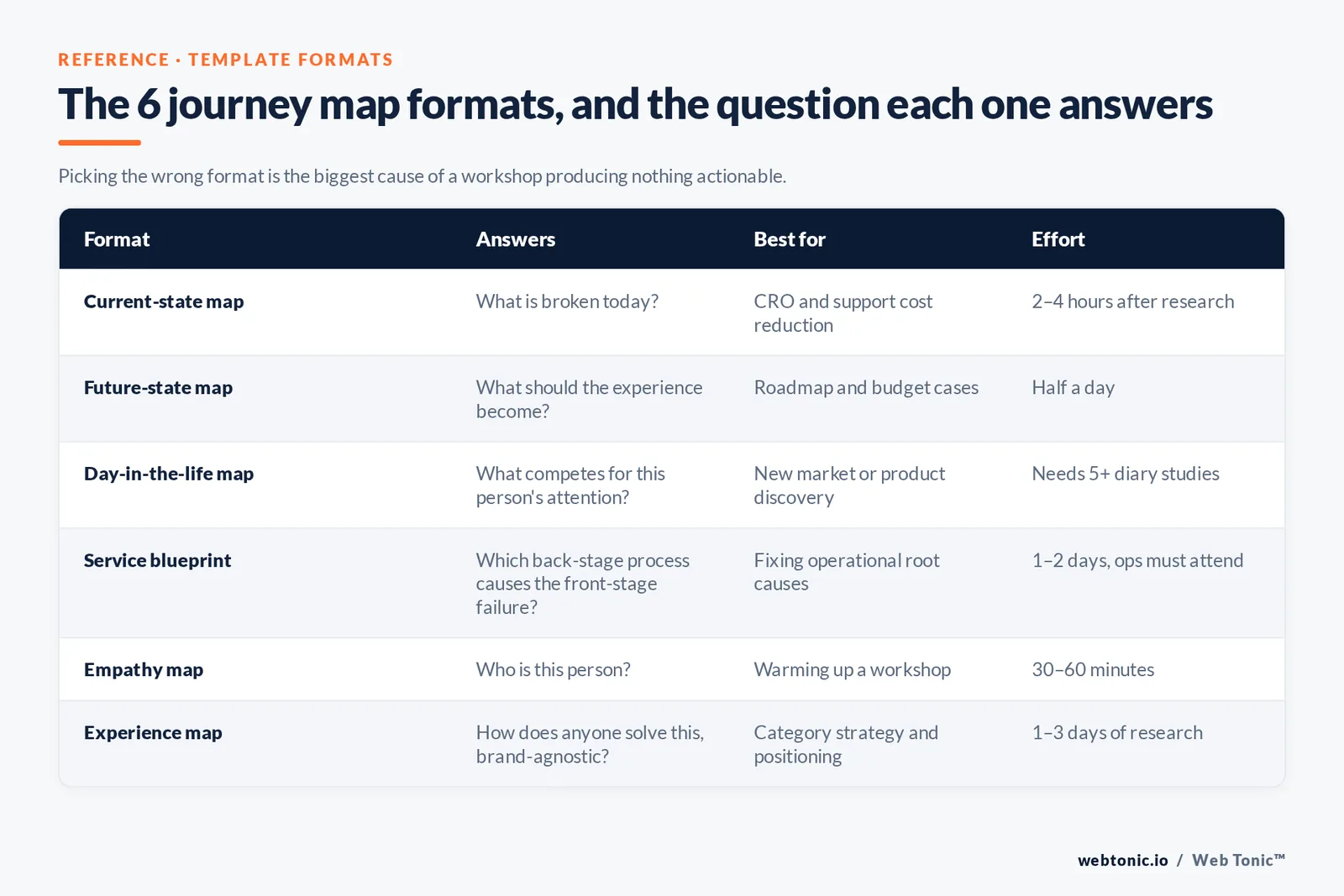
Teams usually search for "a customer journey map template" when they need one of six quite different artefacts. Picking the wrong format is the single biggest cause of a workshop producing nothing actionable. NN/g's mapping overview and its separate explainer on service blueprints draw the distinctions most clearly.
| Format | Answers | Rows to include | Best for | Effort |
|---|---|---|---|---|
| Current-state map | What is broken today? | Stages, actions, emotions, pain points, metrics | CRO and support cost reduction | 2 to 4 hours after research |
| Future-state map | What should the experience become? | Stages, intended actions, target emotions, required capabilities | Roadmap and budget cases | Half a day |
| Day-in-the-life map | What competes for this person's attention? | Timeline by hour, contexts, devices, mood | New market or new product discovery | Needs 5+ diary studies |
| Service blueprint | Which back-stage process causes the front-stage failure? | Customer actions, front-stage staff, back-stage staff, systems, policies | Fixing operational root causes | 1 to 2 days, ops must attend |
| Empathy map | Who is this person? | Says, thinks, does, feels | Warming up a workshop in 30 minutes | 30 to 60 minutes |
| Experience map | How does anyone solve this problem, brand-agnostic? | Generic stages, jobs to be done, market alternatives | Category strategy and positioning | 1 to 3 days of research |
Rule 2: never build a future-state map before a current-state map exists. Teams that skip the diagnosis design improvements for stages customers do not use. Interaction Design Foundation makes the same sequencing point in its topic overview.
Where to get a free customer journey map template
You do not need to buy a template. Four sources cover almost every situation, and each has a different bias worth understanding before you commit a workshop to it.
- 1. Whiteboard tools. Miro's journey map template is the default for live remote workshops because the sticky-note grid absorbs messy input fast and the map stays editable afterwards.
- 2. Documentation tools. Confluence's journey mapping template suits teams who need the map to live beside tickets and specs rather than in a design tool nobody outside the team opens.
- 3. Experience management platforms. Qualtrics ties the map to survey data by stage, which is the fastest route to a real emotion line instead of an invented one.
- 4. Spreadsheets. A 10-row, 7-column sheet is genuinely sufficient, exports cleanly, and forces one quote per cell. Zendesk's walkthrough shows the support-led version of this layout.
Cost check: the template is free in all four cases. The real budget is research time — plan roughly 8 hours of interviews, 3 hours of analytics pulls and 1 half-day workshop for a first map.
How to fill a template in 7 steps
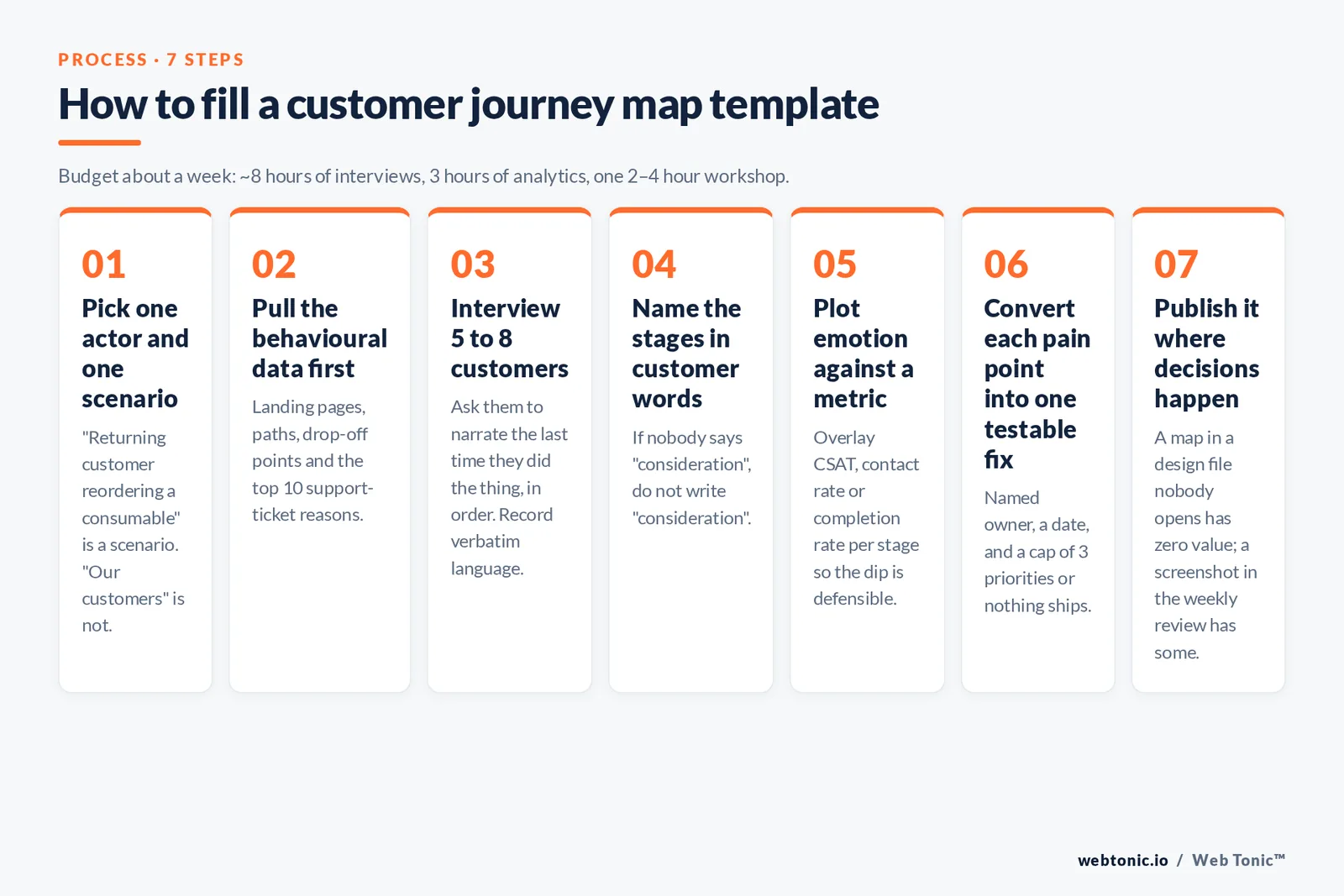
- Step 1 — Pick one actor and one scenario. "Returning customer reordering a consumable" is a scenario. "Our customers" is not.
- Step 2 — Pull the behavioural data first. Landing pages, paths, drop-off points and the top 10 support-ticket reasons. Google's own consumer journey research is a useful reminder that real paths loop and stall rather than run in a straight line.
- Step 3 — Interview 5 to 8 customers. Ask them to narrate the last time they did the thing, in order. Record verbatim language; you will use it as row content and as ad copy.
- Step 4 — Name the stages in customer words. If nobody says "consideration", do not write "consideration".
- Step 5 — Plot emotion against a metric. Overlay CSAT, contact rate or completion rate per stage so the dip is defensible in a budget meeting.
- Step 6 — Convert every pain point into one testable opportunity with a named owner and a date. Cap it at 3 priorities or nothing ships.
- Step 7 — Publish it where decisions happen. A map in a design file nobody opens has zero value; a screenshot in the weekly review has some.
Personas feed step 1, and the US government's persona method guide remains a clean, vendor-free reference for building them from research rather than imagination.
Which template to use by business type
The same six formats apply everywhere, but the useful starting point changes with how the business sells. This is the table most template posts leave out.
| Business type | Start with | Stages that matter most | Data source to trust | Typical hidden pain point |
|---|---|---|---|---|
| Ecommerce | Current-state map | Discovery, product evaluation, checkout, delivery, reorder | Checkout funnel and returns reasons | Shipping cost revealed too late |
| B2B SaaS | Current-state plus service blueprint | Trial, evaluation, procurement, onboarding, renewal | Product analytics and win/loss calls | Procurement and security review stall |
| Local service business | Current-state map | Search, shortlist, quote, scheduling, follow-up | Call recordings and quote-to-job rate | Slow first reply to an enquiry |
| Healthcare or clinic | Service blueprint | Referral, booking, intake, visit, aftercare | Wait-time and no-show data | Intake paperwork duplication |
| Marketplace | Two maps, one per side | Listing, matching, transaction, dispute | Supply and demand liquidity metrics | Dispute handling destroying repeat use |
| Subscription / DTC | Current-state plus day-in-the-life | Trial, habit formation, pause, cancel, win-back | Cohort retention curves | No graceful pause option |
| Nonprofit | Experience map | Awareness, first gift, second gift, advocacy | Donor retention by cohort | Silence between appeals |
| Enterprise services | Future-state map | Problem framing, RFP, pilot, rollout, expansion | Deal-desk notes and stakeholder maps | Champion turnover mid-cycle |
Journey map templates by tool: what you can download for free
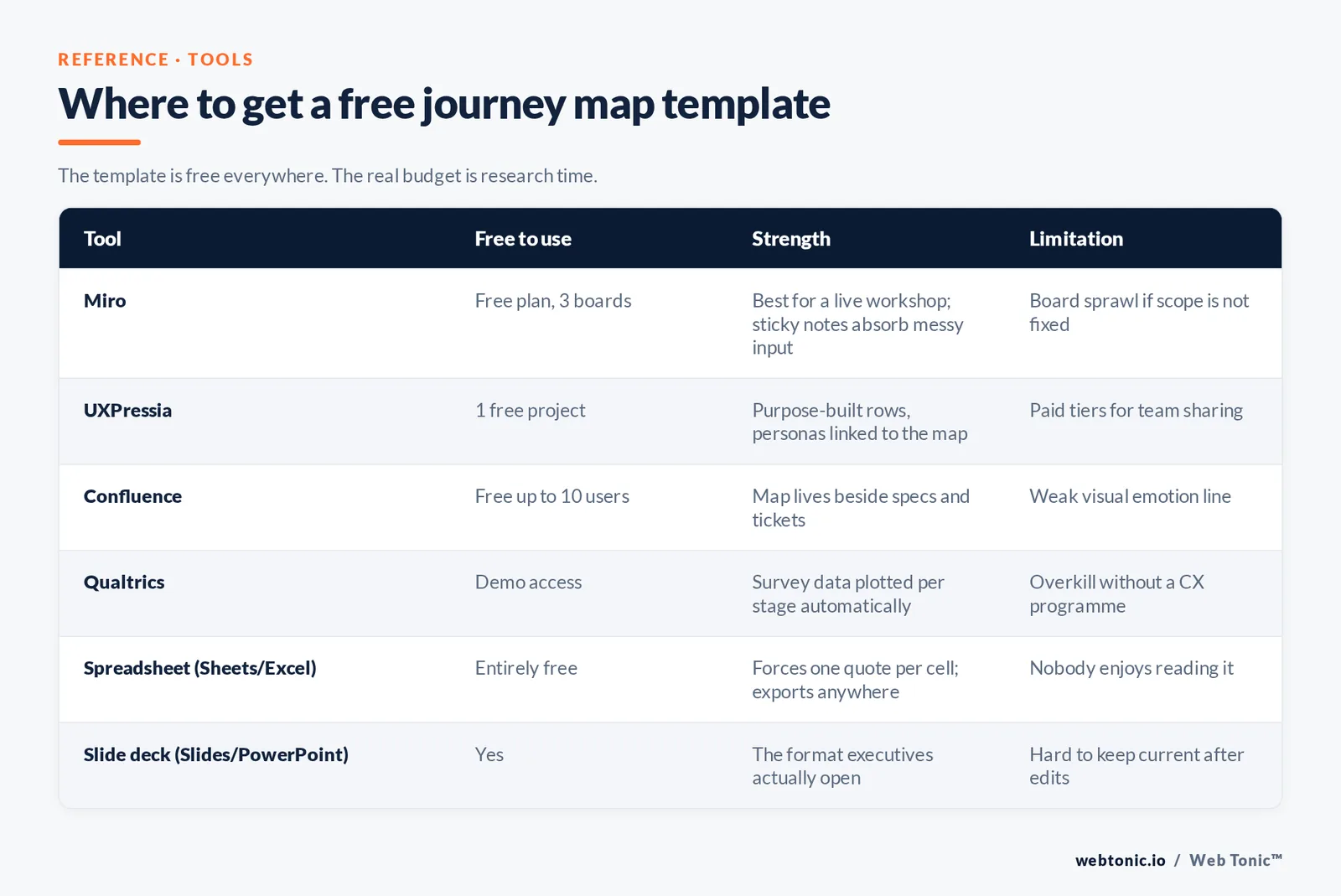
Tool choice changes what the template can do, not what the map means. Teams that need an editable, shareable customer journey map template usually start from one of six options — and the free tier is enough for a first map in every case.
| Tool | Template type | Free to download or use | Strength | Limitation |
|---|---|---|---|---|
| Miro | Whiteboard journey map template | Yes, free plan with 3 boards | Best for a live workshop; sticky notes absorb messy input | Board sprawl if scope is not fixed |
| UXPressia | Dedicated CJM and persona builder | Yes, 1 free project | Purpose-built rows, personas linked to the map | Paid tiers needed for team sharing |
| Confluence | Documentation page template | Yes, free up to 10 users | Map lives beside specs and tickets | Weak visual emotion line |
| Qualtrics | Experience management module | Demo access | Survey data plotted per stage automatically | Overkill without an existing CX programme |
| Spreadsheet (Sheets or Excel) | 10-row grid you build in 15 minutes | Yes, entirely free | Forces one quote or datapoint per cell; exports anywhere | Nobody enjoys reading it |
| Slide deck (Slides or PowerPoint) | One slide per stage plus a summary slide | Yes | The format executives actually open | Hard to keep current after edits |
Practical rule: build the map in the tool where the workshop happens, then publish a flattened version into the tool where decisions happen. Two artefacts, 1 source of truth, and a "last validated" date on both.
The companion templates worth pairing with a journey map
A customer journey map answers "what happens". Three adjacent templates answer the questions it leaves open, and using them together is what separates a design exercise from a product and service decision.
1. Persona template. The map needs one actor, and a persona built from research — goals, context, constraints, buying triggers — is what keeps the map from drifting into "all customers". Build the persona first, in a day, then map that person's day-to-day life around the purchase.
2. Empathy map template. Four quadrants — says, thinks, does, feels — filled from interview transcripts. It is a 30-minute warm-up that gives the emotion row of the journey map real language to work with instead of adjectives invented in the room.
3. Service blueprint template. Take the customer actions row from the current-state map and extend it downward through front-stage staff, back-stage staff, systems and policy. This is where a product or service team learns that the checkout problem is a fulfilment problem, and why blueprints are the natural second artefact after a first map exists.
Used in sequence — persona, empathy map, current-state journey map, service blueprint, future-state journey map — the set takes about 2 weeks and gives each team a view they can act on: design gets the experience, product gets the stages, operations gets the systems, and marketing gets the customer's own words for the copy.
How to read the map once it exists
A finished map is a diagnostic instrument, not a poster. Three readings extract most of the value.
Reading 1 — the emotional low point. Find the deepest dip, then check whether any team owns that stage. Unowned stages are where experience quietly fails, and Gallup's engagement research puts numbers on the internal side of that gap: 43% of employees feel personally responsible for the quality customers receive, up five points since 2024, while only 23% believe their organisation delivers on its promises.
Reading 2 — the handoff seams. Most pain points sit between teams, not inside them: marketing to sales, sales to onboarding, support to product. If your map's opportunity row keeps naming a single team, the research was probably run inside that team's silo. Harvard Business Review's customer experience coverage is a useful counterweight when a map is being used to defend an existing structure.
Reading 3 — the channel mismatch. Compare where customers say they want contact with where you actually spend. A map that shows evaluation happening on review sites and comparison pages while 90% of budget sits in bottom-funnel search is telling you something specific about where to shift spend, which is the kind of read our growth marketing and data intelligence teams run alongside the analytics.
Current state versus future state: the same template, read twice
The most common question after a first workshop is whether a team needs two templates or one. One customer journey map template covers both, filled twice with different rules.
The current-state customer journey map is evidence-only. Every action, quote and emotion in it came from a real customer, and any cell you cannot source stays visibly empty. Its job is diagnosis: where does the customer stall, and what does that cost. The future-state customer journey map reuses the same stages but replaces actions with intended actions and pain points with the capability required to remove them — a payment method, an integration, a staffing change, a self-service flow. Its job is a budget case, and it should carry a target metric per stage so the improvement is checkable in 90 days.
Two practical habits keep the pair useful. First, keep them side by side in the same file, so anyone can see what changes and why; a future-state map that lives alone quietly becomes a wish list. Second, date both. When customers, product or pricing move, the current-state map expires before the future-state one does, and a team that forgets that ends up designing improvements for a journey nobody takes any more.
For a small business with one product and one buyer type, the whole exercise is a single afternoon plus a week of customer calls. For a larger team, map the highest-revenue scenario first, ship the 3 agreed fixes, then map the next one — a portfolio of narrow maps beats one enormous diagram that no team owns.
Mistakes that make a journey map useless
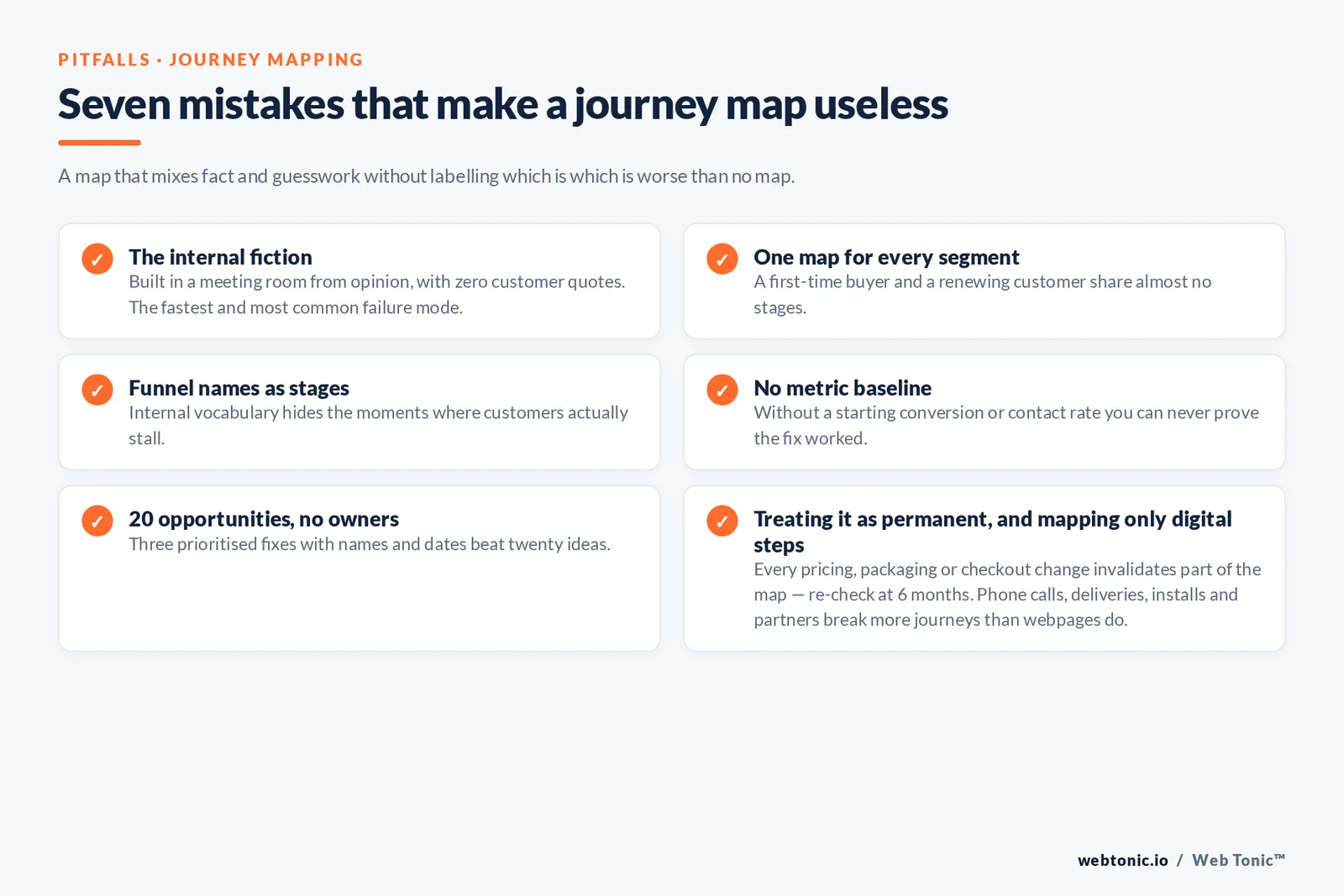
- Mistake 1 — the internal fiction. Built in a meeting room from opinion, with zero customer quotes. Fastest failure mode, and the most common.
- Mistake 2 — one map for every segment. A first-time buyer and a renewing customer share almost no stages.
- Mistake 3 — funnel names as stages. Internal vocabulary hides the moments where customers actually stall.
- Mistake 4 — no metric baseline. Without a starting conversion or contact rate you can never prove the fix worked.
- Mistake 5 — 20 opportunities, no owners. Limit 3: three prioritised fixes with names and dates beat twenty ideas.
- Mistake 6 — treating it as permanent. Every pricing, packaging or checkout change invalidates part of the map. Re-check at 6 months.
- Mistake 7 — mapping only the digital steps. Phone calls, deliveries, installs and third-party partners break more journeys than webpages do.
FAQ
What is a customer journey map template?
It is a reusable grid with the standard rows of a journey map already laid out — stages, actions, thoughts, emotions, pain points and opportunities — so a team fills in evidence instead of designing the framework. Templates exist as whiteboard boards, wiki pages, platform modules and plain spreadsheets, and all of them work if the research behind them is real.
Where can I find a free customer journey map template?
Miro, Confluence and Qualtrics all publish free journey mapping templates, and a 10-row spreadsheet does the same job with no tool commitment. Choose the tool your team already opens weekly; a map stored somewhere nobody visits stops influencing decisions within a month.
How long does it take to create a customer journey map?
Budget about one week end to end: roughly 8 hours of customer interviews, 3 hours pulling analytics and support data, and a 2 to 4 hour workshop to assemble the map. The workshop is the short part — teams that compress the research are the ones who end up with an internal fiction rather than a map.
What is the difference between a customer journey map and a service blueprint?
A journey map shows the customer's experience across stages. A service blueprint keeps that customer row and adds the front-stage staff, back-stage staff, systems and policies underneath it, so you can trace a bad moment to the process that caused it. Use the map to find the problem and the blueprint to fix its root cause.
How often should a journey map be updated?
Re-validate every 6 months as a default, and immediately after any change to pricing, packaging, checkout, onboarding or a major channel. Add a "last validated" date to the header block so nobody quotes an 18-month-old map in a roadmap review.
Need the map turned into shipped changes rather than a wall of sticky notes? Our services pages cover the research, analytics and build side, and you can get in touch for a walkthrough of how we run journey mapping with client data.
Sources: Nielsen Norman Group — Journey Mapping 101, Customer Journey Mapping, Service Blueprints · Interaction Design Foundation — Customer Journey Map topic · Miro — Customer Journey Map template · Atlassian Confluence — Customer Journey Mapping template · Qualtrics — Customer Journey Mapping · Zendesk — Customer journey map guide · Think with Google — Consumer journey research · Usability.gov — Personas · Gallup — Customer Engagement topic hub (Feb 2026) · Harvard Business Review — Customer Experience.