Table of contents
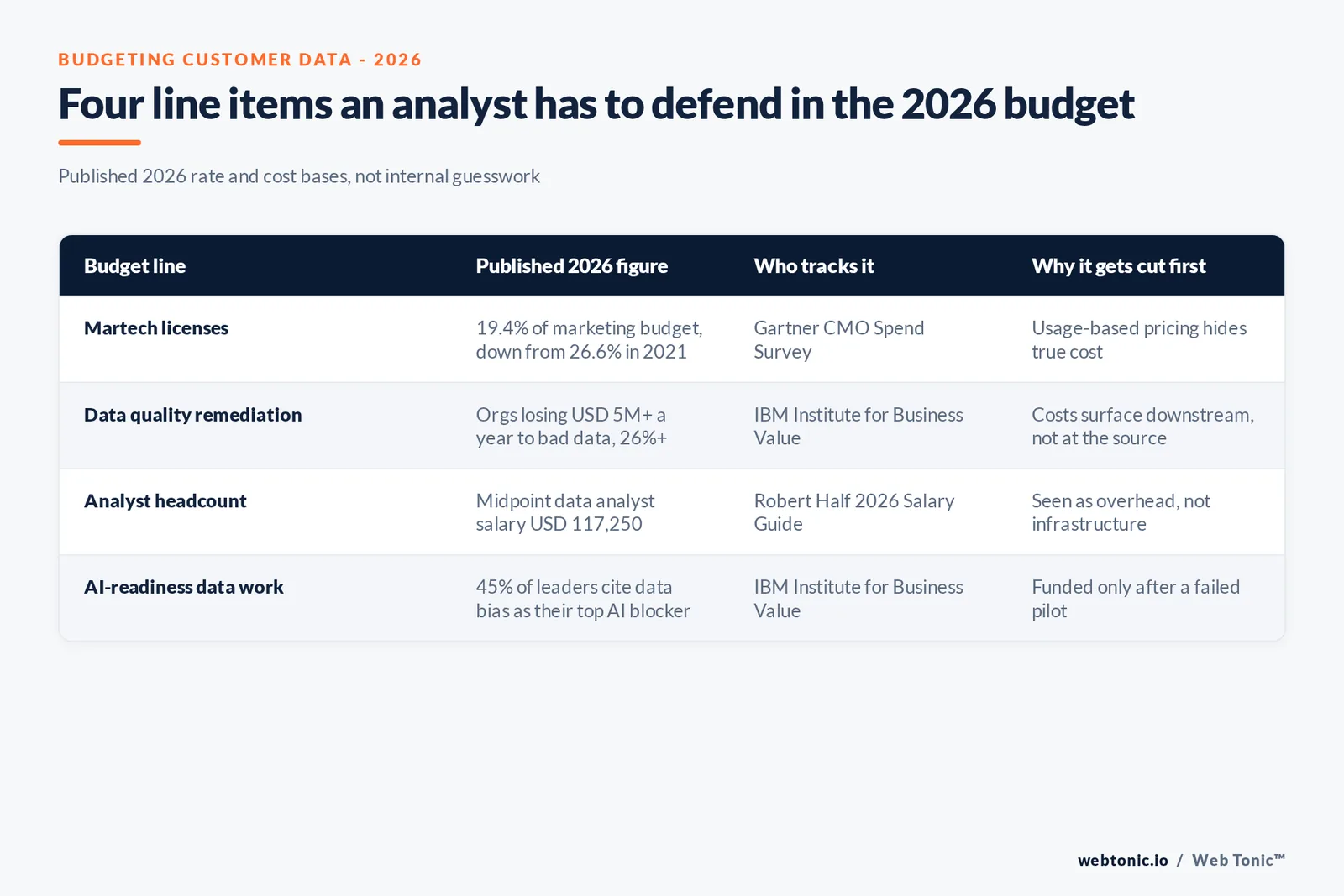
Customer data does not have its own budget line in any 2026 survey, so the honest way to size a request is to combine four adjacent numbers: what martech actually costs, what bad data costs when it is not funded, what the headcount costs, and what share of that is already committed to AI. Put together, they argue for funding data quality and headcount ahead of new platforms.
Key Takeaways
- Martech is 19.4% of the marketing budget in 2026, down from 26.6% in 2021.
- Total marketing budget sits at 7.8% of company revenue in 2026, barely up from 7.7% in 2025.
- 15.3% of the marketing budget now goes to AI specifically.
- Only 30% of CMOs feel ready to scale their AI capabilities.
- 62% of CMOs plan to increase martech investment anyway, despite the falling budget share.
- 56% increased their consumption-based martech allocation in the past year.
- Half of consumption-based adopters are continually renegotiating contracts to control costs.
- 43% of chief operations officers cite data quality as their top data priority.
- Over 25% of organizations lose USD 5 million or more a year to poor data quality.
- 7% of organizations lose USD 25 million or more a year to the same problem.
- 45% of business leaders cite data bias or accuracy as a leading blocker to scaling AI.
- The midpoint data analyst salary is USD 117,250 in the finance sector.
- The full analyst salary range runs USD 96,250 to USD 138,500 in that sector.
- 73% of customers now feel treated as unique individuals, up from 39% in 2023.
- Only 49% feel brands use their information in a genuinely beneficial way.
- Just 42% trust businesses to use AI ethically, down from 58% in 2023.
- Salesforce's report is built on over 16,500 survey respondents worldwide.
Why customer data has no budget line of its own
Every major 2026 marketing-budget survey tracks martech, paid media, headcount and AI as separate lines. Customer data work - collection, cleaning, governance, activation - is scattered across all four. The 2026 Gartner CMO Spend Survey, run across 401 CMOs, found total marketing budgets at 7.8% of company revenue, barely moved from 7.7% in 2025, while martech's share of that marketing budget hit a five-year low of 19.4%, down from 26.6% in 2021.
That falling share is happening while 62% of the same CMOs say they plan to invest more in martech, which only makes sense if the money for customer data infrastructure is being pulled from somewhere else in the budget rather than added on top. Coverage of the same survey puts it plainly: 70% of CMOs call becoming an AI leader a critical 2026 goal while also admitting their processes are not mature enough to scale it, and the Gartner analyst behind the study warned that "the risk is that CMOs invest in AI tools faster than they build the data foundations, processes, governance and talent required to scale them" - which is precisely the customer-data budget gap this page is about.
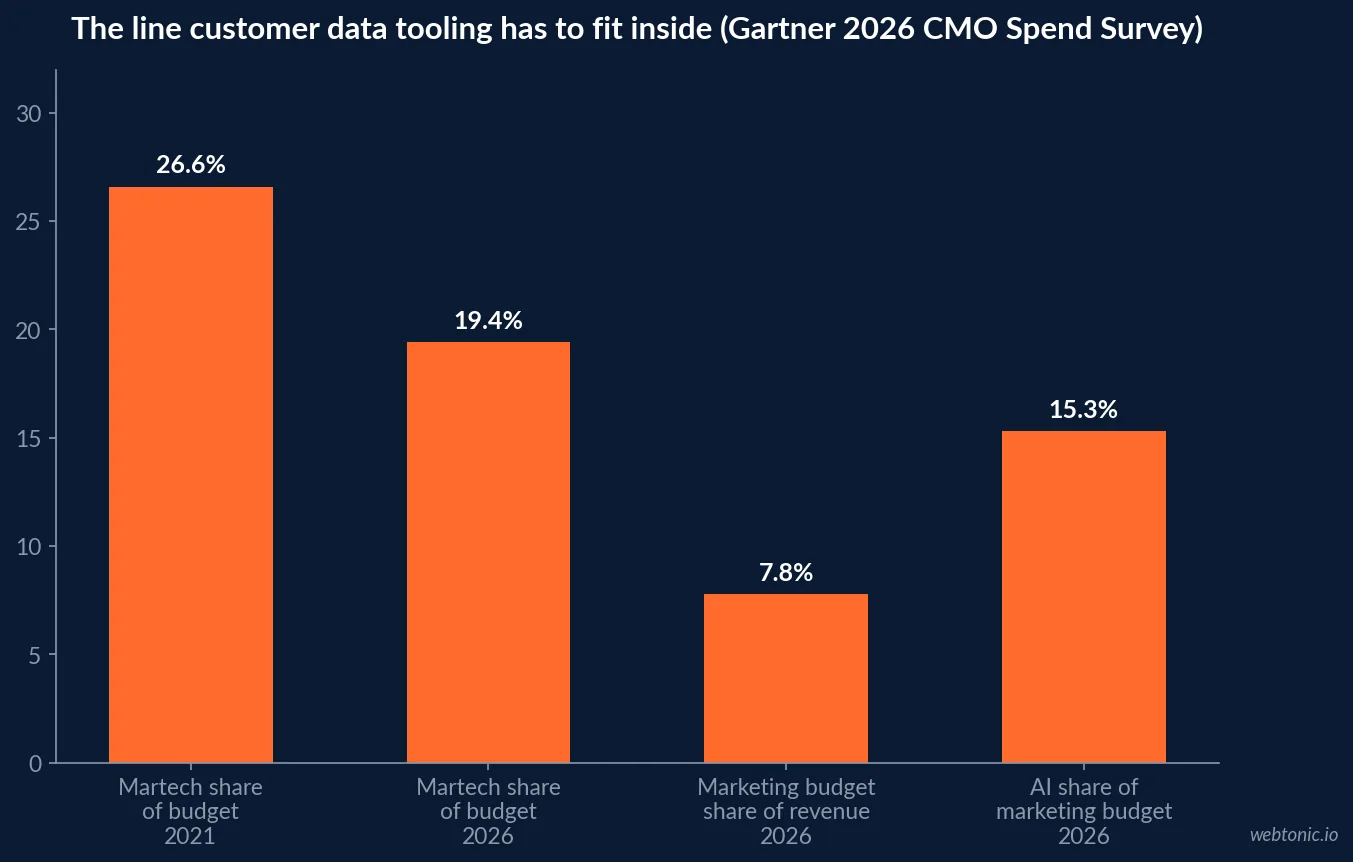
| 2026 budget fact | Figure | Source | What it means for a data request |
|---|---|---|---|
| Marketing budget as % of revenue | 7.8% | Gartner 2026 CMO Spend Survey | The pool the request draws from is flat |
| Martech share of marketing budget | 19.4%, down from 26.6% (2021) | Gartner 2026 CMO Spend Survey | Tooling budget is being displaced, not grown |
| AI share of marketing budget | 15.3% | Gartner 2026 CMO Spend Survey | AI is competing directly with data-quality spend |
| CMOs planning to increase martech spend | 62% of 401 surveyed | Gartner 2026 CMO Spend Survey | Intent exists; the pool has not grown to match it |
| Orgs ready to scale AI capabilities | Only 30% | Gartner 2026 CMO Spend Survey | Most requests should fund readiness, not new use cases |
The consumption-pricing trap that hides the real cost
Part of why martech's budget share looks smaller is a shift toward consumption-based, or usage-based, pricing: 56% of organizations increased their allocation to this model in the past year, against just 9% who decreased it. Gartner's own analysis flags the catch - this pricing model carries an administrative burden that a flat license fee does not, and half of organizations that adopted it are continually renegotiating contracts to avoid unexpected usage spikes. 41% have built or are building real-time cost controls, and 24% are overhauling systems specifically to reduce usage.
Budget for that oversight layer explicitly. A consumption-based data platform that looks cheaper on the quote can cost more than a flat license once the renegotiation and monitoring overhead is counted.
| Consumption-pricing behavior (2026) | Share of organizations | Source | Budget line it implies |
|---|---|---|---|
| Increased consumption-based martech allocation | 56% | Gartner CMO Spend Survey | Usage will keep growing |
| Decreased consumption-based allocation | 9% | Gartner CMO Spend Survey | A minority are pulling back |
| Continually renegotiating contracts | 50% | Gartner CMO Spend Survey | Contract management time and tooling |
| Building real-time usage controls | 41% | Gartner CMO Spend Survey | Monitoring dashboards and alerts |
| Overhauling systems to cut usage | 24% | Gartner CMO Spend Survey | Engineering time, not just a license fee |
What under-funding data quality actually costs
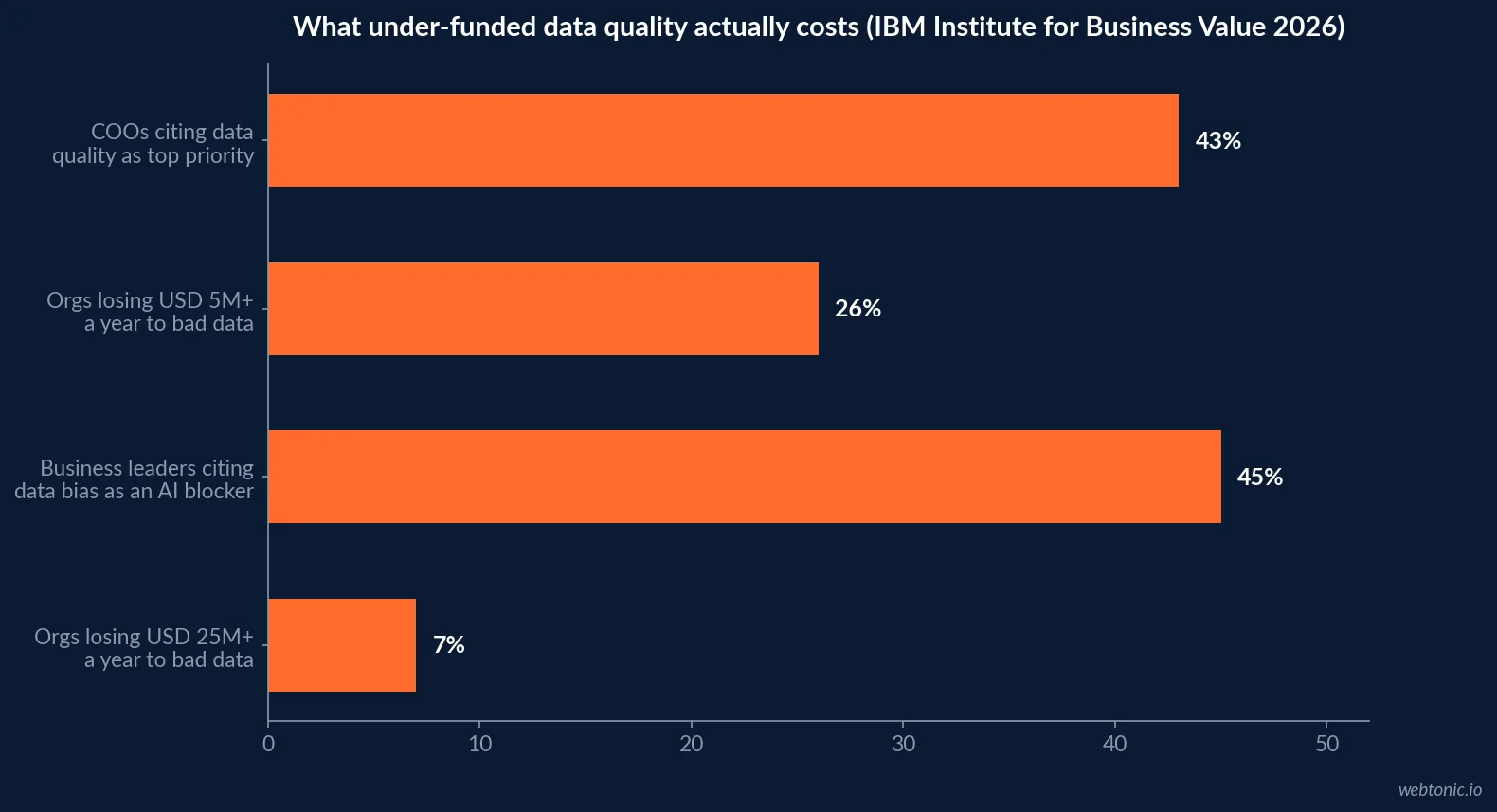
The strongest argument for a data-quality line item is not a tooling feature list, it is the cost of skipping it. IBM's Institute for Business Value found 43% of chief operations officers rank data quality as their single most significant data priority, and for good reason: over 25% of organizations estimate they lose more than USD 5 million annually to poor data quality, with 7% reporting losses of USD 25 million or more. The same research found data accuracy and bias concerns cited by 45% of business leaders as a leading barrier to scaling AI initiatives.
That cost rarely shows up as a line item labelled "bad data." It surfaces as lost revenue, compliance exposure and AI pilots that never reach production - which is exactly why it is under-funded relative to its actual size.
The headcount line most requests skip
Tooling requests are easier to write than headcount requests, which is part of why data teams stay thin relative to the data volume they manage. Robert Half's 2026 Salary Guide puts the midpoint data analyst salary in the finance sector at USD 117,250, with a full range of USD 96,250 to USD 138,500 depending on seniority and market. That is a materially smaller and more predictable annual commitment than a new enterprise data platform contract with usage-based pricing risk attached.
A budget request that pairs one analyst hire with a smaller, targeted tooling ask is easier to defend against the falling martech share than a large platform purchase alone - it converts a variable cost risk into a fixed, forecastable one.
| Role or line item | 2026 figure | Source | Budgeting note |
|---|---|---|---|
| Data analyst, finance sector, midpoint | USD 117,250 | Robert Half 2026 Salary Guide | Fixed, forecastable annual cost |
| Data analyst, finance sector, full range | USD 96,250-138,500 | Robert Half 2026 Salary Guide | Scales with seniority, not usage |
| Consumption-based platform, typical | Variable, usage-driven | Gartner CMO Spend Survey | Requires its own monitoring budget |
| Cost of one unfunded data-quality gap | USD 5M-25M+ a year | IBM Institute for Business Value | The number to compare against both of the above |
A benchmark for the customer-facing spend around that data
Data budgets do not sit in isolation from the customer success spend built on top of them. Gainsight's 2025 Customer Success Index, drawn from more than 400 companies, found a median customer success spend of roughly 3% of revenue among its most efficient operators, against approximately 8% among less mature ones - without a corresponding drop in retention outcomes. The efficient group also runs 13% higher AI adoption for outcome-driven use cases like churn prediction, and supports 25% to 70% more accounts per CSM depending on segment.
The pattern generalizes past customer success specifically: teams that fund the underlying data and workflow infrastructure first tend to spend less on the people-heavy layer above it, not more. That is the argument for sequencing a data-quality and governance budget ahead of a customer-success or advocacy headcount request, not after it.
| CS spend efficiency benchmark (Gainsight 2025 Index) | More efficient operators | Less efficient operators |
|---|---|---|
| Median CS spend as % of revenue | ~3% | ~8% |
| AI adoption for outcome-driven use cases | 13% higher | Baseline |
| Accounts per CSM, commercial/enterprise | ~25% more | Baseline |
| Accounts per CSM, SMB segment | ~70% more | Baseline |
What customers actually expect from that data
The budget case is not purely defensive. Salesforce's State of the AI Connected Customer report, built on over 16,500 survey respondents, found 73% of customers now feel treated as unique individuals, up sharply from 39% in 2023 - a direct result of better first-party data use. But only 49% feel brands use that information in a genuinely beneficial way, and trust that businesses will use AI ethically has fallen to 42%, down from 58% in 2023.
Personalization is improving faster than trust is. A budget that funds activation without funding the transparency and governance work behind it will keep widening that gap, not closing it.
| Customer sentiment (2026, Salesforce) | 2026 figure | 2023 comparison | Gap it points to |
|---|---|---|---|
| Feel treated as a unique individual | 73% | 39% | Personalization has genuinely improved |
| Feel their data is used beneficially | 49% | Not directly comparable | Value exchange still feels one-sided |
| Trust businesses to use AI ethically | 42% | 58% | Trust is falling as AI use expands |
| Total survey base | 16,500+ respondents | N/A | One of the largest named datasets on this question |
A defensible 2026 budget structure
Given the evidence, the request that survives budget season is not the largest one, it is the one structured against the biggest documented cost of inaction first. Fund data-quality remediation before new activation tooling, since IBM's figures put that at up to USD 25 million a year in exposure. Fund one analyst headcount before a second platform contract, since the salary line is smaller and fixed against a usage-based platform's variable one. And fund the transparency and governance work behind personalization, since Salesforce's trust numbers show that gap is currently widening, not closing.
Our data and analytics practice builds that governance layer before recommending new platform spend, and our growth marketing team can model where in the funnel better first-party data actually moves a number worth reporting back to finance.
How to present the request
Lead with the cost of inaction figure from IBM, not a vendor's feature comparison. Pair it with the Gartner budget-share trend so the request acknowledges the flat pool it is competing for, and close with the Salesforce trust gap so the ask is framed as protecting revenue and trust, not just adding a tool. That sequence - cost of inaction, budget context, customer stakes - tends to survive a CFO review better than a platform-first pitch.
If you want a second read on your specific request before it goes to finance, talk to us, or see how we scope this work in our breakdown of what a comparable paid media budget actually costs to benchmark against.
Frequently Asked Questions
How much should a company budget for customer data work in 2026?
There is no single published figure for 'customer data' as its own line, so the honest answer is a composite. The Gartner 2026 CMO Spend Survey puts total marketing budget at 7.8% of company revenue and martech specifically at 19.4% of that marketing budget, down from 26.6% in 2021. Customer data tooling, quality remediation and headcount all draw from that shrinking martech share, which is why the request has to be justified against a cost of inaction, not just a tooling wish list.
What does bad customer data actually cost?
IBM's Institute for Business Value found that over a quarter of organizations lose more than USD 5 million a year to poor data quality, with 7% losing USD 25 million or more, and that 43% of chief operations officers now rank data quality as their single most significant data priority. That is the number to put next to a tooling request - the cost of not funding data quality work, not just the cost of the fix.
Should the budget prioritize new tools or headcount?
Headcount, on current evidence. Gartner reports martech's share of the marketing budget at a five-year low even as 62% of surveyed CMOs plan to spend more on it, which signals organizations are already tool-heavy and under-staffed to run what they have. Robert Half's 2026 guide puts the midpoint salary for a data analyst role in the finance sector at USD 117,250, a smaller and more predictable line than a new platform contract with usage-based pricing risk attached.
What is the single biggest blocker to using customer data for AI?
Data quality and governance, not model capability. IBM's research found data accuracy or bias concerns are cited by 45% of business leaders as a leading barrier to scaling AI initiatives, ahead of most technology-capability concerns. Budget for data cleanup and governance before budgeting for AI use cases that depend on that data being trustworthy.
Is consumption-based pricing a safe way to control the data budget?
Only with active oversight. Gartner found 56% of organizations increased their consumption-based martech allocation in the past year, but also found half of all organizations using that pricing model are continually renegotiating contracts to avoid unexpected cost spikes. Budget for the oversight tooling and process, not just the consumption-based line item itself.
Sources
Chief Marketer - Gartner 2026 CMO Spend Survey coverage
IBM Institute for Business Value - The True Cost of Poor Data Quality, 2026
Robert Half - 2026 Data Analyst Salary Trends
Salesforce Research - State of the AI Connected Customer, 7th edition
The State of AI Marketing - Gartner 2026 CMO Spend Survey AI budget readiness gap coverage
Gainsight - 2025 Customer Success Index: what CS teams are prioritizing in 2026