Table of contents
The honest 2026 answer is: worth it if you run it like a measured program, not worth it if you run it like a content request line. The only publicly documented ROI study on the category reports a 355% three-year return, but the behavioural data on how these programs actually run in 2026 shows most of them under-using their most valuable layer: management, not the C-suite and not the rank and file.
Key Takeaways
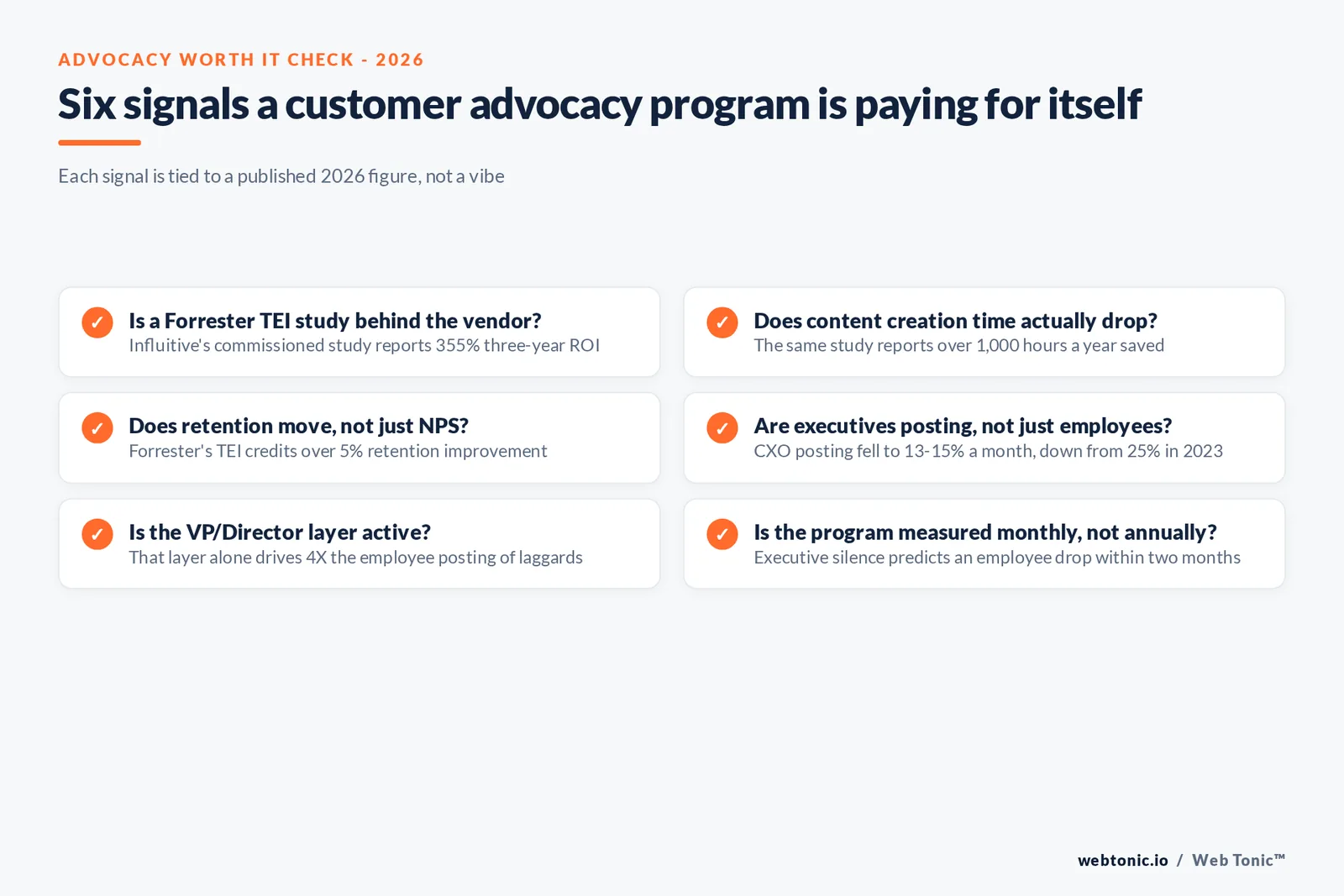
- Forrester's TEI study on Influitive found a 355% three-year ROI.
- The same study reports over 1,000 hours a year saved on content creation.
- Customer retention improved by more than 5% in that study.
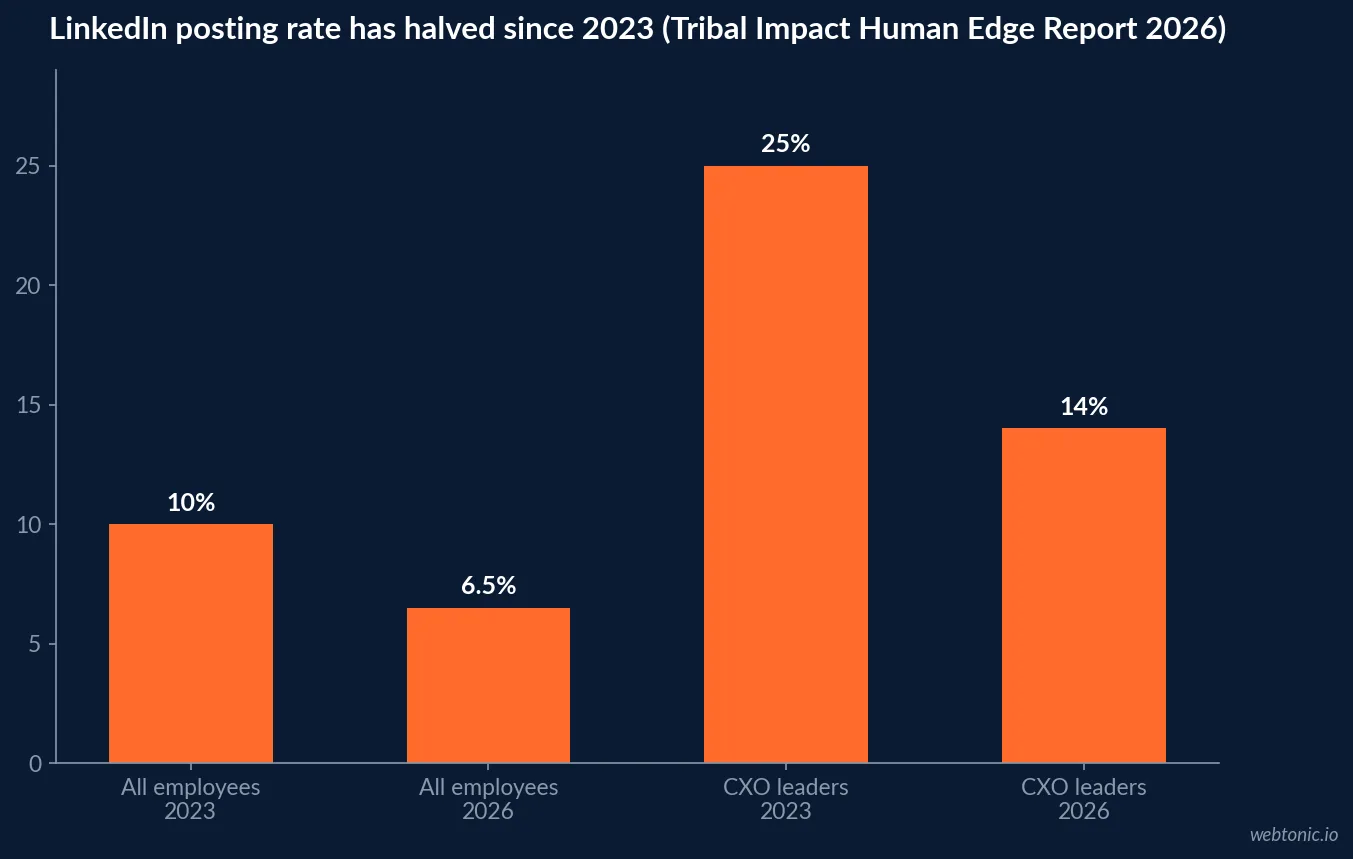
- Employee LinkedIn posting sits at 6 to 7% a month in 2026, down from about 10% in 2023.
- CXO posting fell to 13 to 15% a month, down from 25% in early 2023.
- 70% of tracked companies have seen CXO activity fall since 2023.
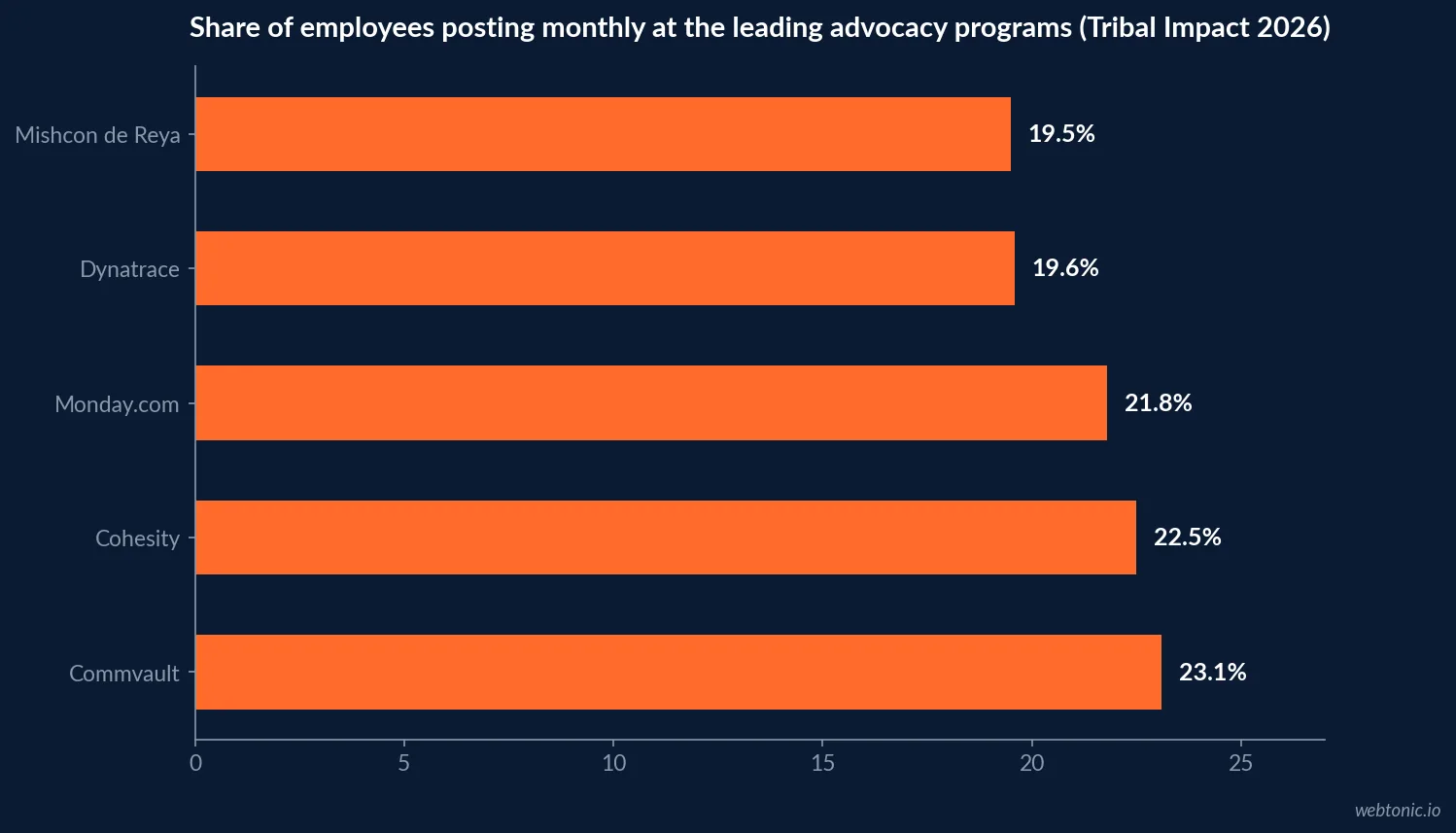
- Commvault leads the dataset at 23.1% of employees posting monthly.
- A 15%+ monthly posting rate is roughly double the global baseline.
- The VP/Director layer drives 4X the employee posting of the least active companies.
- C-suite activity carries a smaller 2.6X multiplier on the same comparison.
- Executive silence predicts an employee drop within two months in 82% of companies tracked.
- DSMN8's 2026 benchmark study covers 200 programs, from Cisco to Toyota.
- That report drew on 187 respondents surveyed August 2025 to January 2026.
- Referral-benchmarked CAC runs far below paid-channel CAC in vendor-published comparisons.
- Communities can deflect a meaningful share of support tickets, per published vendor case data.
- Case studies remain the most requested advocacy asset across surveyed programs.
- Formal, dedicated-headcount programs are described as the 2026 norm at scaled B2B firms.
The one ROI number that is actually documented
Most "advocacy pays for itself" claims trace back to vendor case studies with no named methodology. One exception: Influitive commissioned Forrester Consulting for a Total Economic Impact (TEI) study, a named framework with a named analyst, that found a 355% three-year ROI, over 1,000 hours a year saved by consolidating content creation, and a retention improvement above 5%.
That is a single vendor-commissioned study on a single platform, which is exactly why it is worth citing by name rather than repeating as an industry average. Ask any vendor you evaluate whether they have an equivalent third-party study before budgeting against a number this specific.
| What the TEI study measured | Reported result | Source | How to read it |
|---|---|---|---|
| Three-year return on investment | 355% | Forrester Consulting TEI, commissioned by Influitive | A ceiling case, not an industry norm |
| Content-creation hours saved annually | 1,000+ hours | Same TEI study | Value came from consolidation, not new headcount |
| Customer retention improvement | 5%+ | Same TEI study | Retention, not just NPS, moved |
| Payback period | Under 6 months (vendor-reported) | Influitive resource page | Verify against your own contract term, not the vendor's |
What the behavioural data shows instead of survey answers
Most advocacy benchmarks are self-reported: a program manager describing what their organization says it does. Tribal Impact's Human Edge Report instead tracked the actual LinkedIn posting behavior of 860 global B2B companies every month for 40 months. The 2026 baseline: 6 to 7% of employees post in an average month, down from roughly 10% in early 2023.
Executive posting fell further and faster. CXO-level posting sits at 13 to 15% a month in 2026, down from 25% in early 2023, and 70% of tracked companies have seen executive activity decline since then. A company running above 15% employee participation is, per this dataset, operating at roughly twice the global baseline.
| Layer of the organization | 2026 average posting rate | 2023 average | Trend |
|---|---|---|---|
| All employees | 6-7% a month | ~10% a month | Falling |
| CXO-level leaders | 13-15% a month | 25% a month | Falling faster |
| Top-decile company (Commvault) | 23.1% of all employees | Not tracked in 2023 dataset | Well above baseline |
| Top-decile executives (Commvault) | 52.9% of C-level leaders | Not tracked in 2023 dataset | Roughly half the C-suite active |
Why the VP layer, not the C-suite, decides the outcome
The intuitive fix for a quiet program is more executive posting. The data disagrees. Tribal Impact's dataset finds companies with the most active VP and Director layer see 4 times the employee posting of the least active companies, compared with a 2.6 times multiplier for equivalent C-suite activity. Management sits close enough to daily work to post credibly and senior enough that employees follow the example.
Executive activity still matters, but through a different mechanism: when leaders go quiet, employees follow within roughly two months in 82% of the companies tracked. Treat executive posting as a leading indicator to watch, and the management layer as the lever to actually pull.
What "formal" actually means in the 2026 benchmark
DSMN8's Employee Advocacy Benchmark Report 2026, drawn from 187 respondents surveyed between August 2025 and January 2026 across 200 programs including Cisco, Capgemini, Nissan and Toyota, frames the 2026 default as structured and proactive: dedicated headcount, defined contribution pathways such as case studies and speaking placements, and reference calls tied to specific deal stages rather than ad-hoc requests.
That structural shift is the reason the ROI question has sharpened. A reactive, unstaffed advocacy motion has no budget line to defend. A staffed, tool-backed one does, which is exactly why the Forrester TEI study exists in the first place - someone had to justify the line item.
| Program shape | 2023-era default | 2026 default (DSMN8 2026) | Budget implication |
|---|---|---|---|
| Ownership | Shared across marketing | Named advocacy or customer marketing manager | Dedicated headcount line |
| Trigger | Sales requests a case study | Structured contribution pathway with defined stages | Requires a tracked pipeline |
| Assets produced | Occasional case studies | Case studies, reviews, speaking slots, reference calls | Broader content and events budget |
| Measurement | Anecdotal wins shared internally | Participation tracked alongside retention | Needs a reporting cadence |
The acquisition-cost argument, treated carefully
Proofmap's 2026 ROI compilation names a second documented case alongside Influitive's: a Forrester-measured 415% three-year ROI for UserTesting, and a USD 5.4 million estimated ROI value from Cisco's "Gateway" advocacy program, which Cisco itself reports ran at a 60% advocate engagement rate. The same compilation cites illustrative referral-CAC and ticket-deflection benchmarks that are not independently sourced the way the TEI studies are, so treat those specific figures as a pattern worth testing on your own numbers rather than a citable industry constant.
Separately, the Customer Marketing Alliance's own State of Customer Marketing survey found formal advocacy program ownership climbed to 52.2% of respondents, up from 39.3% the year before, with 52.8% now managing the program through a dedicated customer or advocacy management tool rather than spreadsheets. Case studies remained the most-cited impact area at 37.1% of responses, ahead of referrals at 17.1%.
| Named ROI case | Reported result | Methodology | Source |
|---|---|---|---|
| Influitive | 355% three-year ROI | Forrester Consulting TEI, commissioned study | Influitive resource page |
| UserTesting | 415% three-year ROI | Forrester Consulting TEI, commissioned study | Proofmap compilation, citing Forrester |
| Cisco ("Gateway" program) | USD 5.4 million estimated ROI, 60% advocate engagement | Vendor-published case study | Proofmap compilation, citing Cisco/B2B Marketing |
What replaces a case study as the advocacy asset in 2026
Speaking placements, structured reference calls tied to deal stage, and community contribution roles where advocates answer peer questions directly in the professional communities buyers already research in. DSMN8's 2026 benchmark frames these as additive to, not a replacement for, case studies - programs increasingly run several contribution formats in parallel rather than defaulting to one.
The practical consequence for budgeting: a 2026-shaped program needs event and community tooling alongside the case-study production workflow most 2023-era programs already had, which is part of why headcount has become the norm rather than a shared responsibility.
| Advocacy asset | 2023-era usage | 2026 status | What it demands from the budget |
|---|---|---|---|
| Written case studies | Primary asset | Still core, now process-driven | A repeatable production workflow |
| Structured reference calls | Ad-hoc, sales-driven | Tied to specific deal stages | CRM tagging and a defined trigger |
| Speaking placements | Rare, opportunistic | A named contribution pathway | Event and travel budget |
| Community answer roles | Not tracked | A measured participation channel | A moderated community platform |
The honest budgeting framework
Given one credibly documented ROI case and a clear behavioural gap in how most programs actually run, the defensible 2026 approach is a staged bet, not a full build. Fund the headcount and the measurement first, since DSMN8's data shows structure is what separates 2026-shaped programs from 2023-era ones. Fix the management-layer posting gap before adding budget for new advocacy tooling, since that layer carries the largest multiplier in Tribal Impact's dataset. Only then evaluate a platform purchase against its own named TEI or equivalent study, using Influitive's 355% figure as a ceiling reference rather than a floor guarantee.
Our growth marketing practice builds the measurement layer - retention and reference-pipeline tracking - before recommending which advocacy motion, if any, deserves new tooling spend.
Where this connects to the rest of the customer data stack
Advocacy programs live or die on retention and reference data that usually sits in a CRM or customer success platform rather than the advocacy tool itself. Gainsight's 2026 Digital Customer Success Index tracks exactly this shift: teams are asked to move past engagement metrics toward measurable revenue outcomes, which is the same standard the Forrester TEI study applied to Influitive. If your CRM cannot connect an advocate's activity to a renewal or expansion event, no advocacy platform purchase will fix the measurement problem underneath it.
Before signing a platform contract, confirm the reporting pipeline exists to answer the retention question in six months, not just to count monthly active advocates.
What to ask before renewing or buying
Request the vendor's own third-party ROI study, not a customer quote. Check your management layer's posting rate against the 6 to 7% employee baseline and the 13 to 15% CXO baseline before assuming a quiet program is a tooling problem. And tie the contract renewal date to a retention or reference- pipeline review, not a login-count report, since login counts are exactly the vanity metric the 2026 benchmark data shows programs are moving away from.
If you want the retention and reference-tracking layer built before you evaluate advocacy tooling, talk to us, or read how our data and analytics practice connects CRM activity to renewal outcomes.
Frequently Asked Questions
Are customer advocacy programs still worth it in 2026?
On the only publicly documented case, yes. Influitive commissioned Forrester Consulting for a Total Economic Impact study that found a 355% three-year ROI, over 1,000 hours a year saved on content creation, and a retention improvement above 5%. That is one vendor-commissioned study, not an industry average, so treat it as a ceiling case rather than a guarantee, and ask any platform you evaluate for its own third-party TEI or equivalent before you budget against that number.
What does a formal advocacy program actually require in 2026?
Named headcount with a specific remit, a defined path that moves a customer from satisfied to contributing, and participation measured alongside retention rather than counted on its own. DSMN8's 2026 Employee Advocacy Benchmark Report, built from 200 programs including Cisco and Toyota, frames the shift as programs maturing past ad-hoc case-study requests into structured, always-on motions.
Should employees or executives post more?
Executives, and the data says most companies have this backwards. Tribal Impact's Human Edge Report, tracking 860 B2B companies' actual LinkedIn activity for 40 months, found CXO posting fell to 13 to 15% a month in 2026 from 25% in early 2023, and that a drop in executive posting predicts an employee drop within two months in 82% of the companies tracked. Fix the top of the funnel before recruiting more rank-and-file advocates.
Which layer of the company matters most for an advocacy program?
The VP and Director layer, not the C-suite and not the general employee base. Tribal Impact's dataset shows companies with the most active VP/Director layer get 4 times the employee posting of the least active ones, against a 2.6 times multiplier for C-suite activity. That layer sits close enough to day-to-day work to post credibly and senior enough that employees follow.
How do you measure if a program is failing?
Track the posting rate against the 2026 baseline of 6 to 7% of employees a month, not against last year's own number in isolation - the baseline itself fell from roughly 10% in early 2023, so flat internal numbers can still mean relative decline. Then check whether retention or reference-driven pipeline moved at all; a program with rising posts and flat retention is a content operation, not an advocacy program.
Sources
Influitive / Forrester Consulting - Total Economic Impact study, 355% ROI
Tribal Impact - The Human Edge Report, 2026 employee advocacy behavioural benchmark
DSMN8 - Employee Advocacy Benchmark Report 2026
Gainsight - The (D)CS Index Report 2026
Robert Half - 2026 Data Analyst Salary Trends
Proofmap - Measurable ROI of Customer Advocacy Programs, 2026
Customer Marketing Alliance - State of Customer Marketing survey