Table of contents
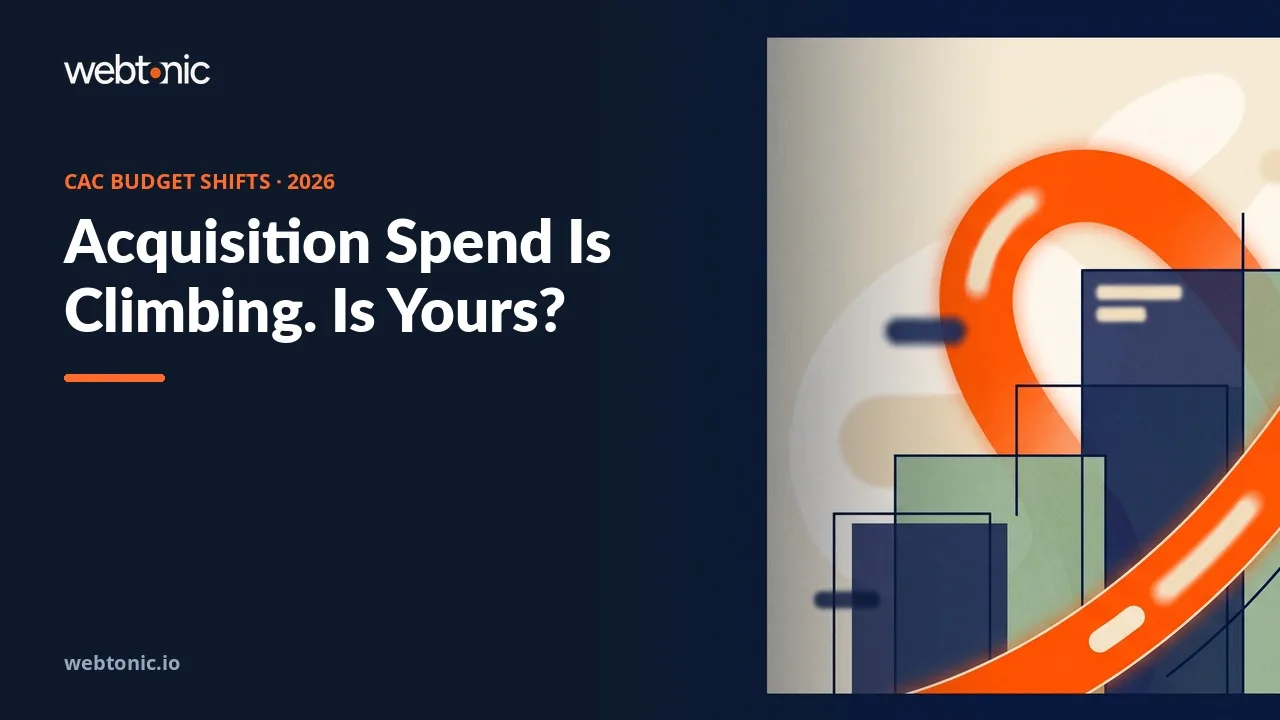
Two independent 2026 surveys, Gartner's CMO Spend Survey and IAB's September outlook, point at the same budget shift: acquisition spend is climbing past 62% of media investment while retention and loyalty funding shrinks. This page tracks where that budget is actually moving and what it costs per channel once it gets there.
Key Takeaways
- Acquisition and conversion now account for 62.6% of media spend.
- That is a rise of more than 10 points since 2024.
- Loyalty and retention spend fell 29% over the same period.
- Retention now sits under 15% of media spend.
- Customer acquisition rose 9 points in importance since January 2026.
- Labor's share of marketing budget rose from 21.9% to 24.5%.
- Martech's budget share hit a five-year low.
- 62% of CMOs planned to invest more in martech regardless.
- The cheapest B2B channel in 2026 costs USD 468 per customer.
- The most expensive, account-based marketing, costs USD 4,664.
- That is roughly a 10x spread across channels.
- 44% of CMOs outperformed their customer acquisition goals.
- Last year that figure was lower, at 43% missing goals outright.
- 73% of CMOs report high or overly ambitious growth expectations.
The budget shift, in one number
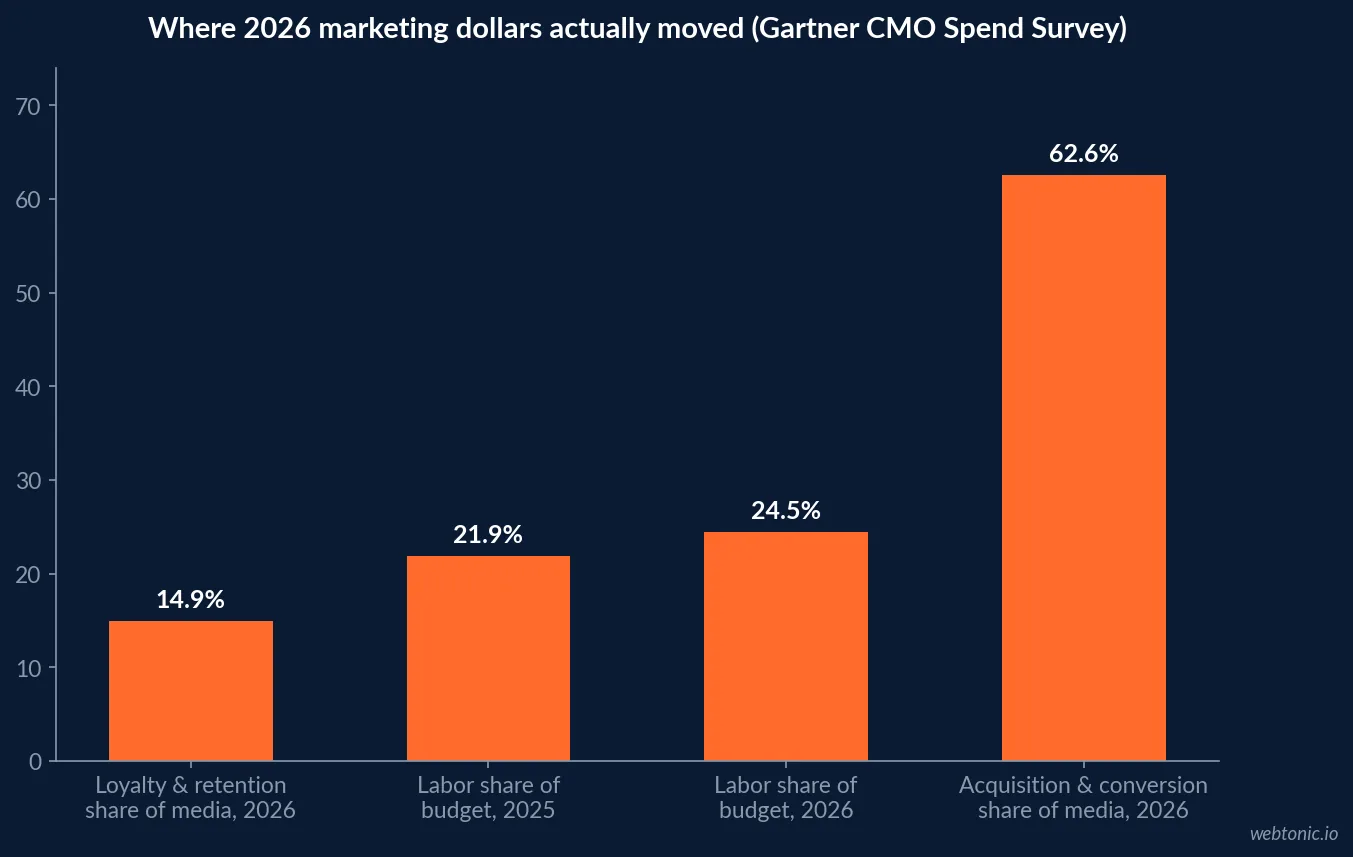
Gartner's 2026 CMO Spend Survey, covering 401 CMOs and reported via Martech.org, found that awareness and conversion activities now account for 62.6% of total media spending - a rise of more than 10 percentage points since 2024. Over the same window, investment in customer loyalty and retention has fallen 29% and now sits at under 15% of media spend. Chief Marketer's coverage of the same survey adds that 62% of CMOs planned to invest a larger share of their budget in martech regardless of the pullback elsewhere.
| Budget line (2026) | Figure | Change vs. 2024/2025 | Source |
|---|---|---|---|
| Acquisition & conversion share of media | 62.6% | +10 points vs. 2024 | Gartner CMO Spend Survey, 2026 |
| Loyalty & retention share of media | Under 15% | -29% vs. 2024 | Gartner CMO Spend Survey, 2026 |
| Labor share of marketing budget | 24.5% | Up from 21.9% in 2025 | Gartner CMO Spend Survey, 2026 |
| Martech share of marketing budget | Five-year low | Down from 26.6% in 2021 | Gartner CMO Spend Survey, 2026 |
| CMOs planning more martech investment | 62% of 401 CMOs | Despite the budget share decline | Chief Marketer, 2026 |
IAB's independent read: acquisition is back as the top goal
IAB's 2H 2026 Ad Spend Outlook Study, surveying senior buyers in September 2026 against a January 2026 baseline, found customer acquisition rose 9 points in importance as a top media-investment goal, with brand equity gaining 6 points while repeat-purchase goals held flat. IAB frames the shift as buyers responding to elevated inflation and near-record-low consumer sentiment by doubling down on winning new customers rather than defending an existing base - the same directional read as Gartner's budget-allocation data, from an independent survey instrument.
Two surveys measuring different things - budget allocation and stated investment priorities - landing on the same acquisition-first conclusion is a stronger signal than either alone.
| Media investment goal | Change since January 2026 | Source |
|---|---|---|
| Customer acquisition | +9 points in stated importance | IAB, September 2026 |
| Brand equity | +6 points in stated importance | IAB, September 2026 |
| Repeat purchases / retention | Held flat | IAB, September 2026 |
| Media efficiency as a stated goal | Growth slowing after near-doubling since 2024 | IAB, September 2026 |
What acquisition actually costs, channel by channel
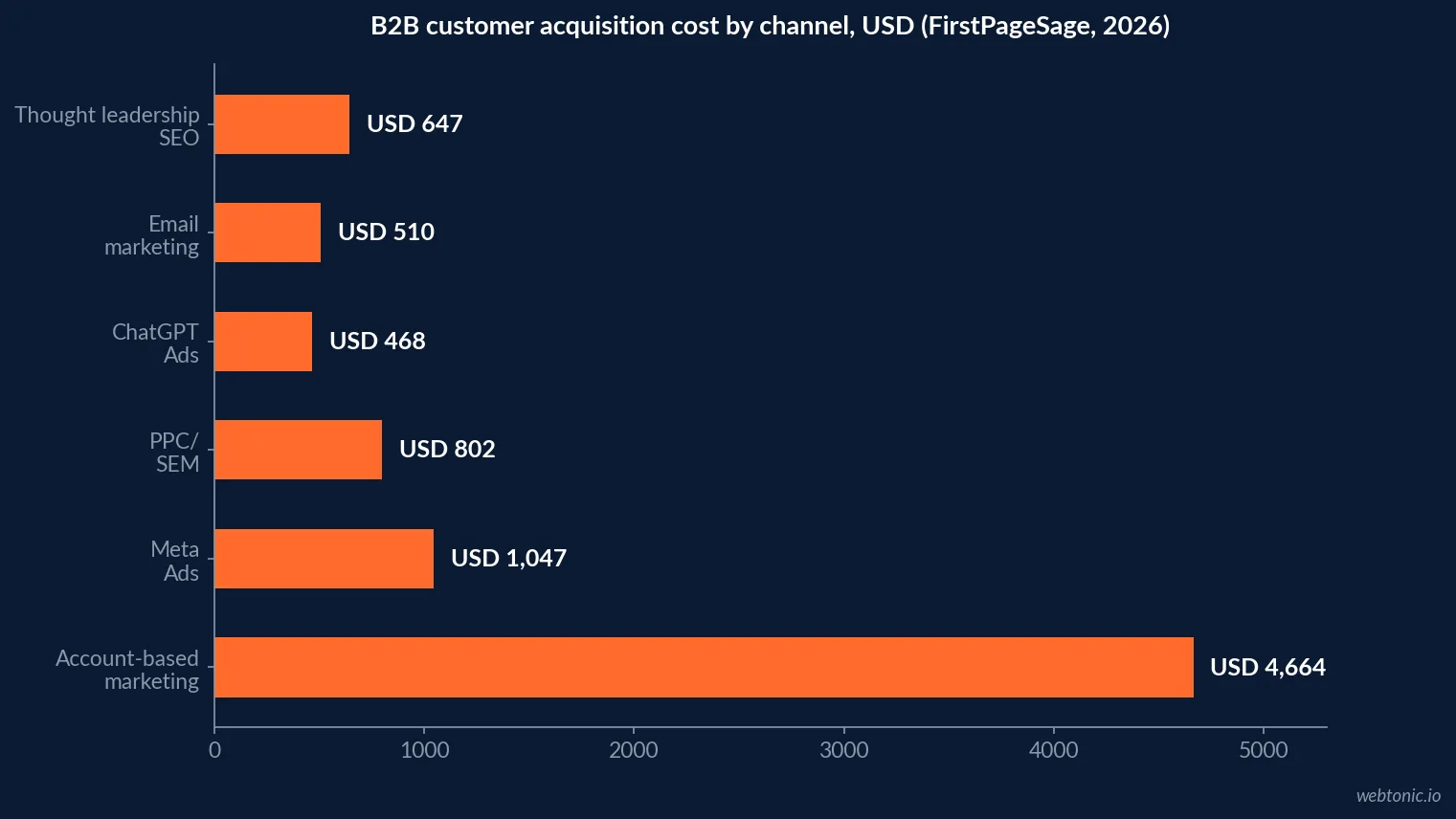
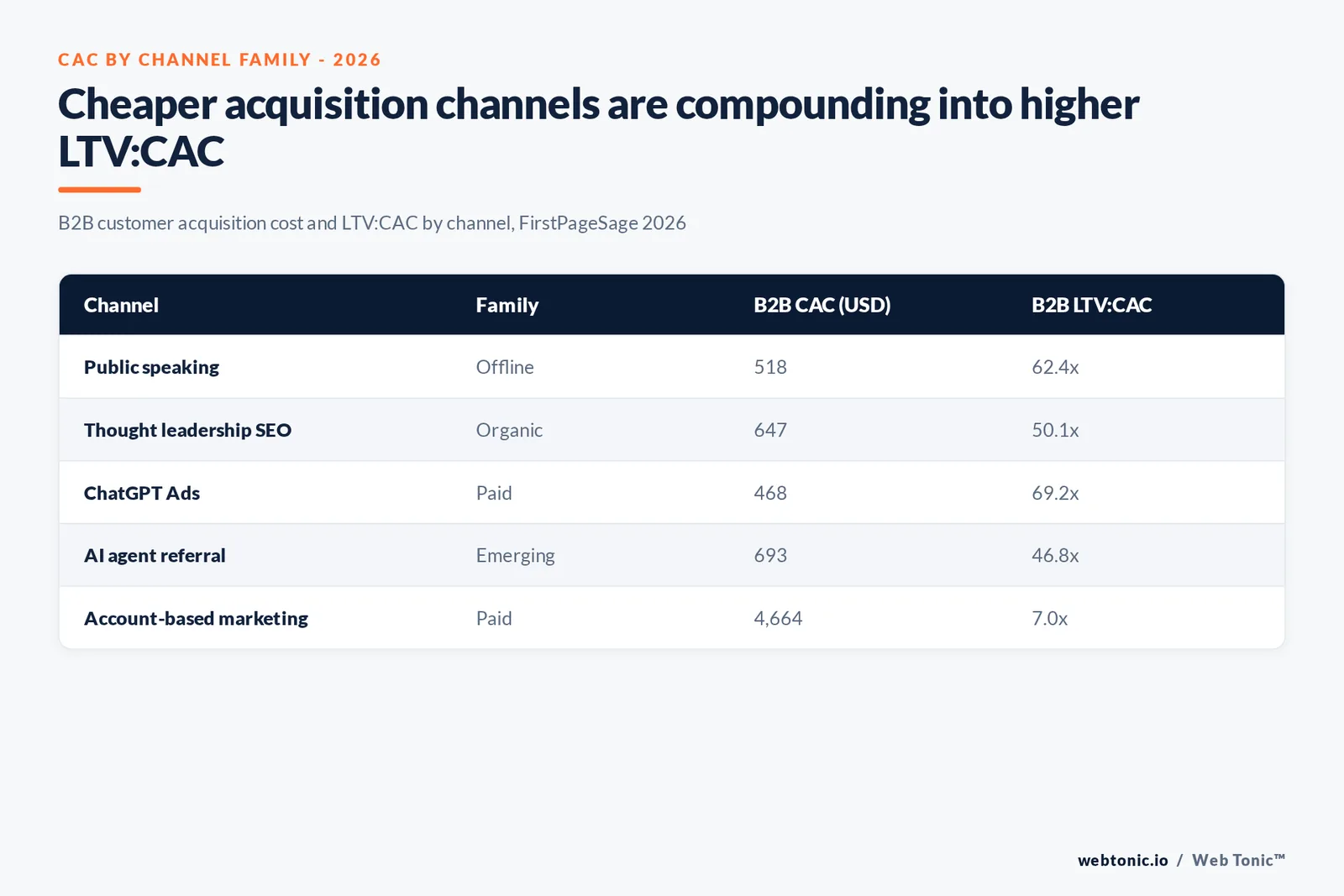
Rising acquisition budgets do not change the underlying cost per channel, and that cost still varies by roughly 10x. FirstPageSage's 2026 analysis of marketing spend and acquisition data from 214 companies (137 B2B, 77 B2C) puts ChatGPT Ads at the lowest B2B CAC in the study, USD 468, roughly 42% below PPC/SEM - though on a seven-week sample rather than a full year. Public speaking (USD 518), email marketing (USD 510) and thought-leadership SEO (USD 647) all land well under PPC/SEM's USD 802 and Meta Ads' USD 1,047. Account-based marketing sits at the top of the range, USD 4,664, reserved for high-ticket accounts where a single closed deal justifies the spend.
| Channel | Channel family | B2B CAC (USD) | B2B LTV:CAC |
|---|---|---|---|
| ChatGPT Ads | Paid | 468 | 69.2x |
| Email marketing | Organic | 510 | 63.6x |
| Public speaking | Offline | 518 | 62.4x |
| Thought leadership SEO | Organic | 647 | 50.1x |
| PPC/SEM | Paid | 802 | 40.4x |
| Meta Ads | Paid | 1,047 | 31.0x |
| Account-based marketing | Paid | 4,664 | 7.0x |
The tension: bigger acquisition budgets, uneven acquisition efficiency
A bigger acquisition budget is not automatically a lower blended CAC. WordStream's 2026 PPC benchmarks, built from thousands of Google Ads and Microsoft Ads campaigns, still show wide variance in cost per lead across roughly 20 industries even within the single paid-search channel - meaning the budget shift documented above can just as easily fund more spend in an inefficient channel as it can fund a genuinely lower CAC. HubSpot's CAC glossary puts the healthy target range at a 3:1 to 5:1 LTV:CAC ratio for SaaS, which every channel in FirstPageSage's B2B table above clears by a wide margin except account-based marketing.
That is the practical takeaway from the budget-shift data: more dollars are chasing acquisition in 2026, so the channel-selection decision matters more this year, not less, because a mediocre channel choice now absorbs a larger share of a larger budget.
| Signal | 2026 figure | What it means for a CAC-heavy budget | Source |
|---|---|---|---|
| CMOs exceeding acquisition goals | 44% | Slightly ahead of last year's pace | Gartner CMO Spend Survey, 2026 |
| CMOs missing acquisition goals last year | 43% ranked it a top-3 shortfall | Acquisition was already under pressure | Gartner CMO Spend Survey, 2026 |
| C-suite growth expectations rated high/ambitious | 73% of all CMOs | Budget shift is under real pressure to perform | Gartner CMO Spend Survey, 2026 |
| Healthy SaaS LTV:CAC target | 3:1 to 5:1 | Most channels above clear this easily | HubSpot glossary |
What CMOs report on hitting their own acquisition goals
The budget shift toward acquisition is already producing mixed results. Gartner's survey found 44% of CMOs outperformed their customer acquisition goals in 2026, alongside 46% who exceeded campaign impact objectives and 43% who beat ROI objectives - all slightly below the prior year's pace, when 57% exceeded campaign impact goals and 56% beat ROI objectives. Expectations have not eased to match: 73% of all CMOs report the C-suite holds high or overly ambitious expectations for marketing's contribution to growth, rising to 83% among "AI strategist" organizations that have restructured budgets furthest toward acquisition and automation.
That combination - more budget, slightly softer goal attainment, higher expectations - is the practical risk behind the 2026 acquisition pivot: the money moved faster than the performance did.
| CMO goal-attainment metric | 2026 | 2025 (prior year) | Source |
|---|---|---|---|
| Exceeded customer acquisition goals | 44% | Lower, per Gartner's 2026 report | Gartner CMO Spend Survey |
| Exceeded campaign impact objectives | 46% | 58% | Gartner CMO Spend Survey |
| Exceeded brand awareness goals | 49% | 57% | Gartner CMO Spend Survey |
| Exceeded ROI objectives | 43% | 56% | Gartner CMO Spend Survey |
| C-suite growth expectations rated high/ambitious | 73% overall, 83% among AI strategists | n/a | Gartner CMO Spend Survey |
Benchmarking against a broader S&M baseline
The channel-level CAC figures above sit inside a wider spending context. Benchmarkit's CY-2025 B2B SaaS benchmarks put the median blended customer acquisition cost ratio at USD 1.30 of sales and marketing spend per dollar of new annual recurring revenue, with a median CAC payback period of 16 months - both useful sanity checks for a budget that is moving more dollars into acquisition without necessarily moving the payback period in the right direction. The CMO Survey 2026 separately reports total marketing budgets sitting at 9.0% of company revenue, which caps how much of this acquisition pivot can be funded by growing the pie rather than reallocating within it.
Read those two benchmarks together: a rising acquisition share of a roughly flat total budget is a reallocation story, not a growth story, which is exactly why the channel-selection math above carries more weight this year than in a year when the whole budget was simply larger.
What this means for a 2026 budget reset
Treat the acquisition-versus-retention split as a deliberate allocation decision, not a default - Gartner's data shows most organizations already moved the money, so standing pat on a 2024-style split now reads as a retention-first strategy by omission. Then spend the incremental acquisition dollars channel-by-channel against the CAC and LTV:CAC table above rather than proportionally across the existing mix, since the 10x spread between channels means proportional scaling multiplies whatever inefficiency already exists in the plan.
Our data and analytics practice builds the blended-CAC dashboard that makes this trade-off visible before the budget is committed, and our Google Ads pricing guide breaks down what one of the largest acquisition channels actually costs to run well. If the 2026 budget needs a second read before it is finalized, talk to us.
Frequently Asked Questions
Are marketing budgets really shifting toward customer acquisition in 2026?
Yes, and by a wide margin. Gartner's 2026 CMO Spend Survey, reported via Martech.org, found awareness and conversion activities now account for 62.6% of media spending, a rise of more than 10 percentage points since 2024, while investment in customer loyalty and retention has fallen 29% over the same period to under 15% of media spend. IAB's September 2026 outlook update separately found customer acquisition rose 9 points in importance as a media-investment goal since January 2026 alone.
Why are CMOs pulling budget away from retention right now?
Gartner's survey ties the shift to consumer sentiment: elevated inflation and near-record-low consumer confidence are making shoppers more selective about which brands and retailers they choose, which pushes buyers toward winning new customers rather than defending an existing base. IAB's data frames it as a return to acquisition and brand-building after several quarters weighted toward retention.
What does customer acquisition cost look like by channel in 2026?
It varies by more than 10x depending on channel, per FirstPageSage's 2026 analysis of 214 companies. Public speaking and email marketing sit near the bottom at roughly USD 518 and USD 510 B2B CAC respectively; PPC/SEM runs about USD 802; Meta Ads about USD 1,047; and account-based marketing, reserved for the highest-value accounts, runs about USD 4,664 - almost 10 times the cheapest channel in the study.
Is a rising acquisition budget the same as a rising CAC?
No - they can move independently, and 2026 data shows both happening at once. Gartner's budget-allocation data shows more dollars flowing into acquisition and conversion activity as a share of the total media budget, while FirstPageSage's channel-level data shows the per-customer cost of acquisition still varies enormously by channel choice. A larger acquisition budget spent on the wrong channel mix can still produce a worse blended CAC than a smaller budget spent well.
What else is competing for budget as acquisition spend rises?
Labor and AI tooling. Gartner's survey found labor's share of marketing budgets rose from 21.9% in 2025 to 24.5% in 2026, even as martech's share of the marketing budget fell to a five-year low. That combination - acquisition spend rising, labor share rising, martech share falling - suggests CMOs are funding acquisition gains partly by squeezing tooling spend rather than by growing the total budget.
Sources
Martech.org - Gartner Finds CMOs Spending More on Digital and Acquisition
Chief Marketer - Gartner CMO Spend Survey coverage, 2026
IAB - 2026 Outlook Study: September Update
FirstPageSage - The Lowest CAC Marketing Channels: 2026 Report
WordStream - Digital Benchmarks by Industry: PPC
HubSpot - Customer Acquisition Cost: Definition, FAQs and How HubSpot Helps
The CMO Survey - Highlights and Insights Report 2026
Benchmarkit - CY-2025 B2B SaaS Performance Metrics Benchmarks