Table of contents

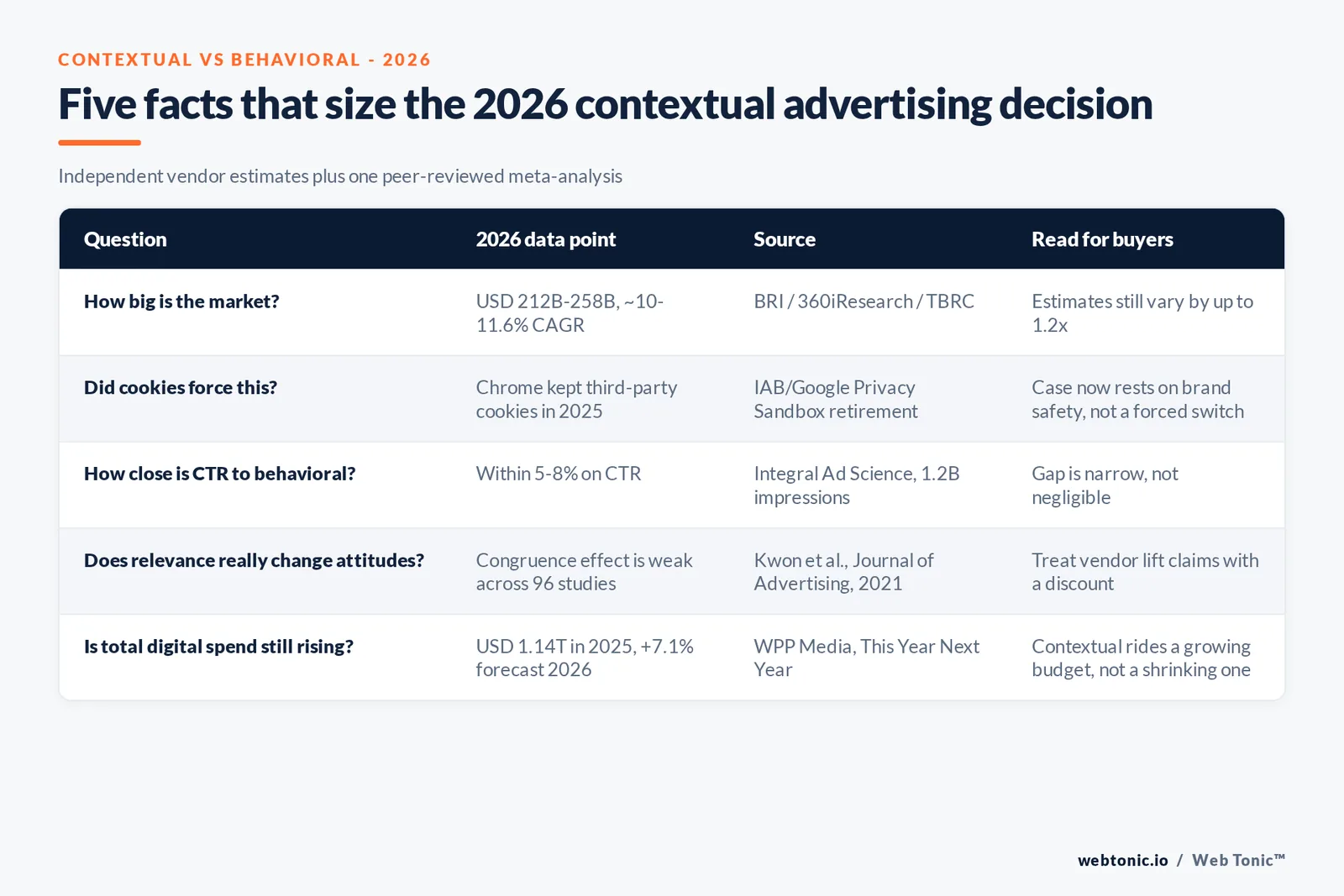
Contextual advertising enters 2026 sized between USD 212 billion and USD 258 billion globally, depending on which research firm you ask. The case for it shifted after Google kept third-party cookies in Chrome in 2025 - so the pitch now rests on brand safety and relevance, not a forced privacy deadline, and the performance evidence is real but narrower than most vendor decks claim.
Key Takeaways
- USD 212B to USD 258B is the 2026 global contextual advertising market range across vendors.
- ~10% to 11.6% CAGR is the forecast growth rate through the early 2030s.
- 1.2x is roughly how much vendor market-size estimates still differ.
- USD 294.6 billion was 2025 US internet advertising revenue, up 13.9%.
- USD 1.14 trillion was total global ad revenue in 2025 (WPP Media).
- +7.1% is WPP Media's forecast global ad revenue growth for 2026.
- Chrome kept third-party cookies after Google's April 2025 reversal.
- 5-8% is the click-through rate gap between contextual and behavioral (IAS, 2024).
- 1.2 billion impressions were analyzed in that IAS contextual-CTR study.
- 96 studies, 597 effect sizes, 139,233 respondents make up the largest congruence meta-analysis (2021).
- Congruence effects are "very weak" on attitudes and purchase intent per that meta-analysis.
- Digital accounts for over 73% of total global ad revenue in 2025.
| Benchmark | 2026 figure | Source |
|---|---|---|
| Global contextual advertising market size | USD 212B-258B | 3 vendor estimates (BRI, 360i, TBRC) |
| Market growth rate (CAGR) | ~10%-11.6% | 3 vendor estimates |
| US internet advertising revenue (2025) | USD 294.6B, +13.9% YoY | IAB/PwC |
| Total global ad revenue (2025) | USD 1.14T | WPP Media, This Year Next Year |
| Contextual vs. behavioral CTR gap | 5-8% | Integral Ad Science, 2024 |
| Media-context congruence effect on attitudes | Very weak (meta-analysis) | Kwon et al., Journal of Advertising, 2021 |
Why the market-size estimates still don't agree
Three independent research firms currently size the 2026 global contextual advertising market between roughly USD 212.3 billion (Business Research Insights) and USD 258.3 billion (The Business Research Company, up from about USD 233.9 billion in 2025), with 360iResearch landing near USD 250.6 billion. Growth forecasts cluster close together at roughly 10% to 11.6% CAGR through the early 2030s. The persistent 1.2x spread between the low and high estimates comes down to definition: some firms count only keyword- and content-based display, others fold in native, in-app and contextual video placements, which inflates the total considerably.
That range sits inside a much larger, better-agreed digital ad market. The IAB/PwC Internet Advertising Revenue Report found US internet advertising revenue reached USD 294.6 billion in 2025, up 13.9% year over year, and WPP Media's This Year Next Year report put total global ad revenue at roughly USD 1.14 trillion in 2025 (up 8.8%), forecasting another 7.1% of growth in 2026, with digital accounting for over 73% of that total. Contextual advertising is competing for a larger slice of a growing pool of budget, not a shrinking one.
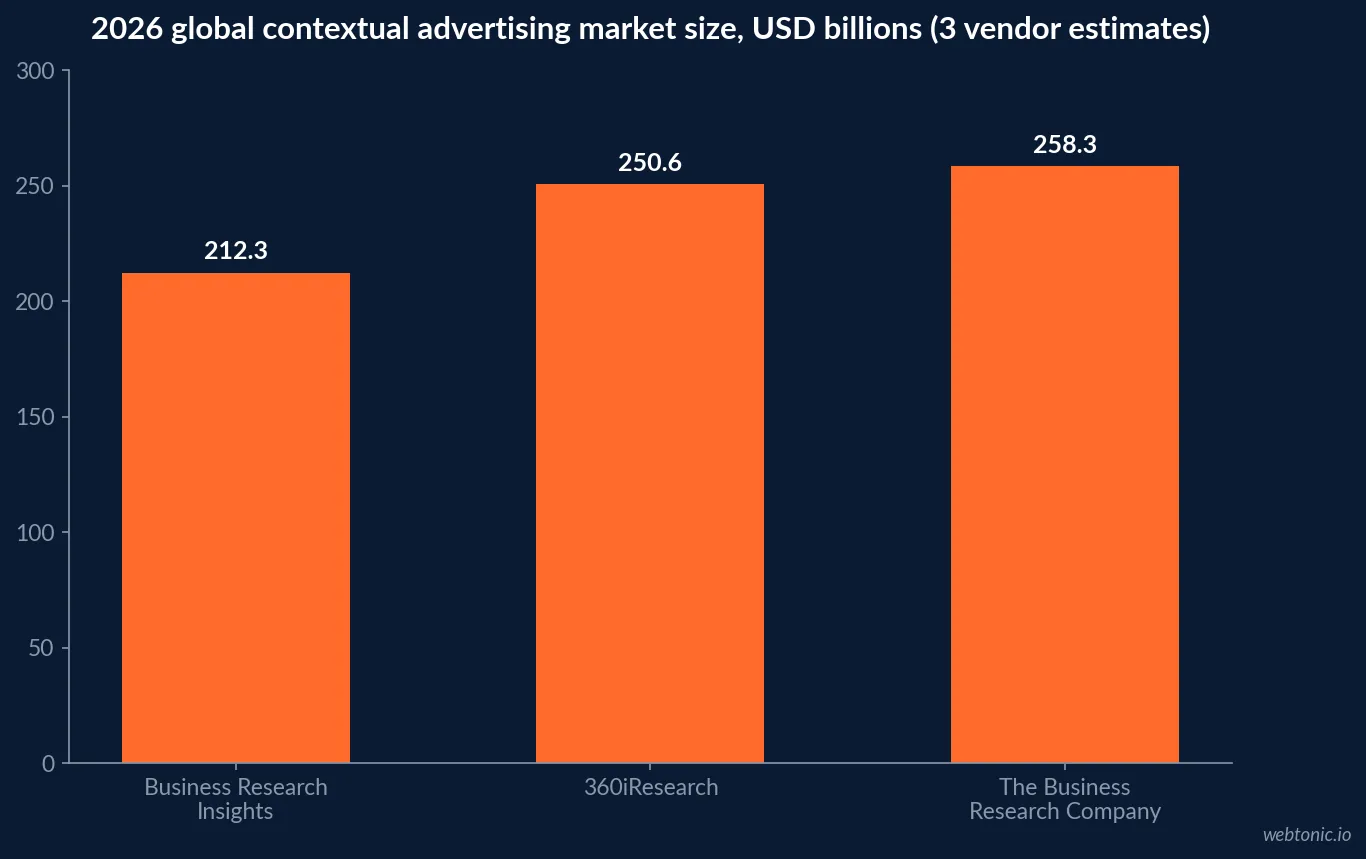
| Vendor market-size estimate (2026) | USD billions | Forecast CAGR |
|---|---|---|
| Business Research Insights | 212.3 | ~10.7% through 2035 |
| 360iResearch | 250.6 | ~11.61% through 2032 |
| The Business Research Company / Research and Markets | 258.3 (from 233.9 in 2025) | ~10.4% through 2030 |
The cookie story that fueled this category flipped in 2025
Contextual advertising's original growth pitch was built on an assumption that turned out to be wrong: that Chrome would deprecate third-party cookies and force advertisers to replace behavioral targeting wholesale. Google planned exactly that for years, then proposed a user-choice consent prompt instead in July 2024, and in April 2025 confirmed it would neither launch the prompt nor deprecate cookies, leaving existing Chrome privacy controls in place. Privacy Sandbox, the alternative-targeting framework built to replace cookies, was retired alongside that decision.
That reversal did not kill contextual advertising's growth case - it changed it. The category's pitch now leans on brand safety, AI-driven content relevance and consumer preference for ads that match the content they are reading or watching, rather than a regulatory or platform-forced migration. Cookie acceptance and consent rates keep drifting down anyway for reasons unrelated to Chrome policy - state and international privacy regulation continues to pressure identity-based targeting on its own timeline, independent of what Chrome does with cookies.
| Cookie/privacy-sandbox timeline event | Date | Effect on contextual's pitch |
|---|---|---|
| Google announces plan to phase out 3rd-party cookies | 2020 (original) | Original driver: forced replacement |
| Google proposes user-choice consent prompt instead | July 2024 | Softens the forced-migration case |
| Google confirms cookies stay, Privacy Sandbox retired | April 2025 | Removes the forced-migration case entirely |
| Contextual pitch shifts to brand safety / AI relevance | 2025-2026 | Growth now argued on merit, not mandate |
What the performance evidence actually shows
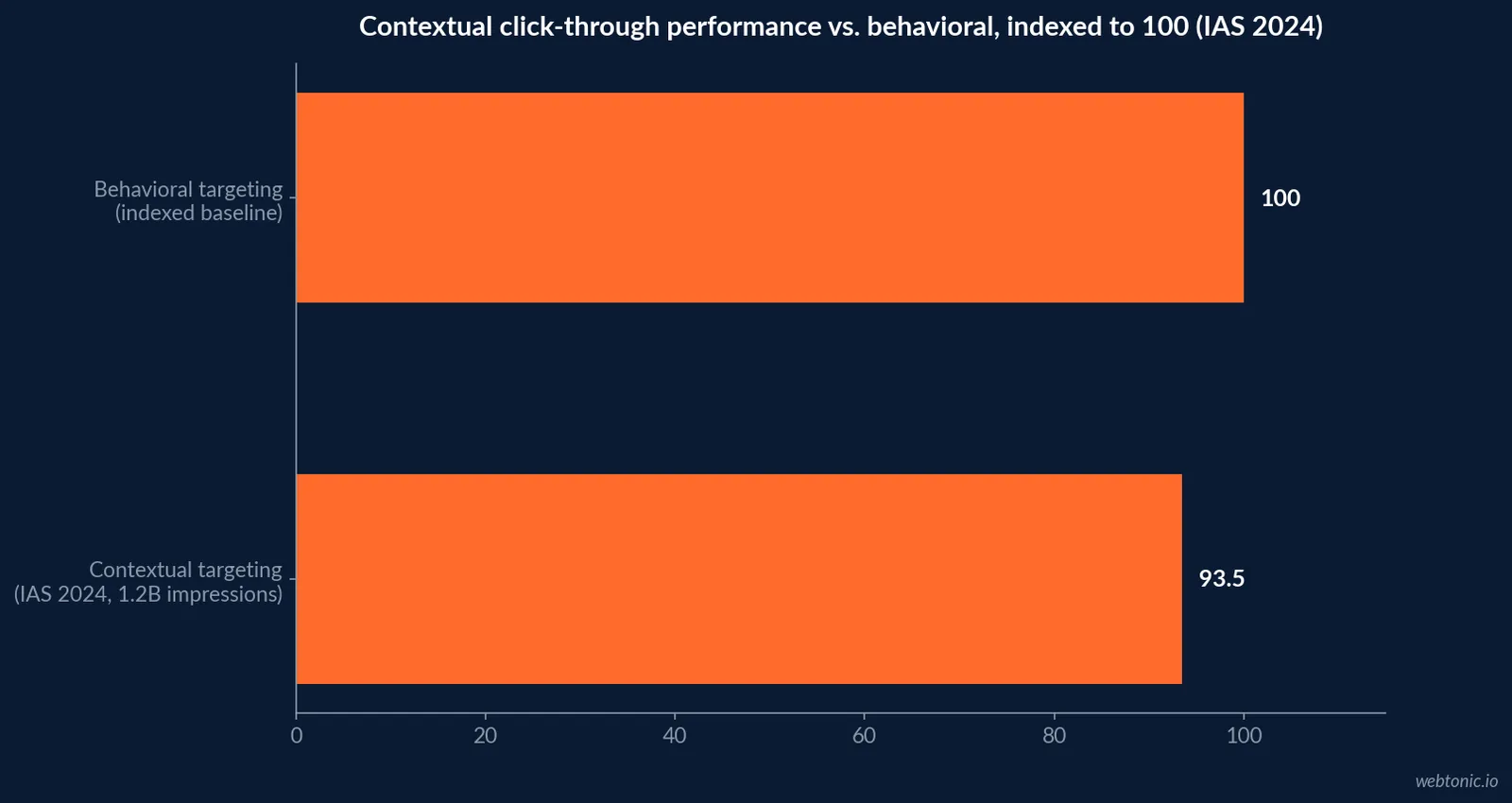
On the metric buyers watch most, the gap is real but narrow. A 2024 study by Integral Ad Science, analyzing more than 1.2 billion ad impressions across multiple verticals, found contextual targeting achieved click-through rates within 5-8% of behavioral targeting - close enough that many buyers accept the trade-off for the brand-safety and compliance benefits contextual carries.
Vendor-sponsored attention and recall studies report much larger lifts - some claim 2x-plus attention or recall gains for emotionally or topically matched placements - but those numbers are almost entirely funded by the vendors whose products they validate. The largest independent check on this claim is a 2021 meta-analysis in the Journal of Advertising by Kwon, Nyilasy, King and Reid, pooling 96 studies and 597 effect sizes across 31 years of research with a combined sample of 139,233 respondents. It found media-ad congruence has a very weak influence on consumer attitudes and purchase intent - felt involvement, transportation into the content and trust in the media vehicle mattered considerably more than simple topical match. Buyers should treat vendor-funded lift claims as directional at best and discount them against this larger, peer-reviewed baseline.
| Performance claim | Evidence strength | Source |
|---|---|---|
| Contextual CTR within 5-8% of behavioral | Single vendor study, 1.2B impressions | Integral Ad Science, 2024 |
| Emotionally/topically matched ads lift attention 2x+ | Vendor-funded studies (not independently replicated) | Various 2025-26 vendor research |
| Media-ad congruence weakly affects attitudes/intent | Independent meta-analysis, 96 studies, 139,233 respondents | Kwon et al., Journal of Advertising, 2021 |
Where contextual fits against the total 2026 media plan
Sizing contextual against total digital spend puts the category in perspective. At the high end of the vendor range, USD 258.3 billion of contextual spend against a global digital ad market north of USD 830 billion in 2025 (73% of the USD 1.14 trillion WPP Media total) implies contextual already represents a meaningful low-double-digit share of all digital advertising, not a niche tactic. That share is exactly why market-size definitions matter so much to a buyer building a plan: a vendor pitching the USD 258 billion figure is implicitly counting more of your existing budget as "contextual" than a vendor citing USD 212 billion would.
US-specific numbers reinforce the same growing-pool story. The IAB/PwC Internet Advertising Revenue Report found US internet ad revenue climbed to USD 294.6 billion in 2025, up 13.9% year over year - the report's 30th consecutive edition and, per IAB, still the industry's definitive benchmark for where digital budget actually lands. A media plan built in 2026 is competing for share of a market that grew nearly 14% in a single year, which changes the calculus on testing a new contextual line versus simply reallocating from a flat or shrinking channel.
| Market-size context (2025-2026) | Figure | Source |
|---|---|---|
| Total global ad revenue, 2025 | USD 1.14 trillion | WPP Media, This Year Next Year |
| Digital share of total global ad revenue | >73% | WPP Media, This Year Next Year |
| US internet advertising revenue, 2025 | USD 294.6 billion (+13.9% YoY) | IAB/PwC Internet Ad Revenue Report |
| Forecast global ad revenue growth, 2026 | +7.1% | WPP Media, This Year Next Year |
How to plan a 2026 contextual advertising budget
- Model on the low end of the market range (USD 212B) when comparing vendor pitches, since some quoted figures fold in formats you may not be buying.
- Don't budget contextual as a cookie-crisis hedge - Chrome kept third-party cookies, so the case has to stand on brand safety and relevance alone.
- Expect a 5-8% CTR gap versus behavioral, and weigh it against the brand-safety and compliance value contextual adds.
- Discount vendor-funded attention and recall lift claims against the independent congruence meta-analysis before building them into a media plan's ROI case.
- Treat total digital ad growth (+7.1% forecast for 2026) as the floor, not the ceiling, for how much room contextual has to grow inside a media mix.
Web Tonic's performance creative team builds brand-safe contextual placements for clients moving budget away from identity-based targeting, our growth marketing group models the CTR trade-off described above against each client's own funnel data, and our team can size a contextual test against a specific media plan.
What "brand safety" is actually buying in 2026
Brand safety is doing more argumentative work in the 2026 contextual pitch than performance is, and that is a defensible trade even without the inflated attention-lift numbers. Placing an ad next to content an AI-driven classifier has verified as brand-suitable avoids the reputational and legal exposure of appearing beside harmful, misleading or simply off-brand content - a risk that identity-based behavioral targeting, which follows a user rather than reading a page, cannot manage the same way. That risk-avoidance value is real even if the CTR and recall gains contextual vendors advertise turn out to be smaller than claimed once measured independently, which is exactly what the 2021 congruence meta-analysis found when it looked past vendor-funded studies.
The practical implication for a 2026 buyer: build the contextual budget case on brand safety and the narrow, real 5-8% CTR gap versus behavioral, not on the larger attention or recall multipliers still awaiting independent replication. That is a more defensible number to bring into a budget review, and it will hold up better if a finance team asks for the underlying source.
Frequently Asked Questions
How big is the contextual advertising market in 2026?
Independent research firms put the global contextual advertising market between roughly USD 212 billion and USD 258 billion for 2026, growing at about 10% to 11.6% CAGR. The range narrowed compared to prior years but still varies by about 1.2x across firms because each defines 'contextual' slightly differently - some include native and in-app contextual, others count only keyword- and content-based display.
Did the end of third-party cookies create the contextual advertising boom?
Not the way the industry originally expected. Google reversed course in 2025: after years of planning to deprecate third-party cookies in Chrome, it proposed a user-choice prompt instead in July 2024, then confirmed in April 2025 it would neither launch that prompt nor deprecate cookies, keeping existing Chrome controls in place. Contextual advertising's growth case now rests on brand safety, AI-driven content relevance and consumer preference rather than a forced cookie replacement.
Does contextual advertising perform as well as behavioral targeting?
It comes close on the metric advertisers watch most closely. A 2024 Integral Ad Science study analyzing more than 1.2 billion ad impressions found contextual targeting achieved click-through rates within 5-8% of behavioral targeting. That is a real but narrow gap, not parity - buyers should expect contextual to trail slightly on direct-response CTR while typically avoiding some of behavioral targeting's brand-safety and privacy-compliance costs.
Is the 'relevant content boosts ad recall' claim actually proven?
It's weaker than most vendor studies suggest. The largest independent synthesis available, a 2021 meta-analysis in the Journal of Advertising pooling 96 studies, 597 effect sizes and 139,233 respondents across 31 years of research, found media-ad congruence has only a very weak influence on attitudes and purchase intent. Felt involvement, transportation into the content and trust in the media vehicle mattered considerably more than topical match alone.
Is total digital ad spend growing enough to support more contextual budget?
Yes. WPP Media's This Year Next Year report put total global advertising revenue at roughly USD 1.14 trillion in 2025, up 8.8% year over year, with growth of about 7.1% forecast for 2026. The IAB/PwC Internet Advertising Revenue Report separately found US internet advertising revenue reached USD 294.6 billion in 2025, up 13.9% year over year - a rising budget pool that contextual is competing to capture a larger share of, not a shrinking one.
Sources
The Business Research Company - Contextual Advertising Global Market Report 2026
IAB/PwC - Internet Advertising Revenue Report, Full Year 2025
Marketing Brew - WPP Media This Year Next Year, 2025 Global Ad Revenue
Adreva - Contextual vs. Behavioral Advertising Performance (citing Integral Ad Science, 2024)
Kwon, Nyilasy, King & Reid - Media Context Effects Meta-Analysis, Journal of Advertising, 2021