Table of contents
The 2026 content marketing budget conversation has shifted from "how much content" to "which line item first." CMI's newest B2B survey shows AI tools now top the investment list, but owned media, experiential and personalization are all close behind - and a strategy alone is no longer the differentiator, since 97% of marketers already have one.
Key Takeaways
- 45% of B2B marketers plan to increase AI-powered marketing tool budgets in 2026.
- 33% plan to increase events and experiential marketing budgets.
- 32% plan to increase owned-media budgets (content assets, website, email).
- 25% plan to increase paid-media budgets.
- 24% plan to increase content-personalization budgets.
- Only 9% plan to increase human-resources budgets (salaries, training).
- 97% of B2B marketers now have a documented content strategy.
- 61% say their content strategy's effectiveness improved this past year.
- 74% of those who improved credit strategy refinement as the main driver.
- 95% of B2B marketers say their organization uses AI-powered applications.
- 28% of B2B marketers experiment with AI agents (43% among pacesetters).
- 78% of B2B marketers allocate budget to experiential marketing.
- Only 30% rate their experiential program established or better.
- 56% of marketers agree the internet is now flooded with AI-generated content.
- 65% say consumers are getting better at spotting AI-generated content.
- 126 million US AI search prompts were analyzed in Semrush's 2026 AI Visibility Index.
| Benchmark | 2026 value | Source |
|---|---|---|
| Have a documented content strategy | 97% | CMI B2B Content Marketing Trends 2026 |
| Top 2026 budget-increase priority | AI tools, 45% | CMI B2B Content Marketing Trends 2026 |
| Fund experiential marketing | 78% | CMI B2B Content Marketing Trends 2026 |
| Rate experiential as established or better | 30% | CMI B2B Content Marketing Trends 2026 |
| Say internet is flooded with AI content | 56% | HubSpot State of Marketing 2026 |
| AI search prompts analyzed for visibility | 126 million | Semrush AI Visibility Index 2026 |
Where the incremental content marketing dollar is going
Orbit Media's long-running annual survey - the 2026 edition drew on 1,042 content marketers - is the other benchmark worth budgeting against for raw output: it has tracked blog publishing cadence and format mix across more than a decade, and its scale alone (over a thousand practitioners surveyed every year since the mid-2010s) is why its year-over-year comparisons carry weight for anyone sizing how much content a given budget should actually produce.
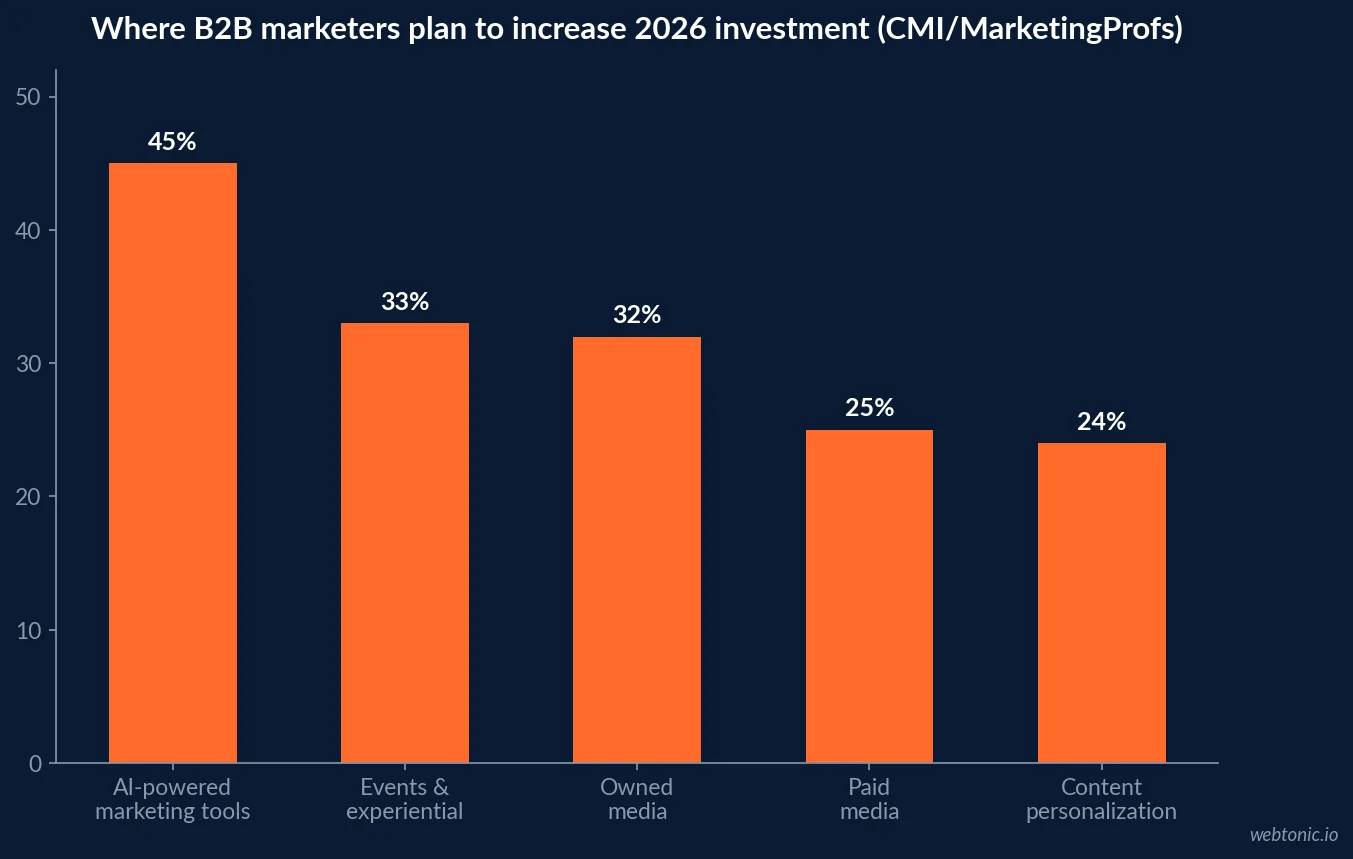
The Content Marketing Institute's B2B Content Marketing and Trends: Insights for 2026 report, surveying 1,015 B2B marketers with MarketingProfs and sponsored by Storyblok, asked which top three areas marketers plan to increase investment in during 2026. AI-powered marketing tools led at 45%, followed by events and experiential marketing (33%), owned media - content assets, website, blog and email - at 32%, paid media at 25% and content personalization at 24%. Tech infrastructure (21%), social/earned media (20%), agency and outsourcing (19%), research and insights (15%), first-party data capabilities (12%) and human resources (9%) round out the list, in that order.
| 2026 budget priority (top 3 picks allowed) | Share planning increase |
|---|---|
| AI-powered marketing tools (generative AI, predictive analytics) | 45% |
| Events and experiential marketing | 33% |
| Owned media (content assets, website, blog, email) | 32% |
| Paid media | 25% |
| Content personalization | 24% |
| Tech infrastructure (martech, analytics, CRM) | 21% |
| Social / earned media | 20% |
| Agency / outsourcing | 19% |
| Research and insights | 15% |
| First-party data capabilities | 12% |
| Human resources (salaries, training, development) | 9% |
Strategy is table stakes now, execution is the differentiator
CMI's 2026 data marks a real shift from prior years: 97% of marketers report having a content strategy, with only 3% saying they don't. Among those with a strategy, 61% say its effectiveness improved over the past year - 13% say significantly and 48% say somewhat, while 30% report it stayed stable and 8% say it declined. When CMI asked what drove the improvement, 74% credited strategy refinement itself, ahead of new technology implementation (51%) and team restructuring or resource changes (40%) - a reminder that budget alone rarely fixes a strategy problem.
AI adoption is close to universal on the surface: 95% of B2B marketers say their organization uses AI-powered applications, but the more advanced layer is thinner. 28% of B2B marketers experiment with AI agents overall, rising to 43% among "pacesetters" - marketers who rate themselves established, advanced or leading in that category. Only 3% overall (6% of pacesetters) call agents core to their strategy today, so most 2026 AI budget is still funding content generation and assistance rather than autonomous workflows.
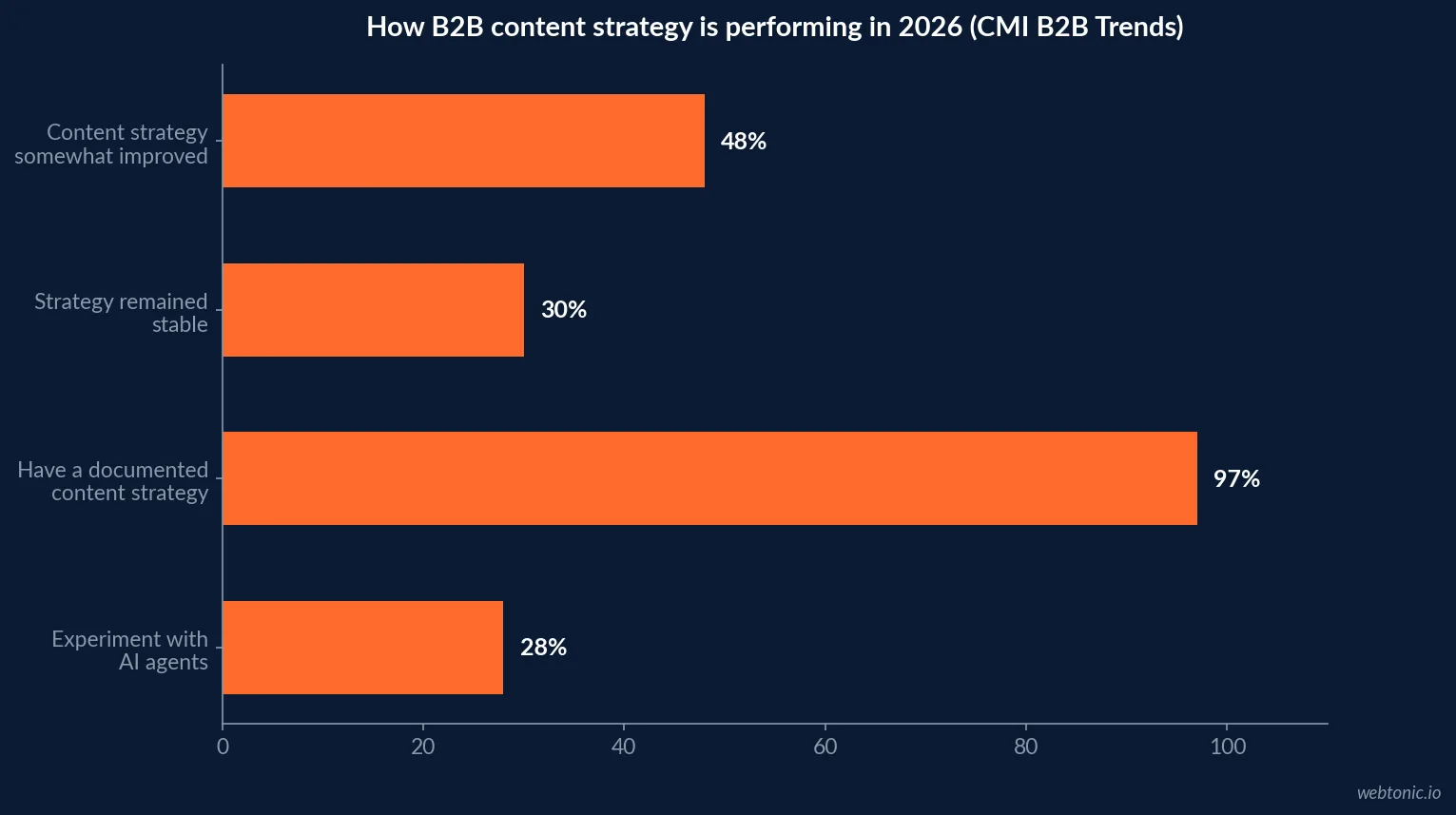
| Content strategy performance (CMI 2026) | Share of marketers |
|---|---|
| Have a documented content strategy | 97% |
| Say the strategy's effectiveness improved (net) | 61% |
| Say it improved significantly | 13% |
| Say it improved somewhat | 48% |
| Say it remained stable | 30% |
| Say it declined | 9% (8% somewhat + 1% significantly) |
Experiential is funded but under-measured
Experiential marketing is one of the clearer budget-vs-maturity gaps in the 2026 data. CMI found 78% of B2B marketers allocate budget to experiential activity - live events, demos, in-person or virtual brand moments - but only 30% rate their program as established (20%), advanced (6%) or leading (4%). The remaining 70% splits evenly between exploratory (35%) and developing (35%) stages. That gap matters for 2026 planning: with events and experiential the #2 budget-increase priority at 33%, most of that new spend is landing inside programs that admit they are not yet measuring results consistently.
| Experiential marketing maturity (CMI 2026) | Share of programs |
|---|---|
| Fund experiential marketing at all | 78% |
| Rate their program as exploratory | 35% |
| Rate their program as developing | 35% |
| Rate their program as established | 20% |
| Rate their program as advanced | 6% |
| Rate their program as leading | 4% |
Budgeting for AI search, not just AI content
A newer 2026 line item is visibility inside AI search itself, separate from AI-assisted production. Semrush's content optimization study analyzed 11,882 prompts across ChatGPT Search, Google AI Mode and Perplexity, comparing 304,805 URLs cited by those AI platforms against 921,614 URLs ranking on standard Google search - the two lists only partially overlap, meaning a page that ranks well organically is not guaranteed a citation inside an AI answer. Semrush's expanded 2026 AI Visibility Index scaled that analysis to 126 million US AI search prompts across 22 industries and four AI platforms, tracked from January through April 2026. On the demand side, HubSpot's 2026 State of Marketing survey of over 1,500 global marketers found 56% agree the internet is now flooded with AI-generated content and 65% say consumers are getting better at recognizing it - both reasons a 2026 content budget needs a distinct quality and distribution line, not just a bigger production line.
First-party data is the budget line most likely to be underfunded
Of all eleven 2026 budget-priority categories CMI measured, first-party data capabilities ranked second-to-last at just 12% planning to increase investment there - well behind AI tools (45%) and even behind research and insights (15%). That is a mismatch worth flagging: the same macro environment pushing budgets toward AI-personalized content and owned media is also the one steadily reducing the reliability of third-party signals, which makes first-party data infrastructure the dependency almost every other 2026 priority quietly relies on. A content marketing budget that funds personalization (24%) and AI tools (45%) without funding the first-party data layer underneath them is funding the visible half of the stack and skipping the foundation.
Human resources sits dead last at 9%, which tracks with CMI's own framing: marketers rank new headcount, training and team development among the lowest 2026 budget priorities even though 74% of teams that improved their content strategy this year credit strategy refinement - a people-driven outcome - over new technology. Budget is flowing toward tools faster than it is flowing toward the people who have to run them.
| Lowest-ranked 2026 budget priorities | Share planning increase |
|---|---|
| First-party data capabilities | 12% |
| Human resources (salaries, training, development) | 9% |
| Research and insights | 15% |
| Agency / outsourcing | 19% |
Setting the campaign budget
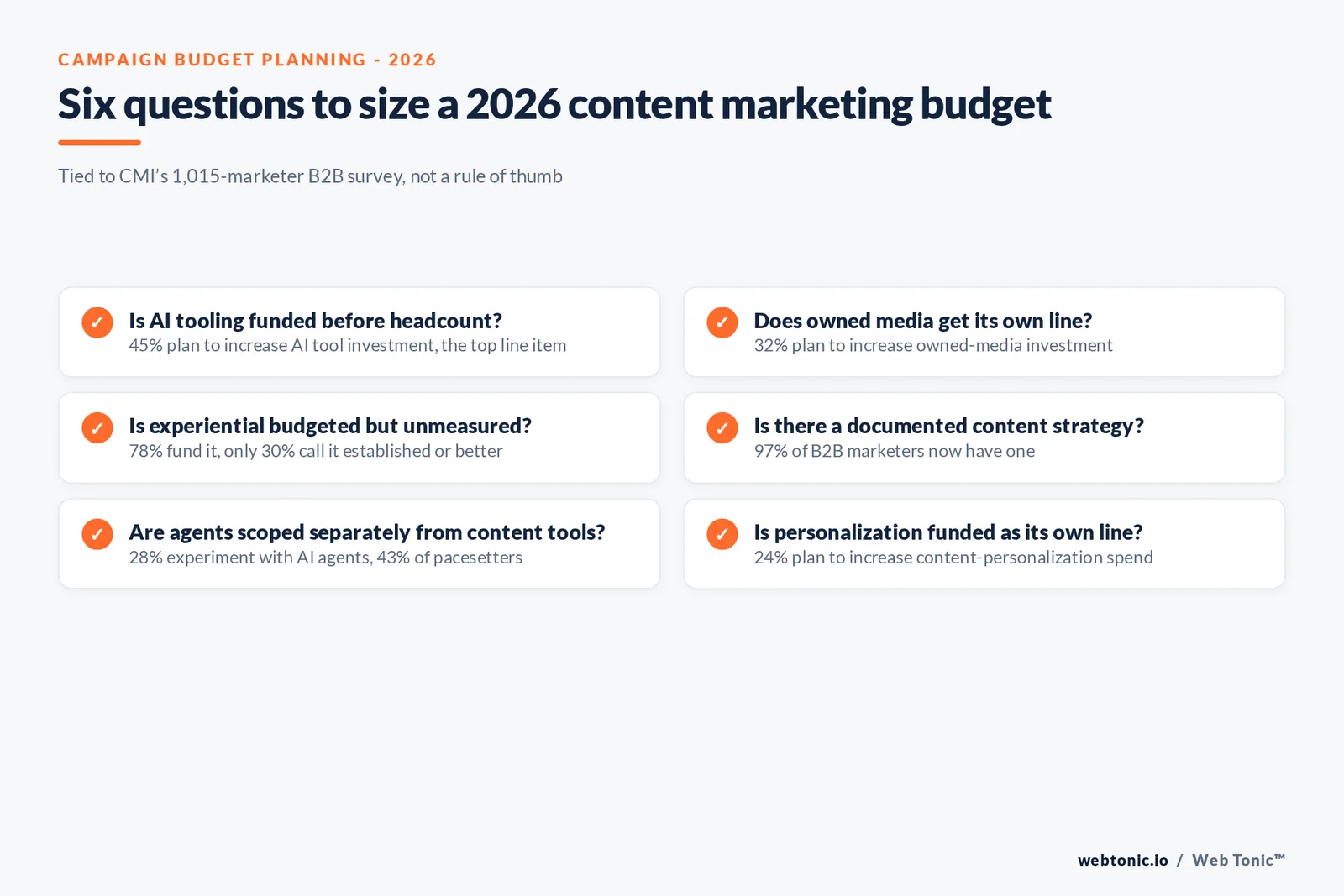
- Fund AI tooling first if the budget is constrained - it is the single most common 2026 priority at 45%, ahead of every other line.
- Give owned media its own line, not a shared one with paid - it ranks third at 32% and is where compounding SEO/AI-search value accrues.
- Pair every new experiential dollar with a measurement plan - 78% fund it, only 30% can prove it is working well.
- Budget for AI-search visibility separately from AI content production - the two url sets that matter (AI-cited vs. Google-ranked) only partially overlap.
- Don't assume a documented strategy is a differentiator anymore - 97% of competitors already have one; execution and measurement are what's left to compete on.
Web Tonic's growth marketing team builds these budget splits by channel for clients, our data intelligence group tracks the AI-search visibility gap described above so content budget isn't spent on pages that never get cited, and our team can walk through how the split applies to a specific account.
Measurement, not more content, is the constraint
The pattern across every section of CMI's 2026 data points the same direction: the bottleneck is rarely production capacity anymore, it is proving what the spend produced. Experiential is funded at 78% but only 30% call it measured well; content strategy is near-universal at 97% but only 61% say it actually got more effective; AI agent experimentation sits at 28% but only 3% call agents core to the strategy, meaning most teams are still in a pilot phase rather than a scaled one. A 2026 campaign budget that adds a measurement or attribution line - even a modest one carved out of the 21% earmarked for tech infrastructure - is addressing the constraint CMI's own data says is most common, rather than adding to the production volume that is, per HubSpot, already flooding the internet.
That also reframes how to read the AI-tool figure at the top of the list. Funding AI tools at 45% is the easy, popular choice; funding the measurement and first-party data infrastructure that proves those tools are working is the 12-15% choice most teams are still under-resourcing. The gap between the two is where a lot of 2026 campaign budget will be quietly wasted if it isn't closed deliberately.
Frequently Asked Questions
Where are B2B marketers putting new content marketing budget in 2026?
Content Marketing Institute's 2026 B2B report, a survey of 1,015 marketers run with MarketingProfs and sponsored by Storyblok, found AI-powered marketing tools top the list at 45%, followed by events and experiential marketing (33%), owned media such as content assets, website and email (32%), paid media (25%) and content personalization (24%). Human resources - salaries, training and development - ranks last at just 9%.
Do most B2B companies actually have a content strategy?
Yes, and it jumped this year. CMI's 2026 survey found 97% of marketers now have a content strategy, with only 3% saying they don't. Among those with one, 61% report it improved over the past year - 13% say significantly, 48% say somewhat - which CMI attributes mostly to strategy refinement (74%) and team restructuring (40%), not just new technology.
Is experiential marketing worth budgeting for in 2026?
Most B2B teams think so, but few have it dialed in. CMI found 78% of B2B marketers allocate budget to experiential marketing, yet only 30% rate their program as established, advanced or leading. The rest are split between exploratory (35%) and developing (35%) stages - meaning most experiential budget is still funding a program that isn't measured well yet.
How much is AI actually changing content marketing output?
Materially, per multiple 2026 surveys. HubSpot's 2026 State of Marketing report, covering 1,500-plus global marketers, found 56% agree the internet is now flooded with AI-generated content and 65% say consumers are getting better at spotting it - meaning volume is up but so is audience skepticism, which raises the bar for what a budget needs to fund beyond raw output.
Should content marketing budgets plan around AI search, not just Google rankings?
It should be on the list. Semrush's 2026 AI Visibility Index analyzed 126 million US AI search prompts across 22 industries and four AI platforms between January and April 2026, and an earlier Semrush content-optimization study found the sets of URLs cited by AI platforms and the sets ranking on Google search overlap only partially - evidence that a 2026 content budget increasingly needs a distinct line for AI-search visibility work.
Sources
Content Marketing Institute - B2B Content Marketing and Trends: Insights for 2026
CMI - Full 2026 B2B Report (PDF)
HubSpot - 2026 State of Marketing Report
Semrush - Content Optimization for AI Search Study
Semrush - 2026 AI Visibility Index
Orbit Media - Annual Blogging/Content Marketer Survey