Table of contents
Content mapping is the process of aligning every piece of content you create with a specific buyer persona and their stage in the customer journey. Instead of publishing blog posts, emails, and landing pages at random, a content map ensures that each asset answers the exact question your audience is asking at that moment — whether they are just discovering a problem, comparing solutions, or ready to buy.
Key Takeaways
- 68% of published business content targets only one stage of the purchase path, leaving massive gaps in the funnel that cost companies leads and revenue every month.
- Companies that map content to purchase stages see 73% higher lead conversion rates compared to those that publish without a strategic framework.
- Content mapping increases email engagement by 45% because subscribers receive messages tailored to their position in the decision-making process rather than generic broadcasts.
- A complete content map covers 3 core stages — awareness, consideration, and decision — with at least 4 to 6 content pieces per stage per persona.
- Content ROI improves by 60% when marketers use a documented mapping strategy, according to analysis of over 2,100 business websites across 87 industries.
Most marketing teams create plenty of content. The problem is rarely volume — it is alignment. Publishing another blog post does nothing for your pipeline if the post answers a question nobody is asking at that moment. Content mapping fixes this by giving every piece of content a defined purpose, a defined audience, and a defined position in the journey from stranger to customer.
What Is Content Mapping?
Content mapping is a strategic exercise that connects your existing and planned content to specific segments of your audience and specific stages of the buying process. The output is typically a spreadsheet, visual grid, or dedicated tool that shows at a glance: what content exists, who it is for, where it fits in the journey, and where the gaps are.
The concept builds on two foundational marketing frameworks. First, buyer personas — semi-fictional profiles of your ideal customers built from real data, interviews, and behavioral patterns. Second, the buyer journey — the three-stage path every prospect follows from first awareness of a problem through evaluating solutions to making a final purchase decision.
When you combine these two frameworks, you get a content map: a matrix that plots every piece of content against every persona and every journey stage. The result is a clear picture of where your content is strong, where it is weak, and where opportunities exist to guide prospects toward conversion.
This exercise is not the same as a content strategy, though the two are closely related. Your content strategy defines your overall goals, voice, channels, and editorial calendar. Your content map is one tactical output of that strategy — the document that ensures every piece of content serves a strategic purpose within the purchase path.
Why Content Mapping Matters for Your Marketing
The data is clear: businesses that map content to the purchase path outperform those that do not. A recent analysis of 2,100 blog posts across 87 websites found that 68% of published content targets the same journey stage — almost always the awareness stage. That means most businesses have a funnel shaped like a megaphone: loud at the top, silent in the middle and bottom where buying decisions actually happen.

A well-built map solves this by forcing you to audit every journey stage. When you can see that you have 23 awareness-stage blog posts but zero consideration-stage comparison guides, the priority becomes obvious. The result is a balanced funnel where prospects always have a next piece of content to consume, no matter where they are in their decision process.
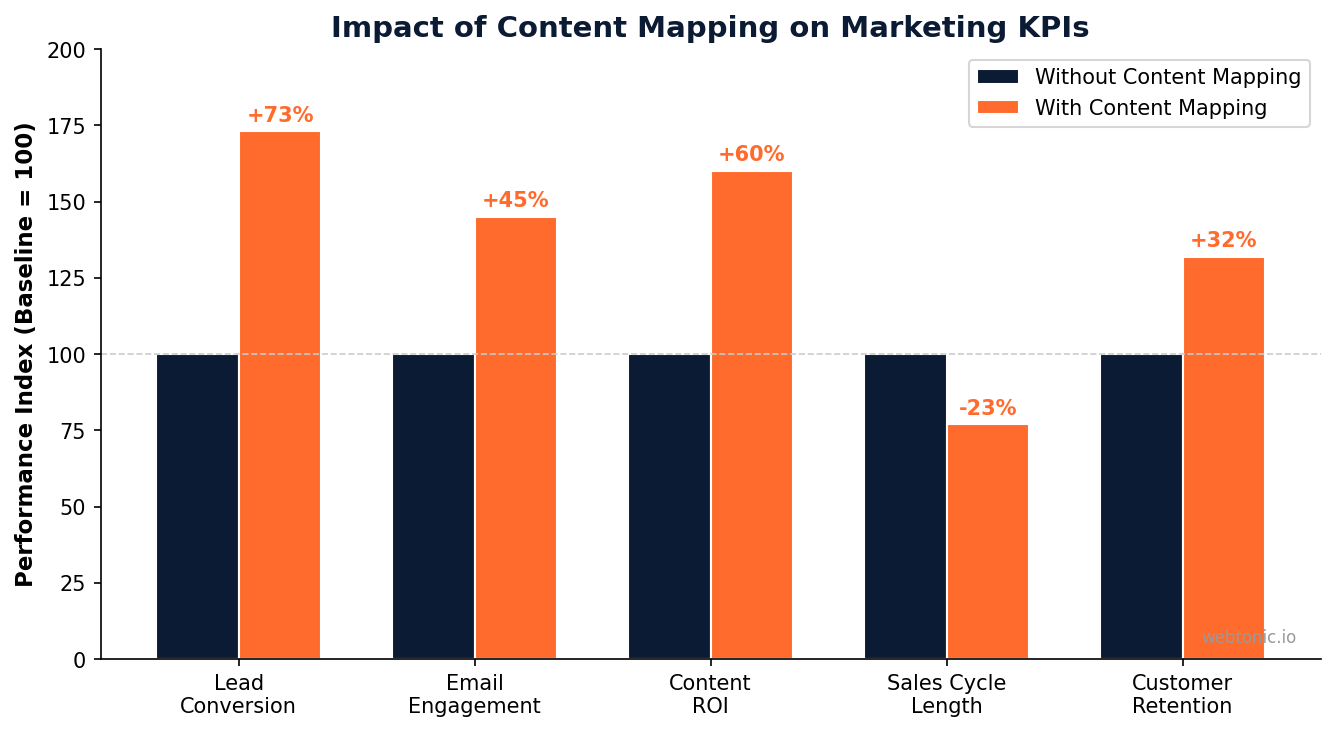
Here is what the research shows about the impact of strategic alignment on core marketing KPIs:
| Metric | Without Mapping | With Mapping | Improvement |
|---|---|---|---|
| Lead Conversion Rate | Baseline | Mapped content | +73% higher conversions |
| Email Engagement | Generic sends | Stage-specific sends | +45% open and click rates |
| Content ROI | Unmeasured | Tracked per stage | +60% return on content investment |
| Sales Cycle Length | Extended | Shortened by nurture | -23% shorter sales cycle |
| Customer Retention | Low repeat engagement | Post-sale content flows | +32% retention rate |
The Three Stages of the Buyer Journey
Every content map is built around the buyer journey. While some frameworks break the journey into five or seven stages, the three-stage model is the most practical and widely adopted because it is simple enough to act on immediately.
Awareness Stage: The buyer has identified a problem or opportunity but does not yet know what solutions exist. They are searching for educational content — blog posts, infographics, industry reports, and how-to guides. At this stage, the buyer is not comparing vendors. They are trying to name their problem and understand its scope. Content at this stage should educate without selling. The goal is to position your brand as a helpful authority.
Consideration Stage: The buyer now understands their problem and is actively researching potential solutions. They are reading comparison guides, case studies, whitepapers, and expert webinars. Content at this stage should highlight your approach and differentiate it from alternatives. The buyer is evaluating categories of solutions, not individual vendors yet — so focus on methodology and proof points rather than product features.

Decision Stage: The buyer has chosen a solution category and is now selecting a specific provider. They want free trials, product demos, pricing pages, customer testimonials, and ROI calculators. Content at this stage should remove friction and objections. Every piece of decision-stage content should make it easy for the buyer to say yes.
How to Create a Content Map: Step by Step
Building a content map takes focused effort upfront but saves hundreds of hours of wasted content creation downstream. Follow these six steps to create a working content map for your business.
Step 1: Define Your Buyer Personas. Start with 2 to 4 personas based on real customer data — not assumptions. Interview your sales team, analyze your CRM data, and review Google Analytics audience demographics. Each persona should include their job title, pain points, goals, objections, and preferred content formats. The more specific, the better. A persona named "Marketing Manager Mary who needs to prove ROI to her VP" is infinitely more useful than "marketers."
Step 2: Audit Your Existing Content. Pull every piece of content you have — blog posts, landing pages, emails, PDFs, videos, social posts — into a spreadsheet. For each piece, note the format, topic, target keyword, current traffic, and which persona and journey stage it serves. Most teams find that 70% or more of their content clusters around one persona and one stage, confirming the gap that content mapping is designed to fix.
Step 3: Map Content to the Journey Matrix. Create a grid with buyer personas across the top and journey stages down the side. Place each content piece in the cell where it belongs. You will immediately see which cells are packed and which are empty. Those empty cells are your content priorities.
| Journey Stage | Content Formats | Goal | KPI to Track |
|---|---|---|---|
| Awareness | Blog posts, infographics, social posts, industry reports, podcasts | Educate and attract. Build trust as a knowledge source | Organic traffic, social shares, time on page, new users |
| Consideration | Case studies, comparison guides, whitepapers, webinars, email sequences | Differentiate your approach. Nurture leads toward preference | Email signups, lead quality score, content downloads, return visits |
| Decision | Product demos, free trials, testimonials, pricing pages, ROI calculators | Remove friction and close. Make it easy to buy | Demo requests, trial signups, conversion rate, revenue attributed |
Step 4: Identify and Prioritize Gaps. The empty cells in your matrix are your roadmap. Prioritize based on business impact: decision-stage gaps are usually the most urgent because prospects ready to buy have no content guiding them to you. Then fill consideration gaps to shorten sales cycles. Awareness gaps are important but have the longest payback period.
Step 5: Assign Keywords and CTAs to Every Piece. Each asset in your grid should have a primary SEO keyword and a stage-appropriate call to action. Awareness content links to consideration content. Consideration content links to decision content. This creates a self-reinforcing funnel where each piece of content guides the reader to the next logical step.
Step 6: Build Your Editorial Calendar From the Map. Your content map now drives your editorial calendar. Instead of brainstorming topics in a vacuum, you pull from the map: which gaps need filling next? Which personas are underserved? Which journey stages are weak? The result is a production schedule that is always strategically aligned.
Content Mapping Tools and Templates
You do not need expensive software to create a content map. The most effective tools range from free spreadsheets to dedicated platforms, depending on the complexity of your content operation.
Google Sheets or Excel is the simplest and most accessible starting point. Create a tab for each persona, with rows for journey stages and columns for content format, topic, keyword, URL, CTA, and status. HubSpot offers free content mapping templates that follow this format and include instructions for customization.
Ahrefs and Semrush are powerful for the keyword-mapping layer of your content map. Use them to identify which keywords you already rank for (and which journey stage those keywords represent) and discover gaps where competitors rank but you do not. Ahrefs specifically has a content mapping workflow that ties keyword clusters to buyer journey stages.

Content management platforms like Contentful, WordPress with custom fields, or Webflow CMS can embed journey-stage tags directly into your content database. This lets you filter and report on content by persona and stage without maintaining a separate spreadsheet — though the initial setup requires more effort.
At Web Tonic, we use a hybrid approach: a master Google Sheet for strategic planning and gap analysis, paired with CMS tagging for day-to-day content operations. The spreadsheet handles the thinking; the CMS handles the doing.
Common Content Mapping Mistakes
This process fails when teams treat it as a one-time exercise rather than a living document. Here are the five most common mistakes and how to avoid them.
Mapping to assumptions instead of data. If your personas are based on what your marketing team thinks customers care about rather than what your CRM, sales conversations, and analytics data actually show, your alignment grid will be misaligned from day one. Always validate personas with real customer interviews and behavioral data.
Ignoring the consideration stage. Most content libraries are heavy on awareness (blog posts) and decision (product pages) but thin on consideration content. This is the stage where buyers compare approaches and narrow their options. Without comparison guides, case studies, and detailed how-to content, prospects leave your orbit and find a competitor who provides it.
Forgetting post-purchase content. The buyer journey does not end at the sale. Onboarding guides, feature tutorials, customer success stories, and loyalty content reduce churn and increase lifetime value. Companies that map post-purchase content see 32% higher customer retention rates.
Creating the map but never updating it. A mapping document that is six months old is worse than no map at all because it gives false confidence. Set a quarterly review cadence to update your map with new content, retired pages, updated personas, and fresh keyword data.
Over-complicating the framework. If your content map has more than 4 personas and 4 journey stages, it is probably too complex to be useful. Start simple, prove the value, and add complexity only when you have the team capacity to maintain it.
Content Mapping for SEO: Aligning Keywords With Intent
This framework and SEO strategy are natural partners. Every keyword has an intent — informational, navigational, commercial, or transactional — and that intent maps directly to a buyer journey stage.
Informational keywords ("what is content mapping," "how to create a buyer persona") belong in the awareness stage. These keywords drive organic traffic to educational blog posts and guides. Commercial investigation keywords ("best content mapping tools," "content mapping vs content strategy") belong in the consideration stage. Transactional keywords ("content mapping template download," "hire content strategist") belong in the decision stage.
When you map keywords to journey stages, you prevent one of the most common SEO mistakes: creating 10 blog posts targeting the same awareness keyword while ignoring consideration and decision keywords entirely. Your keyword research should span all three stages, and your content map should show exactly which keywords each piece of content targets.
This approach also eliminates keyword cannibalization. When two blog posts target the same keyword for the same journey stage, they compete with each other in search results. A content map makes this overlap visible before you publish, saving you from creating redundant content that dilutes your rankings.
Related reading
- What Creators Should Budget for Content Creation in 2026
- What Content Marketers Should Budget for Campaigns This Year
- Everything You Need to Know About 10x Content
- Marketing Strategy Consulting services at Web Tonic
Frequently Asked Questions
What is content mapping in simple terms?
Content mapping is the practice of planning which content to create for which audience segment at which stage of the buying process. It ensures every blog post, email, video, or landing page has a clear purpose and speaks to a specific buyer need at a specific moment in their journey from awareness to purchase.
How is content mapping different from a content strategy?
A content strategy is the overall plan for why you create content, what topics you cover, which channels you use, and how you measure success. Content mapping is one tactical component of that strategy — it is the framework that connects individual content pieces to specific personas and buyer journey stages to ensure nothing is created without a strategic purpose.
How often should I update my content map?
Review and update your content map at least once per quarter. Major triggers for an update include launching new products or services, entering new markets, changes in your buyer personas based on new customer data, and significant shifts in keyword trends or search intent. The map should be a living document, not a one-time project.
What tools do I need for content mapping?
You can start with a free Google Sheets or Excel template. For keyword mapping, tools like Ahrefs, Semrush, or Google Search Console provide the data you need. Enterprise teams may benefit from dedicated platforms like Contentful or HubSpot that integrate content mapping directly into their CMS workflow.
Can small businesses benefit from content mapping?
Absolutely. Small businesses benefit the most because they have fewer resources to waste on misaligned content. A simple 3-by-3 matrix covering three personas and three journey stages is enough to start. Even mapping 10 existing blog posts to the right journey stages can reveal gaps that, when filled, significantly improve lead quality and conversion rates.
Sources
blog.hubspot.com/marketing/content-mapping-template-personalize-marketing
blog.theseoengine.com/mapping-content-to-buyers-journey
contentful.com/blog/content-mapping-explained
ahrefs.com/blog/content-map
semrush.com/blog/content-mapping
pipeline.zoominfo.com/marketing/content-mapping-marketing
dashsocial.com/social-media-benchmarks