Table of contents
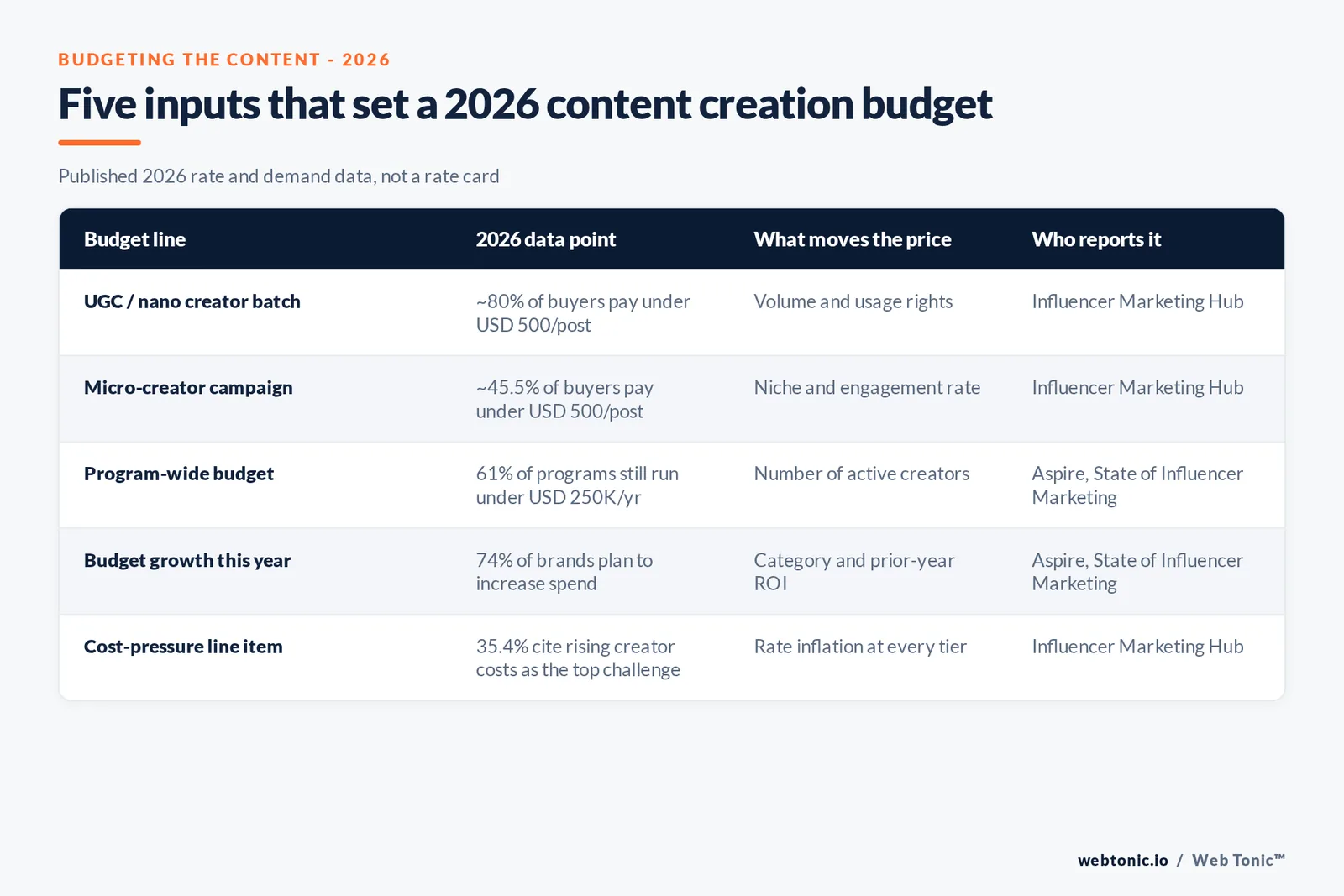
Content creation budgets are growing faster than most marketing lines in 2026, but the money is not spread evenly. Most programs are still modest - 61% run under USD 250,000 a year - while rate inflation at the creator level, not agencies or tools, is the top reported cost pressure.
Key Takeaways
- USD 313.95 billion is the 2026 global creator economy market size (Precedence Research).
- USD 13.7 billion is projected US influencer marketing spend by 2027.
- 15.7% projected growth in US influencer marketing spend in 2026.
- 74% of marketers plan to increase influencer marketing budgets in 2026.
- 87.49% of respondents expect their influencer budget to rise this year.
- 72.22% expect that increase to be 50% or more.
- Only 5.55% expect their influencer budget to fall.
- 23% of total marketing budget went to creator partnerships last year.
- 61% of influencer programs still run under USD 250,000 a year.
- 16% of brands now run multi-million dollar creator programs.
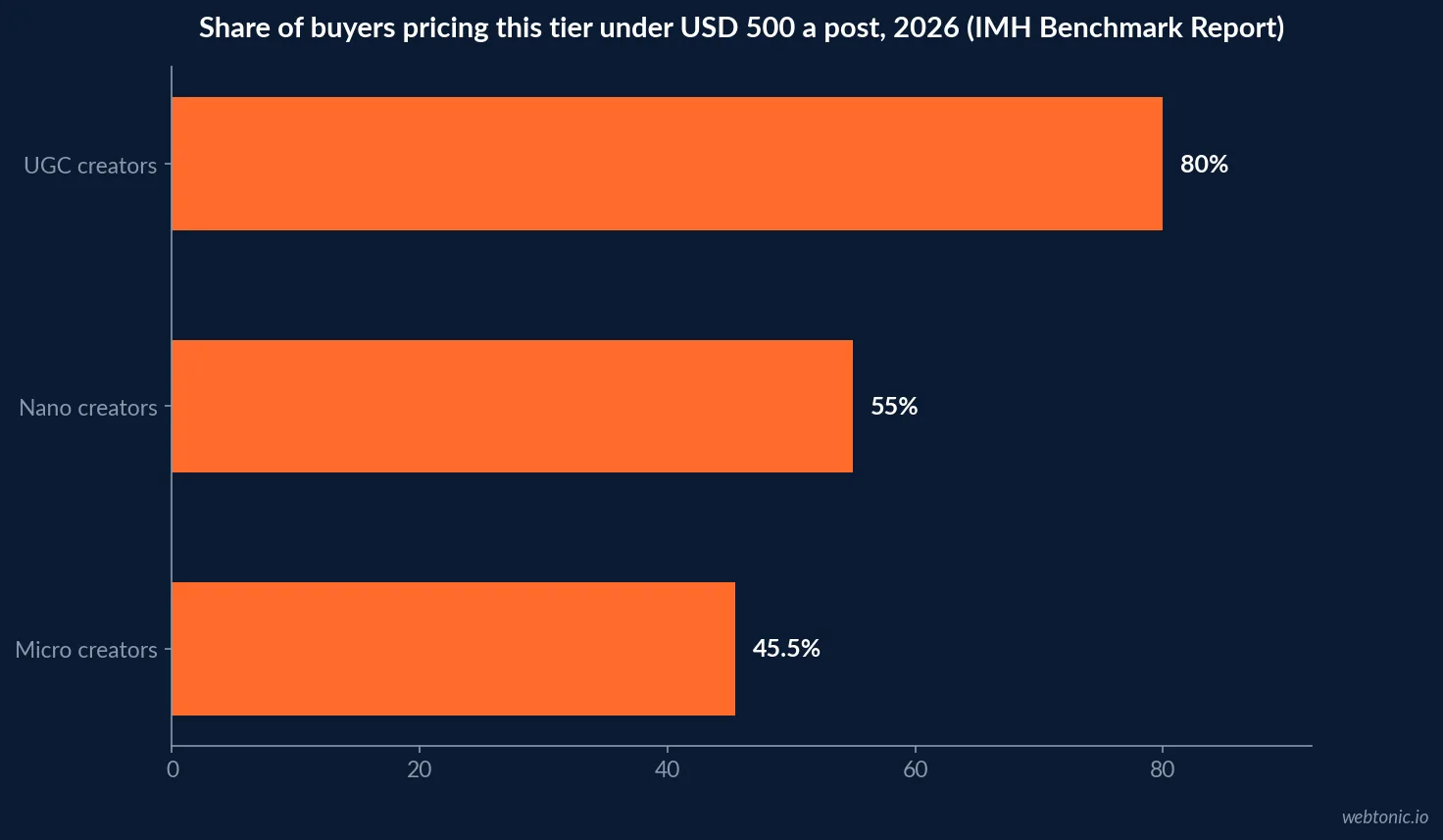
- ~80% of UGC-creator pricing sits under USD 500 a post.
- ~55% of nano-creator pricing sits under USD 500 a post.
- ~45.5% of micro-creator pricing sits under USD 500 a post.
- 35.4% cite rising creator costs as their top program challenge.
- 1,723 respondents across 17 industries answered CreatorIQ's 2025-26 survey.
- Creator budgets surged 171% at reporting organizations, per CreatorIQ.
- 55% of consumers say they take action from creator content (NeoReach 2026).
| Benchmark | 2026 value | Source |
|---|---|---|
| Global creator economy market size | USD 313.95B | Precedence Research |
| Marketers planning a 2026 budget increase | 74% | Aspire, State of Influencer Marketing 2026 |
| Programs still under USD 250K/year | 61% | Aspire, State of Influencer Marketing 2026 |
| UGC-creator pricing under USD 500/post | ~80% | Influencer Marketing Hub Benchmark 2026 |
| Top reported program challenge | Rising creator costs, 35.4% | Influencer Marketing Hub Benchmark 2026 |
| Reported creator-budget growth (CreatorIQ survey) | +171% | CreatorIQ State of Creator Marketing 2025-26 |
The market this budget line sits inside
The creator economy is no longer a side channel. Precedence Research sizes the global creator economy at USD 313.95 billion in 2026, up from USD 254.4 billion in 2025, and projects it reaching over USD 2 trillion by 2035 at a 23.41% compound annual growth rate. On the paid-media side specifically, Aspire's State of Influencer Marketing 2026 report projects US influencer marketing spend growing 15.7% in 2026 and reaching USD 13.7 billion by 2027. Brands allocated an average of 23% of their total marketing budget to creator partnerships last year, and that share is expected to climb again this year.
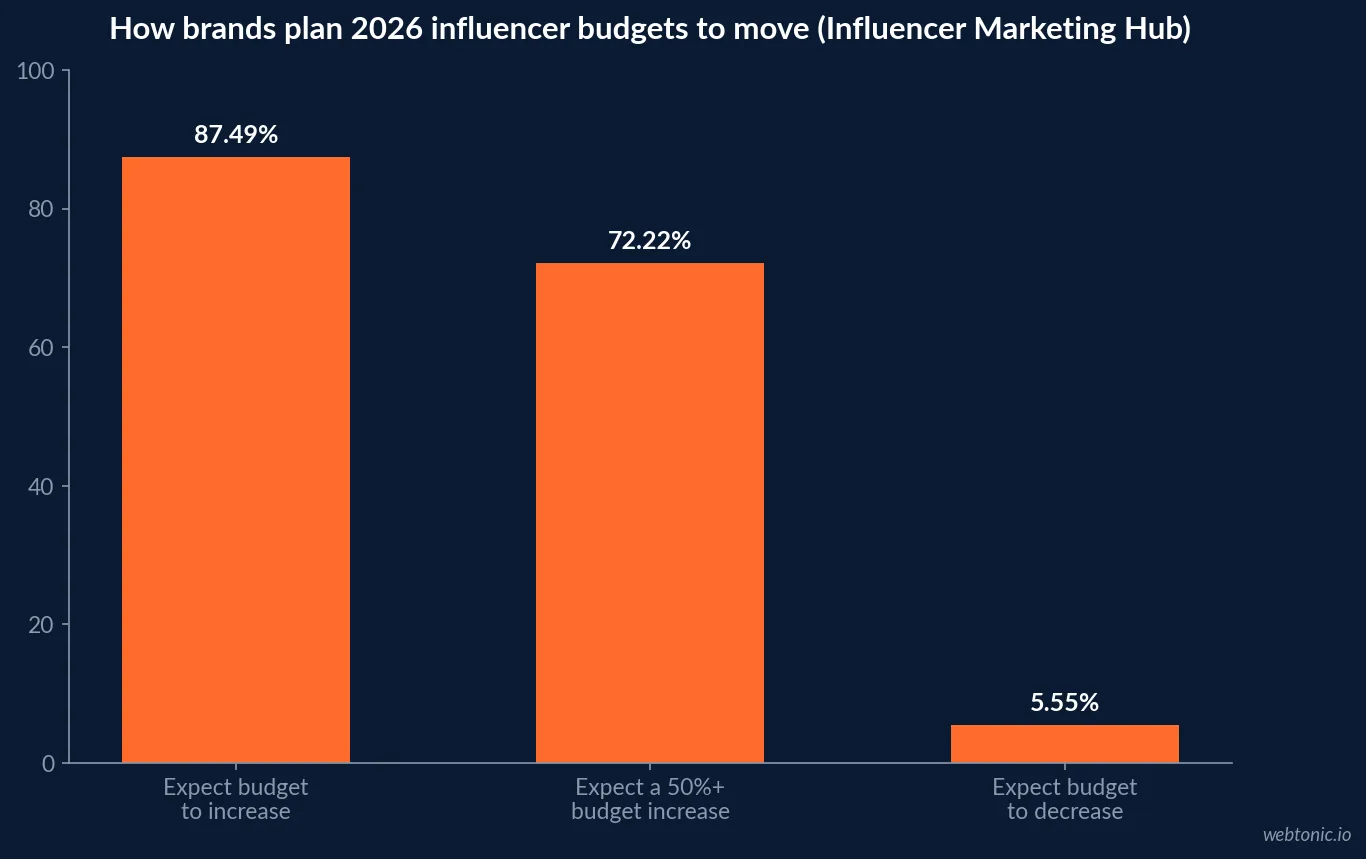
Confidence about growth is close to unanimous. The Influencer Marketing Hub's 2026 Benchmark Report found 87.49% of respondents expect their influencer budget to increase in 2026, and a striking 72.22% expect that increase to be 50% or more - a step-change rather than incremental growth. Only 5.55% expect a decrease.
| Budget growth metric (2026) | Figure | Source |
|---|---|---|
| Projected global creator economy size | USD 313.95B | Precedence Research |
| Projected US influencer spend growth | +15.7% | Aspire, State of Influencer Marketing 2026 |
| Projected US influencer spend by 2027 | USD 13.7B | Aspire, State of Influencer Marketing 2026 |
| Marketers expecting a budget increase | 87.49% | Influencer Marketing Hub Benchmark 2026 |
| Marketers expecting a 50%+ increase | 72.22% | Influencer Marketing Hub Benchmark 2026 |
| CreatorIQ-reported creator budget growth | +171% | CreatorIQ State of Creator Marketing 2025-26 |
What content creation actually costs, by tier
Growth headlines hide a much more modest reality for most programs. Aspire's data shows 61% of influencer marketing programs still run under USD 250,000 a year in total spend, even as a notable 16% now manage multi-million dollar programs - the channel scales widely by business size, not uniformly.
Pricing by creator tier, drawn from brand-side cost selections in the Influencer Marketing Hub's 2026 Benchmark Report, clusters heavily at the low end and then spreads out fast: roughly 80% of UGC-creator pricing sits under USD 500 a post, about 55% of nano-creator pricing sits under USD 500, and 45.5% of micro-creator pricing sits under USD 500 with most of the rest in the USD 500-2,000 band. Mid-tier respondents most commonly place pricing in the USD 2,000-5,000 and USD 5,000-10,000 bands (about 22.2% each), and macro-creator pricing is the most dispersed of all, spanning low-cost to over-USD-10,000 placements.
| Creator tier | Most common price point | Source |
|---|---|---|
| UGC creator | ~80% of pricing under USD 500/post | Influencer Marketing Hub Benchmark 2026 |
| Nano creator | ~55% of pricing under USD 500/post | Influencer Marketing Hub Benchmark 2026 |
| Micro creator | ~45.5% under USD 500, rest mostly USD 500-2,000 | Influencer Marketing Hub Benchmark 2026 |
| Mid-tier creator | ~22.2% each in USD 2,000-5,000 and USD 5,000-10,000 bands | Influencer Marketing Hub Benchmark 2026 |
| Macro / celebrity | Most dispersed - meaningful share above USD 10,000 | Influencer Marketing Hub Benchmark 2026 |
Where the cost pressure is really coming from
It is not agencies or software eating the budget - it is the creators themselves getting more expensive. In the Influencer Marketing Hub's 2026 survey, rising creator costs is the single most cited program challenge at 35.4%. Combined with plain budget constraints (5.28%), economic pressure accounts for roughly 41% of all reported challenges - well ahead of measurement, creative fatigue or platform-policy concerns. That reframes the budgeting conversation: the open question for 2026 is less "should we spend more" and more "how do we afford scale under rising per-creator rates."
CreatorIQ's State of Creator Marketing 2025-26 report, based on a Sapio Research survey of 1,723 brands, agencies and creators across 17 industries and nine regions, headlines a 171% surge in reported creator budgets among its respondents alongside rising demand for scalable, provable ROI - brands are not just spending more, they are being asked to defend every dollar of it harder than in prior cycles.
| Cost pressure signal (2026) | Share of respondents | Source |
|---|---|---|
| Cite rising creator costs as the top challenge | 35.4% | Influencer Marketing Hub Benchmark 2026 |
| Cite budget constraints as a top challenge | 5.28% | Influencer Marketing Hub Benchmark 2026 |
| Combined economic-pressure challenges | ~41% | Influencer Marketing Hub Benchmark 2026 |
| Reported creator budget growth (CreatorIQ survey base) | +171% | CreatorIQ State of Creator Marketing 2025-26 |
Does the spend actually convert?
The consumer-side evidence is what justifies the rising line item. NeoReach's Creator Impact Report 2026, pairing a 1,050-person US consumer survey run with Statista and an independent survey of 539 creators, found 55% of consumers say they take action from creator content, and close to half report making a purchase influenced by a creator on a monthly basis. That is the return side of the budget equation: rising creator rates are being absorbed because the channel is still converting attention into action at a rate few other formats can match.
Platform mix changes what "content creation" even means
A 2026 content creation budget rarely buys one format anymore. CreatorIQ's 1,723-respondent survey spans brands, agencies and creators across 17 industries and nine regions, and the demand pattern it captures - efficacy and provable ROI over reach alone - shows up in how budgets are split across platforms and formats rather than concentrated in a single channel. Short-form video briefs, UGC-style ad creative meant for paid amplification, and long-form platform-native content (YouTube, Substack, Patreon) now typically sit in the same annual plan with different rate cards for each, which is why a single "average creator rate" number is close to useless for budgeting purposes - the tier and the format both move the price independently.
NeoReach's creator-facing data collection for its 2026 Creator Impact Report ran an independent survey of 539 creators between January 21 and March 2, 2026, across a range of platform types, follower sizes and content niches - a reminder that supply is just as fragmented as demand. A brand budgeting for "content creation" in 2026 is really budgeting across several distinct labor markets - UGC, nano/micro social, mid-tier platform-native and macro/celebrity - that happen to share a line item on a media plan.
| Format/platform consideration | 2026 budgeting implication | Source |
|---|---|---|
| UGC for paid amplification | Cheapest per-asset tier; buy in volume, not per campaign | Influencer Marketing Hub Benchmark 2026 |
| Short-form social (Reels/TikTok/Shorts) | Nano/micro rates apply; engagement rate drives price more than followers | Influencer Marketing Hub Benchmark 2026 |
| Long-form platform-native (YouTube/Substack) | Priced closer to mid-tier/macro bands, often with usage-rights add-ons | CreatorIQ State of Creator Marketing 2025-26 |
| Multi-format creator retainers | Where the 16% of multi-million dollar programs concentrate spend | Aspire, State of Influencer Marketing 2026 |
How to set a 2026 content creation budget
- Price by tier, not by a blended average - UGC and nano rates cluster under USD 500, but mid and macro tiers move fast past USD 5,000-10,000 per placement.
- Plan for rate inflation, not just volume growth - it is the top reported program challenge at 35.4%, ahead of budget caps themselves.
- Benchmark against the USD 250K program size, not the multi-million headlines - 61% of programs still operate at that smaller scale.
- Treat the 23%-of-budget share as a floor, not a ceiling, if creator content is already converting for your funnel.
- Fund measurement alongside production so a rising spend line can still be defended the way CreatorIQ's 2026 respondents are being asked to.
Web Tonic's performance creative team builds creator briefs and rate benchmarks by tier for clients scaling content programs, our growth marketing group sets the media budget these figures should sit inside, and our team background covers how those two functions work together on a creator program.
Budgeting for the creators who don't hit a living wage
The supply side of this market is more fragile than the growth headlines suggest. NeoReach's separate Creator Earnings Report line of research is headlined, plainly, "50% Below a Living Wage" - a signal that a large share of full-time creators are not clearing a basic US living-wage benchmark today. That gap is part of why rate inflation at the nano and micro tiers is happening in the first place: creators are actively renegotiating rates upward because the volume-based economics of the lower tiers have not historically supported full-time work. A brand budgeting for 2026 should expect that pressure to continue rather than assume 2025 rate cards hold, particularly for the nano and micro tiers where 55% and 45.5% of pricing respectively still sits under USD 500 today.
That pricing reality also explains why a growing share of 2026 budget is moving toward fewer, better-paid creator relationships rather than a wide roster of one-off placements: retainers and multi-post agreements amortize the negotiation and briefing cost of a creator relationship across more deliverables, which is part of what is driving the 16% of programs now operating at a multi-million dollar scale even as the median program size stays modest.
Frequently Asked Questions
How much does a piece of creator content actually cost in 2026?
It depends heavily on tier. The Influencer Marketing Hub's 2026 Benchmark Report, drawn from brand-side cost selections, found roughly 80% of UGC-creator pricing sits under USD 500 a post, about 55% of nano-creator pricing sits under USD 500, and 45.5% of micro-creator pricing sits under USD 500 with the rest mostly in the USD 500-2,000 band. Mid-tier creators cluster instead in the USD 2,000-10,000 range, and macro and celebrity pricing spreads much wider, including a meaningful share above USD 10,000 per placement.
Should a brand budget more for creator content in 2026 than in 2025?
Most are planning to. Aspire's State of Influencer Marketing 2026 report found 74% of marketers plan to increase their influencer marketing budgets this year, and the Influencer Marketing Hub's 2026 survey found 87.49% expect their budget to rise, with 72.22% expecting a 50%-plus increase. US influencer marketing spend overall is projected to grow 15.7% in 2026 and reach USD 13.7 billion by 2027.
What's the typical size of a full content creation program in 2026?
Smaller than the growth headlines suggest. Aspire's data shows 61% of influencer marketing programs still run under USD 250,000 a year in total spend, even as a notable 16% now manage multi-million dollar programs. Last year brands allocated an average of 23% of total marketing budget to creator partnerships, and that share is expected to rise again in 2026.
What is driving up content creation costs the most?
Rate inflation at the creator level, not agency fees or platform costs. The Influencer Marketing Hub's 2026 survey found rising creator costs is the single most cited program challenge, at 35.4%, and when combined with straight budget constraints (5.28%) it adds up to roughly 41% of all reported challenges being economic pressure rather than measurement or creative issues.
Is AI changing how much content creation costs?
It is changing volume more than price so far. Industry-wide adoption data (HubSpot's 2026 State of Marketing) shows the large majority of marketing teams already use AI in content workflows, which lowers the cost of drafts, captions and iteration, but does not touch what creators charge for original video, photography or on-platform storytelling - the line items still governed by the creator-tier pricing above.
Sources
Precedence Research - Creator Economy Market Size 2026
Aspire - State of Influencer Marketing 2026
Influencer Marketing Hub - Benchmark Report 2026
NeoReach - Creator Impact Report 2026
CreatorIQ - State of Creator Marketing 2025-26