Table of contents
Consumer privacy regulation stopped being a legal footnote and became a marketing budget line in 2026. Twenty US states now enforce a comprehensive privacy law, GDPR fines have crossed EUR 7 billion cumulative, and nearly half of consumers say they have already taken a revenue-relevant action - cancelling, switching or reducing spend - over how a brand handles their data.
Key Takeaways
- 20 US states now have a comprehensive consumer privacy law, up from 1 in 2018.
- 3 more laws (Indiana, Kentucky, Rhode Island) took effect January 1, 2026.
- EUR 7.1 billion in cumulative GDPR fines since May 2018.
- EUR 1.2 billion in GDPR fines issued in 2025 alone, matching 2024.
- EUR 530 million was the largest single 2025 GDPR fine, for cross-border transfers.
- 443 breach notifications a day across the EU in 2026, up 22% year over year.
- 99% of organizations report a tangible benefit from their privacy program.
- 90% of organizations say AI expanded the scope of their privacy program.
- 38% of organizations now spend USD 5 million-plus a year on privacy, up from 14%.
- 93% of organizations plan to add privacy investment over the next two years.
- 46% of organizations rank transparency as the top driver of customer trust.
- 52% of consumers now trust AI less than humans with their personal data.
- 24% of consumers cancelled a subscription or purchase over AI data-use fears.
- 47% of consumers took at least one revenue-consequential action on trust grounds.
- 52% of consumers will pay about 7% more for brands that handle data well.
- 46% of consumers still don't understand how their data is collected or used.
- 65% of organizations struggle to access high-quality data efficiently.
- 81% of organizations want more data localization even though it limits reach.
| Benchmark | 2026 value | Source |
|---|---|---|
| US states with a comprehensive privacy law | 20 states | IAPP Tracker |
| Cumulative GDPR fines since May 2018 | EUR 7.1B | DLA Piper Survey |
| Orgs spending USD 5M+/yr on privacy | 38% | Cisco Benchmark Study |
| Consumers who took a revenue-relevant privacy action | 47% | Usercentrics 2026 |
| Consumers willing to pay ~7% more for trusted brands | 52% | Usercentrics 2026 |
| Orgs citing transparency as the top trust driver | 46% | Cisco Benchmark Study |
The regulatory map a national campaign now runs against
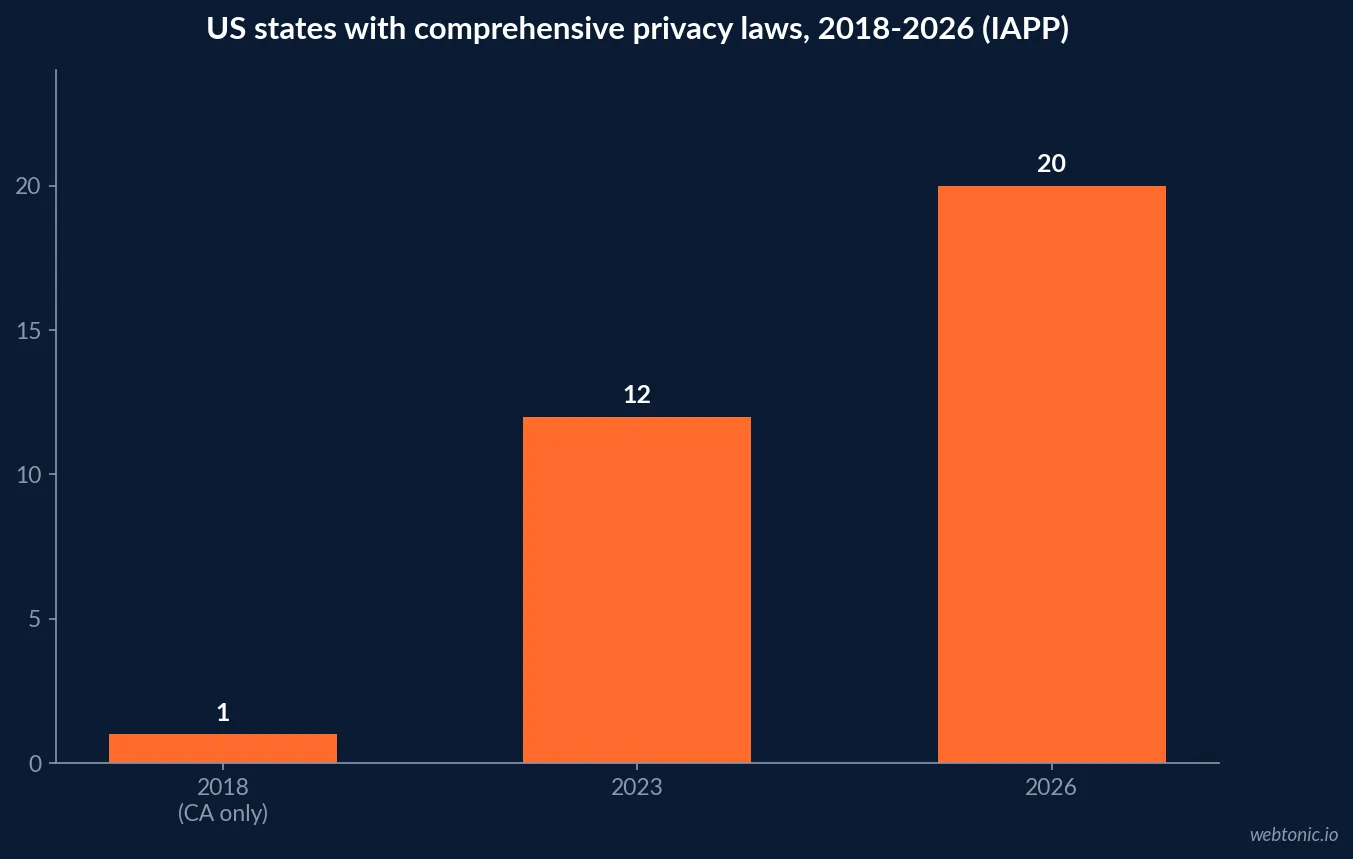
The compliance surface for a US marketing team roughly 20x'd in eight years. The IAPP's US State Privacy Legislation Tracker lists 20 states with a comprehensive consumer privacy law in effect as of early 2026, up from a single state - California's CCPA - in 2018. Indiana, Kentucky and Rhode Island brought their laws into force on January 1, 2026, and there is still no federal law unifying the patchwork, so a single campaign can trigger four or five different consent, opt-out and data-sale definitions depending on where the click lands.
Europe's enforcement side is not slowing down either. DLA Piper's 2026 GDPR Fines and Data Breach Survey - its eighth annual edition - found European supervisory authorities issued about EUR 1.2 billion in fines in 2025, closely matching 2024 and pushing the cumulative total since GDPR's 2018 start date to roughly EUR 7.1 billion. Ireland's Data Protection Commission drives most of that, with EUR 4.04 billion in cumulative fines and the largest single 2025 penalty, EUR 530 million, against a social media company for unlawful international data transfers.
| Enforcement metric | 2026 figure | Source |
|---|---|---|
| Cumulative GDPR fines since May 2018 | EUR 7.1 billion | DLA Piper GDPR Fines Survey 2026 |
| GDPR fines issued in 2025 | EUR 1.2 billion | DLA Piper GDPR Fines Survey 2026 |
| Largest single 2025 GDPR fine | EUR 530 million (Ireland DPC) | DLA Piper GDPR Fines Survey 2026 |
| Ireland DPC cumulative fines since 2018 | EUR 4.04 billion | DLA Piper GDPR Fines Survey 2026 |
| Average daily EU breach notifications, 2026 | 443, up 22% YoY | DLA Piper GDPR Fines Survey 2026 |
What privacy programs are actually costing marketing-adjacent budgets
Cisco's 2026 Data and Privacy Benchmark Study, a survey of more than 5,200 privacy, IT and security professionals across 12 markets, found spending has jumped sharply: 38% of organizations now spend USD 5 million or more a year on privacy, up from just 14% a year earlier, and 43% increased privacy spending over the past year. AI is the driver named most often - 90% say their privacy program's scope expanded because of AI, and 93% plan to add more resources over the next two years. Two-thirds (65%) still struggle to access high-quality data efficiently, which is the operational reason marketing measurement keeps getting harder even as budgets for the function rise.
The report also complicates the "privacy is pure cost" narrative: 99% of those organizations report at least one tangible benefit from their privacy investment, and when asked what actually builds customer confidence, 46% point to clear communication about data use - well ahead of demonstrating legal compliance (18%) or simply avoiding a breach (14%). Cross-border friction is real too: 81% of organizations want more data localization even though most say it limits their ability to serve markets seamlessly, and 83% support harmonized international transfer rules instead.
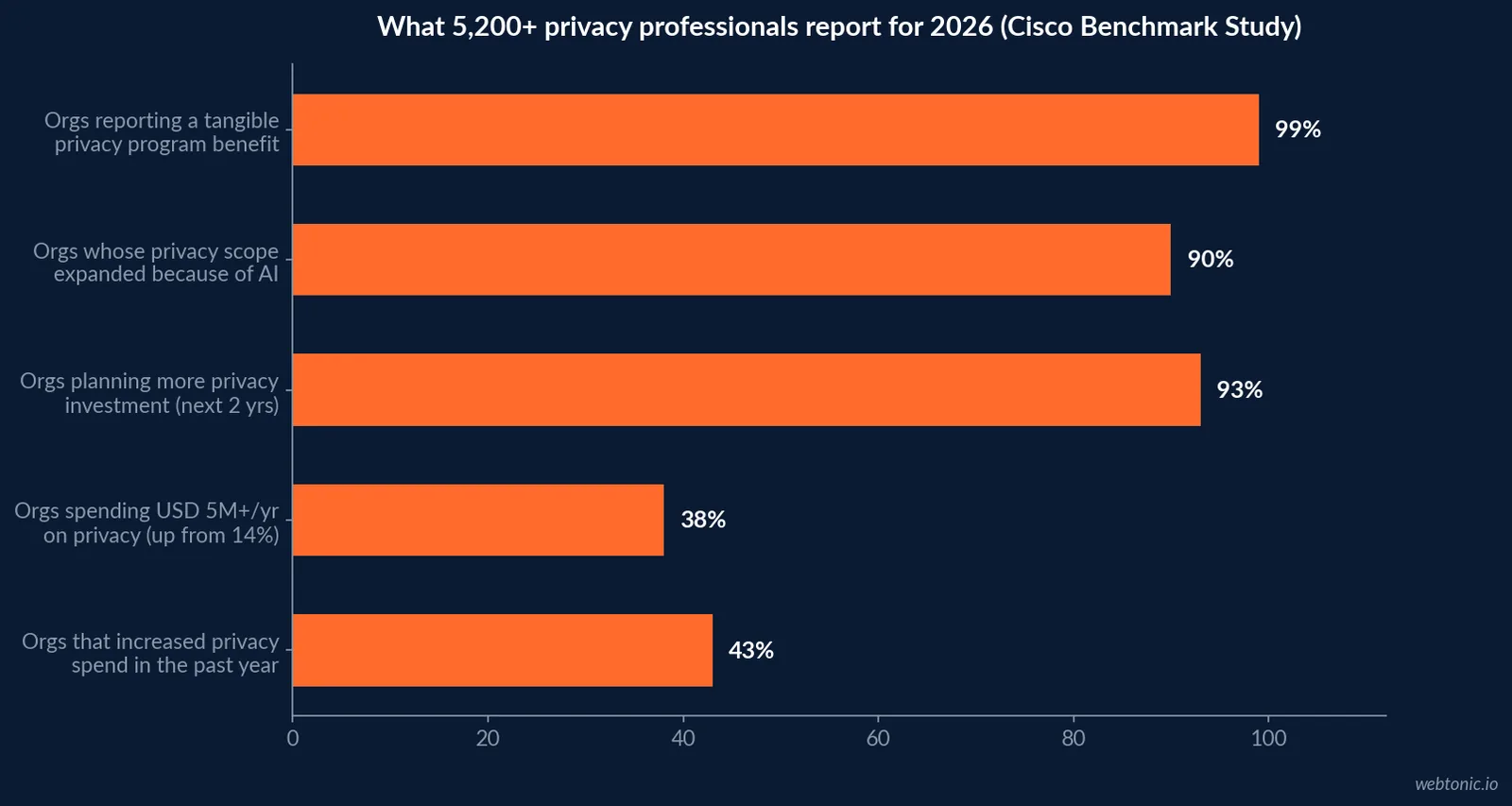
| Cisco 2026 benchmark metric | Share of organizations |
|---|---|
| Report at least one tangible privacy program benefit | 99% |
| Say privacy program scope expanded because of AI | 90% |
| Plan to add privacy investment over next 2 years | 93% |
| Increased privacy spending in the past year | 43% |
| Now spend USD 5M+/year on privacy (vs. 14% a year prior) | 38% |
| Rank transparency as the top driver of customer trust | 46% |
How consumers are actually reacting
The behavioral evidence backs up why marketers should care beyond legal exposure. Usercentrics' State of Digital Trust 2026 report, built on a Sapio Research survey of 11,000 consumers across seven markets, found the share who trust AI less than humans with their personal data rose from 48% to 52% year over year - the single largest movement in the survey. 24% of consumers cancelled a subscription or stopped purchasing from a brand in the past six months specifically over how their data was used in AI, one in five (20%) switched to a competitor they trusted more, and 47% took at least one action with a direct revenue consequence. The reward side is just as measurable: 52% say they will pay roughly 7% more for brands that get transparency right, and in the US specifically only 39% trust government services with their data - the lowest of any market studied, which leaves brands more room to be the trusted party by comparison.
What has not moved is comprehension: 46% of consumers still say they don't have a good understanding of how their data is collected and used, identical to the year before. Two years of headline privacy coverage have not closed that education gap, which is itself an opportunity for a marketing team willing to explain data use in plain language rather than legal boilerplate.
| Consumer behavior (2026) | Share reporting it | Source |
|---|---|---|
| Trust AI less than humans with personal data | 52% | Usercentrics State of Digital Trust 2026 |
| Cancelled a subscription/purchase over AI data use (6 mo.) | 24% | Usercentrics State of Digital Trust 2026 |
| Switched to a more-trusted competitor | 20% | Usercentrics State of Digital Trust 2026 |
| Took any revenue-consequential trust action | 47% | Usercentrics State of Digital Trust 2026 |
| Will pay ~7% more for brands that handle data well | 52% | Usercentrics State of Digital Trust 2026 |
| Still don't understand how their data is used | 46% | Usercentrics State of Digital Trust 2026 |
The privacy-personalization paradox is not going away
Qualtrics' XM Institute surveyed more than 20,000 consumers across 14 countries for its Consumer Preferences for Privacy and Personalization report and named the tension directly: people want customized experiences but trust in how brands handle their data has not kept pace with that appetite. That gap - wanting the benefit of data without trusting the collection - is the single hardest thing for a marketing team to design around in 2026, and it is why consent-management and first-party data infrastructure now sit inside marketing operations budgets rather than purely in legal or IT.
The IAB's State of Data research series has tracked the same shift from the media side for several cycles running: signal deprecation keeps pushing budgets toward first-party data, alternative identifiers and data clean rooms, even as AI adoption changes what "using data well" means to both regulators and consumers at the same time.
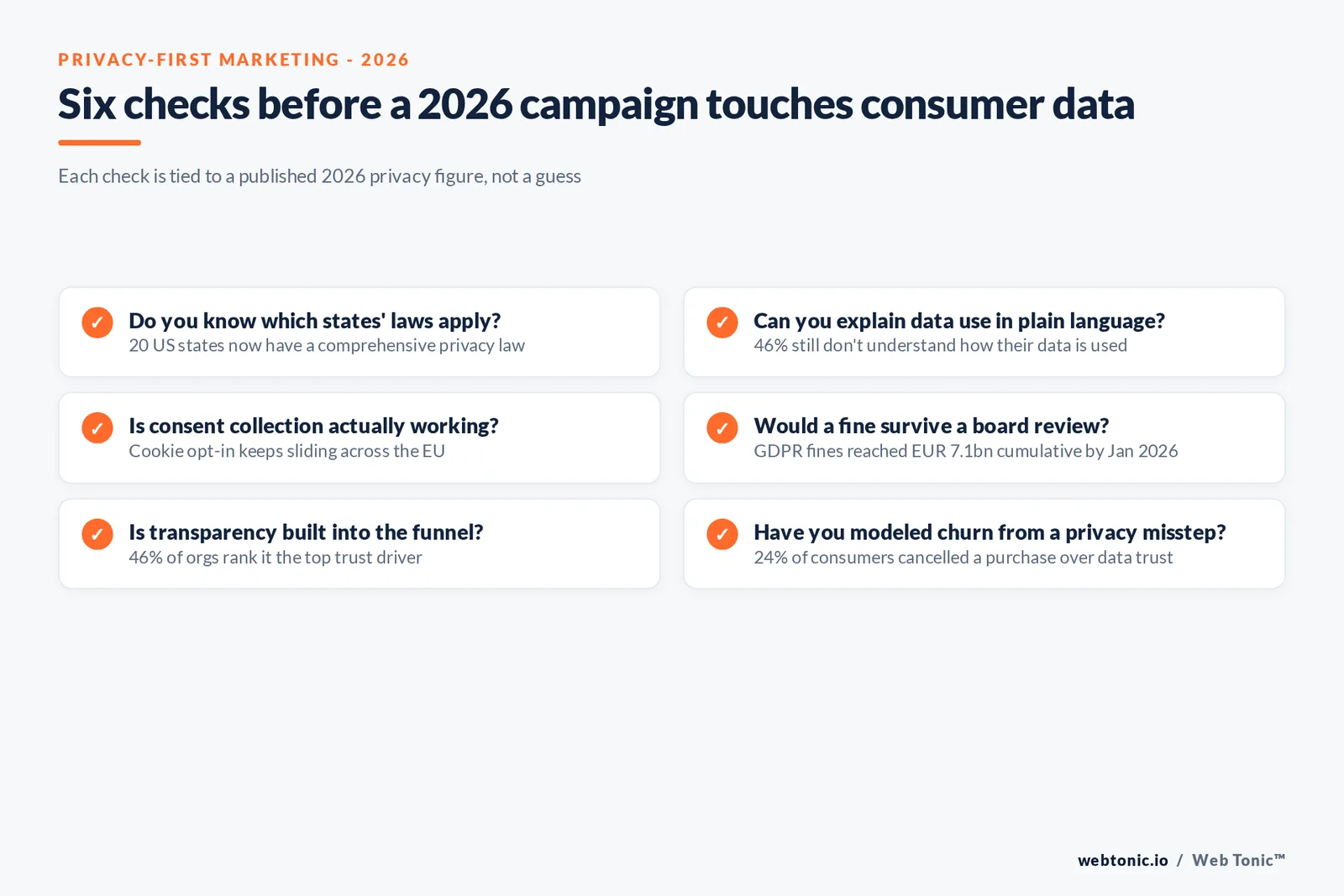
Where the next enforcement wave is likely to land
Three states brought new comprehensive privacy laws into force on January 1, 2026 alone - Indiana, Kentucky and Rhode Island - and the IAPP tracker shows several more with laws passed but not yet effective, meaning the count of 20 is a floor, not a ceiling, for the year. Cross-border data flows are the other flashpoint: Cisco's 2026 study found 81% of organizations want more data localization even though most admit it limits their ability to offer seamless service across markets, while 83% would rather see harmonized international transfer rules than a patchwork of local requirements. That tension - between localization pressure and the operational cost of fragmenting infrastructure - is exactly what a 2026 marketing technology stack has to be built to survive, since a campaign built around a single global data pipeline is the one most exposed to the next state or national law.
The practical read for a media plan: assume a 21st state passes its own comprehensive law before the year closes, and build consent-management and data-flow documentation once, at the strictest applicable standard, rather than patching campaign-by-campaign every time a new state takes effect.
| Governance friction point (Cisco 2026) | Share of organizations |
|---|---|
| Struggle to access high-quality data efficiently | 65% |
| Want more data localization | 81% |
| Support harmonized international transfer rules instead | 83% |
What this means for a 2026 marketing budget
- Budget for compliance as a recurring line, not a one-time project - 43% of organizations increased privacy spend this past year alone, and the states keep adding up.
- Rebuild attribution around first-party, consented data before the next signal-loss event forces the change under deadline pressure.
- Turn transparency into a message, not just a policy page - it is the single most-cited driver of customer trust in Cisco's 2026 data, ahead of compliance claims.
- Price in churn risk from data missteps: nearly half of consumers have already taken a revenue-relevant action over trust.
- Treat consent-rate improvement as a growth lever, not a legal checkbox - over half of consumers say they will spend more with brands that earn their trust.
Web Tonic's data intelligence team builds first-party measurement and consent-aware attribution for clients navigating exactly this shift; our growth marketing group then plans budgets against the signal that survives regulation instead of the signal that doesn't, and our team background covers how we structure that work end to end.
Frequently Asked Questions
How many US states have a comprehensive privacy law in 2026?
At least 20, according to the IAPP's US State Privacy Legislation Tracker, up from a single state - California - in 2018. Three more laws, in Indiana, Kentucky and Rhode Island, took effect on January 1, 2026 alone, and there is still no federal standard unifying them. A marketing team running national campaigns is effectively complying with 20 different rulebooks on consent, opt-outs and data sale definitions at once.
How much do GDPR fines actually cost companies?
European supervisory authorities issued roughly EUR 1.2 billion in GDPR fines in 2025, matching 2024, and cumulative fines since May 2018 reached about EUR 7.1 billion by early January 2026, per DLA Piper's GDPR Fines and Data Breach Survey. Ireland's Data Protection Commission alone accounts for EUR 4.04 billion of that total and issued the largest single 2025 fine, EUR 530 million, against a social media company for unlawful international data transfers. These are enforcement risks a media budget has to price in, not abstract legal line items.
Do consumers actually change behavior over data privacy?
Yes, and increasingly with their wallets. Usercentrics' State of Digital Trust 2026 survey of 11,000 consumers across seven markets found 24% cancelled a subscription or stopped purchasing from a brand in the past six months over data-use concerns, one in five (20%) switched to a competitor they trusted more, and 47% took at least one action with a direct revenue consequence. On the upside, 52% say they will pay about 7% more for brands that get AI and data use right.
Is privacy compliance actually good for marketing, or just a cost center?
Both, per Cisco's 2026 Data and Privacy Benchmark Study of 5,200-plus privacy, IT and security professionals: 99% report at least one tangible benefit from their privacy program, and 46% rank 'clear communication about data use' as the single most effective way to build customer confidence - ahead of demonstrating compliance (18%) or avoiding breaches (14%). Treating consent and transparency as a marketing asset, not just a legal checkbox, is where the study's data points.
What should a marketing team change first because of privacy regulation?
Start with measurement, not messaging. With cookie consent rates declining and 65% of organizations telling Cisco they struggle to access high-quality data efficiently, the practical first move is auditing what first-party, consented data your funnel actually produces, then building attribution around that rather than around signals regulation is steadily removing.
Sources
IAPP - US State Privacy Legislation Tracker
DLA Piper - GDPR Fines and Data Breach Survey 2026
Cisco - 2026 Data and Privacy Benchmark Study
Usercentrics - State of Digital Trust 2026
Qualtrics XM Institute - Consumer Preferences for Privacy and Personalization, 2026
IAB - State of Data Report