Table of contents
CFPB complaint volume reached 6.6 million in 2025, roughly doubling every year since 2023, and independent data from the BBB, Trustpilot and the American Customer Satisfaction Index all point the same direction. This page tracks where consumer complaint statistics are heading next across the channels consumers actually use to file them.
Key Takeaways
- CFPB complaints reached 6,635,400 in 2025, up from 3,187,900 in 2024.
- Complaint volume has roughly doubled every year since 2023.
- 2023 CFPB complaints totaled 1,657,600, the earlier baseline year.
- BBB Scam Tracker has logged over 433,000 reports since 2022.
- Trustpilot-based research analyzed over 4.5 million US reviews in 2025 alone.
- ACSI reported record-high customer complaints in August 2026.
- Corporate profits sit at record levels alongside record complaints, per ACSI.
- About 89% of 2024's complaints were referred to companies for response.
- 3% of complaints were referred to other regulators in 2024's reporting.
- 8% of complaints were found not actionable in the same period.
- Ignoring a complaint drops a review's star rating by over 1.6 stars in the US.
- Credit reporting is a top-three CFPB complaint category nationally.
- Identity theft accounted for 18% of FTC-tracked reports in the most recent Data Book.
- Fraud made up 40% of all FTC Sentinel reports in the same year.
- Nearly 180 data sources feed the FTC's Consumer Sentinel Network.
The headline number: complaints are compounding, not stabilizing
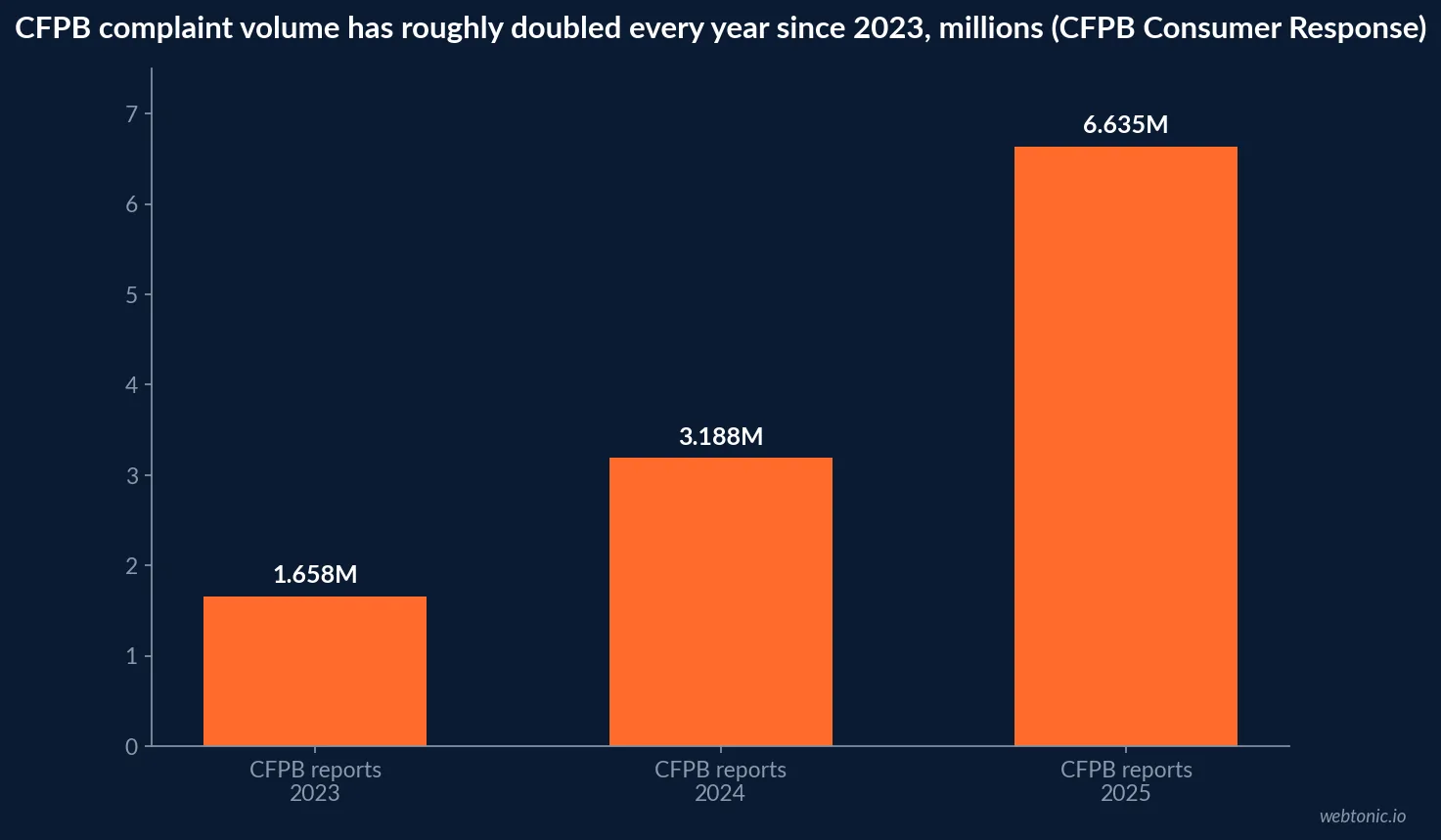
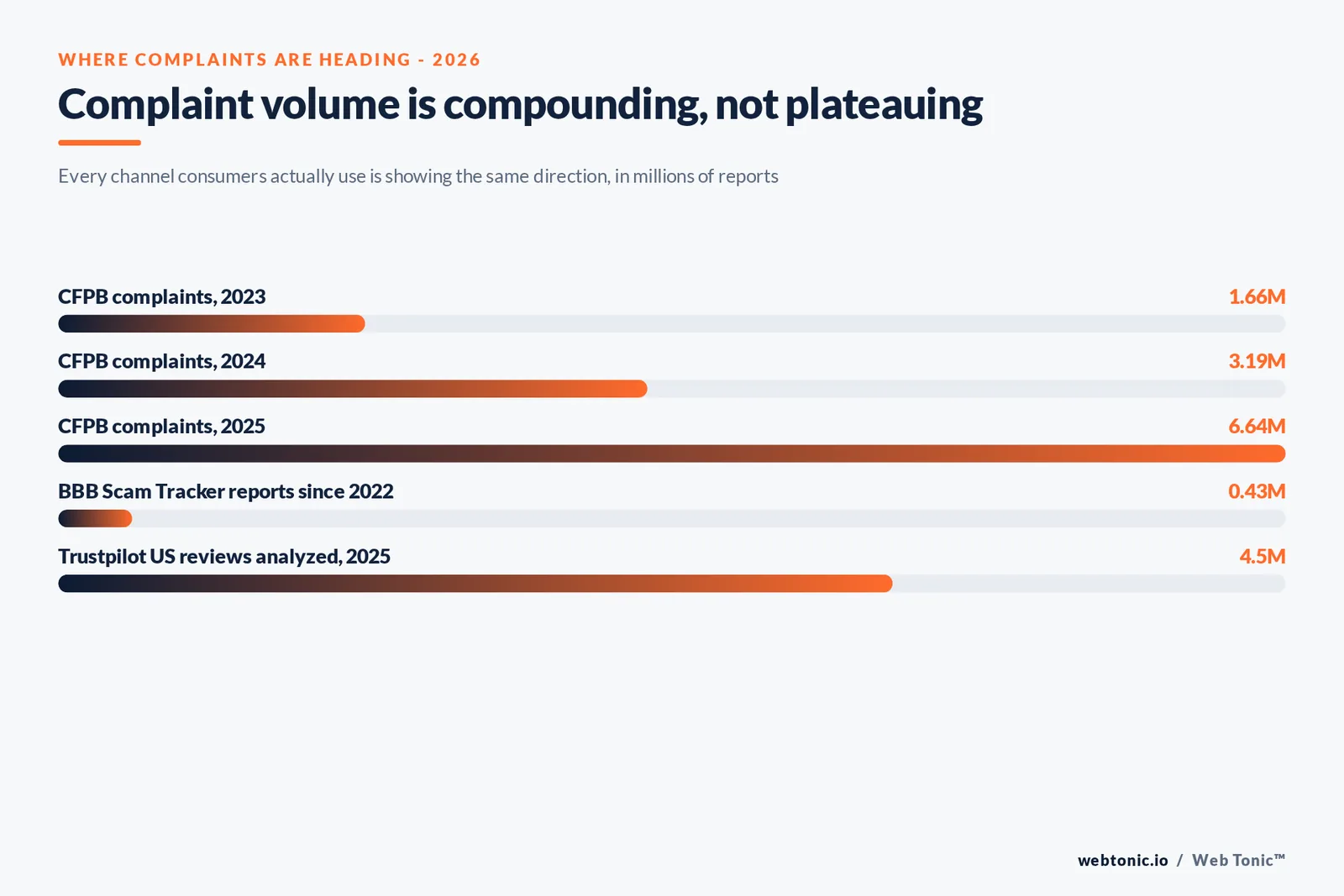
The clearest single data point on where this is heading comes straight from the regulator that collects the most complaints. The CFPB's Consumer Response Annual Report shows complaint volume moving from 1,657,600 in 2023 to 3,187,900 in 2024 to 6,635,400 in 2025 - a pattern the agency itself describes as roughly doubling each year since 2023. That is not a plateau with noisy quarters; it is sustained, compounding growth across three consecutive reporting years.
| Year | CFPB complaints received | Year-over-year change | Source |
|---|---|---|---|
| 2023 | 1,657,600 | Baseline for this trend | CFPB Consumer Response Annual Report |
| 2024 | 3,187,900 | +92% | CFPB Consumer Response Annual Report |
| 2025 | 6,635,400 | +108% | CFPB Consumer Response Annual Report |
It is not just one regulator's inbox
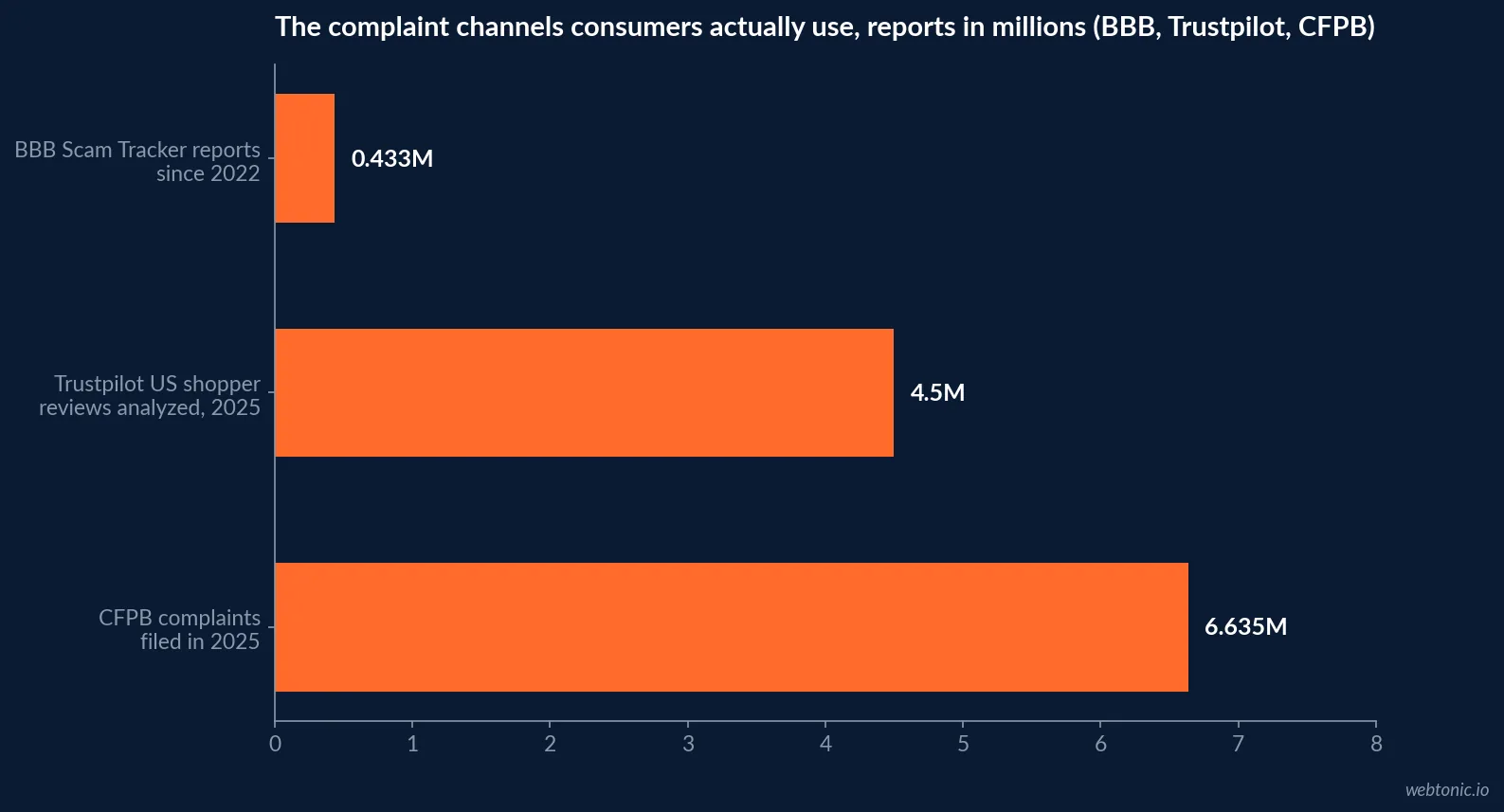
The same direction shows up outside the CFPB. The Better Business Bureau's Scam Tracker has logged more than 433,000 reports since 2022, giving what BBB itself calls "a unique glimpse into the patterns developing across the North American scam landscape." Separately, research covered by CustomerThink analyzed more than 4.5 million US shopper reviews on Trustpilot over a single 12-month window in 2025 alone, a volume that dwarfs the BBB's multi-year total and shows how much complaint and review activity now happens entirely outside any regulatory channel.
| Channel | Volume | Time window | Source |
|---|---|---|---|
| CFPB complaints | 6.64 million | Calendar year 2025 | CFPB Consumer Response Annual Report |
| Trustpilot US reviews analyzed | 4.5 million+ | 12-month window, 2025 | Trustpilot research via CustomerThink |
| BBB Scam Tracker reports | 433,000+ | Since 2022 | Better Business Bureau |
| FTC Consumer Sentinel reports | 6.5 million | Calendar year 2024 | FTC Consumer Sentinel Data Book 2024 |
What happens to a complaint once it is filed
Volume growth does not appear to be matched by a proportional change in how complaints get resolved. In its reporting on 2024's 3,187,900 complaints, the CFPB documented referring approximately 89% to companies for review and response, 3% to other regulatory agencies, and finding 8% not actionable. That routing split has stayed structurally similar even as the raw numbers moved sharply upward, which means the system's throughput per complaint has not obviously scaled alongside intake.
What the FTC's broader fraud data adds
The FTC's Consumer Sentinel Network Data Book received 6.5 million consumer reports in 2024 across 29 top categories, fed by nearly 180 data sources including other government agencies, industry members and consumer groups. Fraud made up 40% of all reports and identity theft 18%, with Credit Bureaus and Information Furnishers, Identity Theft and Imposter Scams as the top three individual categories. That breadth of sourcing is part of why the FTC's total moves somewhat independently from the CFPB's finance-specific numbers, even though both point toward sustained growth.
| Category (FTC Sentinel, 2024) | Share of reports | Notes |
|---|---|---|
| Fraud | 40% | Largest single category |
| Identity theft | 18% | Second-largest single category |
| Other consumer protection issues | 43% | Includes Credit Bureaus & Info Furnishers, Imposter Scams |
Why the growth curve keeps compounding instead of leveling off
Three factors show up across this research as likely contributors to the compounding pattern rather than a one-time spike. First, filing a complaint has gotten structurally easier: online portals, review sites and Scam Tracker-style tools lower the friction of reporting compared with phone or mail complaints a decade ago. Second, Rulebase's State of Complaints Report 2026 notes the CFPB total alone nearly doubled year over year while Trustpilot volume grew independently, suggesting more than one category of consumer issue is expanding at once rather than a single event driving the whole trend. Third, awareness of where to complain has spread: a consumer who might once have simply stopped using a product now has a specific, well-known channel - regulatory, retailer, or review-platform - to route the frustration through instead.
None of those three factors point toward the trend reversing on its own in the near term, which is the basis for reading this as a compounding pattern rather than a temporary spike tied to one bad year.
The satisfaction data behind the complaint growth
The American Customer Satisfaction Index reported in August 2026 that customer complaints are at a record high, and framed the finding as a warning: pretax corporate profits sit at record levels according to the US Bureau of Economic Analysis, but so do customer complaints per ACSI's own tracking - a combination ACSI calls dangerous because of the pent-up customer defection it signals once conditions shift. Companies reading strong margins as evidence of customer health, in ACSI's framing, are watching the wrong number.
The measurable cost of ignoring a complaint
The clearest quantified cost in current research comes from Trustpilot-based analysis: ignoring a complaint decreases a review's star rating by more than 1.6 stars in the US market. Combined with the growth curves above, that single figure argues for treating complaint response time as a metric worth its own dashboard line, not a support-team afterthought measured only in ticket count.
The same research, covered by CustomerThink, frames handled returns and complaints as the biggest untapped loyalty lever available to a brand in 2026 - the businesses gaining the most ground are not the ones with the fewest complaints, but the ones responding fastest and most visibly to the complaints that do arrive.
| Response behaviour | Measured effect | Source | Practical takeaway |
|---|---|---|---|
| Complaint ignored entirely | Star rating drops more than 1.6 stars | Trustpilot via CustomerThink | Silence is the costliest response |
| Complaint acknowledged publicly | Framed as the biggest untapped loyalty lever | Trustpilot via CustomerThink | Visible response beats private resolution alone |
| Complaint routed to correct channel | 89% of 2024 CFPB volume reached companies | CFPB | Most complaints do reach the business eventually |
What smaller businesses can take from national-scale data
The CFPB and FTC numbers are dominated by large financial institutions and national scams, but the underlying behavioural shift applies further down market. If national complaint volume is roughly doubling annually and the American Customer Satisfaction Index is finding record complaints alongside record profits, a business assuming its own complaint rate is stable purely because revenue looks healthy is making the same reading error ACSI is warning against at the macro level. The 1.6-star penalty for an ignored review applies to a five-location local business the same way it applies to a national brand - the absolute review counts differ, but the proportional cost of silence does not.
Businesses building a customer-response process for the first time, or rebuilding one under rising volume, can pair the monitoring layer with our creative and response messaging work so replies do not just get sent faster but actually read as resolution rather than deflection.
| Business size | Realistic complaint monitoring channel mix | Priority signal to track |
|---|---|---|
| Local / single-location | Google reviews, direct email, BBB profile | Response time under 48 hours |
| Regional, multi-location | Reviews + social + a shared support inbox | Star-rating trend by location |
| National | CFPB/FTC category tracking + reviews + social | Category share vs. published national trend |
Where this likely goes next
Three consecutive years of the CFPB's numbers roughly doubling, combined with Trustpilot and BBB volumes climbing independently and ACSI calling out record complaints against record profits, points toward continued growth rather than a near-term plateau. Brands that build complaint monitoring across regulatory, review and social channels together - rather than watching one inbox - will see the shift earlier than the ones waiting for a single annual report. Our data and analytics practice builds that kind of cross-channel monitoring layer, and our team can scope it against your current support stack.
Frequently Asked Questions
How many consumer complaints did the CFPB receive in 2025?
The CFPB's Consumer Response Annual Report shows 6,635,400 complaints received in 2025, up from 3,187,900 in 2024 and 1,657,600 in 2023 - meaning complaint volume has roughly doubled every year since 2023 according to the agency's own reporting.
Is complaint volume rising across every channel, or just to regulators?
Every channel tracked shows the same direction. The BBB's Scam Tracker has logged more than 433,000 reports since 2022, and a Trustpilot-based analysis covered by CustomerThink examined over 4.5 million US shopper reviews in a single 12-month window in 2025. The American Customer Satisfaction Index reported in August 2026 that customer complaints are now at a record high nationally, independent of any single regulatory channel.
Are companies actually resolving more complaints as volume rises?
The available CFPB data does not show resolution scaling with volume. In earlier reporting on 2024's 3,187,900 complaints, the CFPB noted it referred roughly 89% of complaints to companies for response, 3% to other regulators, and found 8% not actionable - a distribution that describes routing volume, not a change in resolution capacity as complaint counts climbed.
What does the ACSI's record-high complaint finding mean for brands?
The American Customer Satisfaction Index frames it as a dangerous combination: pretax corporate profits sitting at record levels alongside record customer complaints, which it describes as a sign of pent-up customer defection risk. In ACSI's own words, satisfaction and profit have decoupled, and companies treating strong margins as proof of customer health are reading the wrong signal.
Does ignoring a complaint measurably hurt a business?
Yes, according to Trustpilot-based research cited by CustomerThink: ignoring a complaint decreases a review's star rating by more than 1.6 stars in the US market. That single data point is one of the clearest quantified costs of complaint mishandling available in current published research.
Sources
FTC - Consumer Sentinel Network Data Book 2024
FTC - Consumer Sentinel Network Data Book 2024 (PDF)
Better Business Bureau - BBB Complaint and Inquiry Statistics
BBB Institute for Marketplace Trust - Risk Report 2025, US
American Customer Satisfaction Index - Customer complaints are at a record high
Rulebase - The State of Complaints Report 2026
CustomerThink - New report from Trustpilot finds returns are biggest untapped loyalty lever