Table of contents
54% of consumers say they are making fewer impulse purchases in 2026, and Gen Z shoppers in developing markets now use AI in half of their purchase journeys. Between 2023 and 2026, published research from NielsenIQ, Capgemini, Roland Berger and BCG points to two structural shifts happening at once: deliberate, value-conscious spending, and the early spread of AI-assisted discovery layered on top of it.
Key Takeaways
- 54% of consumers report fewer impulse purchases in 2026, down from 71% a year earlier.
- 41% of shoppers now prepare a list before shopping.
- 38% plan ahead specifically to manage spending.
- Three in four consumers cite money-off discounts as most motivating.
- 50% of Gen Z shoppers in developing markets use AI in their purchase journey.
- 36% of that group relies on AI regularly for shopping decisions.
- 26% buy directly on an AI recommendation, in developing markets.
- Only 26% of all shoppers use AI in the purchase journey overall.
- 14% of all shoppers rely on AI regularly versus 36% for Gen Z in developing markets.
- 10% of all shoppers buy on AI recommendation, a quarter of the Gen Z rate.
- Baby boomers shop online least, at about 2% of purchases per Salsify.
- Online share of purchases dropped 12 points year over year in Salsify's 2026 data.
- Consumers are filling carts with more items while spending less per order, per impact.com.
- Roland Berger frames the 2026 consumer as structurally less loyal across income groups.
- PwC surveyed 21,808 consumers across 27 countries for its 2026 Voice of the Consumer study.
From reactive to deliberate: the inflation-era shift outlasted inflation
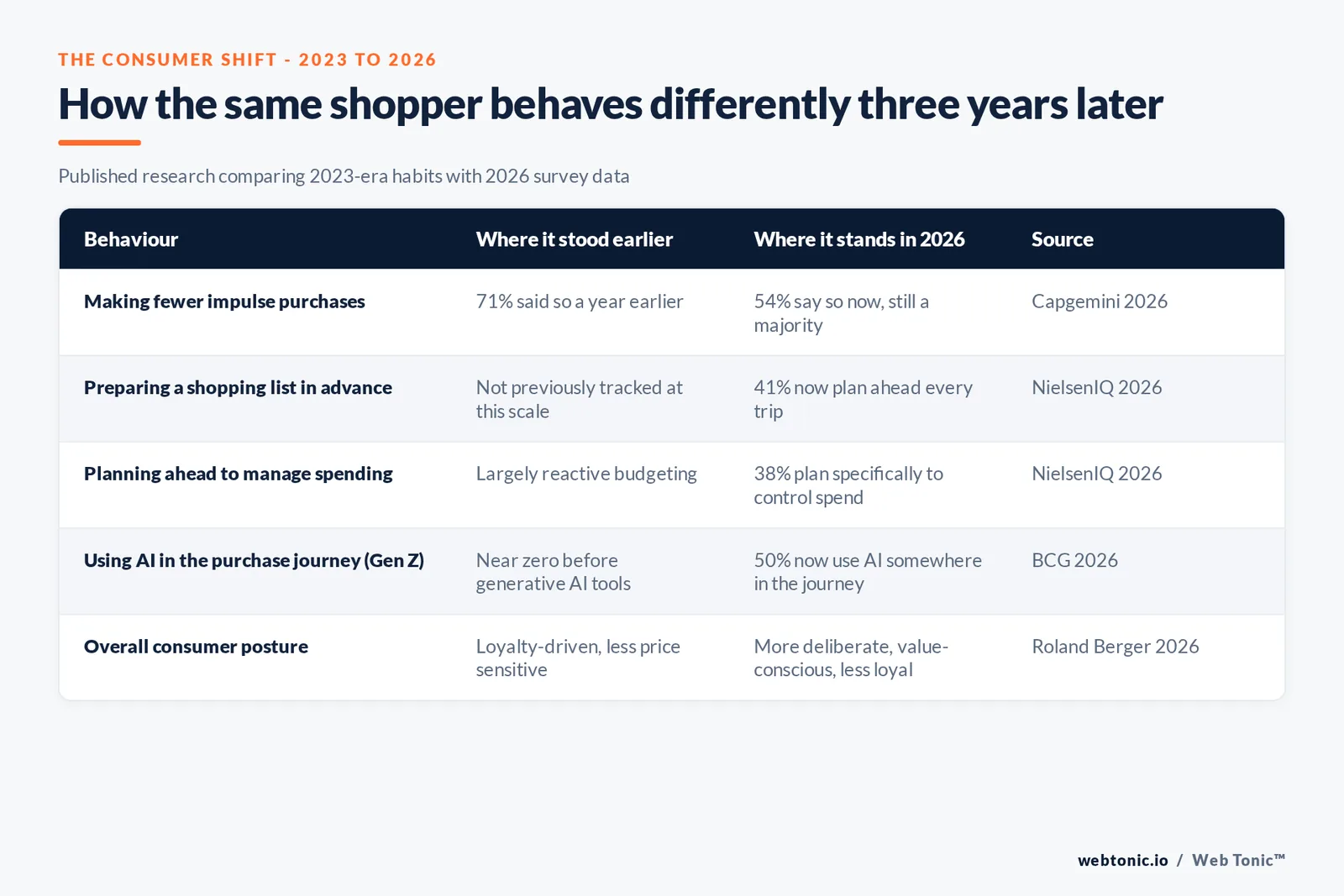
Roland Berger's 2026 research describes the consumer of 2026 as more deliberate, more value-conscious and less loyal than in previous years - a pattern that started as a direct response to inflation and, in Roland Berger's own framing, is increasingly a structural shift in behaviour rather than a temporary reaction to price. That distinction matters for anyone planning past a single quarter: this is not a cycle expected to reverse once prices stabilize.
| Behaviour | 2023-era baseline | 2026 figure | Source |
|---|---|---|---|
| Making fewer impulse purchases | 71% said so | 54% say so | Capgemini 2026 |
| Preparing a shopping list in advance | Not tracked at this scale | 41% | NielsenIQ 2026 |
| Planning specifically to manage spending | Largely reactive budgeting | 38% | NielsenIQ 2026 |
| Most motivating offer type | Mixed incentive structures | 75% cite money-off discounts | Capgemini 2026 |
| Overall consumer posture | Loyalty-driven | Deliberate, value-conscious, less loyal | Roland Berger 2026 |
Impulse buying eased, it did not disappear
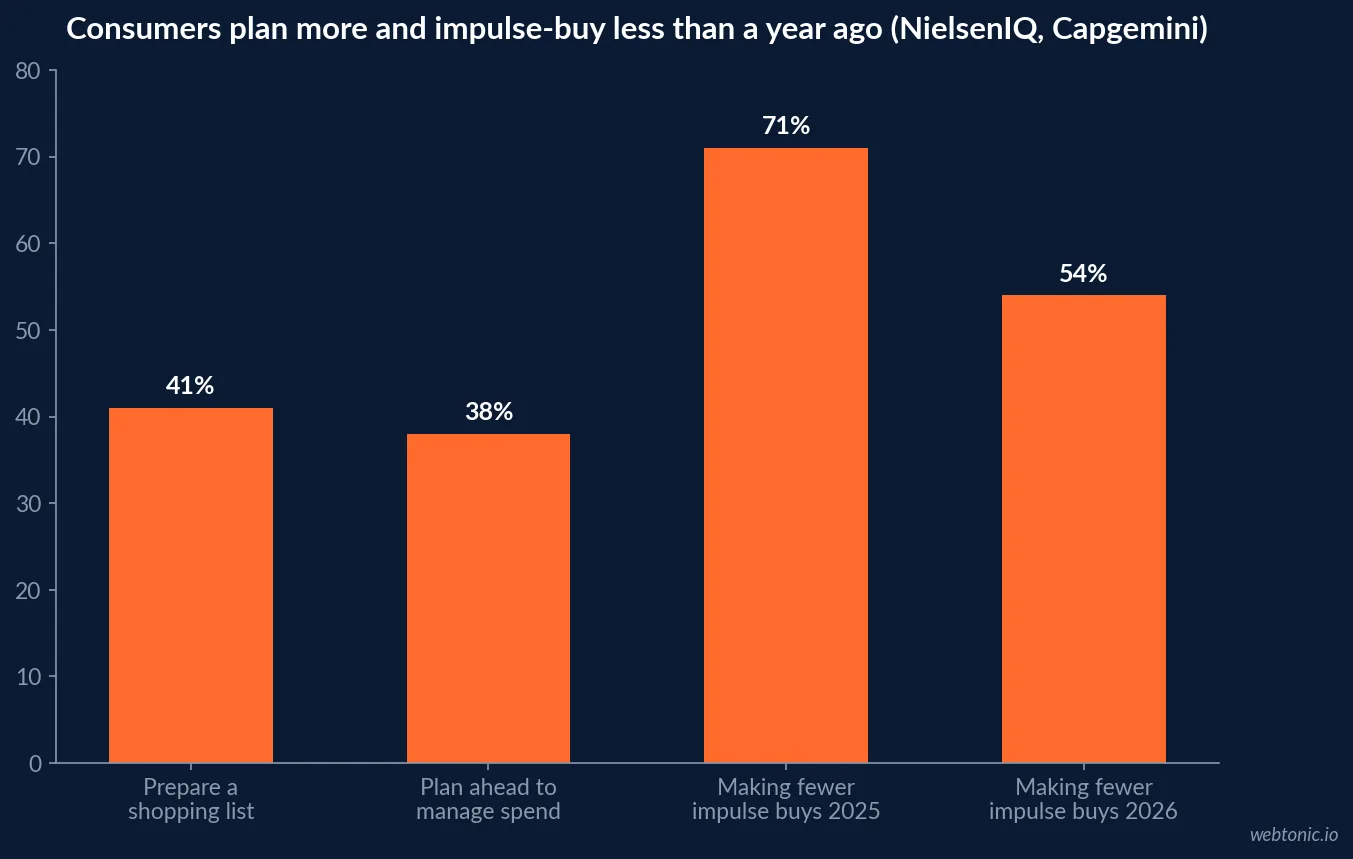
Capgemini's 2026 Consumer Trends report found 54% of consumers saying they now make fewer impulse purchases, down from 71% the year before. Read one way, that is a large majority still restraining impulse spending. Read the other way, the restraint eased meaningfully year over year, suggesting some of the tightest inflation-era discipline is loosening even as the underlying deliberateness Roland Berger describes persists.
The same report puts money-off discounts well ahead of percentage-off and bundled offers as the single most motivating incentive, at roughly three in four consumers - a sign that value-consciousness in 2026 shows up as a preference for simple, legible price cuts over more complex promotional mechanics.
Planning has become the default, not the exception
NielsenIQ's Consumer Outlook Guide to 2026 found 41% of shoppers preparing a list before they go into a store and 38% planning ahead specifically to manage spending, against just 22% who say they make most purchase decisions while already in the store. That ratio - roughly two planners for every one in-store decider - marks a meaningful move away from the browse-and-decide shopping pattern retailers built merchandising strategy around for decades.
AI-assisted shopping: a generational gap, not yet a universal shift
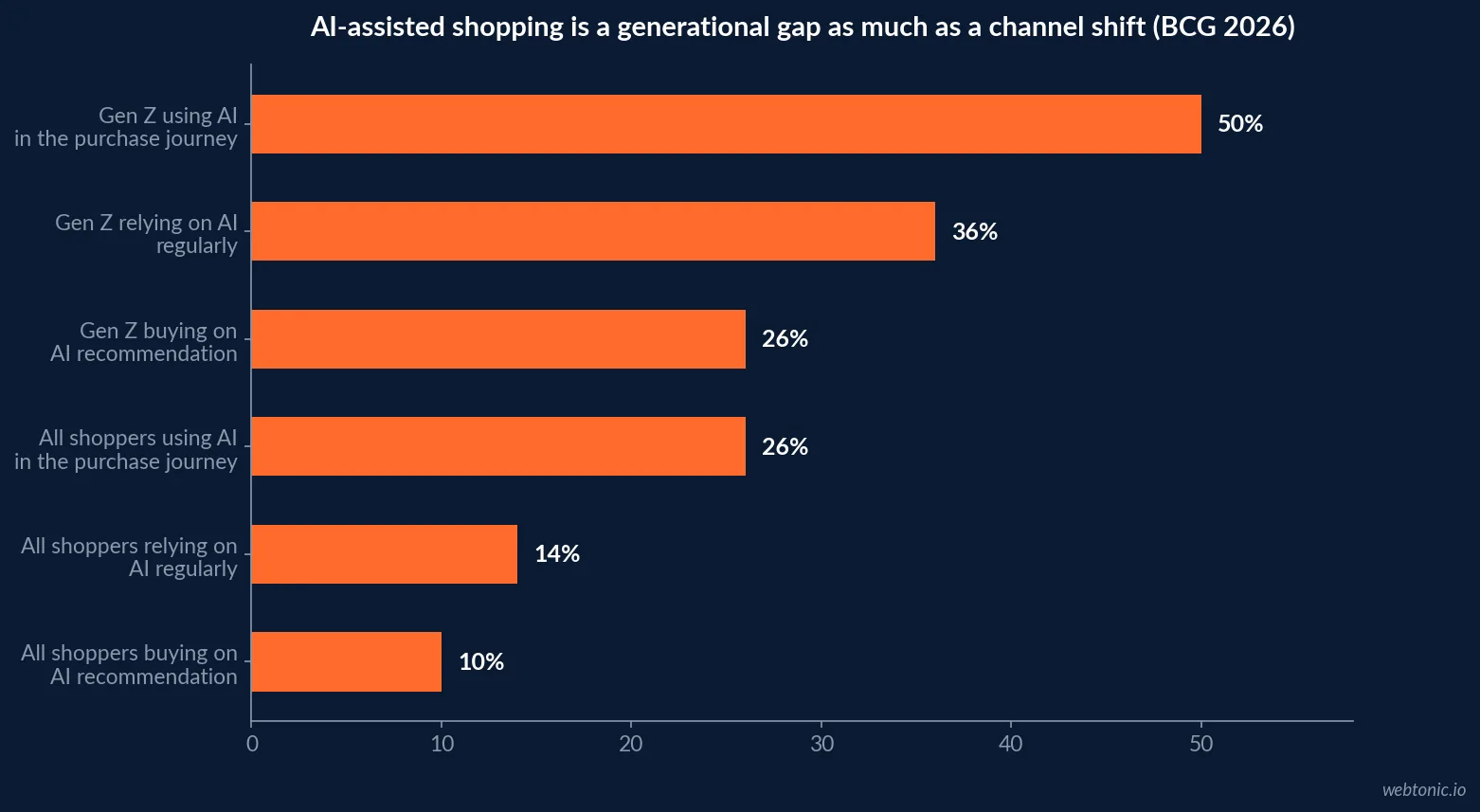
BCG's 2026 research on consumer shifts found AI already embedded in the early stages of the shopping journey for younger and higher-income consumers specifically. In developing markets, 50% of Gen Z consumers use AI somewhere in their purchase journey, 36% rely on it regularly, and 26% buy directly on its recommendation - compared with 26%, 14% and 10% respectively for the overall shopper base.
That is not a small gap. It means the segment driving AI-assisted commerce today is concentrated and identifiable, which has direct implications for where a brand should be testing AI-visibility and discovery tactics first rather than rolling them out uniformly.
| Segment | Uses AI in journey | Relies on AI regularly | Buys on AI recommendation |
|---|---|---|---|
| Gen Z, developing markets | 50% | 36% | 26% |
| All shoppers, global | 26% | 14% | 10% |
| Gap (percentage points) | 24 pts | 22 pts | 16 pts |
Online share of purchases actually pulled back
Salsify's 2026 Consumer Research Report found the share of purchases made online down 12 points year over year, dropping from 21% to 9% for the behaviour it tracked, with the pattern fairly consistent across Gen Z, millennials and Gen X (roughly 10-12% each). Baby boomers shop online the least of any generation, at only about 2% of purchases in Salsify's data. Read alongside NielsenIQ's planning data, this suggests some channel switching back toward in-store shopping is happening at the same time consumers are planning more carefully overall, rather than these being two separate trends.
| Metric | 2026 figure | Change noted | Source |
|---|---|---|---|
| Online share of the tracked purchase behaviour | 9% | Down from 21%, -12 points YoY | Salsify 2026 |
| Gen Z / millennial / Gen X online share | 10-12% each | Broadly consistent across generations | Salsify 2026 |
| Baby boomer online share | ~2% | Lowest of any generation | Salsify 2026 |
| Cart size vs. spend per order | More items, less spend per order | Conversion needs more touchpoints | impact.com 2026 |
What is driving the channel switch back toward physical stores
The pullback in online purchase share Salsify documented is not necessarily a rejection of e-commerce as a category. Read against NielsenIQ's planning data, it more likely reflects consumers using stores differently: arriving with a list already built (often researched online), and using the in-store visit to execute a plan rather than to browse and discover. That distinction matters for attribution models that still credit the final transaction channel without accounting for the research that happened somewhere else first.
Deloitte's ConsumerSignals tracking shows spending intentions rising for both discretionary and non-discretionary categories even as channel share shifts, which argues the movement is about where the transaction closes, not whether the consumer is spending at all.
Cart composition is shifting even where spend is not
impact.com and Cardlytics' 2026 Consumer Spending Report found shoppers filling carts with more items while spending less per order - not because demand has disappeared, but because conversion now needs more touchpoints to close. That finding lines up with NielsenIQ's planning data: a shopper working from a list and a spending plan naturally builds a different cart than one deciding item by item in the aisle.
What PwC's global survey adds to the picture
PwC's Voice of the Consumer 2026 research, surveying 21,808 consumers across 27 countries, documents how quickly new consumer behaviours are becoming everyday habits rather than novel ones - consumers increasingly tracking, adjusting and personalising decisions across categories, not only where a brand markets directly to them. Combined with Deloitte's ConsumerSignals tracking, both spending intentions and behavioural adjustment show the same direction: consumers making more active, tracked decisions than they were three years ago.
Why loyalty programs are struggling to keep pace
A more deliberate, price-led consumer is a harder one to hold with a loyalty points program alone. Capgemini's finding that money-off discounts beat every other offer type by a wide margin suggests loyalty mechanics built around accumulated points or tiered perks are competing against a much simpler, more legible incentive: an immediate price cut. Roland Berger's framing of declining loyalty as structural, not cyclical, means this is not a problem a single strong promotional quarter fixes - it is a preference brands likely need to design around rather than out-wait.
Retailers that have adapted their paid social and retargeting strategy to lead with direct, quantified discounts rather than loyalty-tier messaging are working with the grain of this shift rather than against it.
| Offer type | Consumer preference rank | Why it works with 2026 behaviour | Risk if overused |
|---|---|---|---|
| Money-off discount | 1st, ~75% cite as most motivating | Simple, immediate, easy to compare | Margin compression |
| Percentage-off deal | 2nd | Still legible but requires quick math | Perceived as less generous |
| Buy-one-get-one | 3rd | Works for planners buying in bulk | Less appealing for single-item planners |
| Loyalty points / tiers | Not in Capgemini's top three | Rewards patience, not urgency | Competes poorly with instant discounts |
What this means for how brands plan campaigns
Three years of data point at the same conclusion from different angles: today's consumer plans more, trusts price cuts over complex offers, and - for a specific, identifiable segment - is already letting AI shape part of the decision. A campaign plan built for 2023's more impulsive, more loyal shopper is optimizing for a customer that has measurably changed. Our data and analytics practice builds the customer research layer that keeps a plan current with the behaviour data actually shows, not the behaviour a brand assumes, and our team background covers the growth-marketing side of acting on it.
Frequently Asked Questions
What is the biggest change in consumer behaviour since 2023?
Deliberateness. Roland Berger's 2026 research describes today's consumer as more deliberate, more value-conscious and less loyal than in previous years, a shift that started as a response to inflation and has since become structural. NielsenIQ's 2026 data backs this up directly: 41% of shoppers now prepare a shopping list in advance and 38% plan ahead specifically to manage spending, both signs of planning replacing impulse.
Are consumers still making impulse purchases?
Fewer than before, but a majority still do occasionally. Capgemini's 2026 Consumer Trends report found 54% of consumers say they are making fewer impulse purchases, down from 71% saying the same the year before - meaning the pullback in impulse buying eased somewhat year over year even as it remains a widespread stated behaviour.
How is AI changing the way people shop?
Unevenly by generation and geography. BCG's 2026 research found 50% of Gen Z consumers in developing markets using AI somewhere in their purchase journey, 36% relying on it regularly, and 26% buying directly on its recommendation - compared with 26%, 14% and 10% respectively across the wider consumer base. AI-assisted shopping is currently a generational and market gap as much as a universal shift.
What discounts or offers still motivate consumers in 2026?
Straightforward price cuts remain dominant. Capgemini's 2026 report found three in four consumers citing money-off discounts as their most motivating offer type, ahead of percentage-off deals and buy-one-get-one promotions - a signal that value-consciousness is expressed most directly through price, not through loyalty programs or bundled perks.
Has consumer loyalty declined since 2023?
Yes, according to Roland Berger's 2026 analysis, which frames today's consumer as structurally less loyal across income groups and geographies than in prior years. The shift began as a reaction to inflation but Roland Berger's researchers now describe it as a lasting behavioural change rather than a temporary response to price pressure.
Sources
NielsenIQ - Consumer Outlook Guide to 2026
Capgemini - Consumer Trends 2026
Roland Berger - Understanding the New Consumer Playbook for 2026
BCG - Five Consumer Behavior Shifts Reshaping Growth in 2026
Salsify - 2026 Consumer Research Report
impact.com and Cardlytics - Consumer Spending Report 2026
PwC - Voice of the Consumer 2026
Deloitte Insights - State of the US Consumer