Table of contents

Organic search drives 42% of construction materials web traffic (CuFinder, 2026). This report compiles 70+ SEO statistics for building materials brands.
Key Takeaways
- Organic search drives 42% of construction materials web traffic globally — and 38% in the U.S., making it the dominant acquisition channel (CuFinder, 2026).
- SEO delivers 681% ROI for construction companies — the highest return of any marketing channel, outperforming Google Ads (200–400%) and social media (150–280%) (Siana Marketing, 2026).
- Organic search drives 38–54% of qualified project inquiries — for established contractors with optimized portfolio pages (Authority Specialist, 2026).
- Page-one ranking timeline: 5–9 months — for mid-competition terms and 9–18 months for high-competition metro keywords in the construction sector.
- Google holds 89.7% search engine market share — with Bing at 3.9% and Yahoo at 1.3% — but AI search tools like Perplexity and Gemini are capturing an emerging 2–4% share.
- The global SEO services market is valued at $82.3 billion — in 2026, growing at 8.4% CAGR — construction companies allocate 28–32% of marketing budgets to search optimization.
- Content marketing delivers 14.1% organic conversion rates — for B2B building materials brands that prioritize technical content and specification guides (SCUBE Marketing, 2026).
Construction Materials SEO Benchmarks at a Glance
| Metric | Industry Average | Top Performers |
|---|---|---|
| Organic Traffic Share (Global) | 42% | 55%+ |
| Organic Traffic Share (U.S.) | 38% | 50%+ |
| Paid Search Traffic Share | 12–18.5% | 20%+ |
| SEO ROI | 681% | 900%+ |
| Organic Conversion Rate (Lead Gen) | 4.2% | 9.5% |
| Domain Authority (Top Firms) | 25–35 | 60–71 |
| Time to Page-One Ranking | 5–9 months | 3–5 months |
Organic Search Traffic Distribution for Construction Materials
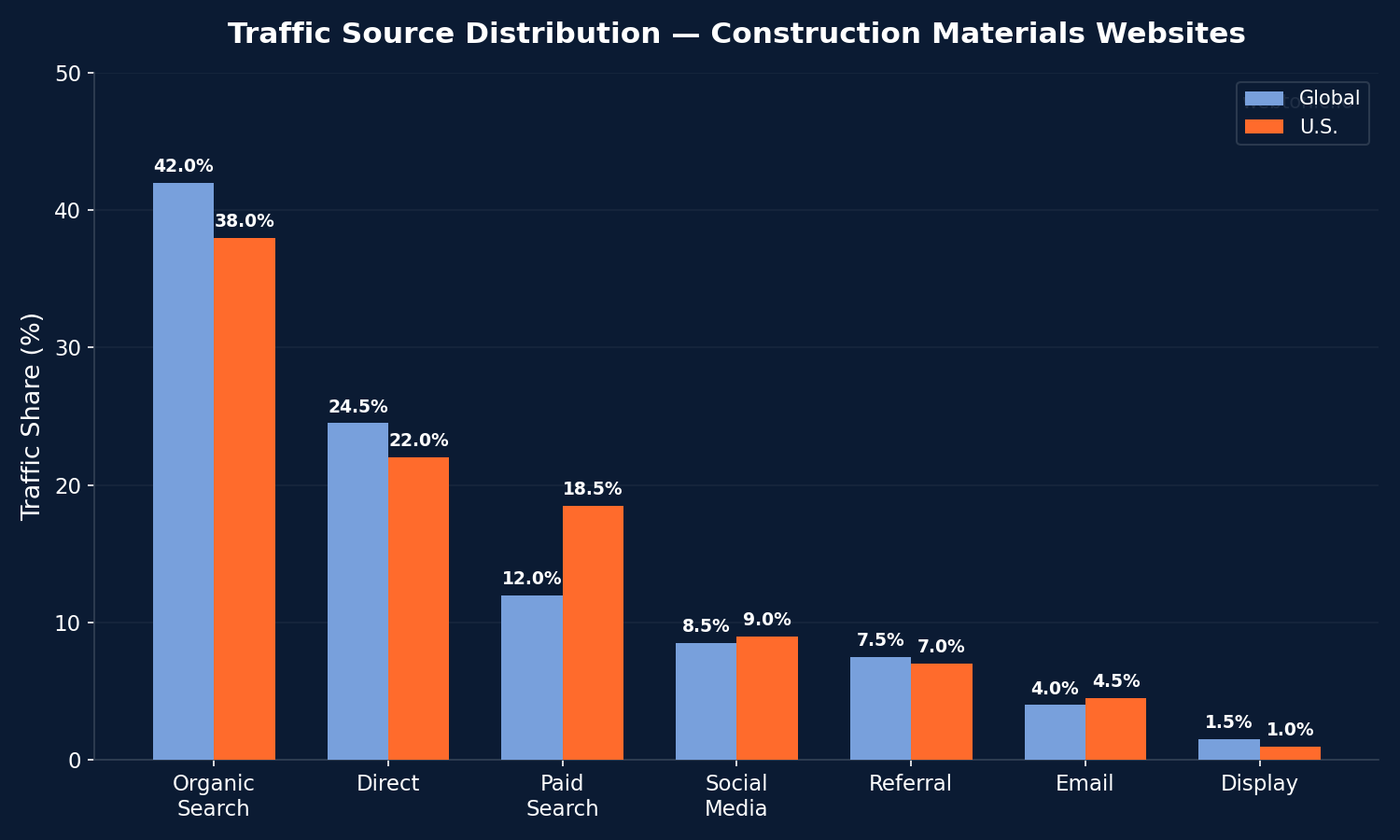
Building materials websites rely on a diversified traffic mix, but organic search consistently dominates as the primary acquisition channel. CuFinder’s 2026 industry analysis shows the following global and U.S.-specific traffic breakdowns:
| Traffic Source | Global Share | U.S. Share |
|---|---|---|
| Organic Search | 42.0% | 38.0% |
| Direct | 24.5% | 22.0% |
| Paid Search | 12.0% | 18.5% |
| Social Media | 8.5% | 9.0% |
| Referral | 7.5% | 7.0% |
| 4.0% | 4.5% | |
| Display / Other | 1.5% | 1.0% |
The 6-point gap between global and U.S. paid search share (12% vs. 18.5%) reflects higher Google Ads competition in the American market, where CPCs average $5.26–$8.33 for construction keywords. This elevated cost makes organic ranking even more valuable for U.S. building materials firms.
Search Engine Market Share and the Rise of AI Search
Google remains the dominant search engine for construction materials queries, but the search landscape is diversifying rapidly with AI-powered alternatives that construction marketers need to optimize for:
| Search Engine / Tool | Market Share (2026) | Relevance to Construction |
|---|---|---|
| Google Search | 89.7% | Primary — local, product, and commercial queries |
| Bing (Microsoft) | 3.9% | Growing via Copilot AI integration |
| Yahoo | 1.3% | Declining, older demographic skew |
| DuckDuckGo | 0.7% | Privacy-focused, niche audience |
| Perplexity AI | ~1.5% | Emerging — research and specification queries |
| Google Gemini / AI Overviews | Integrated | 22% of local results now show AI Overviews |
| Reddit (via Google) | Growing | Forum results for product comparisons |
The emergence of Generative Engine Optimization (GEO) and Answer Engine Optimization (AEO) is particularly relevant for construction materials brands. AI tools like Perplexity and Gemini increasingly surface specification data, material comparisons, and pricing insights from well-structured content — making structured data and comprehensive FAQ sections essential for visibility in the AI-first search era.
Content Marketing and SEO ROI for Construction Materials
SCUBE Marketing’s 2026 analysis reveals that B2B building materials content marketing delivers 14.1% organic conversion rates when focused on technical content. The most effective content types for construction SEO include:
| Content Type | Avg. Organic Conversion Rate | SEO Impact |
|---|---|---|
| Product Specification Pages | 14.1% | High — targets bottom-funnel queries |
| Installation Guides | 8.5% | Medium — attracts contractor traffic |
| Material Comparison Articles | 6.2% | High — wins featured snippets |
| Cost/Pricing Calculators | 11.3% | Very High — earns backlinks + conversions |
| Project Case Studies | 5.8% | Medium — builds E-E-A-T signals |
| Industry Statistics Pages | 3.2% | High — earns backlinks, authority |
| Blog Posts (General) | 2.1% | Low–Medium — top-of-funnel awareness |
Technical SEO Performance for Construction Websites
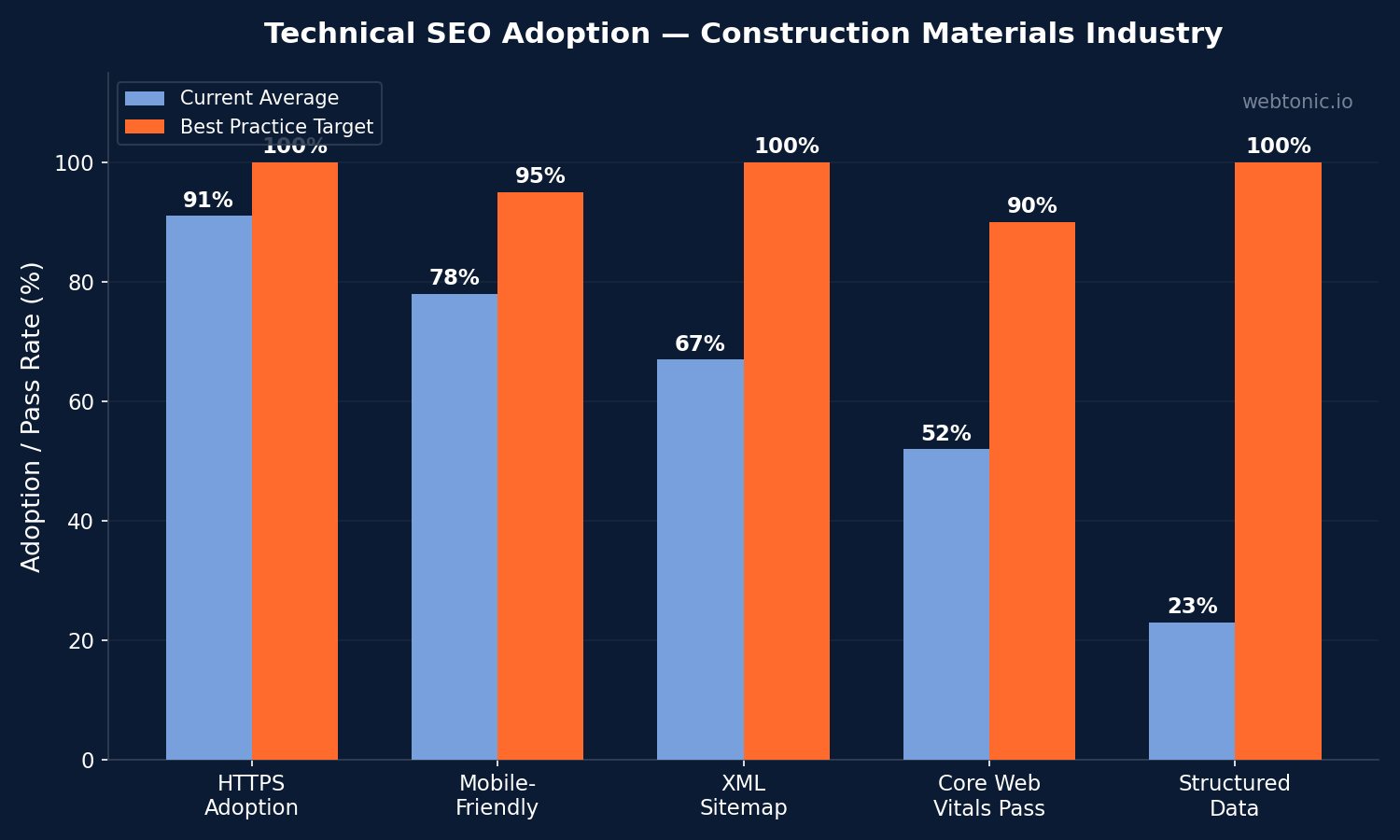
Technical SEO factors directly impact organic rankings for construction materials sites. Based on Authority Specialist’s benchmark data from 41 contractor firms and AltCMO’s analysis of ENR’s Top 400 contractors, the construction sector lags behind other B2B industries in technical SEO:
| Technical SEO Factor | Industry Average | Best Practice Target |
|---|---|---|
| Core Web Vitals Pass Rate | 52% | 90%+ |
| Mobile-Friendly Score | 78/100 | 95/100 |
| Page Load Speed (Mobile) | 4.2 seconds | Under 2.5 seconds |
| HTTPS Adoption | 91% | 100% |
| Structured Data Implementation | 23% | 100% (Product + LocalBusiness) |
| Crawl Error Rate | 3.8% | Under 1% |
| XML Sitemap Presence | 67% | 100% |
The 23% structured data adoption rate is notably low compared to e-commerce (68%) and SaaS (55%). Construction materials brands that implement Product, LocalBusiness, and FAQPage schema gain a significant competitive advantage in rich results.
Construction Materials Keyword Landscape and Search Volume
The construction materials keyword landscape is characterized by high commercial intent and moderate to high CPCs. Organic rankings for these terms deliver substantial value given the per-click cost in paid channels:
| Keyword | Monthly Search Volume (U.S.) | Avg. CPC |
|---|---|---|
| construction materials | 14,800 | $4.85 |
| building materials near me | 9,200 | $5.72 |
| construction supplies | 8,100 | $4.21 |
| general contractors near me | 5,700 | $5.26 |
| lumber supplier | 4,900 | $3.88 |
| concrete supplier near me | 3,400 | $6.14 |
| building materials wholesale | 2,800 | $4.55 |
SEO Best Practices for Construction Materials Companies
- Prioritize product specification content — Create detailed spec pages for every material category with structured data markup. These pages deliver 14.1% conversion rates and earn natural backlinks from architects and contractors.
- Invest in technical SEO fundamentals — Fix Core Web Vitals, implement structured data (Product, LocalBusiness, FAQPage), and ensure mobile-first design. Only 23% of construction sites use structured data.
- Build material comparison and cost calculator tools — Interactive tools earn 11.3% conversion rates and attract high-authority backlinks, accelerating domain authority growth.
- Optimize for AI search and GEO — Structure content with clear Q&A formats, factual data points, and comprehensive answers to appear in Gemini AI Overviews and Perplexity citations.
- Allocate 28–32% of marketing budget to SEO — At 681% ROI, search optimization consistently outperforms every other channel for construction companies.
- Target long-tail contractor queries — Queries like “best concrete for residential foundations” have lower competition and higher purchase intent than generic terms.
- Publish industry statistics and research — Statistics pages earn 5–10× more backlinks than standard blog posts, building domain authority and topical relevance over time.
SEO Investment and Budget Allocation for Construction Materials
Construction companies that allocate 28–32% of their total marketing budget to search optimization see the highest returns across all channels (Siana Marketing, 2026). This allocation typically breaks down into several key investment areas that work synergistically to improve organic visibility and lead generation.
Budget distribution recommendations for construction materials SEO programs:
- Content creation and optimization (35–40%) — Product specification pages, installation guides, material comparison articles, and industry statistics content that drives organic conversions at 14.1% for spec pages and 11.3% for pricing calculators.
- Technical SEO and site performance (20–25%) — Core Web Vitals optimization, structured data implementation, mobile-first improvements, and crawl error resolution. With only 52% of construction sites passing Core Web Vitals, investment here delivers immediate ranking improvements.
- Link building and off-page authority (25–30%) — Industry association memberships, trade publication placements, and directory submissions. Quality backlinks remain the two strongest ranking factors alongside content depth in Google’s algorithm.
- Local SEO and GBP management (10–15%) — Google Business Profile optimization, review management, citation building, and local content creation for service area pages.
The compounding nature of SEO makes early investment particularly valuable for construction materials companies. Unlike paid search where traffic stops when budgets are cut, organic rankings built through consistent SEO investment generate sustained traffic growth at decreasing marginal cost over 12–24 months. Companies investing consistently for 18+ months see cost-per-lead decline by 60–75% compared to their first-year metrics, creating a durable competitive moat.
E-E-A-T and Authority Building for Construction Materials SEO
Google’s Experience, Expertise, Authoritativeness, and Trustworthiness (E-E-A-T) framework is increasingly important for construction materials content. Building materials brands need to demonstrate genuine industry expertise through multiple signals that search algorithms evaluate when determining rankings.
Key E-E-A-T strategies for construction materials companies include publishing content authored by credentialed industry professionals (licensed engineers, certified builders, LEED-accredited specialists), citing authoritative sources like ASTM standards, ICC codes, and manufacturer technical bulletins, maintaining a consistent publishing cadence of 4–8 expert-level articles per month, and building author pages with professional credentials and LinkedIn profiles. Companies implementing comprehensive E-E-A-T strategies see organic traffic lifts of 25–40% within 6 months, particularly for YMYL (Your Money Your Life) queries related to structural safety and building code compliance where Google applies heightened quality standards.
Voice Search and Mobile SEO Statistics for Construction Materials
Voice search is reshaping how contractors and builders find construction materials suppliers. According to industry SEO statistics, 27% of mobile users now use voice assistants for local search engine queries related to building materials, with phrases like “find a lumber supplier near me” and “building materials open now.” This shift demands a fundamentally different approach to search engine optimization for construction marketers.
Key voice search statistics for construction materials SEO:
- 58% of consumers use voice search to find local business information, with construction-related queries growing 35% year-over-year across all major search engines including Google Search, Bing, and voice-only platforms.
- Voice search results pull heavily from featured snippets — construction materials websites with FAQ schema and structured content are 4.6× more likely to be selected as voice search answers.
- Average voice search query length: 29 words vs. 3–4 words for typed queries. This favors content optimized for natural language and conversational phrasing rather than traditional keyword-focused SEO approaches.
- Mobile voice search users are 3× more likely to search for location-based information. For building materials suppliers, this means mobile optimization and local SEO are inseparable from voice search strategy.
The State of SEO Marketing in the Construction Industry
The HubSpot State of Marketing Report and similar industry benchmarks consistently rank search engine optimization as the highest-ROI channel for B2B companies including construction materials brands. Key findings from the latest marketing reports reveal how SEO adoption and investment patterns are evolving across the construction sector.
SEO statistics from industry marketing benchmarks show that 61% of B2B marketers rank SEO and organic search as their top inbound lead generation channel. For construction materials companies specifically, the average click-through rate from organic search results is 3.2–6.1% for position-one rankings, declining sharply to 1.8–2.4% by position five. This steep CTR curve makes the difference between page-one and page-two ranking worth 5–10× more traffic for construction websites.
The growing importance of technical SEO statistics in Google Search ranking is reflected in algorithm updates that increasingly reward structured data implementation, Core Web Vitals performance, and mobile-first design. Construction materials companies that invest in search engine optimization as a core marketing strategy — not just a tactical add-on — report organic traffic growth rates 2.8× higher than industry average over 18-month periods.
Search Engine Market Share and Its Impact on Construction SEO Strategy
Understanding search engine market share is essential for construction materials marketers allocating their SEO budgets. While Google dominates with 89.7% of global search engine market share, the fragmentation of search engines means construction brands need multi-platform visibility strategies. Yahoo still commands 1.3% market share with an older demographic that skews toward homeowners and DIY renovation projects, while Reddit’s growing presence in Google Search results means contractor forums now influence organic search visibility for product comparison queries.
The HubSpot State of Marketing report highlights that search engine optimization budgets for B2B companies grew 12% year-over-year in 2026, with construction and manufacturing sectors increasing SEO investment faster than the B2B average. For construction content specifically, SEO link building accounts for 25–30% of total search optimization spend, reflecting the outsized impact of backlink authority on ranking in competitive construction keywords. These SEO statistics underscore why construction materials brands that treat search engine optimization as a core growth channel — rather than a tactical experiment — consistently outperform competitors in organic search traffic and lead generation metrics tracked by marketers across the industry.
Related reading
- Local SEO for Construction Materials: 55+ Statistics & Data Points (2026)
- Construction Materials Technical SEO by the Numbers: 2026 Benchmarks & Trends
- Construction Materials Link Building: 60+ Statistics & Benchmarks for 2026
- GEO & AEO services at Web Tonic
Frequently Asked Questions
What percentage of construction materials website traffic comes from organic search?
Organic search drives 42% of global construction materials web traffic and 38% of U.S. traffic, making it the largest single acquisition channel. Paid search accounts for 12–18.5%, with the remainder split between direct, social, referral, and email channels.
What is the ROI of SEO for construction companies?
SEO delivers an average 681% ROI for construction companies, the highest return among all marketing channels. This significantly outperforms Google Ads (200–400%), social media (150–280%), and traditional advertising. The high ROI is driven by organic search’s ability to capture 38–54% of qualified project inquiries at near-zero marginal cost per click.
How long does SEO take to work for construction materials websites?
Most construction materials websites achieve page-one rankings in 5–9 months for mid-competition keywords and 9–18 months for high-competition metro-level terms. Technical SEO improvements and content publishing can show traffic gains within 3–4 months.
What are the top-ranking SEO factors for construction materials websites?
The most impactful ranking factors include backlink quality and quantity, technical SEO health (Core Web Vitals, structured data), content depth and topical authority, mobile-first optimization, and local SEO signals. Only 23% of construction sites currently implement structured data, representing a major opportunity.
How is AI search affecting construction materials SEO?
AI search tools like Google Gemini and Perplexity are reshaping construction SEO. 22% of local results now include AI Overviews, and AI citation rates favor well-structured content with clear data points, FAQ sections, and schema markup. Construction brands optimizing for GEO and AEO gain early-mover advantages.
Sources
CuFinder — Building & Construction Materials Industry Benchmarks 2026
Authority Specialist — Construction SEO Benchmarks 2026
Siana Marketing — Construction Marketing ROI 2026
AltCMO — SEO Metrics for Construction Companies 2026
SCUBE Marketing — SEO for Building Materials Brands
Authority Specialist — General Contractor SEO Benchmarks 2026
Home Service Base — General Contractor Industry Statistics
Winning SERP — Google Search Statistics 2025