Table of contents
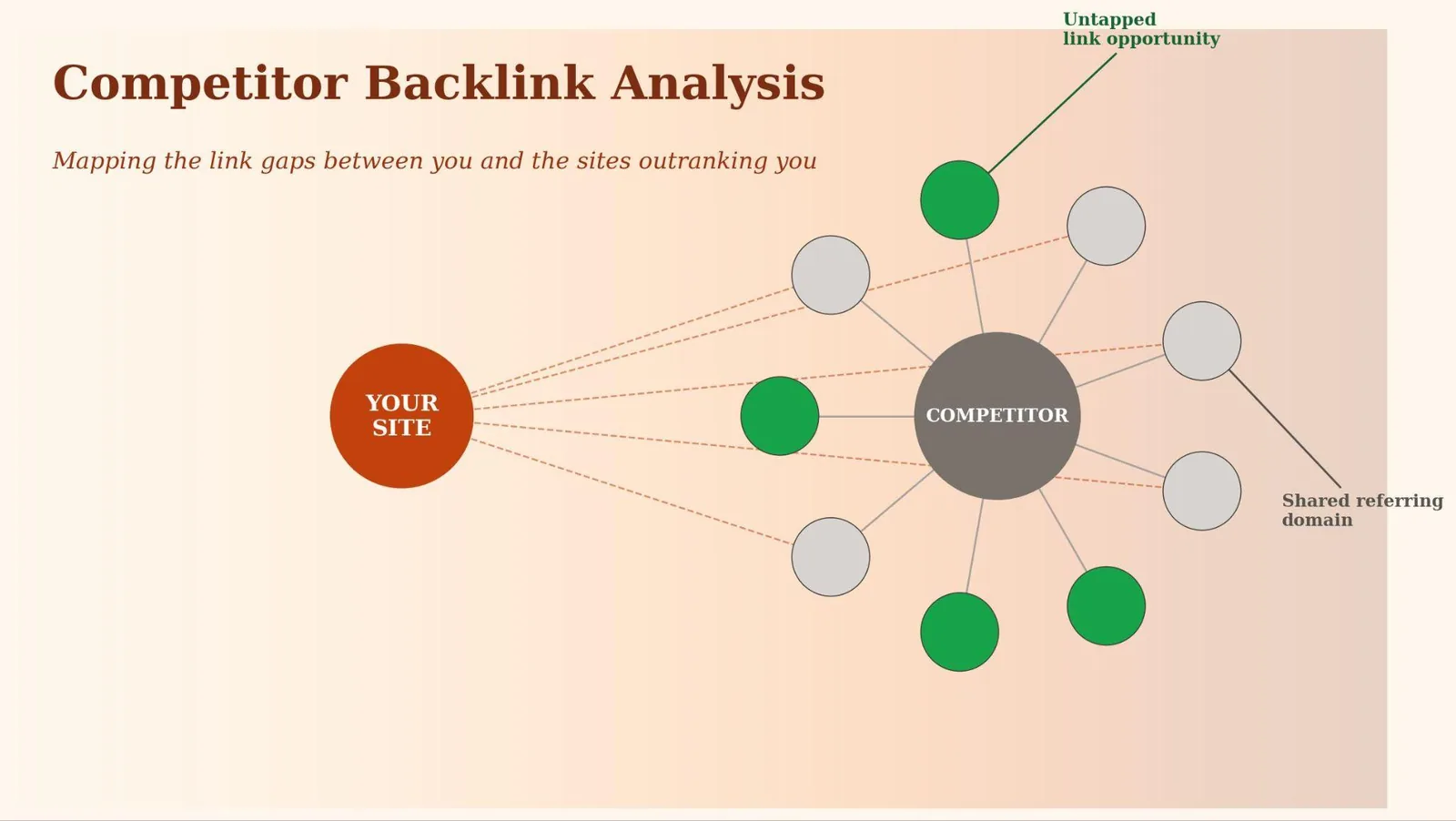
Somewhere out there, a website that ranks above yours for a keyword you want has a backlink profile you can actually see. Not guess at. See. Every domain linking to it, every anchor text they used, every piece of content that earned the link in the first place. Competitor backlink analysis is the practice of pulling that data apart until it tells you exactly how they built their domain authority, and where the gaps are that you can fill.
This isn't about copying anyone. Two sites in the same niche rarely have identical resources, audiences, or content strengths. What competitor backlink analysis gives you is a shortcut past blind outreach: a pre-vetted list of high-authority websites that have already shown they're willing to link to content in your space. From there, the work is building something worth linking to and pitching it well.
Key Takeaways
- Competitor backlink analysis means running a rival's domain through a backlink checker to study their referring domains, anchor text patterns, and link types, then using that data to find realistic backlink opportunities for your own site.
- A backlink gap analysis compares your competitors' backlinks against your own at once, usually the fastest way to surface link-building opportunities you'd never find through manual prospecting.
- Domain rating matters less than people think in isolation. According to Backlinko's analysis of 11.8 million Google search results, both total backlinks and referring domain count correlate with higher rankings, but a page's individual link authority matters far less than the domain's overall authority as a whole. A prospect with a lower domain authority but strong topical relevance often beats a high-authority domain with no connection to your niche; the goal is quality backlinks, not just more of them.
- Ahrefs, Semrush, Moz, and budget alternatives like SE Ranking remain the main backlink analysis tools in 2026. The right one depends on your budget and whether you need backlink depth or broader marketing features.
- Referring domain counts still predict traditional rankings, and they're also emerging as a signal behind whether pages get cited by AI answer engines like Perplexity, a shift some practitioners now call AEO (answer engine optimization).
- Treat competitor backlink analysis as a recurring habit, not a one-time audit. Competitor link-building strategies shift monthly, and last quarter's gap list goes stale fast.
What Is Competitor Backlink Analysis?
Competitor backlink analysis is the process of examining the backlinks pointing to a rival's website to understand how they earned their search visibility, then using that data to find link opportunities for your own site. Every backlink acts as a kind of vote of confidence from one site to another. Search engines read the volume, quality, and relevance of those votes as a trust signal. That's a large part of why two pages with near-identical on-page optimization can still rank very differently.
Running this kind of analysis means looking at more than just how many backlinks a competitor has. Referring domain count, the authority of those domains, the anchor text used, whether the links are editorial or paid, how the profile has changed over time — that combination tells you a story. Which publishers already care about the topic. Which link-building strategies actually earned links. Where a realistic opening exists for you.
Two flavors of the term are worth telling apart. A general backlink analysis looks at one domain in isolation. A backlink gap analysis goes further: it lines up your competitor backlinks against three to five rivals simultaneously and flags every domain that links to them but not to you. For most teams, the gap analysis is where the actual target list comes from.
Why Backlink Data Still Matters in 2026
Google's algorithm has kept evolving, but the underlying logic hasn't disappeared: high-quality links from relevant, authoritative domains are still one of the clearest signals that content deserves to rank. What's shifted is the bar for "high-quality." According to Google's own spam policies documentation, its systems have gotten considerably better at detecting manipulative link patterns, including large-scale link buying, selling, and low-quality guest posting schemes, so the strategic advantage in 2026 sits with link building that behaves like a natural editorial relationship, not a transaction.
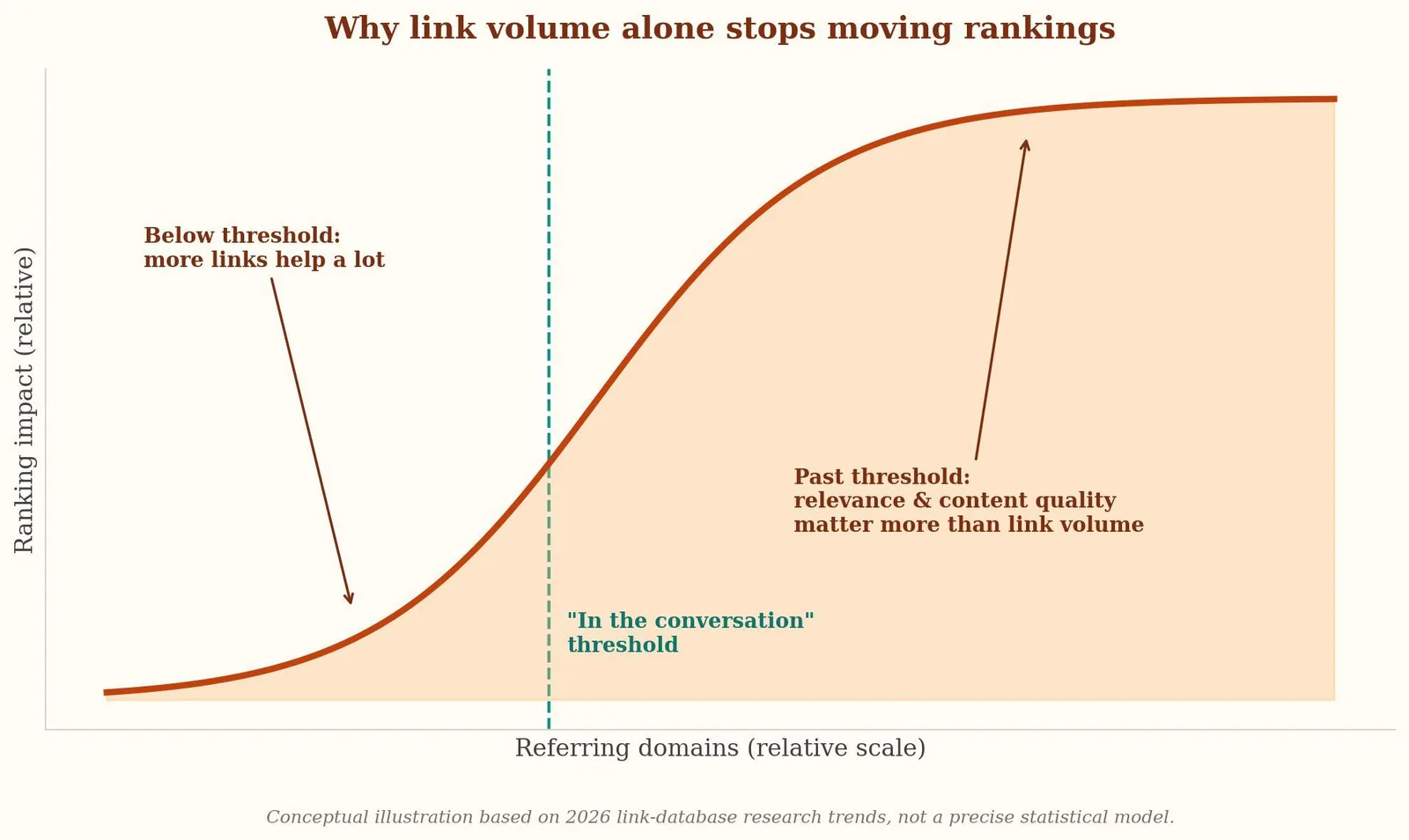
There's a threshold effect worth understanding before you obsess over any single number, too. Research into ranking pages consistently shows that sites need enough referring domains to be competitive at all for a given keyword. Below that point, additional links tend to help significantly. Past it, relevance and content quality start to matter more than adding yet another link. Competitor backlinks tell you the floor you need to clear, not a number to chase indefinitely.
AI-driven search adds a second layer worth tracking. Referring domain count is turning out to be one of the stronger available predictors of whether a page gets cited by tools like Perplexity or shows up in an AI-generated answer, even though the relationship is looser than it is for classic rankings. According to Ahrefs' own analysis of 1.9 million AI Overview citations, a meaningful share of the pages AI assistants cite most often don't rank in Google's top 100 for the same query at all, which suggests content clarity and direct-answer formatting can win citations that link volume alone wouldn't predict.
The Competitor Backlink Analysis Workflow
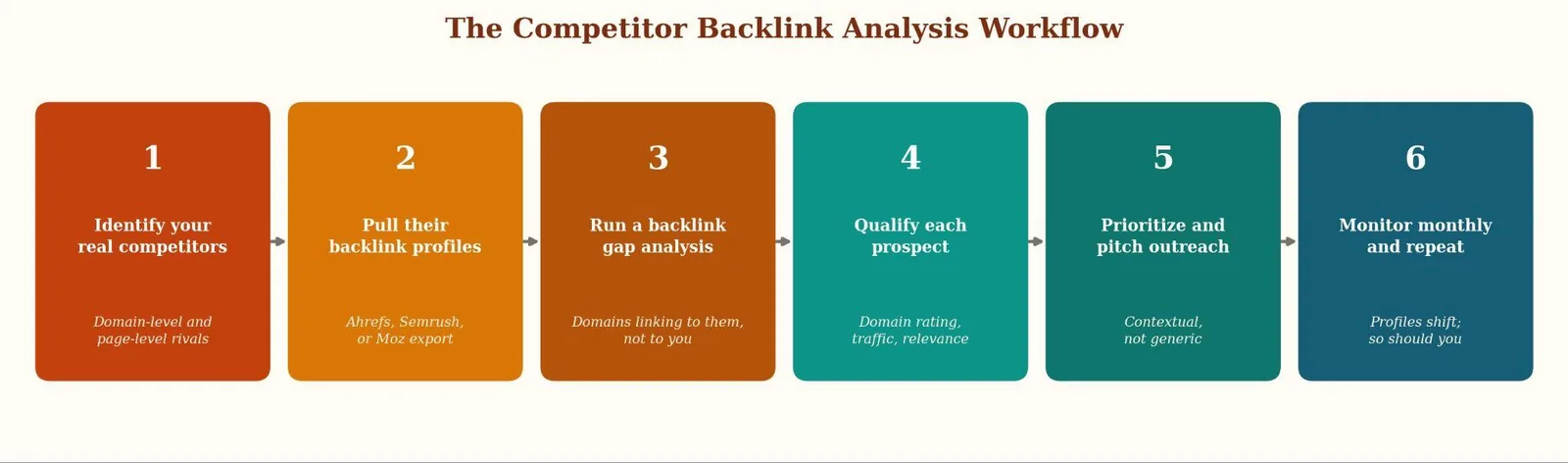
Six steps cover the process from start to a working outreach list.
Step 1: Identify your real competitors. Not every site that outranks you belongs on your analysis list. Separate domain-level competitors (rivals across your whole site and audience) from page-level competitors (a specific page that happens to outrank one of yours for one keyword). Pull your priority keyword list first — it's the input for deciding who's actually worth analyzing.
Step 2: Pull their backlink profiles. Run each competitor's domain through a backlink checker like Ahrefs, Semrush, Moz, or SE Ranking and export the full referring domain report. Most tools let you download this as a CSV, worth doing even if the platform has its own dashboard: it's easier to drop the raw backlink data into Google Sheets and cross-reference several competitors side by side than to flip between browser tabs.
Step 3: Run a backlink gap analysis. Compare three to five competitors against your own domain to surface every referring domain that links to them but not to you. This is the step that actually produces your target list, and most backlink analysis tools have a dedicated feature for it (Semrush calls its version the Backlink Gap tool, built into its broader Backlink Analytics suite; Ahrefs calls its equivalent Link Intersect).
Step 4: Qualify each prospect. Not every domain on the gap list is worth pursuing. Score each one against domain rating, estimated traffic, and topical relevance. A high-authority domain with zero relevance to your niche is a weaker target than a moderately authoritative one that's directly on-topic.
Step 5: Prioritize and pitch outreach. Lead with domains that already link to multiple competitors — they've demonstrated a repeated willingness to link to content like yours. Reference the specific competitor page they linked to, and say plainly what your content adds that theirs didn't.
Step 6: Monitor monthly and repeat. Competitor backlink profiles aren't static. Set a recurring cadence to re-check them; new links, lost links, and sudden spikes are all useful intelligence on their own.
How to Qualify a Backlink Prospect
Once your gap analysis produces a list of domains, run each one through a short mental checklist before spending outreach time on it:
- Domain rating / authority score. Higher generally means more trust passed to your site, but it shouldn't be the only factor you weigh.
- Estimated traffic. A backlink from a domain with real visitors carries more potential referral value than one from a site nobody actually visits.
- Topical relevance. A backlink from a site in your niche is worth more, in Google's eyes and in practice, than one from an unrelated domain at a similar authority level.
- Number of competitors it already links to. A domain linking to four of your competitors has shown a clear, repeated editorial interest in your space — a warmer prospect than one linking to just a single rival.
- Link type. Editorial links embedded naturally in content tend to carry more weight than directory listings, sponsored placements, or forum signatures.
Backlink tool
Is this linking domain worth pursuing?
Score a prospect you found during competitor backlink analysis before you spend time on outreach.
Set the fields above
Your priority score will appear here.
]
Comparing the Main Backlink Analysis Tools
| Tool | Index size (self-reported) | Entry price (paid monthly) | Strongest for | Best fit |
|---|---|---|---|---|
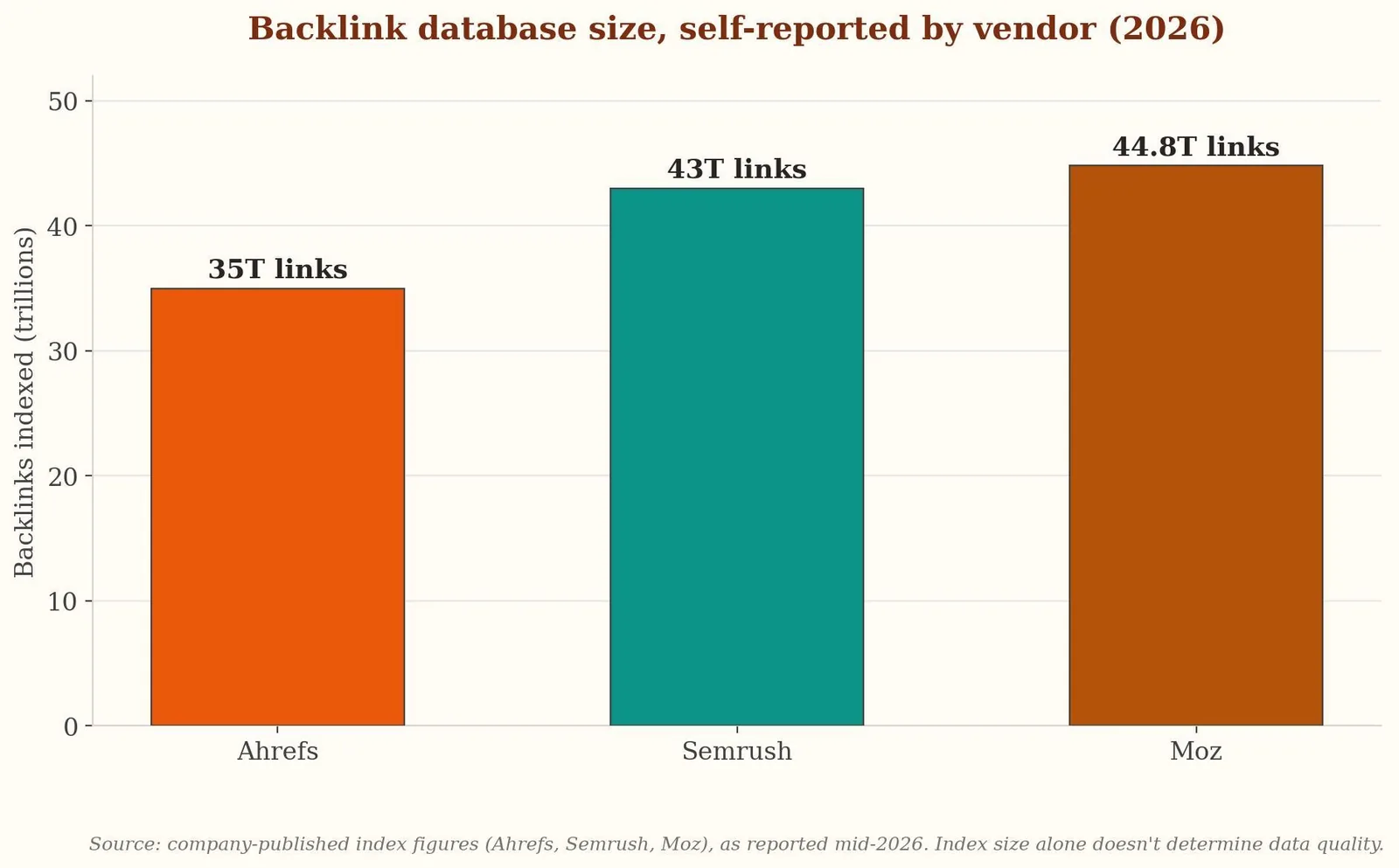
| Ahrefs | ~35 trillion links, ~494 million domains | Around $108–129 USD/month (Lite plan) | Backlink depth, crawl freshness, historical data back to 2013 | Teams whose SEO strategy is built primarily around link building |
| Semrush | ~43 trillion links, ~390 million domains | Around $99–140 USD/month (Pro plan) | Backlink Gap tool, Backlink Analytics, toxic link auditing, all-in-one suite | Agencies that need backlink data plus PPC, content, and keyword tools in one platform |
| Moz | ~44.8 trillion links (largest self-reported index) | Generally the most budget-friendly of the three | Beginner-friendly interface, simplicity | Smaller sites or teams newer to SEO |
| SE Ranking | Smaller index, positioned as a lower-cost alternative | Typically the most affordable entry point | Competitor discovery bundled with rank tracking | Teams that want backlink monitoring without a dedicated enterprise SEO budget |
Most practitioners land on one of two setups: Ahrefs alone for link-building-focused work, or Ahrefs plus Semrush together to cover both backlink depth and broader keyword intelligence. Semrush's Backlink Audit feature also integrates directly with Google's own disavow tool inside Search Console, which streamlines disavowing harmful links you turn up during analysis.
For quick, no-cost vetting before committing research time to a prospect, free backlink checkers — including limited free tools from Ahrefs and Semrush themselves — can confirm basic authority signals. They won't support a full-scale outreach campaign, but they're enough to rule out obviously weak domains early.
Common Mistakes in Competitor Backlink Analysis
The biggest one is copying instead of adapting. Competitor insights are inspiration, not a blueprint — two sites rarely have the same resources, existing relationships, or content strengths, so a strategy that worked for a rival won't transplant cleanly onto your site.
Close behind it: chasing volume over relevance. A domain with a high authority score but no topical connection to your niche is a weaker target than a moderately authoritative, directly relevant one, even when the numbers on paper look more impressive.
Treating the whole exercise as a one-time project is another common trap. Competitor link profiles shift every month, so a gap analysis from six months ago is already missing new opportunities and new competitors by the time anyone acts on it.
Some teams also ignore toxic or spammy patterns when they show up in a competitor's profile. Don't replicate them — use that as a signal of what's putting their own rankings at risk, not as a tactic worth borrowing.
And finally, analyzing the wrong competitors in the first place. In eCommerce especially, large marketplaces like Amazon often show up in the SERP for your terms. These aren't real analysis targets; their link-building resources, and their reasons for ranking, have nothing in common with a smaller site's.
Frequently Asked Questions
What's the difference between backlink analysis and backlink gap analysis? A general backlink analysis looks at one domain's link profile in isolation. A backlink gap analysis compares multiple competitors against your own site at the same time to identify referring domains they have that you don't.
How many competitors should I analyze? Start with three to five direct competitors — the ones you consistently see ranking for your priority keywords. Analyzing too many at once dilutes focus and makes prioritization harder.
Is Ahrefs or Semrush better for competitor backlink analysis? Ahrefs generally has the edge for backlink depth and crawl freshness. Semrush's Backlink Gap tool and built-in toxic-link auditing make it stronger for ongoing competitive workflows. Many teams end up running both.
What if a competitor's backlink profile looks spammy or low-quality? That's useful information too. It shows you what to avoid, and it may partly explain why their rankings are inconsistent or vulnerable to a future algorithm update.
Do backlinks still matter with AI Overviews and tools like Perplexity around? Yes. Backlinks still drive traditional Google rankings, and ranking well remains one of the more reliable paths into AI-generated citations, even though the relationship between link volume and AI citation isn't a direct one-to-one.
Turning Analysis Into a Real Link-Building Strategy
Competitor backlink analysis only pays off once the data turns into action. The pattern that works is consistent: identify the right competitors, pull clean data, run the gap analysis, qualify every prospect against relevance and authority rather than authority alone, and pitch with specifics instead of a generic template. Do that on a recurring monthly cadence, and the target list keeps refreshing itself instead of going stale.
None of this replaces creating something genuinely worth linking to. The analysis tells you who's willing to link and why. What you publish still has to earn it.
Ready to Turn Competitor Insights Into Real Backlinks?
Running a thorough backlink gap analysis takes time, and turning that data into a working outreach campaign takes even more. Web Tonic's growth marketing team handles off-site SEO, digital PR, and high-quality backlink acquisition as part of a full-funnel approach, so your link-building efforts connect directly to the technical SEO and content work driving the rest of your organic strategy.
More from Web Tonic: growth marketing services, data & analytics.
Sources: backlinko.com · developers.google.com · ahrefs.com · semrush.com · moz.com · seranking.com · support.google.com