Table of contents
Most common SEO issues are not mysteries. They are a short list of crawl, duplicate content, on-page and link defects that show up in Google Search Console long before rankings move, and each one has a documented fix.
Key Takeaways
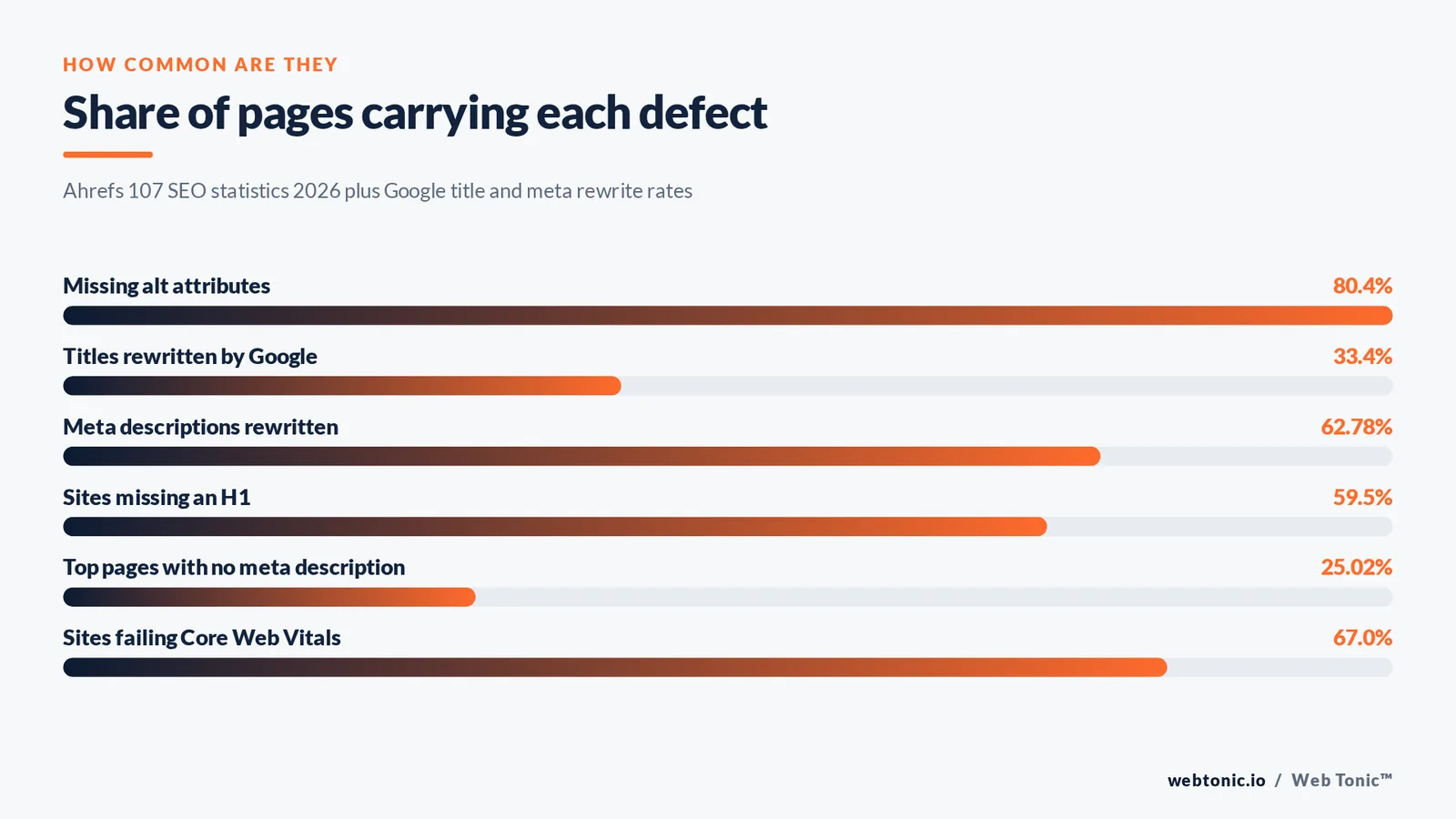
- 80.4% of pages miss alt attributes and 59.5% of sites miss H1s, so on-page basics remain the most common SEO issues on real websites (Ahrefs, 107 SEO statistics).
- Only 33% of sites pass all three Core Web Vitals, and Google rewrites titles on 33.4% of pages and meta descriptions on 62.78%.
- Triage by revenue risk, not by tool severity colour: an indexing block costs 100% of a page's search visibility, a weak meta description costs a few percent of clicks.
- Google holds 91.25% of search (StatCounter, June 2026), so its documentation is the specification you audit against.
Triage: which common SEO issues actually cost traffic
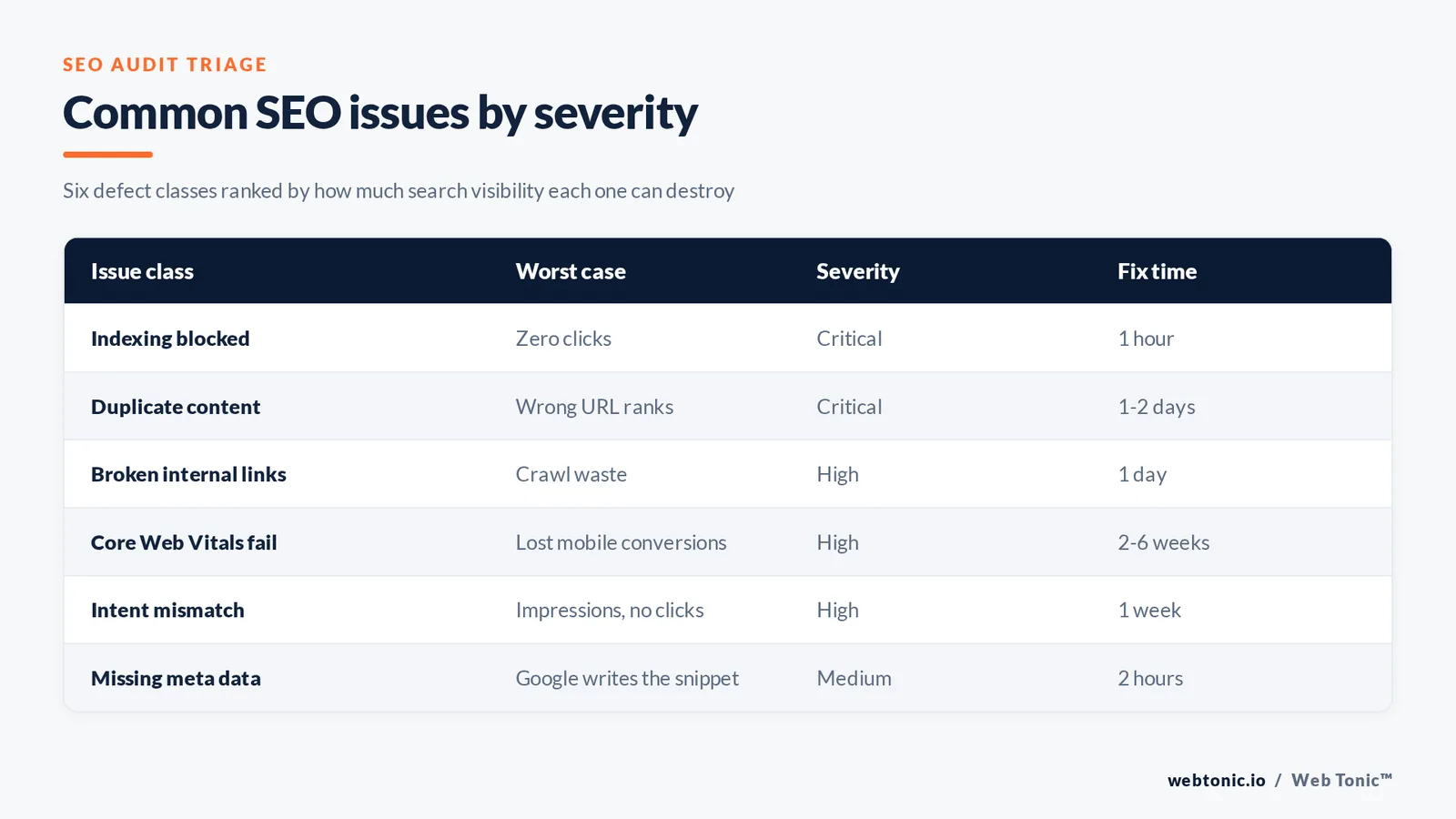
Site audit tools return hundreds of flags. Rank them by how much search visibility each defect can destroy, then work top down. The table below is the triage order we use in every SEO audit at Web Tonic.
| Issue class | Worst case | Where you see it | Severity | Typical fix time |
|---|---|---|---|---|
| Indexing blocked | Page earns zero clicks | Search Console Pages report | Critical | 1 hour |
| Duplicate content issues | Wrong URL ranks, equity split | Duplicate without canonical | Critical | 1-2 days |
| Broken internal links | Crawl waste, dead-end users | Crawl report, 404 log | High | 1 day |
| Core Web Vitals failure | Poor user experience, lost mobile conversions | Core Web Vitals report | High | 2-6 weeks |
| Search intent mismatch | Impressions without clicks | Query report, low CTR | High | 1 week per page |
| Missing titles and meta descriptions | Google writes its own snippet | HTML crawl | Medium | 2 hours |
| Keyword stuffing | Spam policy exposure | Manual read | Medium | 1 day |
| Missing alt text | No image search visibility | Crawl report | Low | 2 hours |
| No structured data | No rich results | Rich Results Test | Low | 1 day |
Rule 1 — fix eligibility before optimisation. A page that search engines cannot crawl or index cannot be improved by better copy, faster images or more internal links. Google's own Search Essentials spell out the three requirements: Googlebot is not blocked, the page returns a 200 status, and the content has some value.
Crawl and indexing: the technical SEO issues that hide a site
These are the common technical SEO issues that produce the fastest, largest losses, because they stop search engines crawling or indexing at all. A single line in a robots txt file can remove a whole directory from search.
| Technical SEO issue | Symptom in Search Console | Root cause | Fix |
|---|---|---|---|
| Blocked by robots txt | "Blocked by robots.txt" in the Pages report | Disallow rule copied from staging | Remove the rule, then request indexing |
| Noindex tag left in place | "Excluded by noindex tag" | Launch checklist skipped | Delete the meta robots noindex |
| Crawled, currently not indexed | Page known but not selected | Low quality content or thin duplication | Consolidate or expand the page |
| Discovered, currently not indexed | URL queued, never fetched | Crawl budget spent on parameters | Prune faceted URLs, tighten the sitemap |
| Sitemap lists 404s | Sitemap errors | Sitemap generated statically | Regenerate on publish, list canonical URLs only |
| Soft 404 | "Soft 404" status | Empty template or thin result page | Return a real 404 or add content |
| Redirect chain of 3+ hops | "Page with redirect" | Years of migrations stacked | Point every 301 to the final URL |
Check the exact syntax against Google's robots.txt introduction before editing, and remember that robots.txt controls crawling while a noindex tag controls indexing. Confusing the two is the single most common SEO mistake we see on new builds: a blocked URL can still be indexed from links, so Google can list a page it was never allowed to read. Redirects should also be permanent where the move is permanent — the 301 status definition is what tells search engines to transfer signals.
Duplicate content issues and canonical mistakes
Duplicate content rarely earns a penalty. It wastes crawl budget, splits link equity and lets the wrong URL win. Almost every ecommerce and multi-location site carries at least three of the patterns below.
| Duplicate pattern | Example | What Google does | Correct handling |
|---|---|---|---|
| www and non-www both live | site.com and www.site.com | Picks one, sometimes the wrong one | 301 to one host, self-referencing canonical |
| HTTP and HTTPS both live | Mixed SSL migration | Splits signals | Force HTTPS site-wide |
| Trailing slash variants | /page and /page/ | Treats as two URLs | Redirect one form |
| Faceted and sorted URLs | ?sort=price&colour=blue | Burns crawl budget | Canonical to the clean URL, block deep facets |
| Printer and AMP copies | /print/page | May index the copy | Canonical to the main version |
| Boilerplate location pages | 12 city pages, one paragraph changed | Filters as low quality content | Unique proof, pricing and photos per page |
| Syndicated posts | Same article on a partner site | Ranks the stronger domain | Ask for a canonical or a noindex |
Google's guidance on consolidating duplicate URLs is explicit: a canonical is a hint, not a command, so back it with consistent internal links and one XML sitemap entry. Keyword cannibalisation is the content-side twin of this problem, where two of your own pages target one query — Ahrefs' guide to keyword cannibalization shows how to decide whether to merge or differentiate. Merging two thin pages into one strong page is the highest-return SEO fix available on most blogs, and it takes about 3 hours.
Broken links, broken internal links and redirect waste
Broken links are cheap to find and cheap to fix, which is exactly why they accumulate. Their real cost is crawl efficiency and user experience rather than a direct ranking drop.
| Link defect | How to detect it | Impact | Fix |
|---|---|---|---|
| Broken internal links | Crawl the site, filter 404 targets | Crawl waste, dead ends for users | Update the href or redirect the target |
| Broken outbound links | Link checker, quarterly | Signals a stale page | Replace with a live source |
| Links to redirected URLs | Crawl report status 301 | Slower crawl, diluted signals | Link straight to the final URL |
| Orphan pages | Sitemap minus crawl set | No internal links, weak discovery | Add contextual internal links |
| Over-optimized anchor text | Anchor report, exact-match ratio | Spam pattern risk | Vary anchors, describe the target |
| Toxic inbound links | Backlink audit, spam score | Rarely harmful, occasionally manual action | Ignore most, disavow only manual actions |
| Lost backlinks after migration | Referring domains trend | Authority drops | Restore the 301 map |
Rule 2 — every redirect costs a crawl. On a 5,000-URL site, cutting 2,000 internal links that pass through redirects measurably speeds up recrawl of the pages you actually changed. Ahrefs' overview of technical SEO is a useful checklist companion here.
Core Web Vitals and the lack of mobile optimization
Page experience is where most sites fail measurably: only about 33% of sites pass all three Core Web Vitals, and mobile devices now generate roughly 51% of web traffic. The thresholds are fixed, so this is one of the few SEO issues with a pass or fail answer.
| Metric | Good threshold | Common cause of failure | Highest-leverage fix |
|---|---|---|---|
| LCP (loading) | 2.5 seconds or less | Hero image unoptimised, slow server | Preload the hero, compress to WebP, cache HTML |
| INP (interactivity) | 200 milliseconds or less | Heavy third-party JavaScript | Defer tag managers, split bundles |
| CLS (stability) | 0.1 or less | Images without width and height | Reserve space, load fonts with a fallback |
| Mobile usability | No errors | Tap targets under 24 by 24 px | Increase spacing, test at 320 CSS px |
| Render blocking | Under 500 ms | Fonts and CSS in the critical path | Inline critical CSS, self-host fonts |
| Image weight | Under 200 KB per image | Full-size uploads | Serve responsive WebP or AVIF |
Read the thresholds at source on web.dev, then measure field data rather than lab scores — a perfect Lighthouse run on a fast laptop hides the mobile reality. Slow pages also damage the paid side of the funnel, which is why we treat speed work as shared between SEO and measurement.
On-page mistakes: titles, meta descriptions, headings and alt text
These are the most frequent common SEO mistakes by raw count. They are also the cheapest to clear, so they belong in the first week of any remediation plan.
| On-page element | Frequency of the mistake | Why it hurts | Standard to hit |
|---|---|---|---|
| Title tag | Google rewrites 33.4% of titles | Weak match to the query | One primary keyword, 50-60 characters, unique |
| Meta descriptions | 25.02% of top pages have none | Google writes the snippet for you | 140-158 characters, benefit plus proof |
| H1 | 59.5% of sites miss an H1 | Search engines lose the page topic | One H1 that matches the title intent |
| Alt text | 80.4% of pages miss alt attributes | No image search visibility, no accessibility | Describe the image in 8-15 words |
| Heading hierarchy | Common on page builders | Structure unreadable to crawlers | H2 for sections, H3 for questions |
| URL slug | Frequent on CMS defaults | Unreadable, unstable | Short, hyphenated, keyword-first |
| Structured data | Missing on most SMB sites | No rich results | Article, FAQ, LocalBusiness or Product |
Google documents what it wants from a title link and from structured data. Our deeper walkthrough of these elements lives in the on-page SEO guide, and the crawl-to-ranking sequence is covered in the Google SEO guide.
Content mistakes: low quality content, keyword stuffing and search intent
Technical fixes make a site eligible. Content decides whether it wins. Only 5.7% of new pages reach the top 10 within a year, and 72.9% of pages that do rank there are over three years old, so thin content is not a slow build, it is a permanent ceiling.
| Content mistake | How it looks | What it costs | Correction |
|---|---|---|---|
| Low quality content | 600 words restating the query | Crawled, currently not indexed | Add data, examples and a table only you can publish |
| Keyword stuffing | The same phrase 40 times | Spam policy exposure, unreadable copy | Use the term where it reads naturally, add synonyms |
| Search intent mismatch | A sales page ranking for a how-to query | High impressions, low CTR | Match the format the SERP already rewards |
| No unique data | Rewritten competitor content | No links, no citations | Publish one original number or benchmark |
| Outdated pages | 2021 statistics in a 2026 guide | Traffic decay | Refresh dates, figures and screenshots quarterly |
| Missing supporting terms | Head term only | Loses to more complete pages | Cover the entities and questions in the SERP |
| AI-drafted filler | Generic advice, no proof | No differentiation | Add practitioner detail and named examples |
Google's guidance on creating helpful content is the standard to write against. Aim for one original data point per 1,000 words: a client benchmark, an internal test result or an audit statistic. That single habit separates pages that earn links from pages that merely exist.
Internal linking issues that trap authority
Internal links are the cheapest ranking lever most sites never pull. They tell search engines which pages matter and help users go deeper.
| Internal linking issue | Diagnostic | Effect | Action |
|---|---|---|---|
| Money pages 4 clicks deep | Crawl depth report | Slow discovery, weak signals | Link from the homepage or a hub |
| Navigation-only linking | Few contextual in-body links | No topical signal | Add 3-5 in-body links per article |
| Generic anchors | "Click here" repeated | No context for crawlers | Use descriptive anchor text |
| No topic clusters | Flat blog archive | No topical authority | Hub page plus 6-10 supporting pages |
| Broken hub links | 404s inside a cluster | Cluster leaks equity | Repair and re-crawl |
| Nofollowed internal links | Crawl attribute report | Blocks signal flow | Remove nofollow internally |
Local SEO issues and the Google Business Profile
For service businesses, the map pack outranks the website. Yet BrightLocal's 2026 consumer research found that only 35% of small businesses have a Google Business Profile at all, and 47% of consumers will not use a business with fewer than 20 reviews.
| Local issue | Consequence | Fix | Effort |
|---|---|---|---|
| Unverified profile | No map pack presence | Verify, then complete every field | 1 week including postcard |
| Wrong category | Ranks for the wrong queries | Set the primary category precisely | 10 minutes |
| Inconsistent name, address, phone | 68% of consumers stop using a business after wrong info | Fix the site, profile and top citations | 1 day |
| No reviews in the last 3 months | 74% of consumers only value recent reviews | Ask at the point of service | Ongoing |
| Unanswered reviews | 80% of consumers favour businesses that reply | Reply within 48 hours | 20 minutes a week |
| No location page | No landing page for the query | One page per city with unique proof | 1 day per city |
The ranking factors are relevance, distance and prominence, as Google explains in its local ranking documentation. Our Google Maps SEO guide covers the profile work in detail.
The new layer: issues that keep you out of AI answers
AI Overviews cut click-through for the top organic result by roughly 58%, so the same page can hold its ranking and lose traffic. Search visibility now means being both ranked and quotable.
| AI-search issue | Why it happens | Fix |
|---|---|---|
| Answer buried below 400 words of preamble | Extraction needs a clean answer | Answer in the first two sentences |
| No structured data | Machines cannot parse entities | Add Article, FAQ and Organization markup |
| Claims with no source | Low trust signals | Cite a primary source inline |
| Content locked in images | Text is not extractable | Put numbers in HTML tables |
| No brand entity consistency | Ambiguous entity | Same name, description and links everywhere |
Google documents how its AI features select content, and the requirements overlap heavily with classic SEO best practices: crawlable HTML, clear structure, real expertise.
The 12-check SEO audit routine in Google Search Console
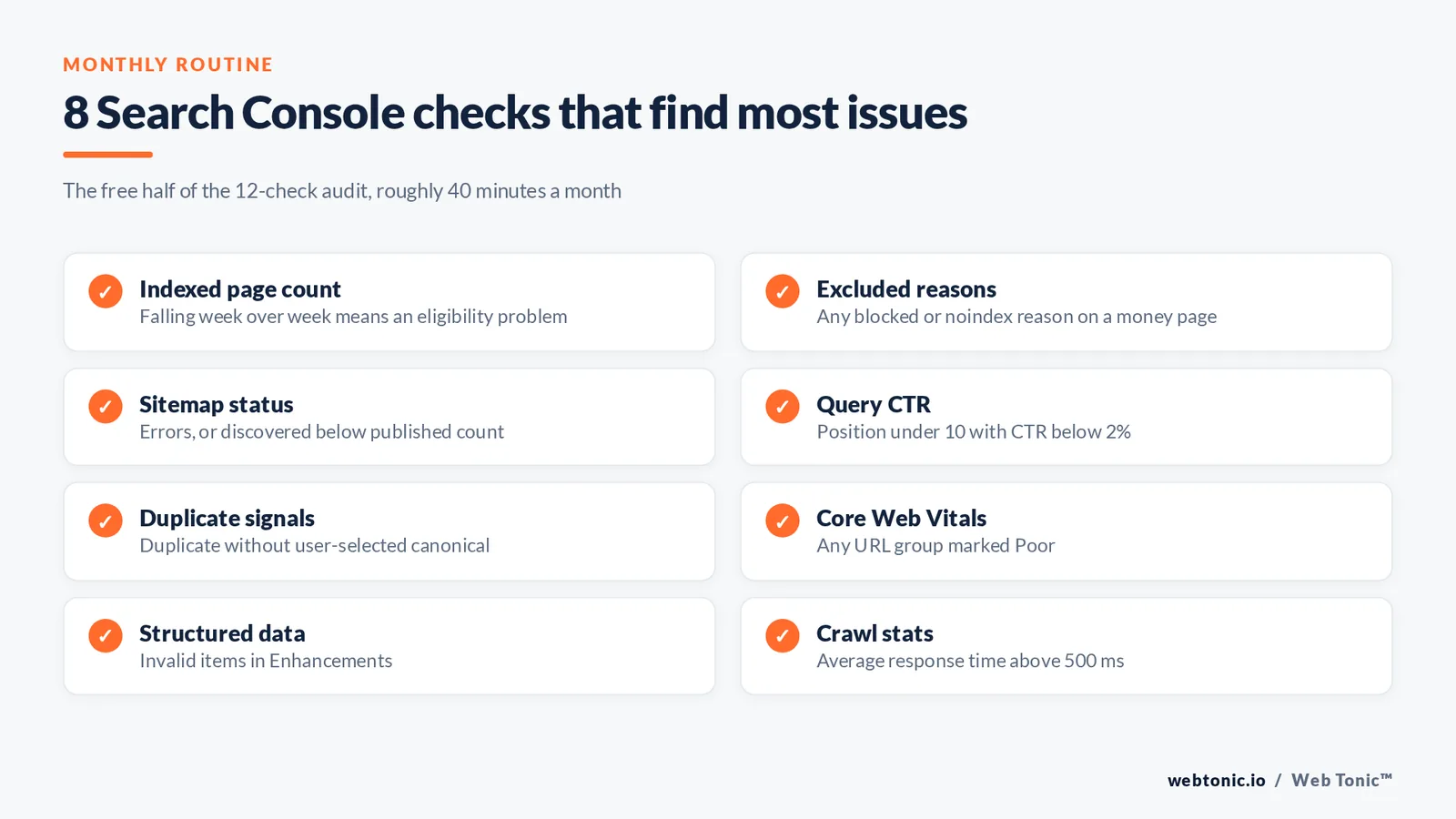
You do not need a paid crawler to find most common SEO issues. This monthly routine in Google Search Console surfaces 80% of them in under an hour.
| Check | Report | Red flag | Time |
|---|---|---|---|
| Indexed page count | Pages | Indexed count falls week over week | 5 minutes |
| Excluded reasons | Pages | Any "Blocked" or "noindex" reason on money pages | 5 minutes |
| Sitemap status | Sitemaps | Errors, or discovered count below published count | 3 minutes |
| Query CTR | Performance | Position under 10 with CTR below 2% | 10 minutes |
| Losing queries | Performance, compare 28 days | Clicks down more than 20% | 10 minutes |
| Duplicate signals | Pages | "Duplicate without user-selected canonical" | 5 minutes |
| Core Web Vitals | Core Web Vitals | Any URL group marked Poor | 5 minutes |
| Mobile usability | Experience | Errors on template pages | 3 minutes |
| Structured data | Enhancements | Invalid items | 5 minutes |
| Manual actions | Security and Manual Actions | Anything at all | 1 minute |
| Crawl stats | Settings, Crawl stats | Average response time above 500 ms | 5 minutes |
| Links report | Links | Top linked page is not a money page | 5 minutes |
Start the habit with Google's Search Console onboarding guide, and log every finding in one sheet so fixes can be verified rather than assumed. Because Google handles 91.25% of searches (StatCounter, June 2026), one property covers nearly all the risk — verify the market share yourself on the StatCounter dashboard.
Which tool finds which SEO issue
| Tool | Cost | Finds | Blind spot |
|---|---|---|---|
| Google Search Console | Free | Indexing, queries, Core Web Vitals, schema errors | No crawl of unlinked pages |
| Google Analytics | Free | Landing page decay, engagement drops | No crawl or index data |
| PageSpeed Insights | Free | Field and lab performance per URL | One URL at a time |
| Screaming Frog | Free to 500 URLs | Broken links, duplicate titles, redirect chains | No ranking data |
| Ahrefs or Semrush | Paid | Backlinks, cannibalisation, rank tracking | Estimated volumes |
| Rich Results Test | Free | Structured data validity | Single URL |
| Google Business Profile insights | Free | Local visibility and review velocity | Website issues |
Rule 3 — two free tools beat one expensive one you never open. Search Console plus a 500-URL crawl covers the majority of the defect list above; add a paid suite only when you need backlink and competitor data. Teams that want the audit run for them can see how we scope it on the services page or get in touch.

FAQ
What are the most common SEO issues on a new website?
A noindex tag or robots.txt rule left over from staging, missing title tags and meta descriptions, no XML sitemap submitted, thin category pages and images uploaded at full size. All five are fixable in a day, and all five are visible in Search Console within a week of launch.
How do I find and fix broken links?
Crawl the site with a free tool such as Screaming Frog, filter for 404 response codes, then group the results by the page that contains the link. Update the href where the correct target exists and 301 the old URL where the page has moved. Re-crawl afterwards to confirm the 404 count is zero.
Does duplicate content cause a Google penalty?
No. Google filters duplicates rather than penalising them, unless the duplication is deliberate scraping. The real damage is diluted signals and wasted crawl budget, which you resolve with 301 redirects, self-referencing canonicals and consistent internal linking.
How often should I run an SEO audit?
Run the 12-check Search Console routine monthly, a full technical crawl quarterly, and a content and backlink review twice a year. Always run a crawl immediately before and after a redesign or migration, when most catastrophic SEO issues are introduced.
Which SEO mistakes hurt rankings the most?
Anything that removes eligibility: blocked crawling, noindex tags, server errors and duplicate URLs without canonicals. After that, search intent mismatch and low quality content do the most damage, because they cap what any technical fix can achieve.
Sources: Google Search Central documentation (Search Essentials, robots.txt, duplicate URLs, title links, structured data, helpful content, AI features, Search Console); web.dev Core Web Vitals; Ahrefs 107 SEO Statistics 2026 and technical SEO guides; BrightLocal Local Consumer Review Survey 2026; StatCounter Global Stats, June 2026.