



Table of contents
Google Maps SEO is the work of making one company entry the most relevant, closest-looking and most prominent option for a nearby query. Rankings move when the entry is complete, the categories are right, the ratings are recent and the site backs it all up.
Key Takeaways
- Google ranks Maps results on three published inputs — relevance, distance and prominence — and only two of them are inside your control.
- Whitespark's practitioner survey puts Business Profile signals at roughly 32% of map pack influence, the single largest block.
- Google reports that a complete entry makes a firm look 2.7x more reputable, drives up to 70% more visits and lifts purchase consideration by 50%.
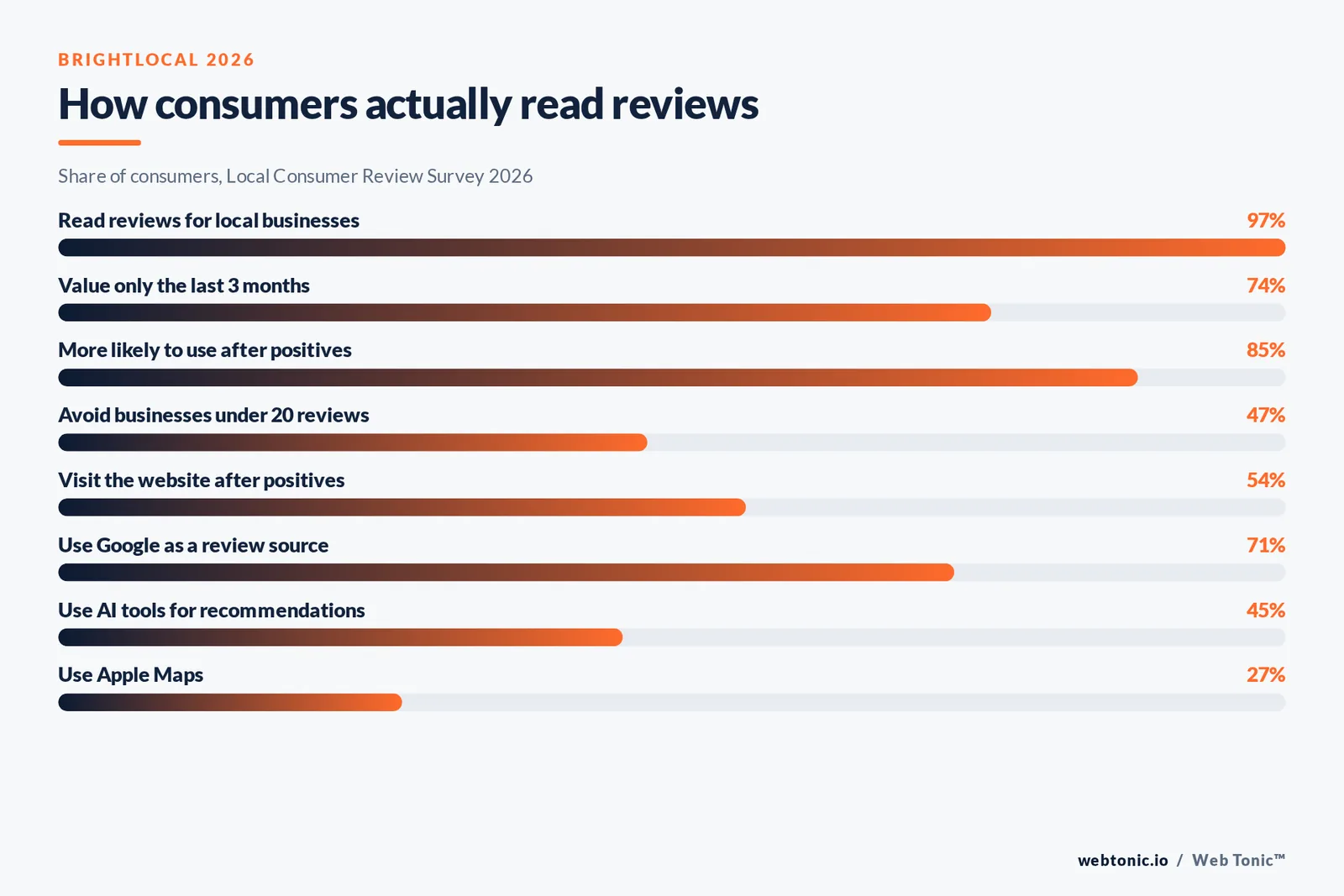
- BrightLocal's 2026 consumer survey found 97% of consumers read ratings and 47% will not use a firm with fewer than 20 ratings.
- Review recency is now a gate: 74% of consumers only value ratings from the last three months, and 32% only the last two weeks.
- The opportunity is still enormous — only 35% of small operators have a Google Business Profile at all, and only 40% of small operators run a dedicated site.
- A realistic first read on Maps work is 90 days: entry and category fixes land in weeks, rating velocity and town landing pages compound over quarters.

What Google Actually Ranks in Maps
Google publishes its ranking logic in plain language, and it is shorter than most SEO advice suggests. Google's own documentation on local ranking names three inputs: relevance (how well the entry matches the query), distance (how far the searcher is from the firm) and prominence (how well known the company is offline and online). Distance is largely fixed once your street details are set. Relevance and prominence are what an operator can move.
That framing matters because it kills two common myths. The first is that map results are a single national leaderboard — they are not, they are recalculated per searcher coordinates, which is why your own phone is a terrible position tool. The second is that posting more often is the lever. Posting helps engagement, but the listing fields, category set and rating corpus carry far more weight. Whitespark's local search ranking factors survey attributes about a third of map pack influence to listing signals alone, with ratings and on-page signals filling most of the rest. Our growth marketing team treats those three blocks as a sequence: fix the listing, then earn the ratings, then build the pages.
| Signal block | Approx. share of map pack influence | What sits inside it | Control level |
|---|---|---|---|
| Google Business Profile | ~32% | Categories, name, street details, opening times, offerings, attributes, products | Full |
| Reviews | ~16% | Volume, rating, recency, keyword content, owner replies | Influence, not control |
| On-page site signals | ~19% | Location pages, NAP markup, job-type pages, internal links | Full |
| Links | ~15% | Local press, sponsorships, associations, supplier pages | Partial |
| Behavioural signals | ~8% | Clicks, calls, direction requests, dwell on the listing | Indirect |
| Citations | ~7% | Directory consistency, duplicate suppression | Full |
| Personalisation & distance | Remainder | Searcher coordinates, history, device | None |
Rule 1 — Finish the Profile Before Anything Else
Most listings that underperform are simply incomplete. Google's profile management documentation exposes dozens of fields, and each one is a chance to match a query. A plumbing listing with 4 offerings listed cannot appear for the 30 trade phrases people actually type. Fill every field that is true, and refuse to fill any field that is not — fake addresses and keyword-stuffed company names are the fastest route to a suspension, and reinstatement can take weeks.
Work the fields in descending order of weight, not in the order Google shows them. Categories first, then offerings, then opening times and attributes, then images and products. Treat the company description as a conversion asset rather than a discovery one: it is not a heavy input, but it is read.
| Profile field | What to enter | Ranking weight | Common mistake |
|---|---|---|---|
| Primary category | The single closest match to your main revenue line | Very high | Choosing a broad umbrella category |
| Secondary categories | 2–5 genuine additional lines of business | High | Adding 9 loosely related ones |
| Business name | Exactly the real-world signage name | High | Appending city or trade keywords |
| Services / menu | 15–40 named offerings with 2-line descriptions | Medium-high | Leaving the section empty |
| Service area | Up to 20 towns you truly serve | Medium | Listing an entire state |
| Opening times & exceptions | Accurate opening times plus every holiday exception | Medium | Never updating them |
| Attributes | All true accessibility, payment and amenity flags | Medium | Skipping the section entirely |
| Photos | 20+ real, geotag-free, well-lit images | Low-medium | Uploading stock photography |
| Description | 750 characters, benefit-led, 1 city mention | Low | Keyword stuffing |
Rule 2 — Categories Decide Which Queries You Can Even Enter
Category selection is the highest-leverage 10 minutes in Maps SEO. Your primary category defines the query set you are eligible for; secondary categories widen it. Pick the wrong primary and no amount of rating work can rescue the listing, because you are competing in the wrong auction entirely.
The method is empirical, not intuitive. Search your top three money queries from a point inside your service area, open the top three Maps results, and read the category each of them declares. If two of three declare the same primary category and you declare something different, you have found your problem. Repeat this for every distinct revenue line, then map secondary categories to the lines that generate at least 5% of revenue.
| Business type | Primary category pattern | Useful secondaries | Category trap |
|---|---|---|---|
| Single-location restaurant | The cuisine-specific type, not "Restaurant" | Bar, caterer, breakfast restaurant | Generic "Restaurant" primary |
| Home services (service-area) | The trade itself (e.g. roofing contractor) | Gutter care, siding contractor, emergency line | "General contractor" umbrella |
| Professional services firm | The specialisation clients ask for | Consultant, notary, adjacent specialisms | Firm-wide category on every office |
| Medical / dental practice | The practising specialty | Cosmetic sub-specialty, emergency care | "Doctor" as primary |
| Retail store | The dominant product category | Repair bench, rental desk | "Store" as primary |
| Multi-branch brand | Identical primary across all locations | Site-specific work lines | Inconsistent categories per branch |
Rule 3 — Reviews Are a Recency Engine, Not a Trophy Case
Reviews have quietly become the hardest part of nearby discovery, because the bar moved. BrightLocal's 2026 Local Consumer Review Survey found that 97% of consumers read ratings for nearby companies and 41% now say they always do, up from 29% the year before. Volume alone no longer clears the bar: 47% will not use a company with under 20 ratings, and 74% only consider ratings from the past three months meaningful. A 4.9-star listing whose last rating is 14 months old reads as a closed business.
That makes rating generation a process, not a campaign. The workable version is a single request sent at the moment of delivered value, one reminder, and nothing else. Replies matter too — roughly 80% of consumers favour businesses that reply to all ratings, and replies are the only place you can legitimately restate job and city language in your own words. If you want a written cadence for this, our data intelligence team builds the request timing off the transaction record rather than a monthly blast.
| Review metric | Working target | Why it matters | How to move it |
|---|---|---|---|
| Total rating count | 20 minimum, 50+ competitive | 47% avoid businesses under 20 | Ask every completed job, once |
| Velocity | 4–8 new testimonials per month | 74% only value the last 3 months | Trigger the ask off invoice or checkout |
| Average rating | 4.4–4.8 | A perfect 5.0 reads as filtered | Fix delivery failures, not the rating |
| Reply rate | 100% within 72 hours | 80% favour full responders | Assign one named owner |
| Service mentions | Top 5 work items named in testimonials | Review text feeds relevance | Ask about the specific job done |
| Photo testimonials | 10% of testimonials with images | Higher perceived credibility | Request a photo in the ask |
| Second-platform coverage | 2 platforms beyond Google | Google's share of rating reading fell to 71% | Rotate the secondary ask quarterly |
Rule 4 — Consistency Across the Wider Map Ecosystem
Google is not the only map that matters any more. BrightLocal recorded Apple Maps rising from 14% to 27% as a nearby discovery source, and generative AI assistants jumping from 6% to 45% — those assistants read the same structured business information. Meanwhile, Google still commands the overwhelming majority of search sessions according to StatCounter's search engine market share tracker, so the priority order is clear without being exclusive. Claim Apple Maps and Bing Places once, then leave them alone.
Citation work is unglamorous but it is cheap and it removes ambiguity. Moz's primer on local citations is the clearest explanation of why: conflicting addresses and phone numbers make it harder for any engine to be confident about the entity. Fix the handful of sources that actually get scraped and ignore the long tail of link-farm directories.
| Source | Why it counts | What to verify | Review cadence |
|---|---|---|---|
| Google Business Profile | The primary record | Name, street details, phone, opening times, categories | Monthly |
| Your own website footer | The reference Google cross-checks | Exact NAP string match | On every redesign |
| Apple Maps Business Connect | 27% of consumers now use Apple Maps | Pin position, times, images | Quarterly |
| Bing Places | Feeds several assistants and devices | Categories and description | Twice a year |
| Better Business Bureau | Trust signal and a real citation | Address and trading name | Annually |
| Chamber of commerce listing | Local relevance and a nearby link | Category and URL | Annually |
| Industry association directories | Highest-quality niche citations | Membership status and page URL | Annually |
| Duplicate listings | Splits testimonials and signals | Search brand + old addresses | Twice a year |
Rule 5 — The Website Still Carries a Fifth of the Weight
Maps positions are not decided inside Maps. Roughly a fifth of map pack influence comes from website signals, which is why service-area businesses with a one-page site plateau quickly. The fix is structural: one page per offering, one page per priority town, and internal links that connect them in a way a human would follow. Google's LocalBusiness structured data reference defines the markup that removes ambiguity about opening times, geo coordinates and departments — it is not a placement booster on its own, but it makes your entity information machine-readable.
Depth beats breadth here. Ten genuinely differentiated town pages with nearby proof, pricing context and named projects outperform 200 templated pages with the city name swapped, and they avoid the thin-content risk. Our web development team builds these as reusable components so each page can carry unique proof without a rebuild, and the Web Tonic blog documents the patterns we reuse.
| Page element | Local requirement | Why it helps Maps | Fail state |
|---|---|---|---|
| Title tag | Service + city, under 60 characters | Direct relevance match | Brand-only titles |
| H1 | One H1 naming the offering and area | Confirms page topic | Missing H1 entirely |
| NAP block | Identical string to the listing | Entity confirmation | Phone shown as an image |
| Embedded map | One embed per branch page | User confidence, not placement | Embeds on 200 thin pages |
| Local proof | 3+ named projects or comments per page | Uniqueness and prominence | Same testimonial site-wide |
| Schema | LocalBusiness plus Service markup | Machine-readable entity information | Copy-pasted wrong coordinates |
| Internal links | Service ⇄ town cross-links | Distributes authority locally | Orphaned town pages |
| Page speed | Mobile LCP under 2.5s | Most nearby searches are mobile | Unoptimised hero images |
Rule 6 — Photos, Posts and Products Earn Attention, Not Rank
The content surfaces on a listing do real work, just not the work most guides claim. Photos change click behaviour, posts surface offers, and products or offerings make the listing answer more queries. Google's guidance on listing imagery and video sets the technical bar; the strategic bar is that the images look like your actual premises and staff. Think with Google's search behaviour research is a useful reminder of how compressed the nearby decision window is — nearby searches convert to a visit within a day for around 76% of searchers, and about 28% end in a purchase.
Set a cadence you can actually keep for a year. Two images a month beats forty in one week and then silence.
| Asset | Cadence | Minimum volume | What it moves |
|---|---|---|---|
| Exterior images | Refresh twice a year | 4 angles | Findability on arrival |
| Interior images | Refresh yearly | 6 images | Confidence to visit |
| Team imagery | Yearly | 3 images | Trust in service businesses |
| Work-in-progress shots | Monthly | 2 per month | Perceived activity |
| Google posts | Weekly or fortnightly | 2 per month | Offer visibility |
| Products / offerings | Quarterly audit | 15 entries | Query coverage |
| Q&A seeding | Quarterly | 5 owner questions | Pre-empts objections |
Six Traps That Keep Profiles Stuck
The failure patterns repeat across industries. Nearly all of them are self-inflicted and cheap to reverse once identified.
| Trap | What it looks like | Consequence | Fix |
|---|---|---|---|
| Trap 1 — Keyword-stuffed name | "Acme Plumbing Best Emergency Plumber Austin" | Suspension risk, weeks offline | Revert to the signage name today |
| Trap 2 — Fake or virtual address | A mailbox used as a storefront | Hard removal, hard to appeal | Convert to a service-area business |
| Trap 3 — Review gating | Only happy customers asked | Policy violation, review removal | Ask 100% of customers the same way |
| Trap 4 — Duplicate listings | 2 listings from an old address | Reviews and signals split in half | Claim, then request a merge |
| Trap 5 — Ranking checked on your own phone | "We are number 1" from the office | Wrong decisions from personalised information | Use grid-based rank checks by area |
| Trap 6 — One page for 30 towns | A list of city names in a footer | No relevance outside the pin | Build 5 real town pages first |
How to Measure Maps SEO Properly
The reporting mistake is treating a single rank position as the metric. Maps results vary by the searcher's exact coordinates, so the honest measure is a grid: check the same query from 20–50 points across your service area and track the average position and the share of points where you appear. Everything else is downstream demand information from the record itself, which Google's performance reporting documentation explains field by field.
Pair the grid with actions taken. A record that gains 30% more calls at the same average position is winning even if the position never moves, because the photos, review corpus and offer copy improved. Backlinko's local SEO guide is a reasonable cross-check on the metric set if you want a second reference point.
| Metric | Where it lives | What it tells you | Action when it drops |
|---|---|---|---|
| Grid average rank | Rank grid tool | True geographic visibility | Re-check categories and competitor reviews |
| Search-term report | Profile performance view | Which queries you actually match | Add missing offerings |
| Calls | Profile performance view | Intent volume, not just impressions | Check times and holiday settings |
| Direction requests | Profile performance view | Real visit intent by area | Verify the pin position |
| Website clicks | Profile + analytics | Whether the record sells the click | Refresh imagery and description |
| Review velocity | Profile reviews tab | Whether the ask process still runs | Audit the request trigger |
| Booked revenue by source | CRM | The only number that pays wages | Trace back through the funnel |
A 90-Day Google Maps SEO Plan
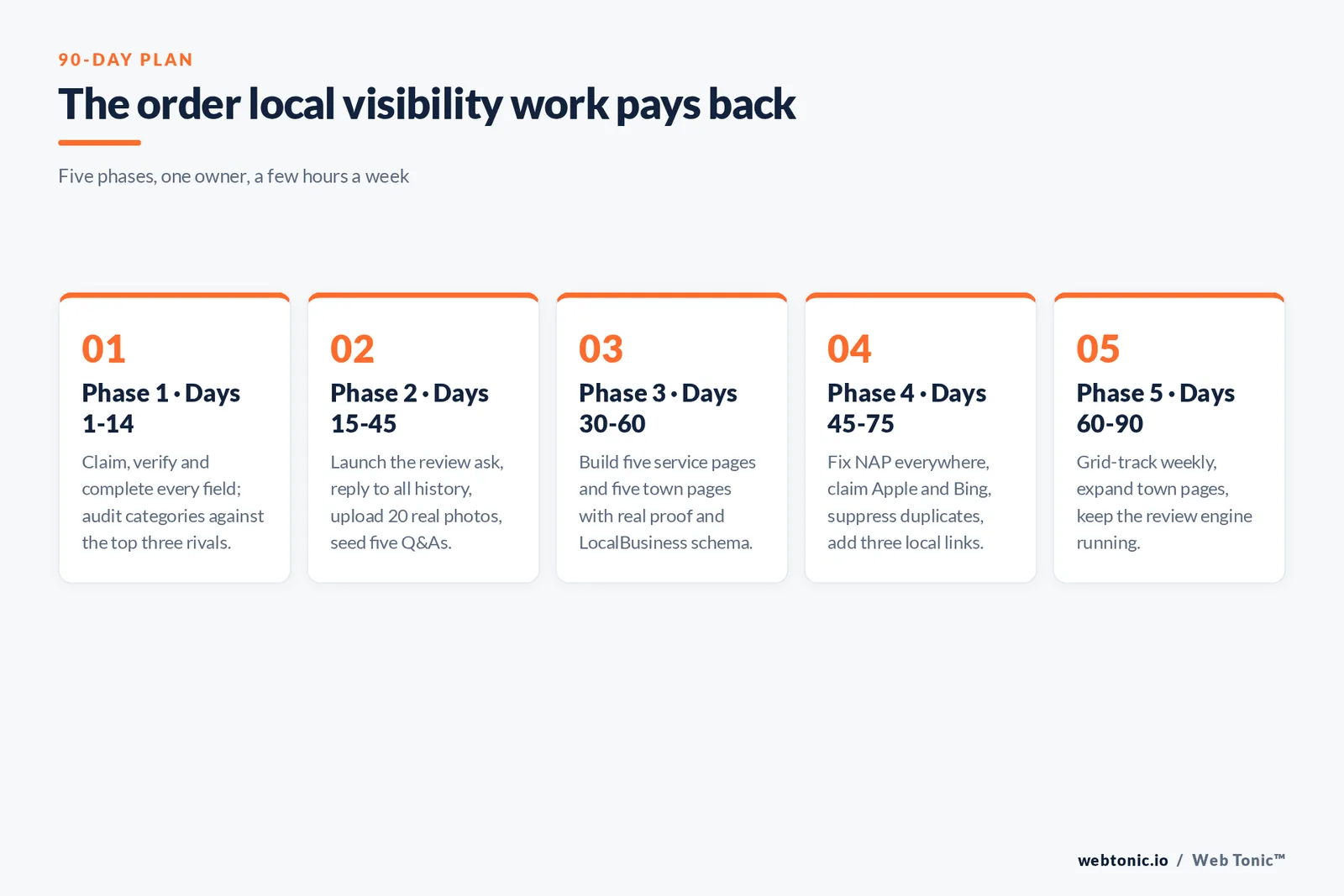
Sequence matters more than effort. Profile and category work pays back in weeks; reviews and pages compound over quarters. This is the order we run for a new area client engagement, and it assumes one owner and a few hours a week rather than a dedicated team.
| Phase | Window | Work | Expected read |
|---|---|---|---|
| Phase 1 — Foundation | Days 1–14 | Claim, verify, complete every field, fix the name, audit categories against the top 3 rivals | Impression lift within 2–4 weeks |
| Phase 2 — Proof | Days 15–45 | Launch the feedback ask, reply to every historic comment, upload 20 real photos, seed 5 Q&As | 4–8 reviews per month, higher click rate |
| Phase 3 — Pages | Days 30–60 | Build 5 service pages and 5 town pages with real proof and LocalBusiness schema | Organic local rankings begin to move |
| Phase 4 — Ecosystem | Days 45–75 | Fix NAP everywhere, claim Apple and Bing, suppress duplicates, add 3 neighbourhood links | Fewer ranking anomalies by area |
| Phase 5 — Compound | Days 60–90 | Grid-track weekly, expand town pages, keep the feedback engine running | Stable pack presence across the service area |
Google Maps SEO by Business Model
The same checklist gets weighted differently depending on how you trade. A service-area business lives or dies on town pages and feedback volume; a storefront lives on photos, hours and behavioural signals; a multi-branch brand lives on consistency and governance.
| Model | Biggest lever | Second lever | What to ignore |
|---|---|---|---|
| Service-area business | Town pages with real proof | Review velocity of 6+ per month | Products section |
| Single storefront | Photos, hours and attributes | Google posts for offers | Wide service-area settings |
| Multi-location brand | Category and NAP governance | Per-location landing pages | One national blog as the local play |
| Practice with named practitioners | Practitioner listings plus the practice record | Specialty-specific categories | Duplicate practitioner listings at one address |
| Franchise | Central template, local proof injection | Local feedback ownership per unit | Franchisee-run rogue listings |

Diagnosing a Sudden Drop
When Maps visibility falls, resist the urge to change five things at once. Work the list in order and change one variable at a time so you can read the result. If you want a second pair of eyes on a drop, talk to our team before you start editing the record.
| Symptom | Most likely cause | First check | Fix window |
|---|---|---|---|
| Profile disappeared entirely | Suspension or unverified edit | Profile status and email notifications | Days to weeks |
| Rank fell in outer areas only | Competitor review growth | Rival review counts over 90 days | 1–2 quarters |
| Rank fell everywhere at once | Category or name change | Profile edit history | 2–4 weeks |
| Impressions flat, calls down | Hours, photos or offer decay | Special hours and last photo date | Days |
| Reviews vanished | Filtered incentivised reviews | How the last 20 asks were made | Immediate process change |
| Two profiles competing | Unmerged duplicate | Brand query plus old addresses | 2–6 weeks |
FAQ
How long does Google Maps SEO take to work?
Profile completeness and category corrections often show impression movement within two to four weeks. Review velocity and local landing pages need a full quarter before the pattern is readable, and competitive urban markets can take two to three quarters to stabilise.
Do Google posts improve Maps rankings?
There is no reliable evidence that posting frequency lifts placement directly. Posts improve engagement, promote offers and give a page a sense of activity, which can influence clicks and calls. Treat posts as conversion assets and spend your first hours on categories, services and reviews instead.
How many reviews do I need to rank in the map pack?
There is no absolute threshold, only a competitive one: match or beat the review count and recency of the three profiles currently ranking for your money query. As a floor, aim for at least 20 reviews, because 47% of consumers will skip businesses below that, and keep four to eight arriving each month.
Can I rank in a city where I have no address?
You can rank in organic local results and sometimes in the pack for nearby towns inside your declared service area, but the pack strongly favours proximity to the searcher. The honest play is a genuinely useful town page plus service-area settings, not a fake address, which risks permanent removal.
Does answering reviews actually matter?
Yes, on two fronts. Around 80% of consumers favour businesses that reply to every comment, and replies are your only owned text inside the comment corpus, which lets you restate service and location language naturally. Reply within 72 hours and keep negative replies short, factual and offline-directed.
Sources
Google Business Profile Help — local ranking and profile management documentation · Google Business Profile performance reporting documentation · Google Search Central — LocalBusiness structured data reference · Whitespark Local Search Ranking Factors survey · BrightLocal Local Consumer Review Survey 2026 · Moz — Local Citations learning centre · Think with Google — search behaviour research · StatCounter Global Stats — search engine market share · Apple Maps · Bing Webmaster Tools · Better Business Bureau · Chamber of Commerce · Backlinko local SEO guide. All figures cited as published by the named source at the time of writing.


