Table of contents
Personalized cold emails open at 20.79% against 14.96% for generic sends, but the reply-rate gap between warm and cold outreach is far larger than the personalization gap. 2026 data from Snov.io, Cognism, Cleverly and Saleshandy points to a specific ceiling: automation scales reach, personalization moves the open rate, and warmth moves the reply rate more than either one alone.
Key Takeaways
- Personalized cold emails open at 20.79% against 14.96% for generic sends.
- AE warm sends open at 67.03% versus 54.04% for SDR cold sends.
- AE warm sends reply at 28.38% against 8.98% for SDR cold sends.
- Cleverly's 100M+ email dataset averages a 3.43% reply rate.
- Sales.co's study finds only 2.09% average reply rate across 2M+ emails.
- Positive replies drop to just 0.64% of all contacts reached.
- Saleshandy's 53M-email study flags 2.2% blended bounce as the danger line.
- Bulk senders must keep spam complaints under 0.3% since 2024's Google/Yahoo rules.
- Gmail's internal spam threshold sits near 0.1%.
- General marketing email opens average 20.73%, well below top cold-email benchmarks.
- With Apple Mail Privacy Protection factored in, opens read 33.87% on average lists.
- SDR automation still delivers 146,832 emails against 2,544 for AE warm sends.
- Opt-out rates run near 1.1-1.4% across both warm and cold sends.
- Social outreach now beats email on response rate, 42% versus 26%, per HubSpot.
- Top-tier personalized B2B campaigns report 27.7% to 44% open rates.
The personalization gap is real, but it is smaller than the warmth gap
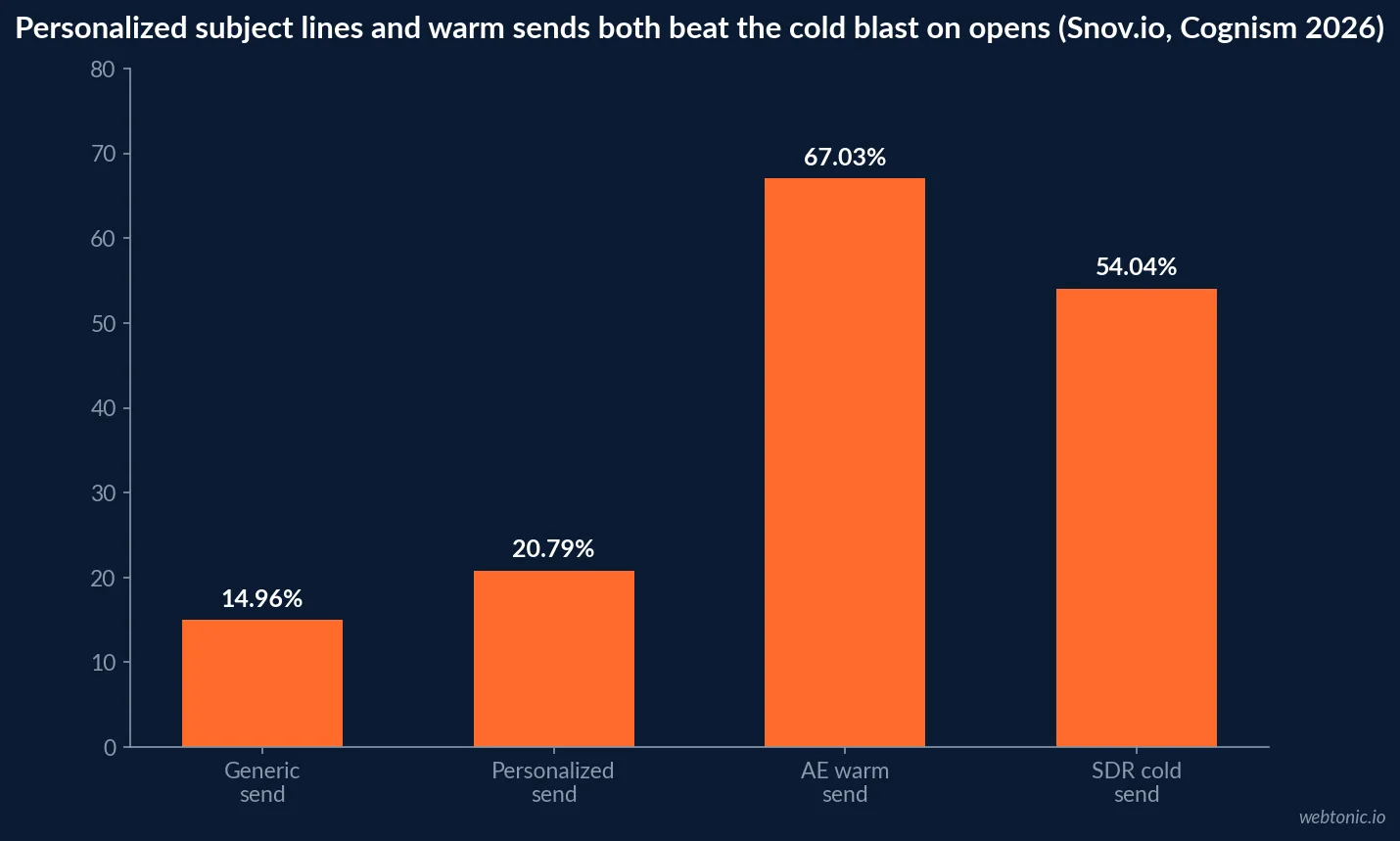
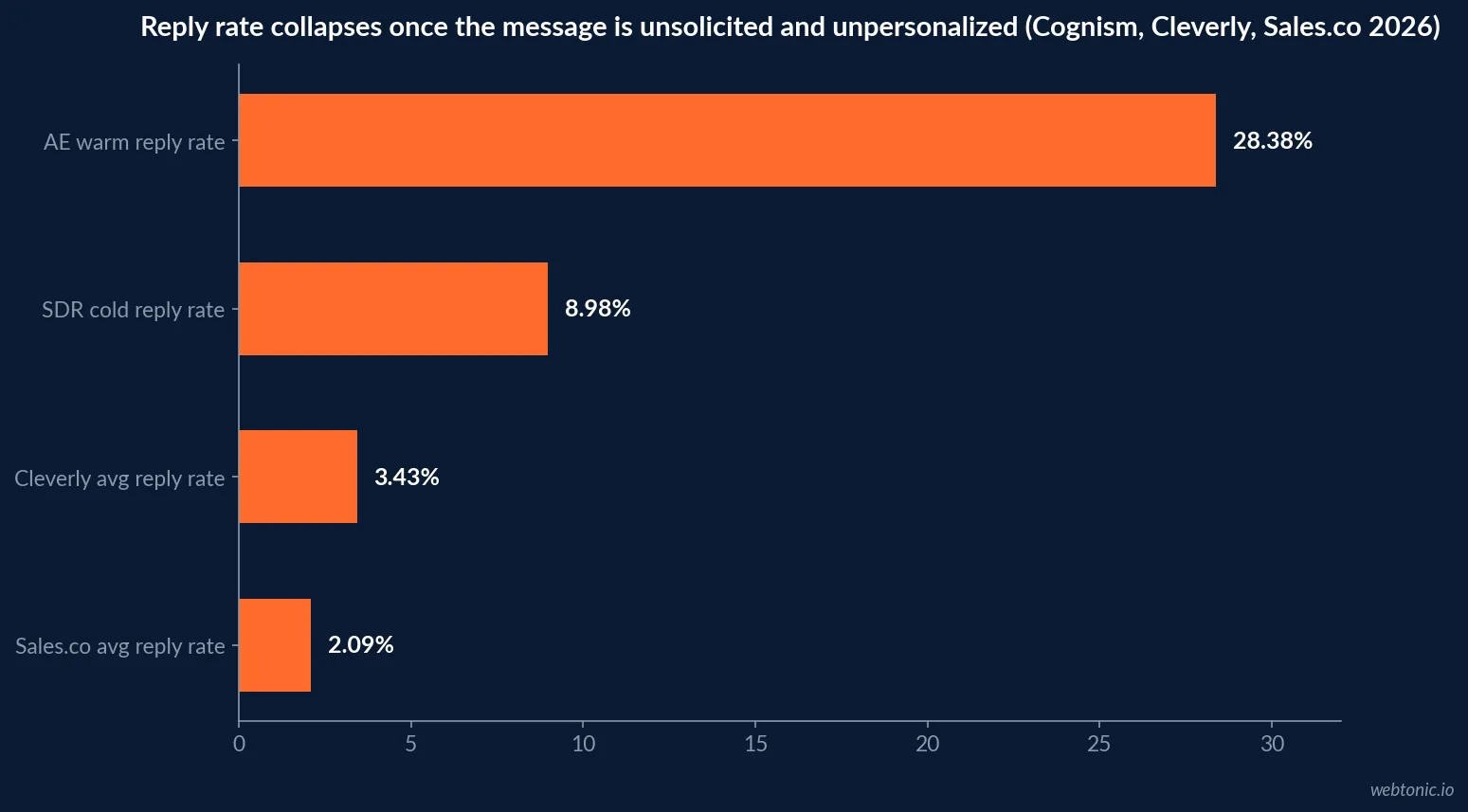
Snov.io's 2026 dataset found personalized cold emails opening at 20.79% against 14.96% for generic sends - a real, repeatable lift. But Cognism's State of Outbound 2026 report shows a far larger gap driven by list warmth alone: AE teams emailing warm leads open at 67.03% and reply at 28.38%, against 54.04% and 8.98% for SDR teams working cold lists.
Read together, the two datasets say the same thing from different angles: personalizing a cold send narrows the gap with a warm one, but it does not close it. The list itself still does most of the work.
| Send type | Open rate | Reply rate | Source |
|---|---|---|---|
| Generic cold email | 14.96% | Not isolated | Snov.io 2026 |
| Personalized cold email | 20.79% | Not isolated | Snov.io 2026 |
| AE warm email | 67.03% | 28.38% | Cognism State of Outbound 2026 |
| SDR cold email | 54.04% | 8.98% | Cognism State of Outbound 2026 |
| Blended cold email average | 27.7%-44% | 3.43% | Cleverly, 100M+ emails |
Where automation quietly caps the reply rate
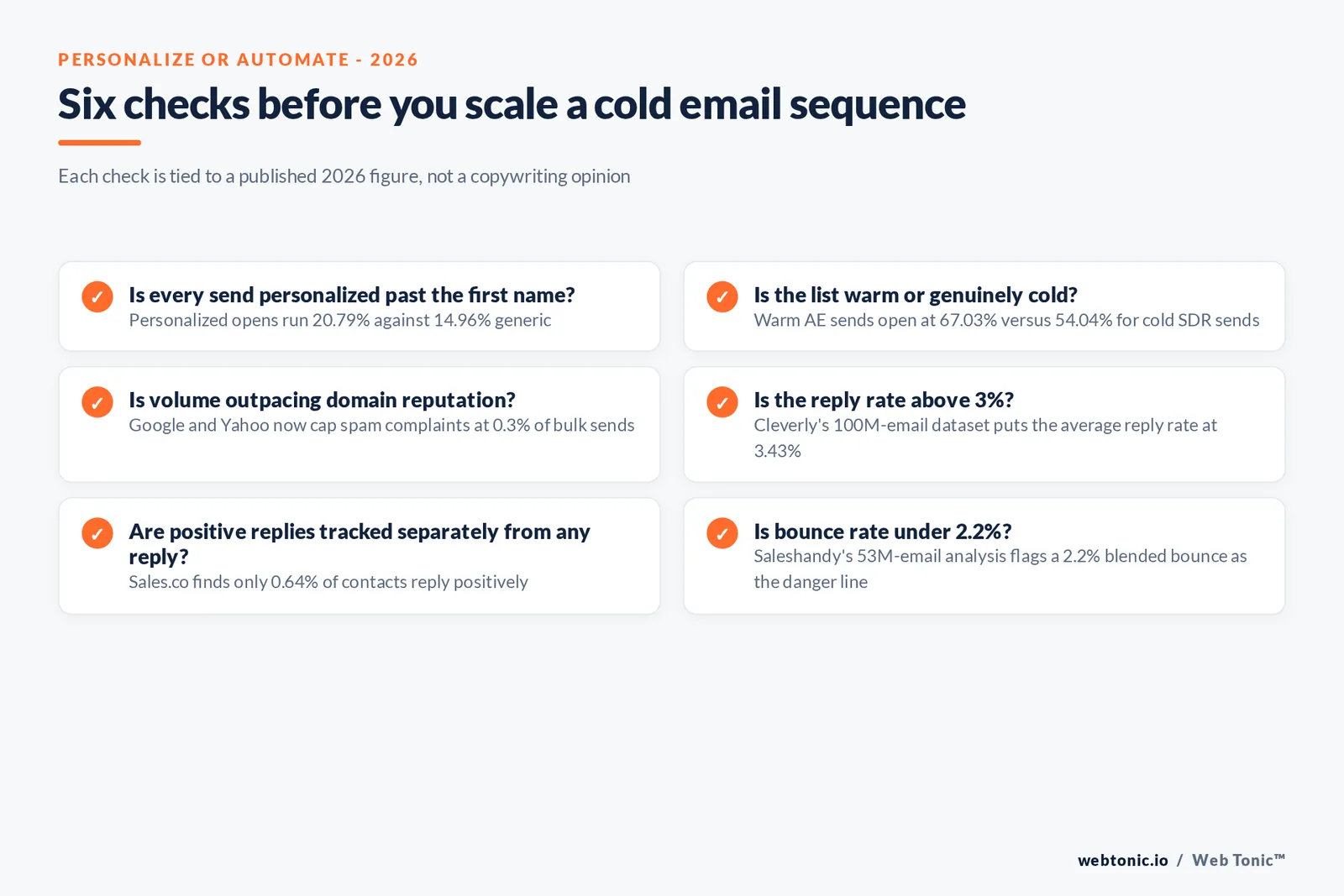
Cleverly's analysis of more than 100 million emails puts the average reply rate at 3.43%, and a separate 2-million-email study from Sales.co found an even leaner 2.09% average, with only 0.64% of contacts replying positively once neutral and negative replies are filtered out. Fully automated sequences at high volume tend to sit at the low end of that range - the copy scales, but the relevance per send does not.
The practical read is that automation is excellent at reach and a poor substitute for the signal that actually drives a reply: evidence the sender did homework on that specific account. Teams pairing outbound email with paid channels can compare notes against our paid search cost benchmarks when deciding how much budget to shift toward manual research versus automated volume.
The deliverability ceiling automation runs into
Saleshandy's analysis of over 53 million emails found a blended bounce rate of 2.2% acting as a practical ceiling before sender reputation starts to degrade. Since 2024, Google and Yahoo require bulk senders to authenticate with SPF, DKIM and DMARC and to keep spam-complaint rates under 0.3%; Gmail's own internal threshold runs even tighter, close to 0.1%. Automated volume that crosses those lines gets filtered or rejected outright, independent of how well the copy converts.
| Deliverability signal | Published threshold | Source | Consequence past it |
|---|---|---|---|
| Blended bounce rate | Above 2.2% is a warning sign | Saleshandy, 53M+ emails | Sender reputation starts falling |
| Spam complaint rate, bulk senders | Must stay under 0.3% | Google/Yahoo bulk sender rules, 2024+ | Authentication and filtering enforced |
| Gmail internal spam threshold | ~0.1% | Cleverly 2026 | Risk of filtering or permanent rejection |
| Toughest inbox provider | Microsoft, 2.46% bounce | Saleshandy 2026 | Lowest engagement of major providers |
What automation still does better
None of this argues automation has no place. Cognism's own data shows SDR-led automated sequences still delivering 146,832 emails in the same window AE-led warm outreach delivered just 2,544 - a scale advantage automation alone can provide. The data argues for a specific split: automate the sequencing, list-building and follow-up cadence, and reserve manual attention for the first line and subject, which is exactly where Snov.io's personalization gap shows up.
Opt-out rates stayed close between the two groups in Cognism's data, 1.40% for AE sends and 1.12% for SDR sends, suggesting recipients are not meaningfully more annoyed by automated cadence itself - they are simply less likely to reply to it.
| Metric | AE warm, mostly manual | SDR cold, mostly automated | Source |
|---|---|---|---|
| Emails delivered per window | 2,544 | 146,832 | Cognism State of Outbound 2026 |
| Open rate | 67.03% | 54.04% | Cognism |
| Reply rate | 28.38% | 8.98% | Cognism |
| Opt-out rate | 1.40% | 1.12% | Cognism |
Benchmarking against the wrong list inflates confidence
Brevo's 2026 benchmark data shows general marketing email opening at 20.73% on average (33.87% once Apple Mail Privacy Protection is accounted for), a figure some teams mistakenly compare their cold sequences against. Cold email to a genuinely cold B2B list should be measured against cold-specific benchmarks - Mailmodo's 2026 guide reports blended average opens closer to 26.8% and click-throughs near 1.89% across general campaigns, both lower than top-quartile cold outreach figures reported by vendors focused specifically on B2B prospecting.
What is shifting the channel mix in 2026
Cold email is also losing some relative share to other outreach channels. HubSpot's sales research found social outreach now outranking email on response rate, 42% against 26%, a reversal from prior years. That does not make cold email obsolete - it makes it one channel in a mix rather than the default first touch, and argues for the same personalization-plus-automation split working across whichever channel opens the thread.
The practical implication for anyone running a multi-channel outbound program is sequencing, not substitution: email remains cheap to scale and easy to automate for reach, while a manually personalized social touch or a cold call - see our companion breakdown of what a paid acquisition strategy needs to cover alongside outbound - can carry more of the reply-rate weight where the response gap is widest.
| Channel | 2026 response rate | Cost to scale | Best role in a 2026 sequence |
|---|---|---|---|
| Cold email, automated | 2.09-3.43% | Very low | Volume and reach, first contact |
| Cold email, personalized | 20.79% open, higher reply | Moderate, needs manual review | First-touch subject and opener |
| Social outreach | 42% | Low to moderate | Second or third touch, warms the thread |
| Cold call | 5.4-13.3% connect | High, needs live reps | Multi-threading once email lands |
Building a sequence around these numbers
A defensible 2026 cold email sequence personalizes the subject and opening line manually, keeps the rest of the sequence automated, watches bounce rate weekly against the 2.2% line, and reports reply rate separately from open rate so a personalization test is not judged on the wrong metric. Read how the same logic applies to cold calling in our campaign strategy guide, or talk to our growth marketing team about building the outreach layer end to end.
Testing personalization without slowing volume to a crawl
The practical objection to personalization is time: writing a genuinely custom first line for every contact does not scale to the volumes Cognism's data shows automated sequences reaching. The workable middle ground splits the sequence into two zones - a personalized, manually-reviewed first touch, and an automated, templated follow-up cadence for contacts who do not respond to it. Snov.io's data suggests the personalization lift is concentrated almost entirely in that first touch, since open rate is what personalization moves and open rate is set the moment the subject line is read.
Testing this split cleanly means measuring open rate on touch one separately from reply rate across the full sequence, rather than blending every touch into one campaign-level average that hides which email in the cadence is actually doing the work.
| Sequence stage | Personalization level | Metric it should move | Automation role |
|---|---|---|---|
| Touch 1 (first send) | Manual subject + opening line | Open rate | Templated body, personalized top |
| Touch 2-3 (follow-ups) | Light merge fields only | Reply rate | Fully automated cadence |
| Touch 4+ (breakup) | Templated, no personalization | Final reply attempt | Fully automated |
| Reactivation (30+ days) | Re-personalized based on new trigger | Re-engagement rate | Automated trigger, manual copy |
Frequently Asked Questions
Does personalization actually improve cold email open rates in 2026?
Yes, measurably. Snov.io's 2026 dataset found personalized cold emails opening at 20.79% against 14.96% for generic sends - a gap of nearly 6 points that held across the full dataset, not just a handful of campaigns. The effect is smaller on reply rate than on open rate, which suggests personalization mostly wins the subject line battle rather than the body copy one.
What is a good cold email reply rate in 2026?
Cleverly's analysis of over 100 million emails puts the average reply rate at 3.43%, while Sales.co's 2M-email study found only 2.09% overall and just 0.64% of contacts replying positively. Cognism's State of Outbound report shows a much wider gap by warmth: AE teams calling warm leads see 28.38% reply rates on email against 8.98% for cold SDR sends.
How much can automation scale before deliverability breaks?
Saleshandy's 53-million-email analysis found a blended bounce rate of 2.2% acting as a practical ceiling - above that, sender reputation starts degrading fast. Google and Yahoo's bulk sender rules, in force since 2024, require spam complaint rates under 0.3%, and Gmail's own internal threshold sits even lower at roughly 0.1%. Automated volume that ignores those numbers gets throttled or blocked regardless of how good the copy is.
Is fully automated cold email dead in 2026?
No, but it is bounded. Cognism's data shows automated cold outreach still functioning at meaningful volume - 146,832 emails delivered for SDR-led automation against 2,544 for AE-led warm sends - so automation clearly still has a job to do at the top of the funnel. The data simply argues for personalizing the first line and subject rather than the whole sequence.
What email marketing benchmarks should a cold sequence be measured against?
Brevo's 2026 benchmark data separates cold outreach from regular email marketing clearly: general marketing email opens average 20.73% (33.87% once Apple Mail Privacy Protection is accounted for), well below the 27.7% to 44% range some cold email vendors report for personalized B2B sequences. Comparing cold outreach against a marketing-list benchmark instead of a cold-specific one usually overstates how well a sequence is performing.
Sources
Snov.io - Cold Email Statistics for 2026
Cleverly - Cold Email Statistics 2026, 100M+ emails
Saleshandy - Email Deliverability Statistics 2026, 53M+ emails
Cognism - State of Outbound 2026
Mailmodo - 70+ Email Marketing Statistics for 2026
Brevo - Email Marketing Benchmarks by Region and Industry, 2026
Zendesk - 73 important sales statistics
HubSpot - 2025 State of Sales Report