



Table of contents
Your email subject line is the single most important factor in whether your message gets opened or ignored — 47% of recipients decide to open an email based on the subject line alone, while 69% will mark it as spam without ever reading the body. Below is the complete, data-backed guide to writing email subject lines that drive opens, clicks, and replies in 2025 and beyond.
Key Takeaways
- Subject lines with 2–4 words achieve a 46% open rate, the highest of any word count range, according to Belkins' analysis of 5.5 million B2B cold emails.
- Personalized subject lines boost open rates by 22.56% on average across millions of sends, with first-name personalization lifting opens by an additional 26% in B2C campaigns (Experian).
- Question-based subject lines generate 21% higher open rates than statement-based alternatives and produce the strongest reply rates in cold outreach (Autobound, 130M+ emails).
- Emojis increase open rates by up to 56% on mobile for consumer brands, though the impact varies by industry — consulting sees a +2.2% lift while ecommerce drops −1.58% (MailerLite).
- AI-generated subject lines outperform human-written versions by 26% in open rate, according to Phrasee's controlled testing data reported by HubSpot.
- Subject lines between 61–70 characters achieve a 43.38% open rate, the highest character-length bracket measured in GetResponse's 2024 email marketing benchmarks.
Why Email Subject Lines Determine Campaign Success
Every email marketing campaign lives or dies in the inbox preview. According to Mailotrix's 2025 subject line statistics report, 33% of people open emails based on catchy subject lines alone, and the decision happens in under two seconds. The subject line is not just a label — it is the entire sales pitch compressed into a single scannable line of text.
The stakes are even higher when you consider that 81% of emails are now opened on mobile devices according to Salesso's 2025 email subject line analysis. Mobile screens truncate subject lines at 33–41 characters, meaning your most important words must appear first. Desktop clients like Gmail display up to 70 characters, but optimizing for the smallest screen protects your message everywhere.
At Web Tonic, we treat subject line optimization as the first lever in any email marketing strategy — because the best email content in the world delivers zero ROI if nobody opens it.
Optimal Subject Line Length by the Numbers
The debate over ideal subject line length has a clear answer when you look at the data across multiple studies. The table below compiles character and word count benchmarks from Twilio SendGrid's analysis, MailOptin's statistics roundup, and ActiveCampaign's subject line length guide.
| Length Range | Open Rate | Source |
|---|---|---|
| 2–4 words | 46% | Belkins (5.5M emails) |
| 6–10 words | 21% | Marketo via Tarvent |
| 9–13 words | 40.20% | BuzzStream (6.4M emails) |
| 21–25 words | 9% | Invesp via FinancesOnline |
| 41–50 characters | 17.57% CTR | GetResponse 2024 |
| 61–70 characters | 43.38% | GetResponse 2024 |
| 241–250 characters | 23.50% | GetResponse 2024 |

The disconnect between word count data (short wins) and character count data (61–70 characters performing best) reflects different email contexts. For cold outreach and sales emails, 2–4 word subject lines that look like internal messages outperform everything else. For marketing newsletters and promotional emails sent to opted-in subscribers, longer subject lines with 61–70 characters provide enough context to drive opens without triggering spam filters.
The practical rule from ActiveCampaign's research: front-load the value into the first 30 characters. That ensures mobile readers see your core message even when the rest gets truncated.
Subject Line Types and Their Performance
Not all subject lines are created equal. Prospectory's analysis of 10 million+ B2B cold emails categorized every email into five subject line types and tracked performance across industries, company sizes, and seniority levels. The findings challenge conventional wisdom about what actually drives engagement.
| Subject Line Type | Avg Open Rate | Avg Reply Rate | Meeting Conversion |
|---|---|---|---|
| Reference-based | 35% | 4.8% | 2.1% |
| Trigger-based | 33% | 4.2% | 1.8% |
| Question-based | 31% | 3.4% | 1.2% |
| Benefit-focused | 28% | 2.6% | 0.9% |
| Personalized (name/company) | 26% | 2.1% | 0.7% |
| Generic ("Quick question") | 18% | 1.2% | 0.3% |
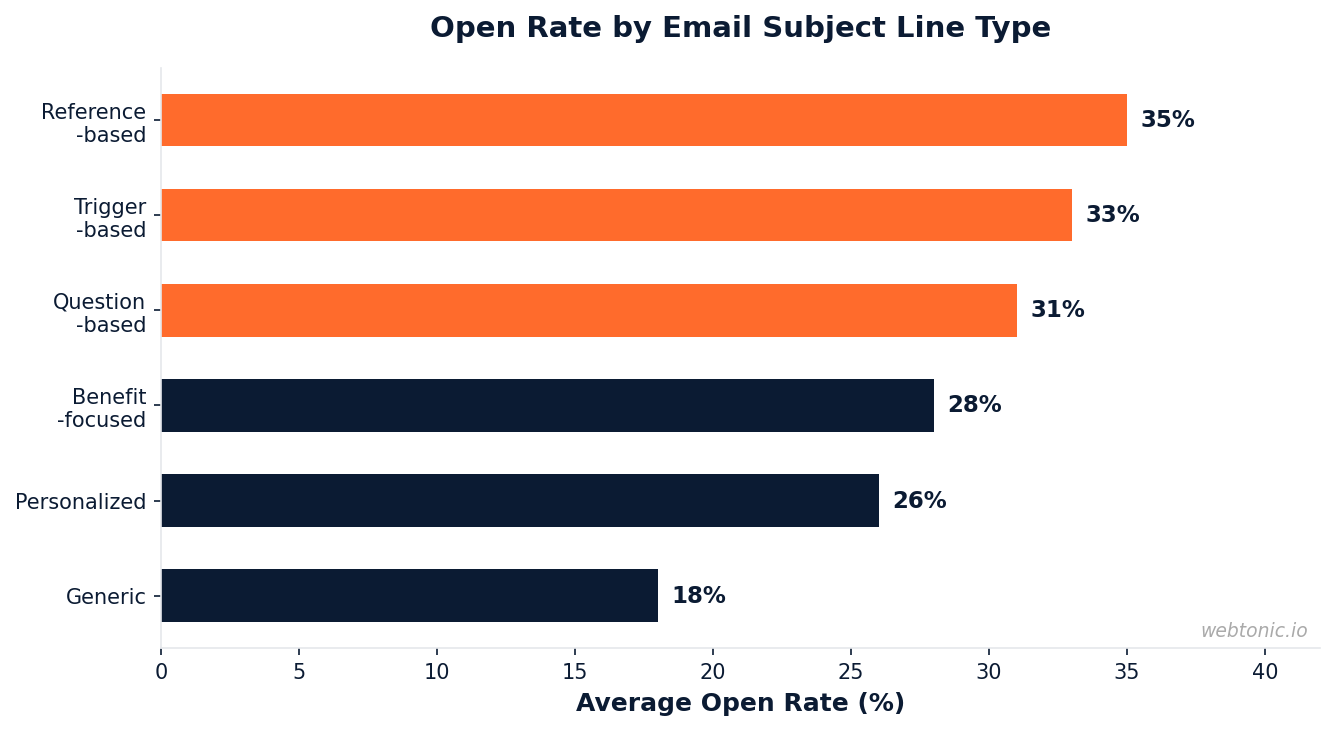
The gap between the best and worst performing categories is dramatic — reference-based subject lines produce 7x the meeting conversion rate of generic ones. The data shows that specificity and relevance consistently beat cleverness and urgency. Autobound's analysis of 130M+ B2B emails independently confirms that salesy language in subject lines reduces open rates by 17.9%. Their recommendation: write subject lines that look like internal emails, not marketing campaigns.

Personalization Tactics That Actually Work
Personalization in email subject lines goes far beyond inserting a first name. According to Gitnux's 2026 email subject line data report, the lift varies significantly depending on the type of personalization you use and how your audience perceives it.
- First-name personalization lifts opens by 26% in B2C but academic research from a 2023 Marketing Letters study found that first-name insertion no longer produces a significant lift in some markets because consumers have grown accustomed to the tactic.
- Surname personalization still works — the same study found that using the recipient's last name lifts both open rates and click-through rates because it signals more effort and feels less automated.
- Company name personalization achieves 35.65% open rates in B2B outreach, making it one of the most reliable personalization tactics for sales emails.
- Location-based personalization yields a 12.5% higher open rate, particularly effective for local businesses and geo-targeted campaigns.
- Segment-specific personalization raises open rates by 14.31% across industries when subject lines reference the recipient's industry, role, or recent behavior.
The best practice for email marketing personalization in 2025 is layering multiple signals. A subject line like "Sarah, your Phoenix team's Q3 pipeline" combines first name, location, and business context — creating a sense of urgency and relevance that a generic "Check out our latest offer" cannot match.
Emojis, Numbers, and Formatting Tricks
Visual elements in subject lines can significantly boost or hurt performance depending on your audience and industry. Here is what the data says about each tactic.
Emojis are polarizing. MailerLite's 2025 email marketing statistics found that emoji impact varies dramatically by industry: consulting sees a +2.20% lift while ecommerce drops −1.58% and educational institutions gain +6%. Subject lines with 1–2 emojis achieve a 24% open rate versus 18% without, but overuse signals spam to both filters and readers. The safest approach: test one emoji at the beginning or end of the subject line, never in the middle.
Numbers perform consistently well across contexts. Subject lines that include numbers see 57% higher open rates according to Zippia's research compiled by Mailotrix. Numbers work because they create specificity — "5 Ways to Cut Your Ad Spend" is more compelling than "Ways to Cut Your Ad Spend" because the number sets an expectation for the content inside.
ALL CAPS is unequivocally harmful. Using all capital letters in email subject lines reduces open rates by 73% according to analysis from Natchezdemocrat. Readers associate uppercase text with shouting or spam, and email filters agree — ALL CAPS triggers aggressive spam scoring across most major providers.
Urgency language requires careful calibration. Words like "now," "today," and "limited" increase open rates by 22% on average, but Autobound's B2B data shows that overt urgency phrases like "ASAP" and "Act Now" actually push open rates below 36% because they trigger both spam filters and reader skepticism.
A/B Testing Your Subject Lines
The most effective email marketers treat every send as a testing opportunity. According to Mailotrix's research, 47% of marketers regularly A/B test their email subject lines, and those who do consistently outperform those who rely on intuition alone.
| Test Variable | Typical Lift | Best Practice |
|---|---|---|
| Length (short vs. long) | 12–15% | Test 3-word vs. 8-word versions, narrow from there |
| Personalization (name vs. none) | 22–26% | Test first name, surname, and company name separately |
| Question vs. statement | 15–21% | Match the question to a known pain point |
| Emoji vs. no emoji | 6–56% | Test by segment — consumer vs. B2B react differently |
| Number vs. no number | 44–57% | Use odd numbers (they outperform even in headlines) |
| Urgency vs. curiosity | 14–22% | Rotate — urgency fatigues; curiosity sustains |
The key to effective A/B testing is isolating a single variable per test. Changing both the length and the tone simultaneously makes it impossible to attribute results. Start with the highest-impact variable — personalization — and work through length, format, and emotional tone over subsequent sends.
At Web Tonic, we build automated A/B testing frameworks that continuously optimize subject lines across every client's email campaigns.

AI-Generated Subject Lines vs. Human-Written
AI tools for email marketing have matured rapidly, and the data on subject line performance is decisive. According to research from Phrasee reported by HubSpot, AI-generated subject lines outperform human-written versions by 26% in open rate. The reason: AI models can process performance data from millions of past sends, identifying patterns in word choice, length, and structure that human copywriters miss.
The best-performing approach combines AI generation with human editing. Let AI generate 10–15 subject line variations based on your campaign content, then have a human editor select and refine the top 3 candidates for A/B testing. This workflow captures AI's pattern recognition without sacrificing brand voice or contextual awareness.
Common AI subject line tools in 2025 include Phrasee, Jasper, Copy.ai, and built-in AI features from platforms like Mailchimp, ActiveCampaign, and HubSpot. Most offer real-time performance predictions that score subject lines before you send, helping you eliminate weak candidates without burning sends on bad tests.
Email Subject Line Best Practices Checklist
Based on the research above, here are the best practices for writing email subject lines that perform across all contexts — cold outreach, marketing newsletters, transactional emails, and promotional campaigns.
- Front-load the value in the first 30 characters. Mobile screens truncate after 33–41 characters, so your core message must land before the cutoff. "50% off ends tonight" beats "Don't miss our limited-time special offer."
- Match length to email type. Cold outreach: 2–4 words. Marketing emails: 6–10 words. Promotional: 41–70 characters. Adjust based on your audience's device data.
- Personalize with specificity. Company names outperform first names in B2B. Location beats generic greetings. Layer 2–3 personalization signals for maximum impact.
- Use numbers to set expectations. "7 Tips" outperforms "Tips" by 57% on average. Odd numbers are more eye-catching than even ones in headline testing.
- Avoid spam triggers. ALL CAPS, excessive exclamation marks, "FREE" in isolation, and phrases like "Act Now" all hurt deliverability and open rates.
- Test one variable at a time. Isolate length, personalization, tone, or format per test. Minimum sample: 1,000 recipients per variant for statistical significance.
- Write for the preview text too. The preheader (first 40–90 characters of email body shown after the subject line on mobile) is free real estate. Leaving it blank wastes half your inbox presence.
- Audit subject line performance monthly. Track open rates by subject line type, length, and personalization method. Drop underperformers, scale what works.
Keywords That Help and Hurt Open Rates
MailerLite's subject line data identified specific keywords that correlate with the best and worst performing email campaigns. These are not rules — they are patterns observed across millions of sends that can inform your subject line vocabulary.
| Category | High-Performing Words | Low-Performing Words |
|---|---|---|
| Transactional | welcome, confirmation, requirements | resend, resending, missed |
| Content | ebooks, video, recording, premiere | article, post, resources, activities |
| Promotional | exclusive, discount, promotion, bargain | flash, grab, easy, unlimited |
| Engagement | event, challenge, surprise, party | game, enter, jump, level |
| Urgency | important, final, announcement | forget, rate, loan, career |
The pattern is clear: words that signal genuine value or create a specific content expectation outperform words that feel manipulative or vague. "Welcome" works because the reader expects useful onboarding information. "Grab" fails because it feels like a pressure tactic with no substance behind it.
Frequently Asked Questions
What is a good email subject line?
A good email subject line is specific, concise, and delivers a clear value proposition in under 50 characters. According to Belkins' analysis of 5.5 million emails, the best subject lines are 2–4 words long, avoid salesy language, and either ask a relevant question or reference something specific to the recipient. Examples: "Q3 pipeline review" (cold outreach), "Your order shipped 📦" (transactional), and "50% off ends tonight" (promotional). The hallmark of a good subject line is that it sets an accurate expectation that the email body delivers on.
How long should an email subject line be?
For cold outreach and sales emails, 2–4 words (under 30 characters) consistently produce the highest open rates at 46%. For marketing newsletters, 6–10 words (41–70 characters) provide enough context to drive opens from opted-in subscribers. The most critical rule is front-loading — put your most important words in the first 30 characters because mobile devices truncate after 33–41 characters, and 81% of emails are opened on mobile.
Do emojis help email subject lines?
Emojis help in some industries and hurt in others. MailerLite's data shows consulting emails gain +2.2% from emojis while ecommerce drops −1.58%. Overall, 1–2 emojis boost mobile open rates by up to 56% for consumer brands. The safest approach: test one emoji at the beginning or end of the subject line with your specific audience. Never use more than 2 emojis — it signals spam.
What words should I avoid in email subject lines?
Avoid words that trigger spam filters or create reader skepticism. Data from MailerLite and Autobound identifies the worst performers: "missed," "grab," "flash," "resend," "unlimited," and "easy" all correlate with lower open rates. ALL CAPS reduces opens by 73%, and overt urgency phrases like "ASAP" and "Act Now" push open rates below 36%. Instead, use specific, value-driven language that sets a clear expectation for the email content.
Should I use AI to write email subject lines?
Yes. AI-generated email subject lines outperform human-written versions by 26% in open rate according to Phrasee's research. The best approach is a hybrid workflow: use AI to generate 10–15 variations, then have a human editor select the top 3 for A/B testing. This combines AI's ability to identify high-performing patterns across millions of past sends with human judgment on brand voice and contextual relevance. Tools like Phrasee, Jasper, and built-in AI features in Mailchimp and ActiveCampaign make this workflow accessible for businesses of all sizes.
Sources
mailotrix.com/email-subject-line-statistics
mailerlite.com/blog/email-marketing-statistics
salesso.com/blog/email-subject-line-statistics
autobound.ai — B2B Email Subject Line Guide
prospectory.ai/resources/email-subject-lines-that-work
twilio.com — Ideal Email Subject Length
mailoptin.io/email-subject-line-statistics
activecampaign.com — Subject Line Length
gitnux.org/email-subject-line-statistics
Springer — Personalized subject lines in email marketing (2023)


