Table of contents
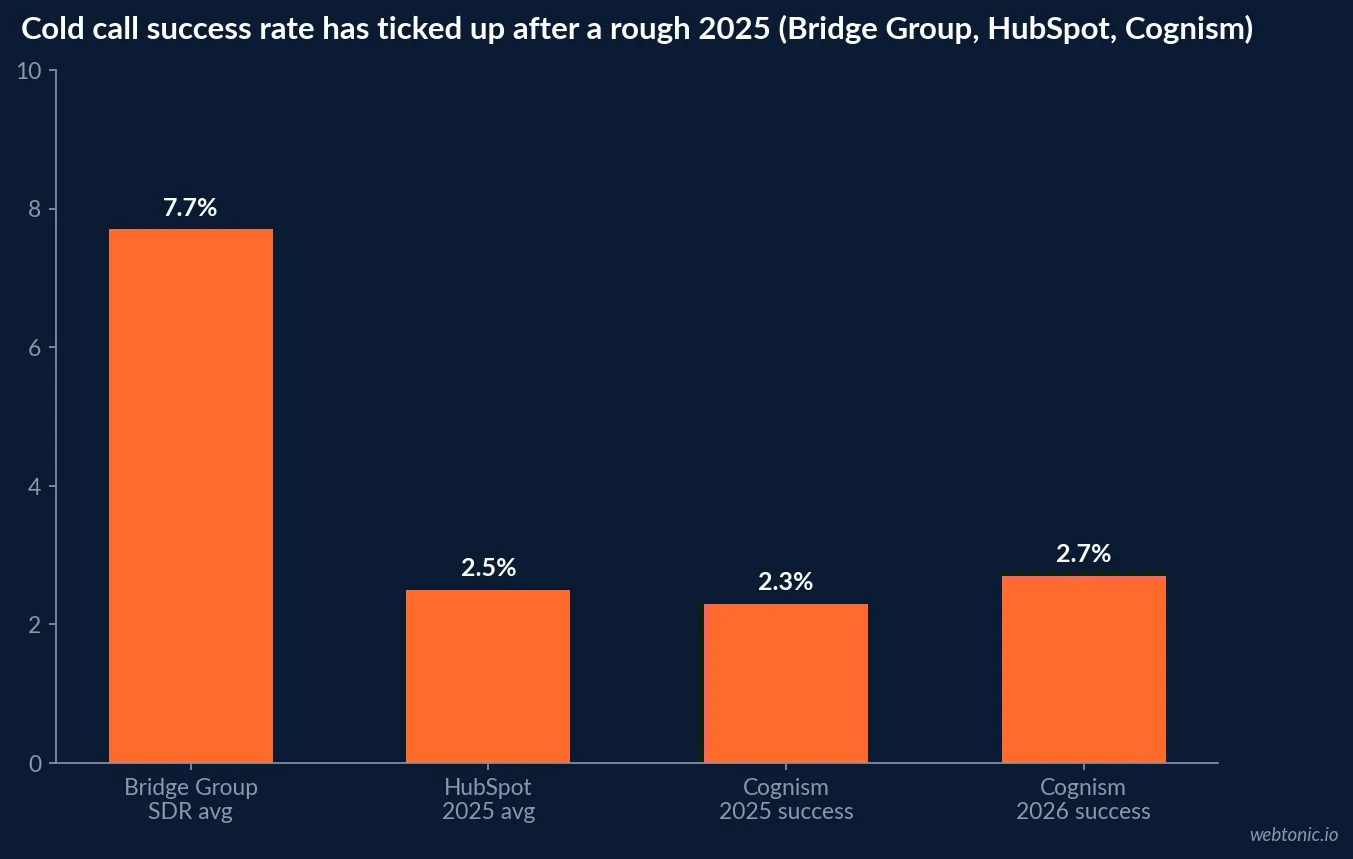
Cold call success rates climbed to 2.7% in 2026, up from 2.3% in 2025, but the metric that actually predicts pipeline is not the success rate on the dashboard. Most sales teams still track total dials, which correlates weakly with revenue and heavily with busywork. This page pulls together 2026 research from Gong, Cognism, The Bridge Group and HubSpot to show which numbers reps should log instead, and why.
Key Takeaways
- Cold call success rate reached 2.7% in 2026, up from 2.3% in 2025.
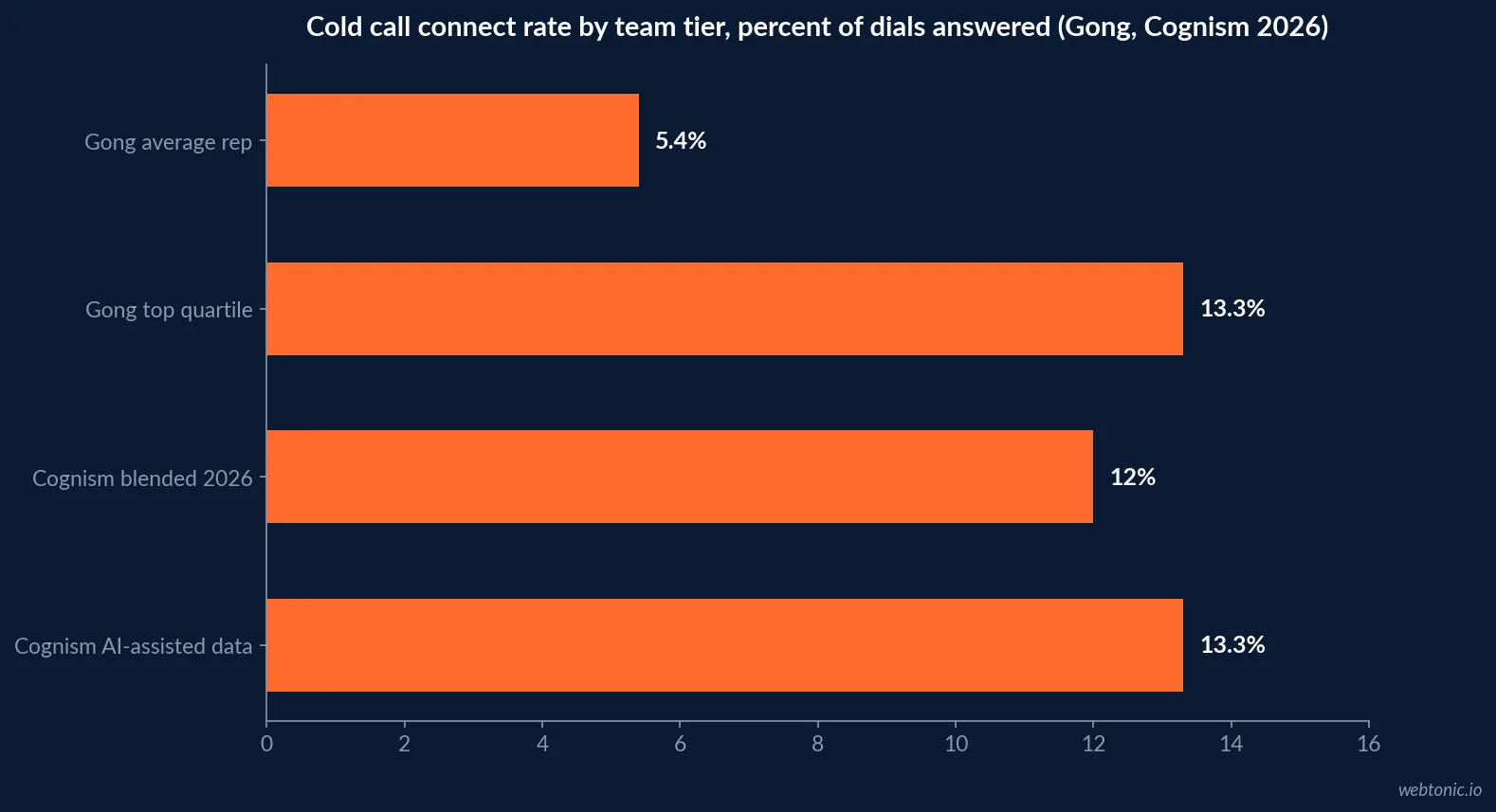
- Average connect rate sits at 5.4% across 300 million analyzed calls.
- Top-quartile reps connect at 13.3%, more than double average.
- Average teams need about 209 to 400 dials per booked meeting.
- Top reps need as few as 50 to 102 dials for the same result.
- The average call-to-meeting set rate is 4.6% once a call connects.
- Top-quartile set rate reaches 16.7% on connected calls.
- AI-verified mobile data lifts answered rates to 13.3%, near warm-lead levels.
- Warm AE calls answer at 14.4% against cold SDR calls.
- The Bridge Group's 2026 study covers 158 B2B companies on AE motion mix.
- HubSpot still logs a 2-3% success band for cold calling generally.
- Tuesday and Wednesday are the strongest booking days per Prospeo's aggregated data.
- Most conversations start within 1.55 dials once a prospect picks up, per Cognism.
- Reply rates on connected AI-assisted calls beat industry average up to 6x.
- Average call duration on a successful call runs about 5:50 against 3:14 on a failed one.
The metric everyone tracks, and the metric that matters
Total dials is the easiest number to put on a dashboard, and it is also the one with the weakest link to revenue. Gong's analysis of 300 million calls found the average rep connecting with just 5.4% of dials, while top-quartile reps hit 13.3%. That gap is not explained by effort. It is explained by list quality, timing and the number a rep is calling from.
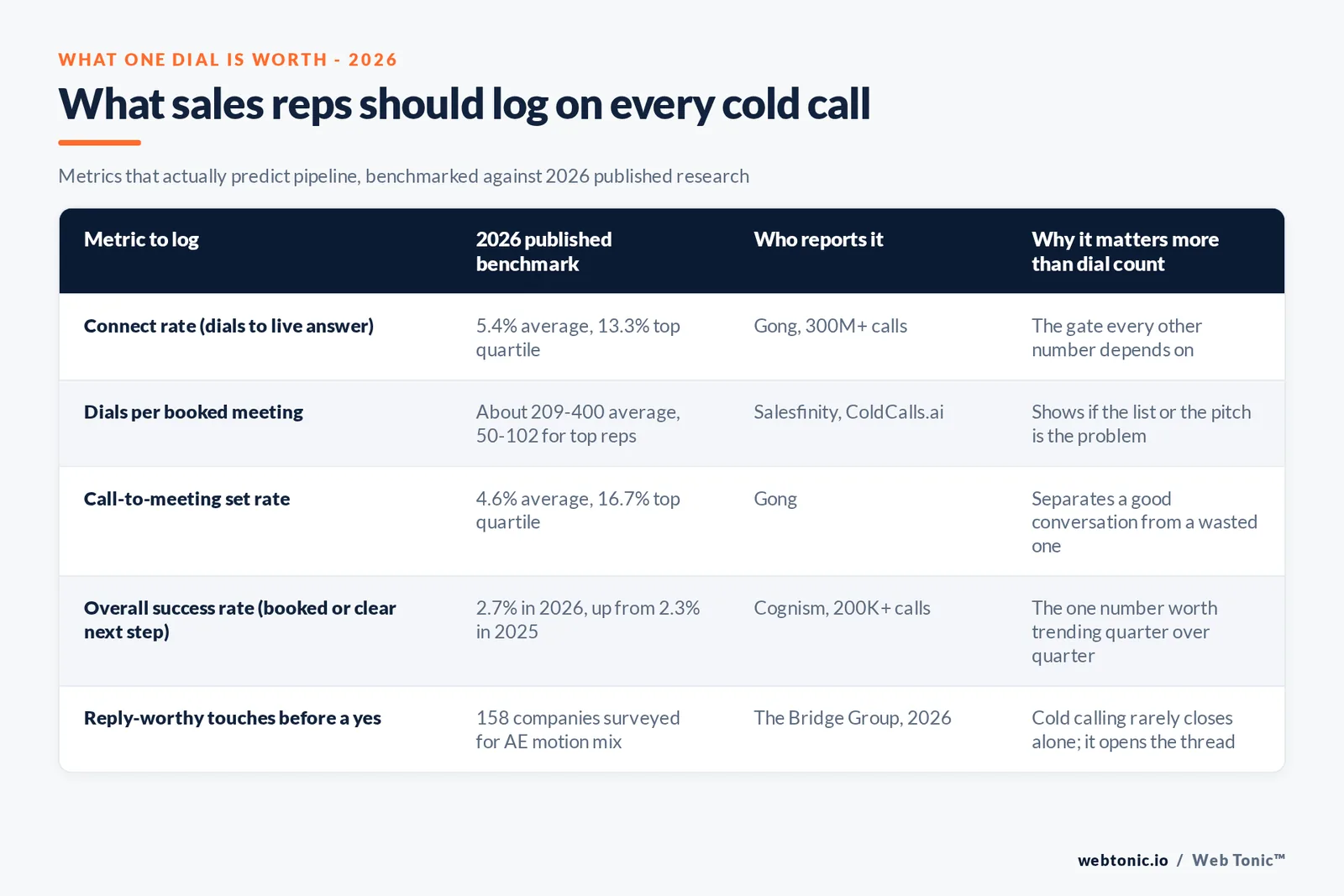
Comparing a rep's raw dial count against a peer's tells you almost nothing. Comparing their connect rate, set rate and success rate side by side tells you exactly where the funnel is breaking.
| Metric | Average team, 2026 | Top-quartile team, 2026 | Source |
|---|---|---|---|
| Connect rate | 5.4% | 13.3% | Gong, 300M+ calls |
| Call-to-meeting set rate | 4.6% | 16.7% | Gong |
| Overall success rate | 2.7% | N/A, blended figure | Cognism, 200K+ calls |
| Dials per booked meeting | 209-400 | 50-102 | Salesfinity, Prospeo, ColdCalls.ai |
| Answered rate, AI-verified data | 12.0% | 13.3% | Cognism State of Outbound 2026 |
Why connect rate is the number that gates every other one
A team cannot set a meeting on a call that never connects, so connect rate functions as a gate on everything downstream. The Bridge Group's 2026 research, covering 158 B2B companies, treats connect rate as a leading indicator worth tracking separately from pipeline metrics precisely because it moves for reasons that have nothing to do with a rep's skill: caller ID reputation, area code matching, and time of day.
Teams that only report success rate at the end of the quarter miss the chance to fix the gate itself. A dip in connect rate this week is a data and dialing problem to solve today, not a coaching conversation to schedule next month.
What dials-per-meeting actually reveals
Dials per booked meeting is the metric most likely to get misread. A high number does not automatically mean a rep is underperforming; it more often means the list is thin. Salesfinity's platform data, drawn from over a million logged dials, found the average team needing 382 dials to book one meeting, while the best team on the same platform needed just 102 and the weakest needed 690. Same tools, same month, radically different lists.
| Data source | Sample size | Avg dials per meeting | Top-team dials per meeting |
|---|---|---|---|
| Salesfinity, 2026 | 1.3M+ dials | 382 | 102 |
| ColdCalls.ai, 2026 | Aggregated platform data | ~400 | ~50 |
| Prospeo, 2026 | 10M+ calls | 209 (1% appt rate) | 50-80 with verified data |
| Martal, 2026 review | Bridge Group cited | 200+ | Not disclosed |
Set rate: the number that separates a good conversation from a wasted one
Once a call connects, the next question is whether the rep can convert that conversation into a meeting. Gong reports an average 4.6% set rate on connected calls, against 16.7% for top-quartile reps - a gap over three times wider than the connect-rate gap. That points to talk track and qualification as the bigger lever once someone actually answers the phone.
Logging connect rate and set rate as two separate lines, rather than one blended success rate, shows a manager exactly which half of the call a rep needs coaching on.
How AI-verified data is closing the gap with warm calling
Cognism's State of Outbound 2026 report found teams using AI-assisted, verified mobile numbers reaching an 13.3% answered rate, nearly matching the 14.4% rate AEs get when calling their own warm leads. Reply rates across both AE and SDR teams in that data set outperformed the broader B2B industry average by up to six times.
The practical read: the biggest single lever left in cold calling in 2026 is not a better script, it is a cleaner, verified number to dial in the first place.
| Call type | Answered rate | Reply rate | Source |
|---|---|---|---|
| AE calling warm leads | 14.4% | 28.38% | Cognism, State of Outbound 2026 |
| SDR cold calling, standard data | 5.4-8% | 8.98% | Gong, Cognism blended |
| SDR cold calling, AI-verified data | 12-13.3% | Up to 6x industry avg | Cognism 2026 |
Timing and duration signals worth tracking
Beyond the core funnel numbers, a few secondary signals are worth a line on the dashboard. Cognism's analysis found most productive conversations starting within 1.55 dials once a prospect answers, and Zendesk's sales statistics roundup notes that reaching the same contact multiple times roughly doubles response rates. A successful call also tends to run longer: about 5:50 on average against 3:14 for a failed one, a gap large enough to flag calls worth a manager's review.
| Timing signal | Figure | What it tells a manager |
|---|---|---|
| Best days to call | Tuesday, Wednesday highest booking rates | Schedule blocks accordingly |
| Best call windows | 11am-12pm and 4-5pm local time | Concentrate dialing time |
| Avg successful call length | 5:50 | A short call is rarely a qualified one |
| Avg failed call length | 3:14 | Early hang-ups signal a weak opener |
| Response lift from repeat contact | ~2x on second or third touch | One dial per prospect undersells the list |
Building this into a weekly scorecard
A workable weekly scorecard needs four rows, not one: connect rate, set rate, dials per meeting and overall success rate, each trended against the prior week rather than judged in isolation. Coaching then targets whichever line moved, instead of a single blended number that hides which stage of the call is actually broken.
Teams building this alongside other outbound channels can pair it with our breakdown of growth marketing execution, and revenue leaders benchmarking pipeline coverage more broadly can start from our paid acquisition strategy guide before layering outbound calling on top.
How team size changes which metric to watch first
The benchmarks above blend teams of very different sizes, and the mix of what matters shifts with headcount. A two-person SDR team with a single shared number pool lives or dies on connect rate, because one bad caller ID reputation sinks the entire operation's ability to book meetings. A 50-person outbound floor can absorb a rough week on connect rate but suffers immediately if set rate drops, since the coaching and QA overhead scales with headcount far faster than list quality problems do.
Salesloft's 2026 US Revenue Benchmark, built with Censuswide from 500 sales and revenue professionals, found reporting cadence itself varying by team size: smaller teams check calling metrics daily out of necessity, while larger teams tend to default to weekly rollups that can mask a single rep's collapsing connect rate for days.
| Team size | First metric to watch | Why it moves fastest here | Reporting cadence that works |
|---|---|---|---|
| 1-5 reps | Connect rate | One bad number pool sinks the whole team's output | Daily |
| 6-20 reps | Set rate | Coaching gaps show up here before connect rate degrades | 2-3x per week |
| 21-50 reps | Dials per meeting variance | Flags which reps need list or script help fastest | Weekly, by rep |
| 50+ reps | Success rate trend, by segment | Aggregate view hides individual collapse otherwise | Weekly, by cohort |
Where cold calling fits against the rest of outbound
None of these numbers argue cold calling should carry a pipeline on its own. The Bridge Group's 2026 research on AE motion mix treats calling as one thread among several, alongside email and social, used to multi-thread an account rather than close it in one conversation. Reading connect rate and set rate correctly is what turns that thread from noise into a repeatable input to the funnel.
If outbound reporting is still built around total activity instead of these funnel metrics, that is usually the first fix worth making before adding headcount or tooling. Talk to us if you want that reporting layer built for your team - see our contact page.
Frequently Asked Questions
What is a good cold call connect rate in 2026?
Gong's analysis of 300 million calls puts the average connect rate at 5.4% and top-quartile reps at 13.3%. Cognism's own outbound team reports a similar 12-13.3% range once AI-assisted verified mobile data is added to the dial list. Anything materially below 5% points at a list quality problem before it points at a rep skill problem.
How many cold calls does it take to book one meeting?
Published figures vary by list quality: ColdCalls.ai and Prospeo both cite roughly 200 to 400 dials per booked meeting for an average team, while top-performing reps on the same platforms need 50 to 102. Salesfinity's platform data lands in the same range: 382 dials for the average team against 102 for the best. The spread between average and top performers is almost entirely list and timing, not raw effort.
Is cold calling still worth doing in 2026?
Cognism's State of Cold Calling report found overall success rates recovering to 2.7% in 2026 from 2.3% in 2025, and HubSpot's own sales research still logs a 2-3% success band. Neither figure is large, but The Bridge Group's 2026 research on 158 B2B companies confirms cold calling still functions as a multi-threading and pipeline-opening motion even where it rarely closes deals on the first conversation.
What should a rep log on every call besides whether it connected?
The call-to-meeting set rate, not just the connect rate: Gong reports an average 4.6% set rate on connected calls against 16.7% for top quartile reps. Logging both numbers separately shows whether a rep's problem is reaching people or converting the conversation once they do.
Does AI-verified contact data actually change the numbers?
Cognism's 2026 outbound report found AI-assisted verified data pushing answered rates to 13.3%, nearly matching the 14.4% rate AEs get calling warm leads, and reply rates across both AE and SDR teams beating the B2B industry average by up to six times. The gap between a cold list and a warm one is closing, but only for teams that invest in the data layer first.
Sources
Gong - The hidden power of cold calling, insights from 300M calls
Cognism - The State of Cold Calling in 2026
Cognism - State of Outbound 2026
Cognism - Is Cold Calling Dead? 2026 data
The Bridge Group - AE Models, Motions & Metrics 2026 Research Report
The Bridge Group - Latest SDR Metrics & Compensation Research
HubSpot - 97 key sales statistics for 2026
Zendesk - 73 important sales statistics
Salesloft - 2026 Revenue Benchmark: US Edition
Outreach - The Icebox, how AI is reshaping cold calling and emailing in 2026