Table of contents

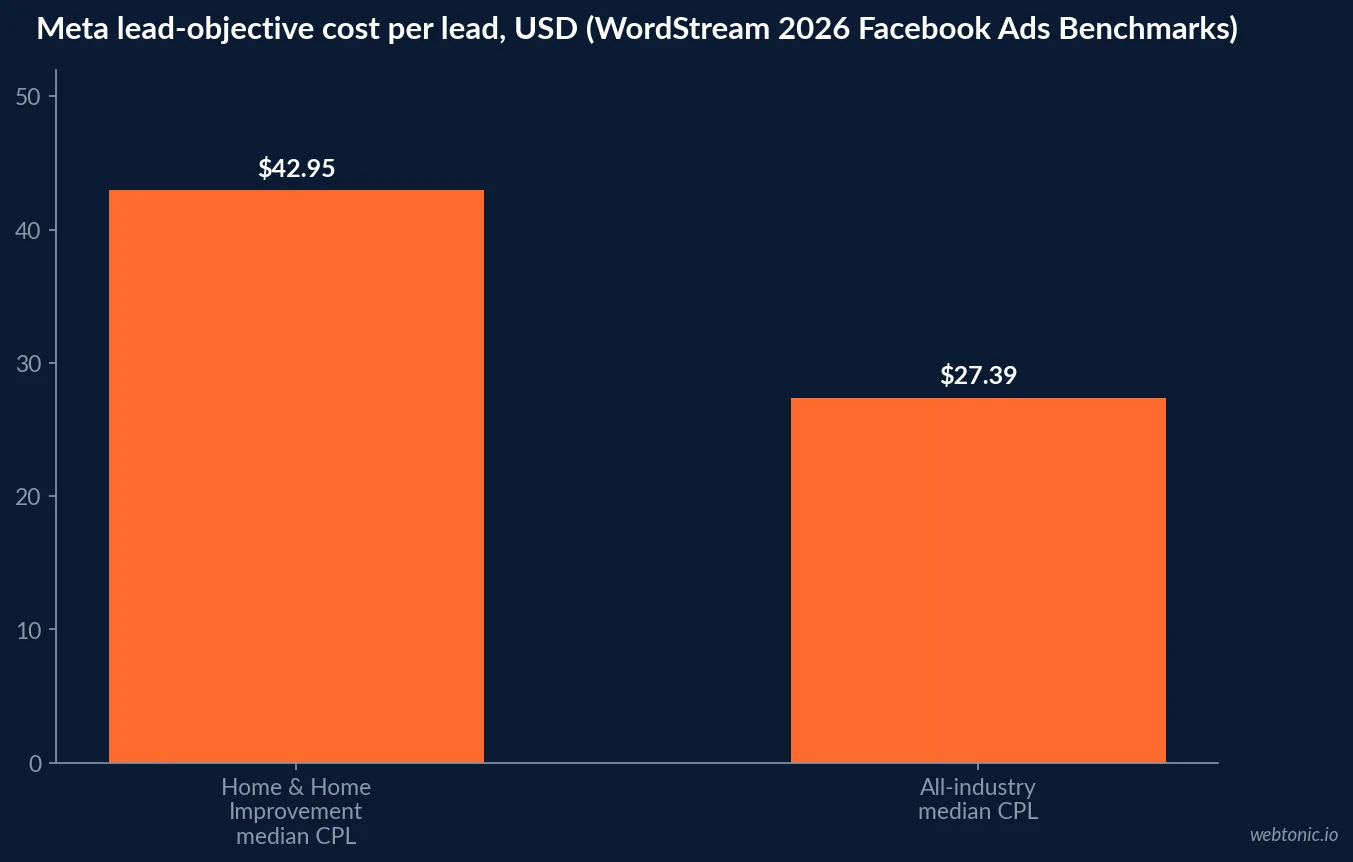
WordStream's newest Facebook Ads Benchmarks report prices a Home & Home Improvement lead at a median $42.95 on Meta - 57% above the $27.39 median across the 14 industries it tracks on the lead objective. This page turns that single number, plus Houzz's own 2026 renovation-spend data, into an actual monthly budget range for a remodeling contractor deciding what Meta Ads should cost.
Key Takeaways
- $42.95 median cost per lead for Home & Home Improvement on Meta in 2026.
- That is 57% above the $27.39 all-industry median lead cost.
- $2.18 median cost per click on lead-objective campaigns, tied with Furniture.
- $0.99 traffic-objective cost per click in 2025, a top-3 industry rate.
- Home & Home Improvement lead conversion rate fell 36% year over year to 5.22%.
- That is roughly 2.5 points below the 7.72% all-industry lead conversion average.
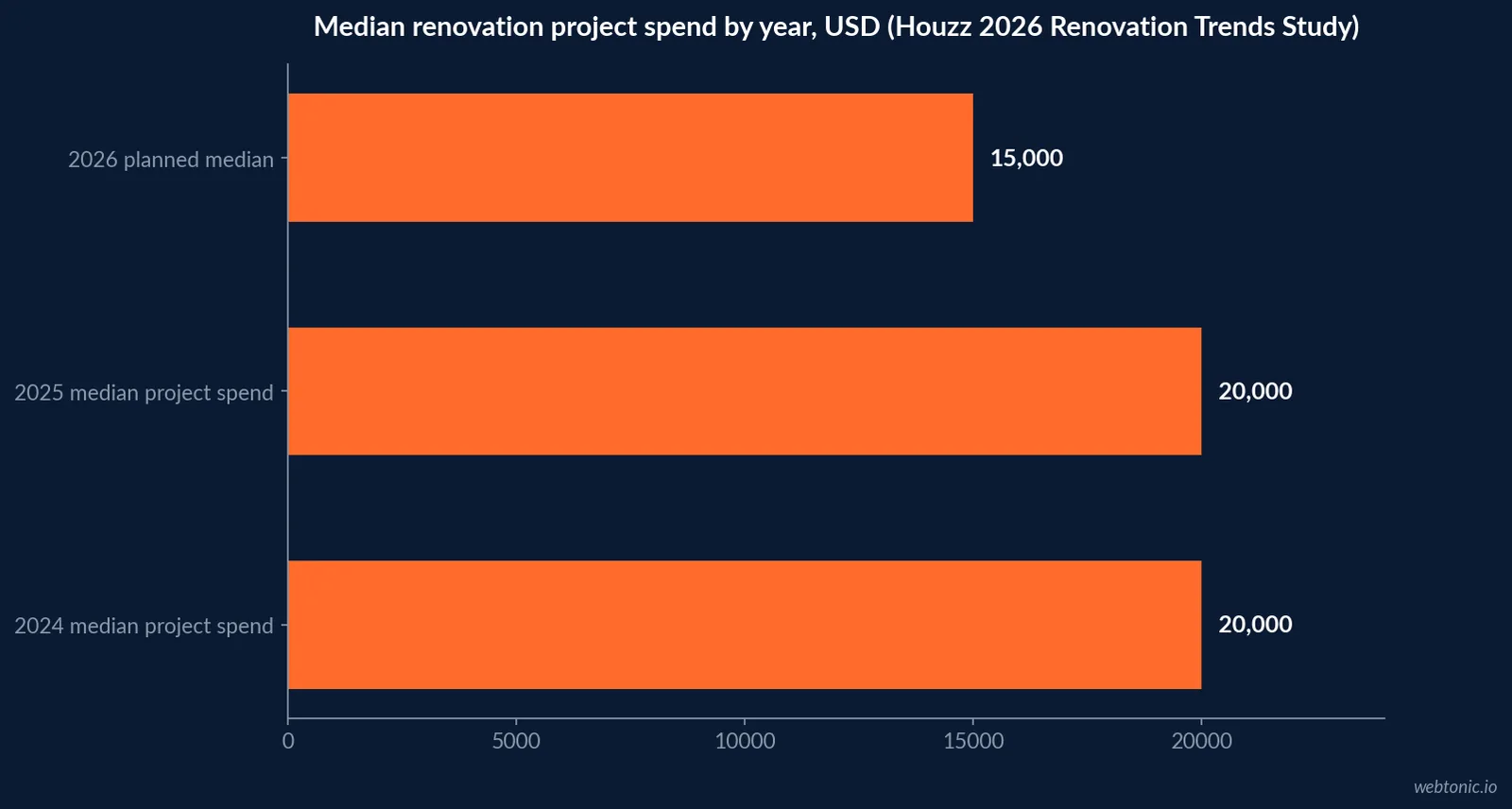
- Median 2025 renovation spend held at $20,000 per Houzz's 2026 study.
- The top 10% of projects reached $150,000 or more, up 7% year over year.
- 2026 planned median spend fell to $15,000, down from $20,000 planned for 2025.
- 37% of homeowners exceeded their renovation budget in 2025.
- The NAHB Remodeling Market Index sat at 61 in Q2 2026, above the 50 break-even mark.
- Harvard's LIRA projects remodeling spend growth slowing to 0.5% by Q2 2027.
- Projected national remodeling spend is near $519 billion through mid-2027.
- 58% of recent pro-hirers did a repair, not a remodel, in the past month (Angi 2026).
- 63% did maintenance work instead of a discretionary renovation.
- A $1,500-$3,000 monthly Meta test buys roughly 35-70 leads at the category median.
The Meta benchmark a remodeling contractor should actually use
WordStream's 2026 Facebook Ads Benchmarks report, built from roughly 1,800 US campaigns across 14 industries on the lead-generation side, is the closest thing to a category-specific number a remodeling contractor gets: it groups home improvement advertisers - remodelers, roofers, window and door installers - under one "Home & Home Improvement" line. That line's median cost per lead is $42.95, against a $27.39 median across every tracked industry, and its median lead-objective cost per click is $2.18, tied with Furniture for the priciest click among the 14 categories.
Nobody publishes a "kitchen remodeler" or "general contractor" line specifically - the closest verified figure is this broader home-improvement category, so treat it as a directional anchor, not an exact quote for your trade.
| Metric (Meta Ads, lead objective) | Home & Home Improvement | All-industry median | Gap | Source |
|---|---|---|---|---|
| Cost per lead | $42.95 | $27.39 | +57% | WordStream 2026 |
| Cost per click | $2.18 | n/a per-industry median stated | Tied 2nd-highest of 14 | WordStream 2026 |
| Traffic-objective CPC (2025) | $0.99 | $0.70 | +41% | WordStream 2025 |
| Lead conversion rate (2025) | 5.22% | 7.72% | -2.5 pts | WordStream 2025 |
| YoY conversion-rate change | -36% | n/a | 3rd-steepest decline tracked | WordStream 2025 |
Why the category's conversion rate fell 36%
The most useful number in the 2025 edition of WordStream's report is not the cost per lead, it is the conversion-rate collapse. Home & Home Improvement's Meta lead conversion rate dropped from a stronger prior-year base to 5.22%, a 36% year-over-year decline - one of the three steepest drops WordStream tracked, alongside Career & Employment and Personal Services.
Angi's 2026 State of Home Spending Pulse explains part of that: 58% of recent pro-hirers completed a repair in the past month and 63% completed maintenance work, both ahead of discretionary renovation. Meta's audience-based targeting is still putting home-improvement ads in front of homeowners, but a bigger share of that audience is fixing something rather than remodeling something, which drags the aggregate conversion rate down without saying anything about your creative or offer.
| Homeowner behavior (Angi, 2026) | Share | What it means for Meta targeting |
|---|---|---|
| Completed a repair in the past month | 58% | Not yet a remodel-ready lead |
| Completed maintenance work | 63% | Budget going to upkeep, not renovation |
| Cited cheaper materials as a reason to act | 59% | Price-sensitive intent signal |
| Cited lower inflation as a reason to act | 54% | Macro-timing, not project-readiness |
| Delayed a project due to an emergency need | 23% | Project got bumped by a repair |
Sizing the budget against the actual job value
Houzz's 2026 U.S. Houzz & Home Renovation Trends Study is the best available source on what a remodeling lead is actually worth once it closes. The median 2025 renovation spend held at $20,000 - the same level as 2024, after peaking at $24,000 in 2023 - while the 90th percentile climbed to $150,000, up 7% from $140,000 the year before. Planned spending for 2026 is more cautious: a $15,000 median, down from a $20,000 median plan for 2025, with the 90th percentile easing to $80,000.
Against a $20,000 median job and a $42.95 median cost per lead, the arithmetic is forgiving even at a low close rate. The real risk is not overpaying for a lead - it is chasing repair-and-maintenance searchers with a remodel-priced offer, which is exactly what the falling conversion rate is describing.
| Renovation spend benchmark (Houzz 2026 study) | 2024 | 2025 | 2026 (planned) |
|---|---|---|---|
| Median project spend | $20,000 | $20,000 | $15,000 |
| 90th percentile spend | $140,000 | $150,000 | $80,000 |
| Homeowners setting an initial budget | n/a | 75% | n/a |
| Homeowners who exceeded that budget | n/a | 37% | n/a |
| Homeowners renovating at all | n/a | 54% | n/a |
What the market backdrop says about timing the spend
Two separate benchmarks describe the same cooling trend from different angles. The NAHB Remodeling Market Index sat at 61 in Q2 2026, down one point from the prior quarter but still solidly above the 50 break-even level, based on a survey of 212 NAHB remodeler members. Harvard's Joint Center for Housing Studies is more cautious: its July 2026 Leading Indicator of Remodeling Activity (LIRA) projects year-over-year growth in home improvement and repair spending slowing to just 0.5% by the second quarter of 2027, with total spending near $519 billion - the third straight quarter of decelerating growth.
Read together, that is a market where demand has not collapsed but is no longer growing on its own. Search volume that used to compound for free now has to be replaced with targeted reach, which is the case for treating Meta as a demand-generation budget line rather than a discretionary add-on.
| Market signal | 2026 reading | Direction | Source |
|---|---|---|---|
| NAHB Remodeling Market Index | 61 (Q2 2026) | Down 1 pt QoQ, above break-even | NAHB |
| JCHS LIRA growth forecast | 0.5% YoY by Q2 2027 | Third straight decelerating quarter | Harvard JCHS |
| Projected remodeling spend through mid-2027 | ~$519B | Flat to slightly down | Harvard JCHS |
| Homeowners renovating in 2025 | 54% | Steady vs. prior year | Houzz 2026 |
| Planned 2026 median renovation spend | $15,000 | Down from $20,000 planned for 2025 | Houzz 2026 |
Four budget tiers, mapped to the $42.95 median
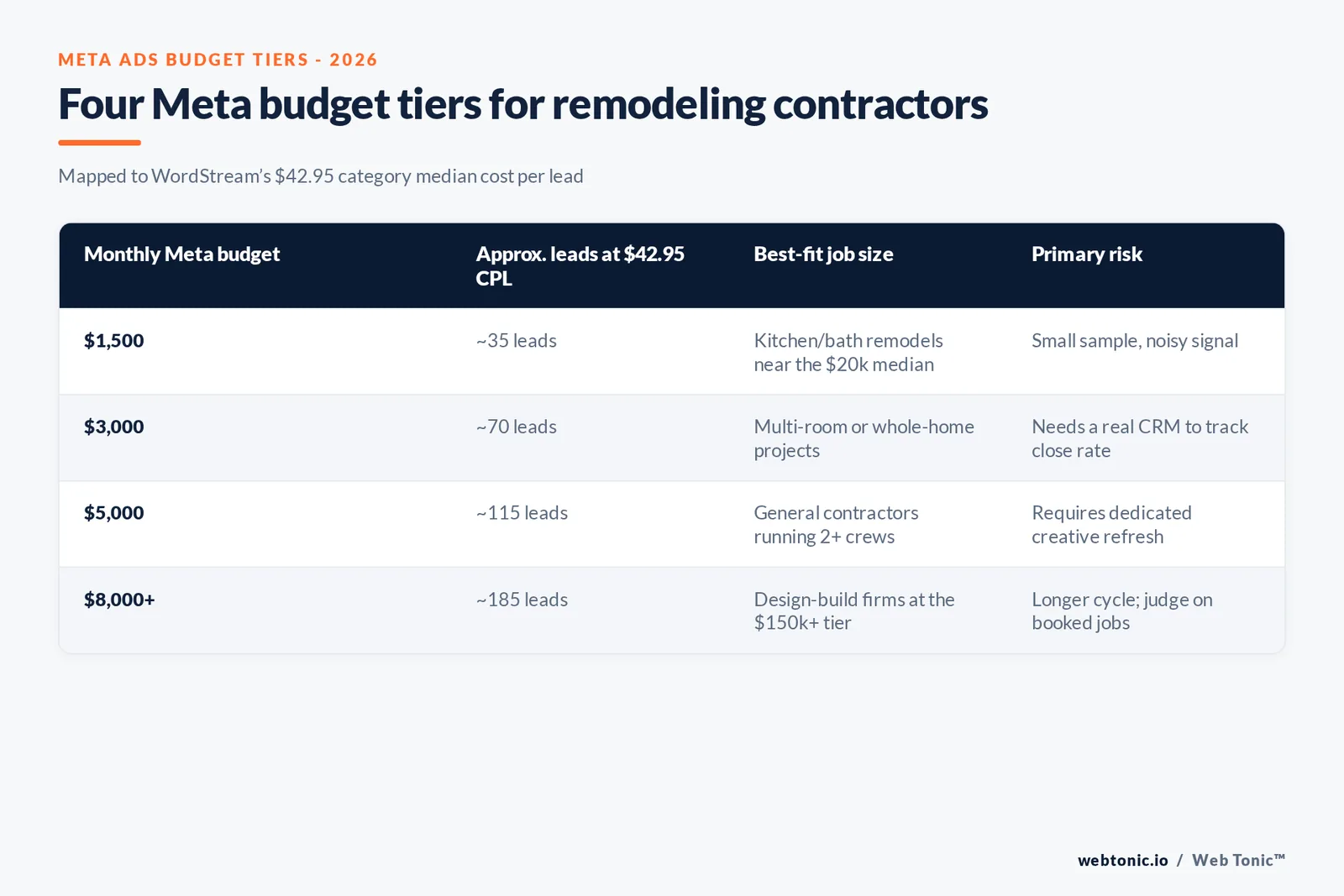
None of this replaces a real test, but it gives a contractor a defensible starting range instead of a guess. At the category median cost per lead, a $1,500 monthly test buys roughly 35 leads before management fees; a $3,000 budget buys roughly 70. For a contractor chasing $20,000-median kitchen and bath jobs, that volume is enough to isolate whether the bottleneck is lead cost or lead quality within 60-90 days - which is the actual decision the budget is meant to answer.
Contractors targeting the $150,000-plus whole-home tier should expect a smaller, more expensive lead pool and budget for a longer sales cycle rather than a lower cost per lead; that tier converts on trust signals - portfolio, reviews, past clients in the same ZIP code - more than on ad spend alone.
| Monthly Meta budget | Approx. leads at $42.95 CPL | Best-fit job size | Primary risk |
|---|---|---|---|
| $1,500 | ~35 | Kitchen/bath remodels near the $20k median | Small sample, noisy signal |
| $3,000 | ~70 | Multi-room or whole-home projects | Needs a real CRM to track close rate |
| $5,000 | ~115 | General contractors running 2+ crews | Requires dedicated creative refresh |
| $8,000+ | ~185 | Design-build firms at the $150k+ tier | Longer cycle; judge on booked jobs, not CPL |
Reading cost per lead against cost per booked job
The single biggest mistake in this category is optimizing to the $42.95 number itself. WordStream's benchmark measures a form fill or a call start, not a signed contract. A contractor converting 1 in 8 leads into a booked $20,000 job is paying roughly $344 in media for that job; a contractor converting 1 in 20 is paying $859 - both can be "on benchmark" for cost per lead while being wildly different businesses. Our performance creative team builds the qualifying questions into the lead form itself so the cost-per-lead number and the cost-per-booked-job number stay close together instead of drifting apart.
If you are still deciding between Meta and Google for that first dollar, our breakdown of when Facebook ads are worth the investment and our Facebook ads pricing breakdown both apply directly to this math.
What to test first on a limited budget
Lead-objective campaigns, not traffic. WordStream's 2025 data showed Home & Home Improvement paying $0.99 per traffic click - a top-3 rate among tracked industries - for a click that still has to convert on your website. A lead-objective ad puts the form in the Meta environment itself, which is the more defensible use of a first $1,500-$3,000 test given the category's already-elevated click cost.
Second, segment creative by project type rather than running one generic "get a free quote" ad. Given that 58-63% of the audience is currently in repair-or-maintenance mode per Angi's data, a remodeling contractor that speaks directly to "planning a kitchen remodel in the next 6 months" filters for project-ready intent before the lead ever reaches a phone call. Book a strategy call with our team to size a test budget against your own job mix and market.
Frequently Asked Questions
What does a Meta Ads lead cost for a remodeling contractor?
WordStream's 2026 Facebook Ads Benchmarks report puts the median cost per lead for the Home & Home Improvement category at $42.95, against a $27.39 median across all 14 tracked industries. Lead-objective cost per click sits at $2.18, tied with Furniture. A remodeling contractor should treat $42.95 as a starting median, not a ceiling - kitchen and whole-home jobs with a five-figure ticket can absorb a higher cost per lead than a $400 gutter cleanout can.
How much should a remodeling contractor budget for Meta Ads per month?
Work backward from the job size you want to fill. Houzz's 2026 Renovation Trends Study puts the median 2025 renovation spend at $20,000, with the top 10% of projects at $150,000 or more. At a $42.95 median cost per lead and a realistic 10-20% lead-to-booked-job rate for a considered purchase like a remodel, landing 4-6 qualified leads a month runs roughly $170-$260 in media spend alone, before agency management or creative production - so most contractors we work with start a Meta test at $1,500-$3,000 a month and scale once cost per booked job, not cost per lead, is proven.
Is Meta Ads worth it if renovation spending is slowing down?
Harvard's Joint Center for Housing Studies projects home improvement and repair spending growth slowing to just 0.5% year over year by the second quarter of 2027, with total spending near $519 billion. A cooling market is exactly when paid social earns its keep: the NAHB Remodeling Market Index was still at 61 in Q2 2026 - solidly above the 50 break-even line - which means demand exists, it is just being fought over by fewer active buyers per lead. Meta's targeting lets a contractor reach homeowners by home value, age of home and life stage rather than waiting for search volume that is no longer growing.
Why did conversion rates for Home & Home Improvement drop on Meta?
WordStream's 2025 benchmarks (based on 1,180 campaigns run between April 2024 and June 2025) showed the Home & Home Improvement category's lead conversion rate falling 36% year over year to 5.22%, one of the three steepest declines WordStream tracked. That decline lines up with Angi's 2026 data showing homeowners prioritizing repairs and maintenance (58% and 63% respectively) over discretionary remodels - the same ad spend is reaching more window-shoppers and fewer homeowners ready to sign a contract.
Should a remodeling contractor budget for traffic campaigns or lead campaigns on Meta?
Lead campaigns, for most remodeling budgets. WordStream's 2025 data put Home & Home Improvement traffic clicks at $0.99, among the three most expensive traffic categories it tracks, while a lead-objective campaign puts a phone number or form directly in front of the click. A remodeling job is rarely bought on the first visit, so paying a premium for a click that still needs to convert on your website is a harder case to make than paying for a form fill Meta already optimized toward.
Sources
PPC Land - WordStream's 2026 Facebook Ads Benchmarks, reported
WordStream - Facebook Ads Benchmarks 2025
Houzz - 2026 U.S. Houzz and Home Renovation Trends Study
NAHB - Remodeling Market Index, Q2 2026 full report
Harvard Joint Center for Housing Studies - Leading Indicator of Remodeling Activity, July 2026
Angi - 2026 State of Home Spending Pulse Report