Table of contents
A business directory listing is your company's record on a third-party site that catalogues businesses — name, address, phone number, website URL, categories and hours. The entries that earn traffic are the accurate, maintained ones, not the most numerous.
Key Takeaways
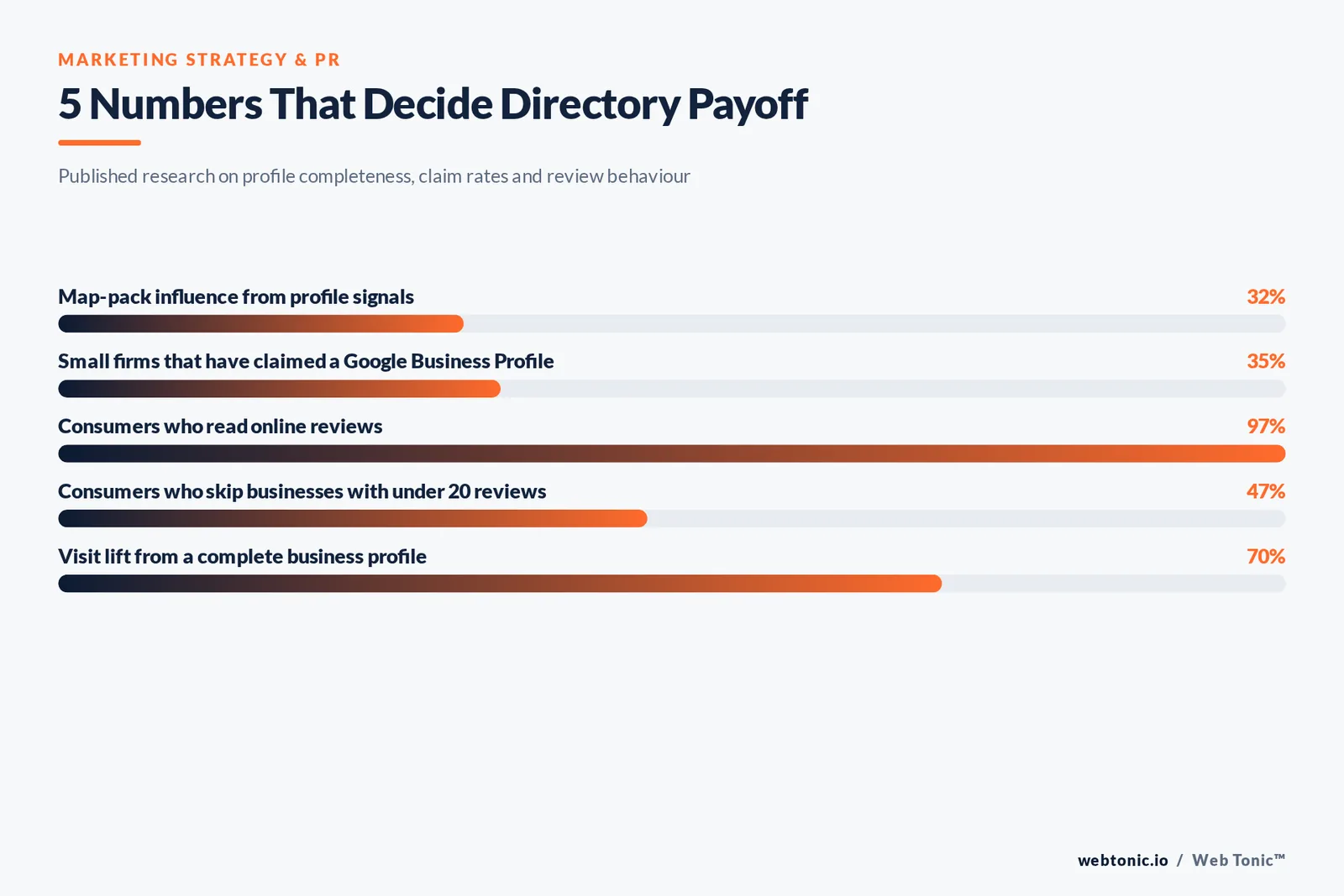
- Google Business Profile is the single highest-value record you own: profile signals account for roughly 32% of map-pack influence.
- Yet only 35% of small firms have claimed one, and only 40% of them run a dedicated website.
- 97% of consumers read reviews, and 47% will not use a business with fewer than 20 of them.
- A complete business profile makes a company appear 2.7x more reputable and lifts visits by about 70%, per Google.
- 8-12 well-maintained directory entries beat 200 auto-submitted ones; duplicates and stale phone numbers actively cost visibility.
What such a record actually contains
Definition: it is a structured entry about one company held on a third-party catalogue site, organised by category and location. Business directories predate the web as printed trade registers; the online versions add search, reviews and map data. If you want the wider view of the format, our guide to how business directories work covers the landscape; this page is about the listing itself and how to run it.
Every directory asks for a variation of the same fields. Treating them as one canonical record — not as separate forms filled in from memory — is the whole discipline.
| Field | Rule | Common error |
|---|---|---|
| Trading name | Exactly as it appears on signage and legal documents | Keyword stuffing: "Acme Plumbing - Best Plumber San Francisco" |
| Address | One format, including suite number | "Ste 4" on one directory, "Suite #4" on another |
| Phone number | A local number that rings a human | A tracking line that varies per entry |
| Website URL | Canonical HTTPS version, no stray tracking parameters | Linking a dead campaign landing page |
| Primary category | The single closest match to your core service | Choosing a broad category to "cover more" |
| Products and services | Named the way customers say them | Internal product codes |
| Hours | Updated for holidays | Left at the 2021 pandemic hours |
| Photos | Real premises, team and work | Stock imagery only |
Rule 1 — write the canonical record once, in a spreadsheet, with all 8 fields above, and paste from it every single time. Every listing built from memory is a future inconsistency.
Which platforms are worth your time
Value is concentrated. A short list of general platforms feeds most maps, voice assistants and AI answer engines; everything past that is a long tail with sharply diminishing returns.
| Directory | Type | Cost | Why it earns a slot |
|---|---|---|---|
| Google Business Profile | Search and maps | Free | Powers the local pack and Google Maps; non-negotiable |
| Apple Business Connect | Maps | Free | Apple Maps rose from 14% to 27% as a review source |
| Bing Places | Search and maps | Free | Feeds Bing and several AI assistants; 8.6% US search share |
| Better Business Bureau | Trust and accreditation | No-cost profile, paid accreditation | Dispute record and trust signal for high-ticket services |
| Local chamber of commerce | Civic membership | Paid membership | Genuinely curated, regionally tied, often a followed link |
| Facebook Page | Social business profile | Free | Doubles as a review surface and messaging channel |
| Foursquare / Places data | Data aggregator | Free | Syndicates coordinates to dozens of downstream apps |
| Industry association register | Vertical | Membership | Highest-intent traffic per visitor of any directory type |
Limit 1 — start with these 8, verify each one, then stop until they are all complete. Getting your Business Profile claimed and verified is worth more than the next fifty submissions combined.
Location-specific and regional records
Metro and state-level directories are where a small business can still outrank a national brand, because the competition is thin and the editorial standard is human. Search patterns follow the same logic everywhere — the example rows below use San Francisco, Florida and London, but the categories transfer to any market.
| Market | Listing type to prioritise | How to find it |
|---|---|---|
| San Francisco | City chamber, neighbourhood merchant associations, SF business portal | Search the city name plus "chamber of commerce" and "merchants association" |
| Florida (statewide) | State business registry, county chambers, tourism boards | State corporations division plus county-level chambers |
| London | Borough business networks, trade bodies, high-street guides | Borough council business pages and BID directories |
| Any small town | Local newspaper business guide, library business register | Ask the librarian — public libraries maintain business lists |
Fact 1 — community news sites fell from 48% to 29% as a consumer review source while generative AI assistants jumped from 6% to 45%, which means directory records now feed AI answers as much as it feeds human browsing. The US Chamber of Commerce resources library and your own state registration record — start from the SBA guide to registering a business — are the two cheapest authoritative records to get right.
Industry and niche registers
Vertical directories convert better than general ones because the visitor has already self-selected. They are also the ones competitors forget.
| Sector | Directory shape | What the listing must show |
|---|---|---|
| Commercial real estate | Broker and listing platforms, tenant rep registers | Licence number, submarket coverage, asset classes |
| Legal services | Bar association referral registers | Jurisdiction, practice areas, admission year |
| Home services | Trade licence registers, manufacturer installer finders | Licence, insurance, certified product lines |
| Healthcare | Insurer provider networks, specialty boards | Credentials, accepted plans, accessibility |
| B2B software and agencies | Vendor marketplaces, partner ecosystems | Verified integrations, named client outcomes |
| Restaurants and retail | Delivery platforms, tourism guides, event calendars | Menu or catalogue, hours, real photography |
Rule 2 — a niche register earns its place if you can answer yes to 2 questions: does it require some proof of credential to join, and does it rank for a term a buyer would type? If both are no, it is a link farm with a nicer template.
Paid tiers: when they pay back
Most no-cost options are worth doing and most paid ones are not. The test is whether the payment buys distribution, curation or a genuine audience — or simply a badge.
| Tier | Typical annual cost | Worth paying when | Skip when |
|---|---|---|---|
| General platforms | $0 | Always — Google, Apple, Bing, Facebook first | Never skip |
| Chamber membership | $200-$800 | You sell in one metro and attend events | You serve one national niche remotely |
| Industry association | $300-$2,500 | Buyers check credentials before calling | Membership is open to anyone who pays |
| Featured or premium placement | $500-$5,000 | The directory already sends you tracked leads | You have no baseline traffic without paying |
| Bulk submission vendors | $100-$1,000 | Rarely — only for aggregator cleanup | The pitch is "500 directories in 24 hours" |
Fact 2 — the sequence that works is no-cost first, measure for 90 days, then pay only where the unpaid version already produced tracked calls or form fills. Anything else is buying hope.
Human-curated versus automated submissions
Automated submission tools create volume; curated directories create trust. They fail in opposite ways, and knowing which you are dealing with tells you how much effort the listing deserves.
| Dimension | Human-curated | Automated / bulk-submitted |
|---|---|---|
| Entry barrier | Review, credential or membership | Form submission, no checks |
| Accuracy over time | Corrected by an editor | Frozen at submission, then drifts |
| Duplicate risk | Low | High — the main source of duplicate listings |
| Referral traffic | Small but qualified | Effectively zero |
| Search engine treatment | Treated as a legitimate citation | Often ignored or discounted |
| Cleanup cost later | None | Hours of duplicate suppression per location |
Limit 2 — bulk services are the reason a single business ends up with 3 or 4 conflicting contact details scattered across the web. Moz's primer on local citations and the BBB's consumer-trust research both point the same direction: consistency and verifiability beat coverage.
How to create and optimise one, step by step
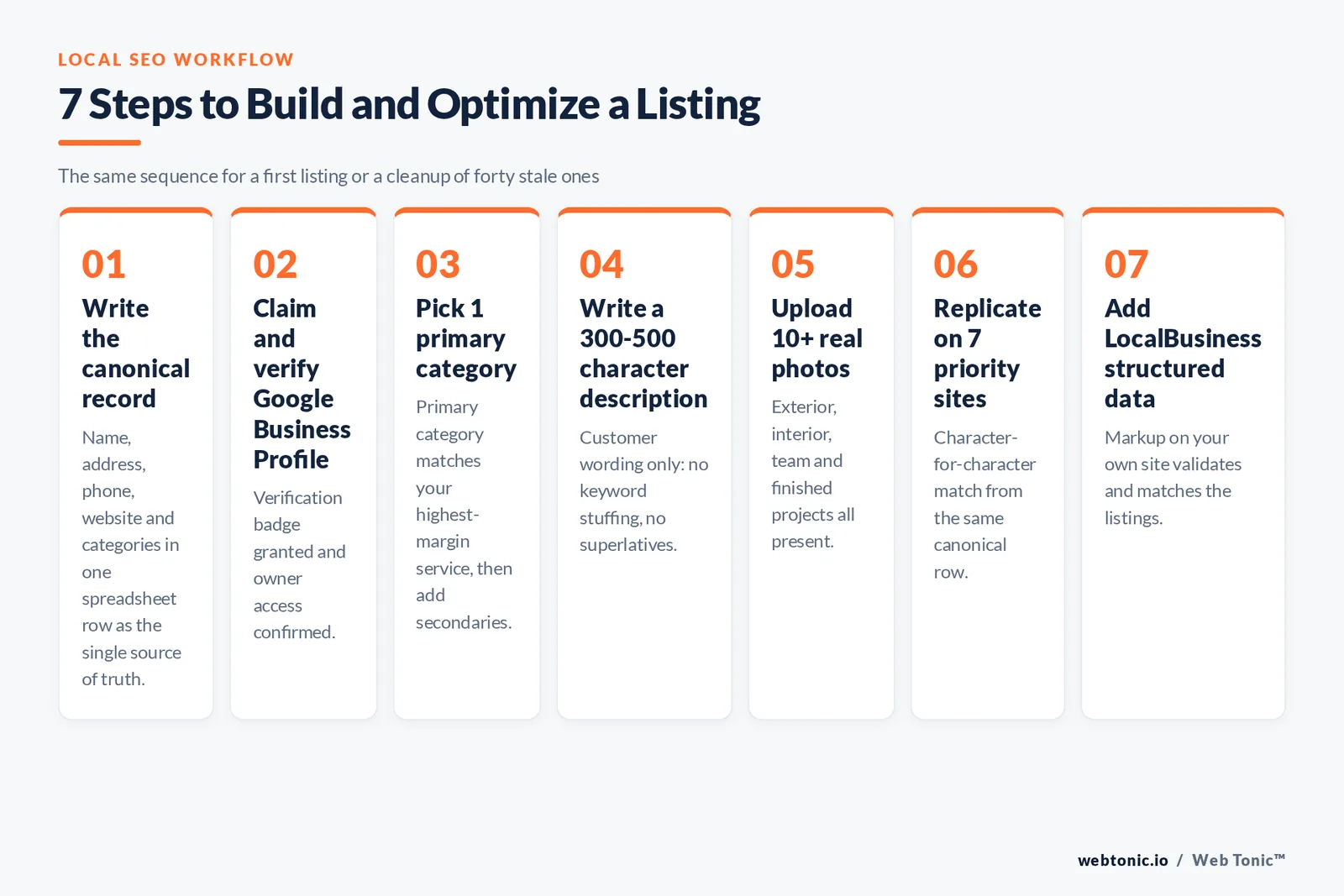
The same seven steps apply whether you are listing a business for the first time or fixing forty stale ones.
| Step | Action | Done when |
|---|---|---|
| Step 1 | Write the canonical record: name, address, phone number, website URL, categories | One spreadsheet row is the single source of truth |
| Step 2 | Claim or create the Google Business Profile and verify | Verification badge granted, owner access confirmed |
| Step 3 | Pick 1 primary category, then secondary categories | Primary matches your highest-margin service |
| Step 4 | Write a 300-500 character description using customer wording | No keyword stuffing, no superlatives |
| Step 5 | Upload 10+ real photos and list products and services | Exterior, interior, team, finished projects all present |
| Step 6 | Replicate across the other 7 priority sites from the same row | Character-for-character match everywhere |
| Step 7 | Add LocalBusiness structured data to your own site | Markup validates and matches the listings |
Fact 3 — Google's guidelines for representing your business require the name to reflect real-world signage, and adding a keyword to it is a suspension risk — not a ranking tactic. Mirror the same data on your own site with LocalBusiness structured data so search engines can reconcile the two.

The citation consistency audit
Entry quality is measured by agreement. When directories disagree about your contact line, search engines have to guess which record is current — and guessing costs you the map pack place.
| Inconsistency | Why it happens | Fix | Priority |
|---|---|---|---|
| Duplicate entries | Bulk submissions, office moves, franchise churn | Claim both, merge or request removal of the weaker one | Highest |
| Stale telephone line | Call-tracking numbers pushed into directories | One primary line everywhere; tracking on your site only | Highest |
| Street formatting drift | Different forms filled by different staff | Copy the canonical row, including suite format | High |
| Closed location still live | Nobody marks closures | Mark permanently closed, never delete the listing | High |
| Category mismatch | Directory taxonomies differ | Map each directory's nearest equivalent once, document it | Medium |
| Broken website URL | Site migration without a listing update | Re-point to the canonical HTTPS URL | Medium |
Rule 3 — audit every entry twice a year and immediately after any move, rebrand or website migration. Budget roughly 2 hours per location per audit; it is the cheapest visibility work available.
How these records affect local SEO and Google Maps
Directory listings are not a ranking cheat code. They do three specific jobs: they confirm that the business exists, they distribute what maps and assistants read, and a curated few send referral traffic.
| Mechanism | Effect on search engines | What actually moves it |
|---|---|---|
| Entity confirmation | Corroborates name, address and telephone | Consistency, not volume |
| Map pack visibility | Profile completeness and proximity dominate | Categories, reviews, hours, photos |
| Google Maps presence | Coordinates pulled from your verified profile | Verification plus accurate pin placement |
| Organic link value | Minor; most directory links are nofollow | Editorial links from local media instead |
| AI and assistant answers | Assistants read aggregator and profile records | Structured data plus clean listings |
Fact 4 — profile-based signals make up about 32% of map pack influence in Whitespark's local search ranking factors survey, while 36% of SEOs name on-page work as their top organic factor. Google's own tips to improve local ranking reduce to relevance, distance and prominence. For the wider tactical picture, see our guide to hyperlocal marketing and align the wording with your SEO keyword set.
Measuring whether an entry earns its place
| Metric | Where to read it | Keep it if |
|---|---|---|
| Profile views and searches | Profile performance report | Views trend up quarter over quarter |
| Calls and direction requests | Profile insights, call logs | Any tracked call volume at all |
| Referral sessions | Analytics referral report | 10+ sessions a quarter from that domain |
| Review volume and recency | Each directory's review tab | Reviews arrive within the last 3 months |
| Record accuracy | Twice-yearly audit | Record matches the canonical row exactly |
Fact 5 — review recency is decisive: 74% of consumers only value reviews from the last three months and 68% require at least a 4-star rating, so an entry with a dormant review feed is a liability. Google's guidance on getting more reviews is the correct starting point — 85% of consumers are more likely to use a business after reading positive reviews. Retail and service brands can extend this with the tactics in Shopify's local marketing playbook.

Five mistakes to avoid
| Trap | Cost | Fix |
|---|---|---|
| Trap 1 — 500 entries in a week | Duplicates and drift on every aggregator feed | 8-12 listings, maintained by hand |
| Trap 2 — keywords in the business name | Suspension risk on Google | Real-world name only |
| Trap 3 — unique tracking line per directory | Fragmented contact records | One primary line; track on-site instead |
| Trap 4 — set and forget | Wrong hours and dead URLs for years | Calendar 2 audits a year |
| Trap 5 — ignoring reviews on secondary profiles | Unanswered complaints rank for your brand | Reply on every platform that allows it |
If you run more than one location, the audit becomes an operations problem rather than a promotional task — our growth marketing team handles multi-location cleanups, and you can send us your locations for a duplicate check.
FAQ
What are the best free business directories to list my company?
Google Business Profile first, then Apple Business Connect, Bing Places, your Facebook Page, the Better Business Bureau and a Foursquare places record. Those six cost nothing and feed most maps, assistants and AI answer tools.
How many business directory listings do I need?
Eight to twelve accurate listings covering the major search and map platforms plus your chamber and one industry register. Beyond that, additional listings rarely produce measurable traffic and increase the risk of duplicates.
Do business directory listings still help SEO?
Indirectly. They corroborate your name, address and telephone, and they feed the data that Google Maps and AI assistants read. Most directory links are nofollow, so treat them as a hygiene task rather than a link building tactic.
How do human-curated directories differ from automated ones?
Curated sites check credentials before publishing and correct data over time, so search engines treat their records as legitimate citations. Automated bulk submissions freeze your data at submission and are the leading cause of duplicate records.
Are there location-specific business directories worth using?
Yes. City chambers of commerce, county business registers, borough business networks and public library business lists are curated, regionally relevant and far less competitive than national platforms.
Sources
Google Business Profile Help — Add or claim your Business Profile; Guidelines for representing your business on Google; Tips to improve your local ranking on Google; Tips to get more reviews. Google Search Central — LocalBusiness structured data. Whitespark — Local Search Ranking Factors. BrightLocal — Local Consumer Review Survey 2026. Moz — Local Citations. Better Business Bureau — consumer trust research. US Small Business Administration — Register your business. US Chamber of Commerce — marketing library. Wikipedia — Business directory. Shopify — local marketing. Accessed August 2026.