Table of contents

A business directory is an online or printed listing that records a company's name, address, phone number, website and category so customers — and search engines — can find and verify it. The useful ones send referrals and confirm your details; the rest are link farms wearing a directory costume.
Key Takeaways
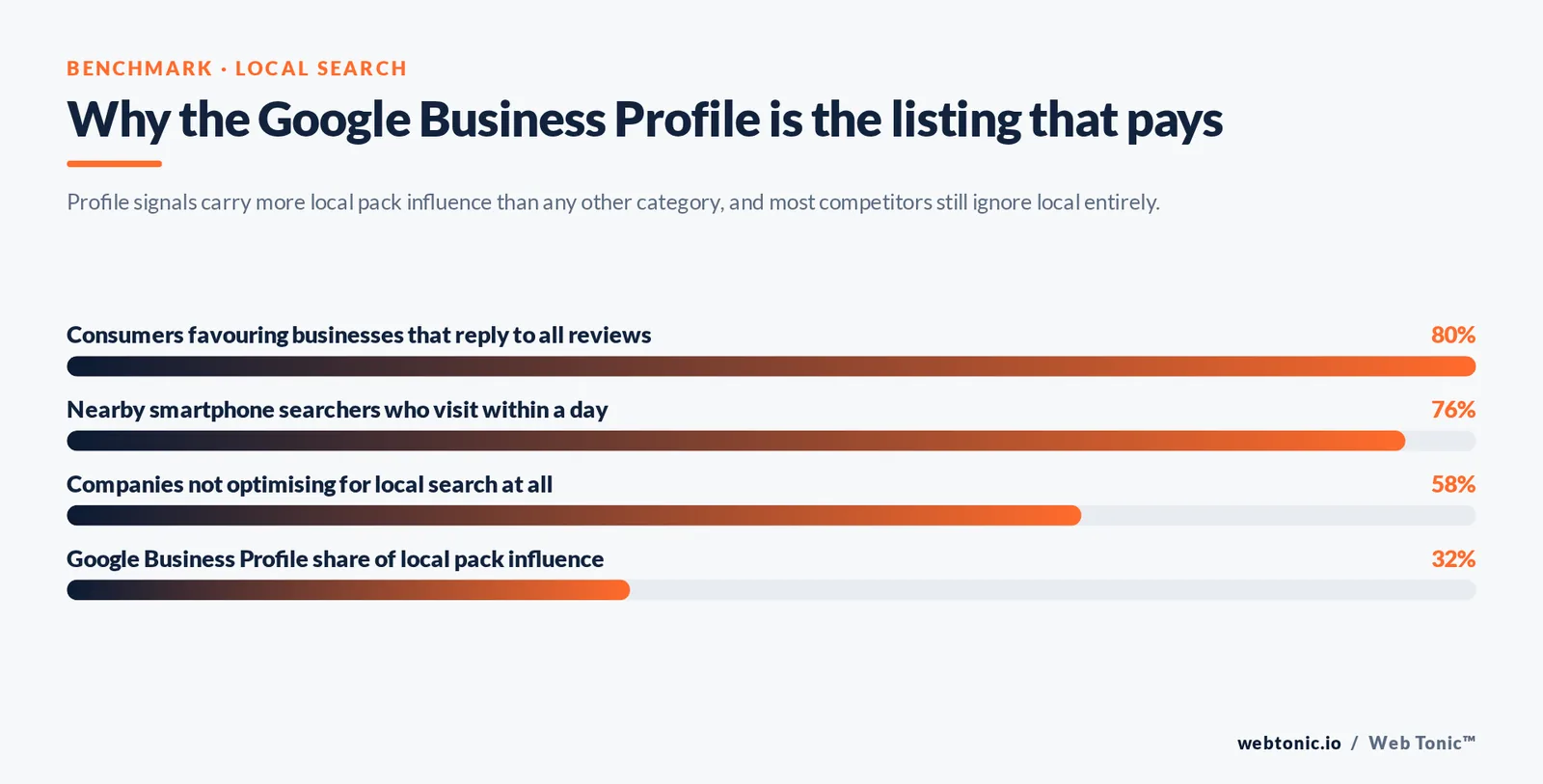
- Google Business Profile signals account for 32% of local pack ranking influence, making the profile the single most important listing you will ever create.
- Customers are 2.7x more likely to consider a business reputable when they find a complete Business Profile on Google Search and Maps.
- A complete profile makes customers 70% more likely to visit and 50% more likely to consider a purchase.
- 76% of people who search on a smartphone for something nearby visit a business within a day, and 28% of those searches end in a purchase.
- 58% of companies still do not optimise for local search at all — the bar to beat in most categories is low.
- 80% of consumers say they are likely to use a business that responds to all of its reviews, so directory listings are reputation assets, not just data records.
- Link rot is the reason listings need maintenance: 66.5% of links created over the last nine years are already dead.
- Only 10.6% of backlinks to the top 110,000 websites are nofollow, but the majority of directory links are — treat them as citations, not link equity.
- 36% of SEO practitioners consider on-page the most important factor for local organic results, meaning directories support your site rather than replace it.
- Google holds a 90%+ global search share, so directories that feed Google's ecosystem matter more than those that do not.
What a business directory actually is
Directories predate the web by a century. Telephone books, chamber of commerce rolls and trade registers all did the same job: collect verified business details in one place and organise them by category and city. The online versions inherited the structure and added reviews, photos, hours, service areas and structured data that search engines can read.
Functionally, a modern directory listing does four things. It makes you discoverable to someone browsing a category. It provides a citation — an independent mention of your name, address and phone number — that search engines cross-reference against your website. It hosts reviews and photos that influence a decision before anyone reaches your site. And it feeds data into larger ecosystems: many niche directories and apps ultimately pull from a handful of primary data sources.
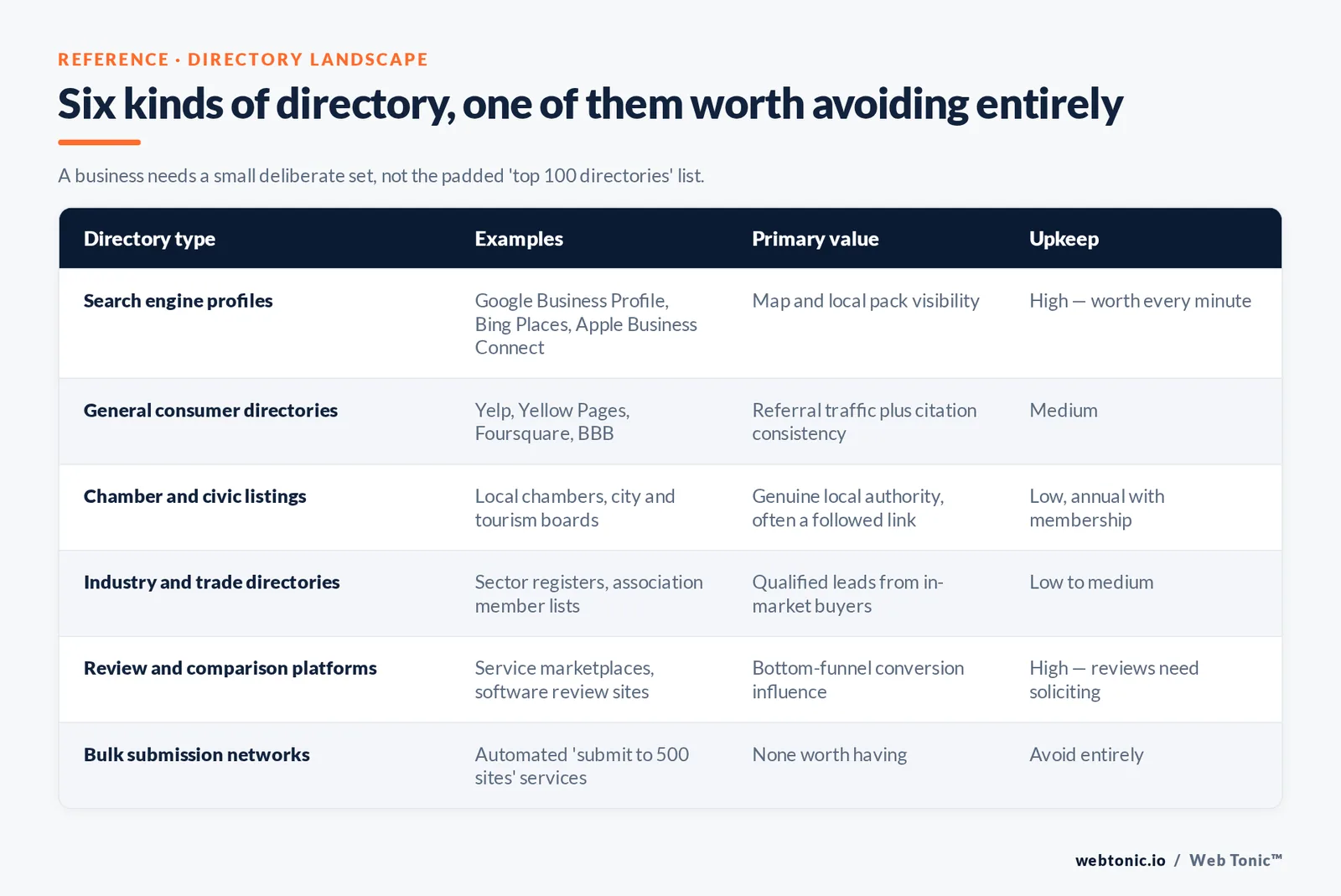
| Directory type | What it covers | Primary value | Effort to maintain |
|---|---|---|---|
| Search engine profiles | Google Business Profile, Bing Places, Apple Business Connect | Direct map and local pack visibility | High — worth every minute |
| General consumer directories | Yelp, Yellow Pages, Foursquare, Better Business Bureau | Referral traffic plus citation consistency | Medium |
| Chamber and civic listings | Local chambers of commerce, city and tourism boards | Genuine local authority and often a followed link | Low, usually annual with membership |
| Industry and trade directories | Sector registers, association member lists, B2B marketplaces | Qualified leads from buyers already in-market | Low to medium |
| Review and comparison platforms | Service marketplaces, software review sites, agency indexes | Bottom-funnel conversion influence | High — reviews need soliciting |
| Research and historical registers | Company databases, library business collections, archives | Due diligence and market research, not marketing | None — you use them, not list on them |
| Bulk submission directories | Automated "submit to 500 sites" networks | None worth having | Avoid entirely |
The directories that are actually worth your time
Nearly every "top 100 directories" list is padded. In practice a business needs a small, deliberate set: the search engine profiles, two or three general consumer platforms, the local civic listings, and whatever trade register your buyers genuinely use.
Google Business Profile comes first and is not negotiable. Whitespark's local search ranking factors survey attributes 32% of local pack ranking influence to profile signals — more than any other category. Google's own help documentation on how to improve local ranking stresses relevance, distance and prominence, and its guidance for entering business information explains why the exact category and address format matter.
Bing Places takes minutes and covers the second-largest engine plus assorted downstream products; the Bing Webmaster toolset is worth claiming at the same time. Apple Business Connect matters for anyone whose customers use Apple Maps for navigation, which in the US is a large share of iPhone users.
For general consumer visibility, the Better Business Bureau still carries trust weight in the US, particularly in home services and finance, while Foursquare remains a location data source feeding a long list of apps. Civic listings are underrated: a local chamber directory or the national Chamber of Commerce index gives you a genuinely local, human-curated mention, and the US Chamber's small business resources point to the state and city equivalents.
For B2B, Crunchbase and the relevant trade association register do more than a hundred generic submissions. And if your goal is research rather than marketing, the Library of Congress company research guides catalogue historical and current business directories — the correct tool for tracing a company's history, ownership or a defunct trade name.
How directories affect SEO — and how they don't
This is where most advice goes wrong in one of two directions. Directories are not a link building strategy, and they are not irrelevant either.
What they genuinely do is establish citation consistency. Search engines cross-check your name, address and phone number across sources to build confidence in the entity behind your site. Moz's explanation of local citations covers the mechanism: consistent, accurate citations across authoritative sources support local rankings, while conflicting data — an old suite number, a disconnected number, two spellings of the company name — creates ambiguity you pay for.
What they mostly do not do is pass meaningful link equity. Most directory links are nofollow or nofollow-adjacent, and directory pages are typically thin, templated and heavily outbound-linked. Ahrefs' SEO statistics show that only 10.6% of links to the top 110,000 sites are nofollow overall — directories skew far above that baseline. Value them for referrals, trust and consistency, and separate that work from real link acquisition, which is what our growth marketing programmes treat as a distinct discipline.
| Claim you will hear | Reality |
|---|---|
| "Submit to 500 directories for instant SEO" | Bulk submissions to low-quality networks add no ranking value and create inconsistent data you then have to clean up |
| "Directory links build authority" | Most are nofollow and templated; their value is citation consistency and referral clicks |
| "Once listed, you're done" | 66.5% of links created over nine years are dead — listings decay, and so do phone numbers, hours and URLs |
| "Reviews don't affect rankings" | Review signals feed local prominence, and 80% of consumers favour businesses that reply to all reviews |
| "Directories replace a good website" | 36% of SEOs name on-page as the top factor for local organic results; directories support the site |
| "Paid listings always outperform free" | Paid placement buys position within one directory only — measure referral traffic before renewing |
How to submit and optimise a listing properly
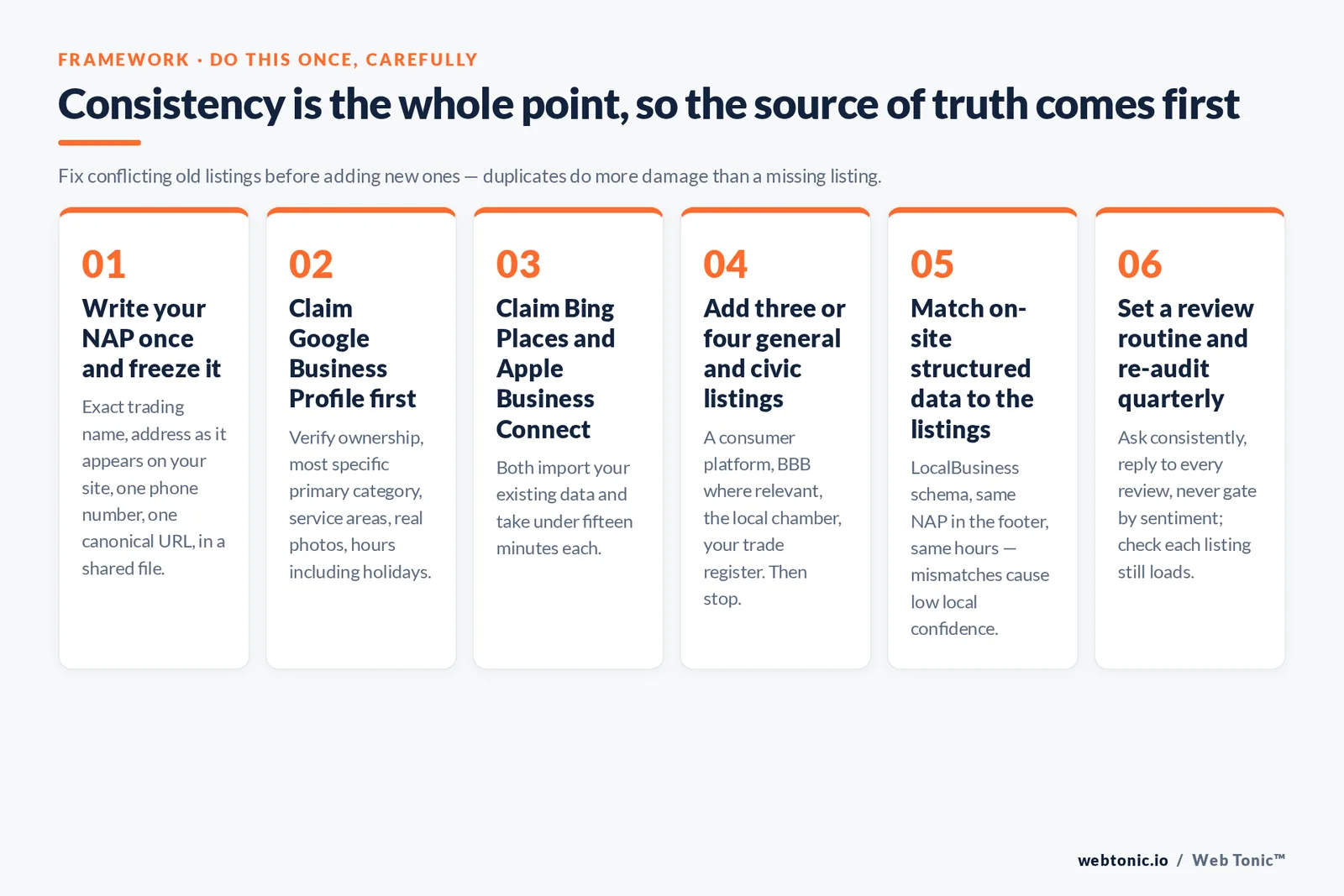
Do this once, carefully, in a fixed order. Consistency is the entire point, so the source of truth comes first.
- Write your NAP once and freeze it. Exact legal or trading name, address formatted exactly as it appears on your website and mail, one primary phone number, one canonical URL. Save it in a shared document. Every listing copies this file verbatim.
- Claim Google Business Profile first. Verify ownership, pick the most specific primary category, add secondary categories, set service areas, upload real photos, and complete hours including holidays. This is the listing that earns 32% of local pack influence.
- Claim Bing Places and Apple Business Connect. Both accept an import from your existing data and take under fifteen minutes each.
- Add the three or four general and civic directories that fit. Consumer platform, BBB where relevant, local chamber, plus your trade register. Stop there rather than chasing volume.
- Fix conflicting old listings before adding new ones. Search your phone number and old addresses. Duplicate and stale entries do more damage than a missing listing.
- Match on-site structured data to your listings. LocalBusiness schema on your contact page, same NAP in the footer, same hours. Mismatches are the most common cause of low local confidence.
- Set a review routine. Ask consistently, reply to every review, and never gate by sentiment. This is the lever that moves the needle after the profile is complete.
- Re-audit quarterly. Check each listing loads, details are current, and the URL has not been redirected or broken by a site change.
Choosing between free, paid and niche directories
Free listings should always be finished first, because they cover the highest-leverage placements. Paid consideration starts only when a directory demonstrably owns your category's search demand — a legal directory in personal injury, a trade marketplace in industrial supply, a review platform your buyers cite in sales calls.
Test a paid listing the way you would test an ad. Add UTM parameters to the listing URL, run it for one full sales cycle, and measure referral sessions, calls and closed revenue against the fee. If it cannot be attributed, it cannot be renewed — the same standard we apply to any channel in data intelligence engagements.
| Question | Green light | Red flag |
|---|---|---|
| Does it rank for your category? | Appears on page one for "[service] [city]" style queries | Invisible in search for anything relevant |
| Is the listing set curated? | Manual review, membership criteria, editorial standards | Instant automated approval, unlimited categories |
| Does it show real activity? | Recent reviews, updated profiles, live photos | Listings last touched years ago, dead links |
| Who is the audience? | Your actual buyers browse or are referred there | Only SEO practitioners visit it |
| Can you measure it? | Trackable URL, call tracking, visible traffic | No attribution possible at any price |
Using directories for research, not just listings
The other half of the directory question is inbound: using them as a data source. Directories are an efficient way to map a competitive set in a specific city, size a category, or find prospects by industry and location. A category listing in one metro area gives you a near-complete competitor list in ten minutes — far faster than assembling one from search results.
They are also historical records. Old telephone books and city directories, catalogued through library research collections, are the standard source for tracing when a company traded, under which name and from which address. That matters for trademark work, acquisitions and brand heritage claims. Just remember that directory data is self-reported and often stale; verify anything load-bearing against a primary source.
What to do this week
Given that 58% of companies do not optimise for local search, a complete set of accurate listings is still a competitive edge rather than table stakes. The sequence is short: freeze your NAP, complete Google Business Profile properly, claim Bing and Apple, add three to five genuinely relevant directories, clean up duplicates, and put a quarterly audit in the calendar. Track referral traffic from each so renewals become an evidence question. If you would rather have that handled alongside the rest of your local visibility, see our services or contact us with your locations and categories.
FAQ
What are the best free business directories to list my business in?
Start with Google Business Profile, Bing Places and Apple Business Connect, since these feed the maps and local packs where customers search. Then add one or two general consumer platforms, your local chamber of commerce, and the trade register your industry actually uses. Five to eight accurate listings beat hundreds of automated submissions.
How do business directories help with SEO and local marketing?
They create consistent citations of your name, address and phone number that search engines cross-reference to confirm your business details, and they deliver referral traffic from people browsing a category. Google Business Profile signals alone account for around 32% of local pack ranking influence.
Are directory links good for SEO?
Rarely as links. Most directory links are nofollow and sit on thin, heavily outbound pages, so they pass little authority. Their real value is citation consistency, trust and referrals — so treat directory work and link building as separate projects with separate success measures.
How do I submit my business to a directory?
Search the directory for an existing entry and claim it if one exists, rather than creating a duplicate. Then complete every field using your frozen NAP details verbatim, choose the most specific category, add photos and hours, and verify ownership by phone, email or postcard when prompted.
Can I use business directories for company or historical research?
Yes. Current directories are efficient for mapping competitors in a city or building prospect lists by industry, and archived telephone and city directories held in library research collections are a standard source for tracing historical trading names, addresses and dates. Verify self-reported details against a primary source before relying on them.

Sources: Google Business Profile Help — improve local ranking, enter business information · Whitespark Local Search Ranking Factors survey · Moz — local citations learning centre · Ahrefs — 107 SEO statistics for 2026 (local SEO and backlink data) · BrightLocal Local Consumer Review Survey · Better Business Bureau · Chamber of Commerce directory · US Chamber of Commerce CO— small business resources · Crunchbase · Foursquare · Apple Maps · Bing Webmaster Tools · Library of Congress business reference — company research guides. All figures verified at time of publication.