Table of contents
The web is constantly losing pages. Domains expire, companies pivot, content management systems get migrated, and links that once pointed somewhere useful start pointing nowhere at all. A broken link building strategy turns that decay into an opportunity: find a dead link on someone else's website, offer a working replacement, and earn an editorial backlink in the process. It works because the pitch leads with something useful instead of an ask. That's rare enough in outreach that it still gets replies. Even a page as heavily maintained as the New York Times accumulates dead links over decades of archived reporting, and high-authority news websites like it are exactly the kind of high quality target that makes this link building strategy worth the effort.
This guide covers how to actually find broken link building opportunities worth pursuing, what makes a replacement page good enough to earn the link, how to write outreach that gets a response, and the seo tools that make each step faster.
Key Takeaways
- Pew Research Center found that 54% of Wikipedia pages have at least one dead reference link, and 23% of news webpages have at least one broken link, making both prime hunting grounds for broken link building.
- Broken link building works because the value exchange is real: the site owner gets a fixed page, their readers stop hitting a dead end, and you get a relevant, editorial backlink.
- The three most reliable discovery methods are checking competitor backlink profiles for dead pages, scanning resource pages in your niche, and finding dead references on Wikipedia.
- The Wayback Machine is the essential tool for understanding what a dead page used to contain, so a replacement can match its format and intent rather than just its general topic.
- A broken link building strategy is one tactic among several, not a complete link building strategy on its own; it works best combined with other content marketing and outreach efforts.
- Conversion rates for well-executed broken link outreach tend to run higher than cold guest post pitches, since the email leads with a genuine fix rather than a request.
What broken link building actually is, and why it still works
Broken link building means finding a dead link on someone else's website, then offering your own relevant page as a working replacement. It counts as a white-hat tactic because the link is editorially given: the site owner adds it because it solves a real problem for their readers and improves their user experience, not because anyone paid for it or gamed an algorithm. Done well, it produces exactly the kind of high quality backlinks that are hard to earn through most other channels, since a good replace-broken-link pitch reads less like outreach and more like a helpful heads-up.
The strategy still works in 2026 for a simple reason: broken links are not becoming rarer. Pew Research Center's 2024 analysis of link rot found that 23% of news webpages and 21% of government webpages contain at least one broken link, and 54% of Wikipedia pages have at least one dead reference link in their citations. A quarter of all webpages that existed between 2013 and 2023 are no longer accessible at all. Every one of those dead links is a page that used to be worth linking to, sitting on a live, indexed, often high-authority page, waiting for a credible replacement.
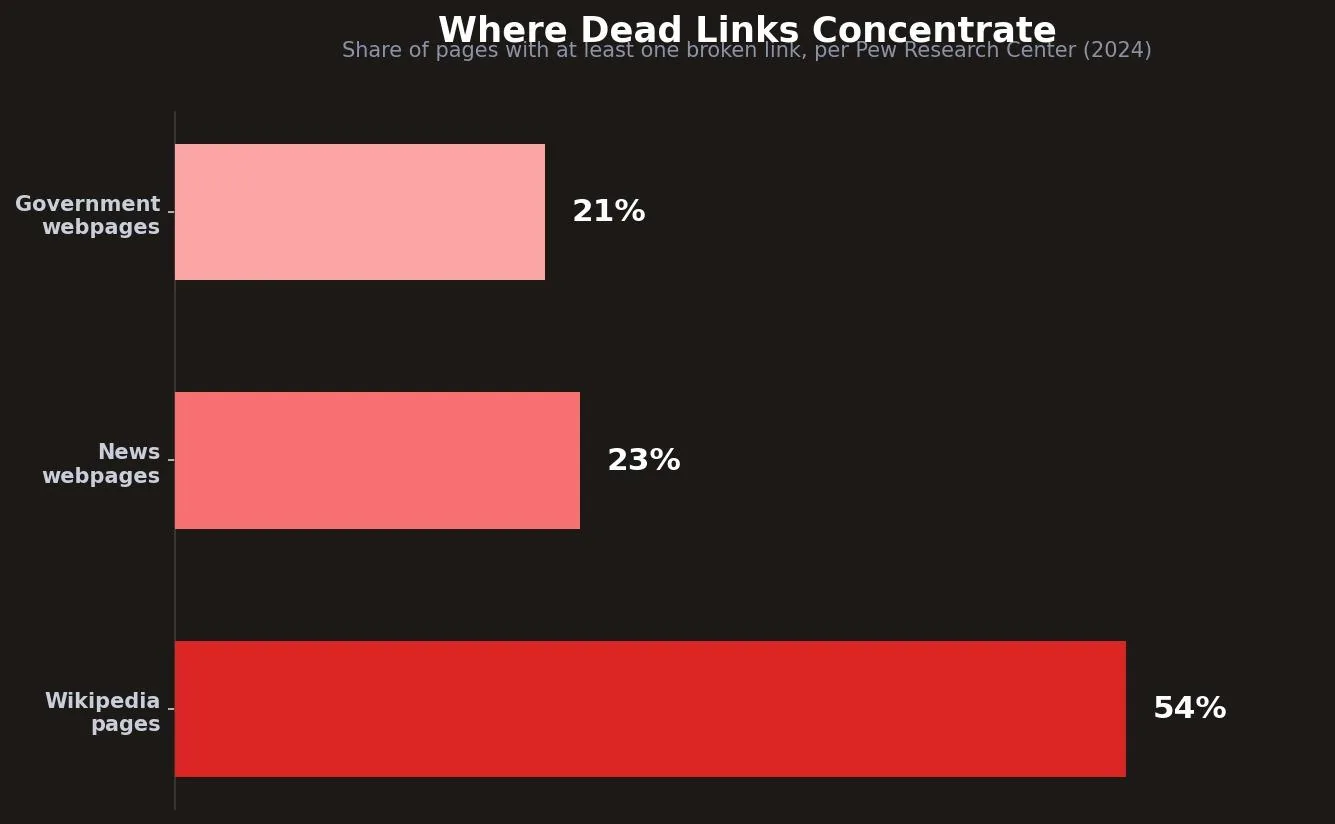
Where broken links actually concentrate
News sites, government sites, and Wikipedia are not obscure corners of the internet; they're exactly where broken link building tends to find its highest-value opportunities, precisely because so many pages on high-domain authority sites have quietly accumulated dead outbound links over the years. A resource page on a smaller niche site can work too, but the math is the same either way: an editorially curated page that once linked to something useful now has a gap, and whoever fills that gap credibly gets the link.
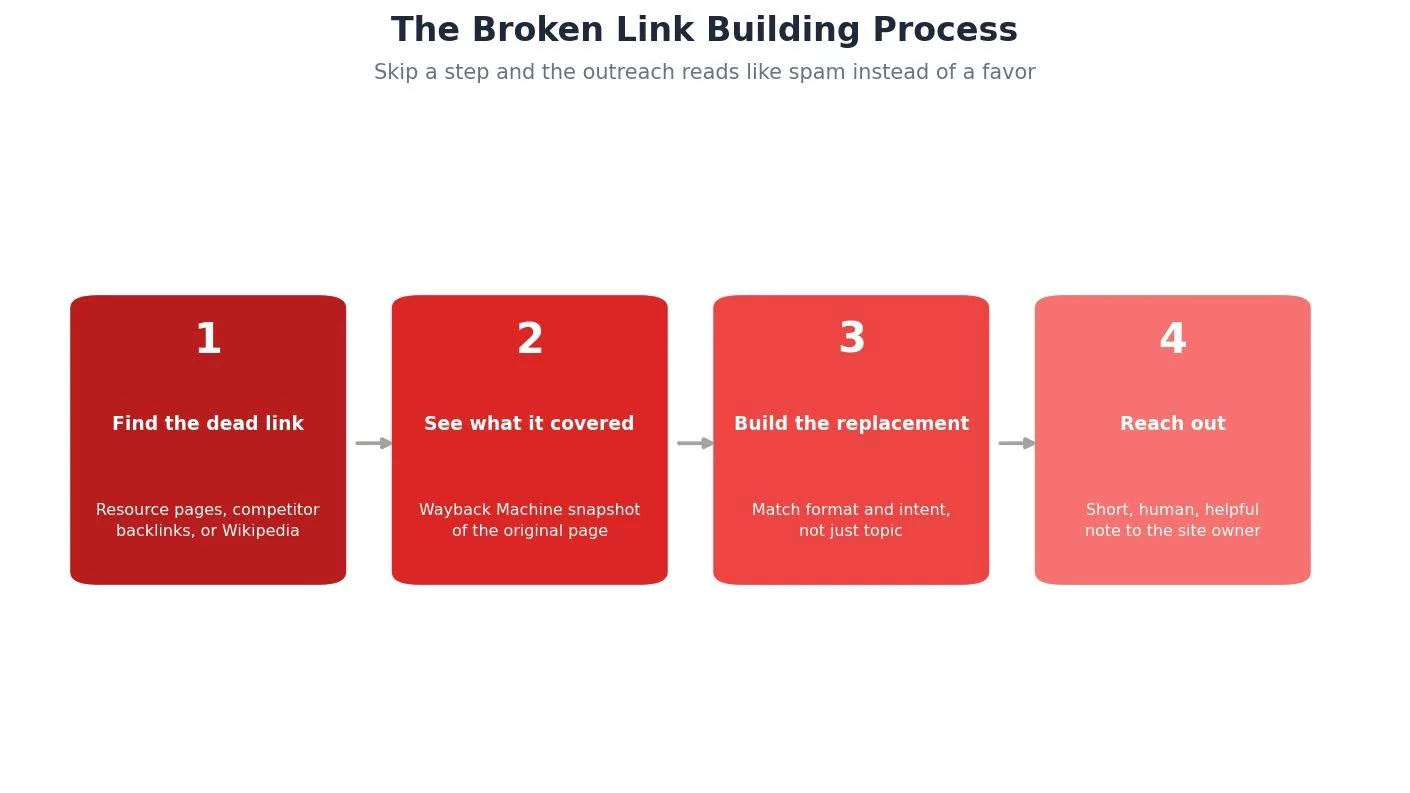
A working broken link building process has four parts, and skipping any one of them is usually why an outreach campaign underperforms. First, find the dead link itself. Second, use the Wayback Machine to see what the original page actually covered, its structure, its depth, and what made it worth linking to in the first place. Third, build or select a replacement that matches that same format and intent, not just the general topic; a curated tools list needs a curated tools list in return, not an essay about why tools matter. Fourth, reach out to the site owner with a short, specific, human note.
Three discovery methods
| Method | Tooling | Why it works |
|---|---|---|
| Competitor backlinks | Ahrefs / Semrush | Find a competitor's dead page, pitch your equivalent to everyone linking it |
| Resource pages | Google search operators | Curated link lists in your niche often go stale and unmaintained |
| Wikipedia references | Wiki Grabber, SEO Minion | One dead citation can point to dozens of other sites with the same link |
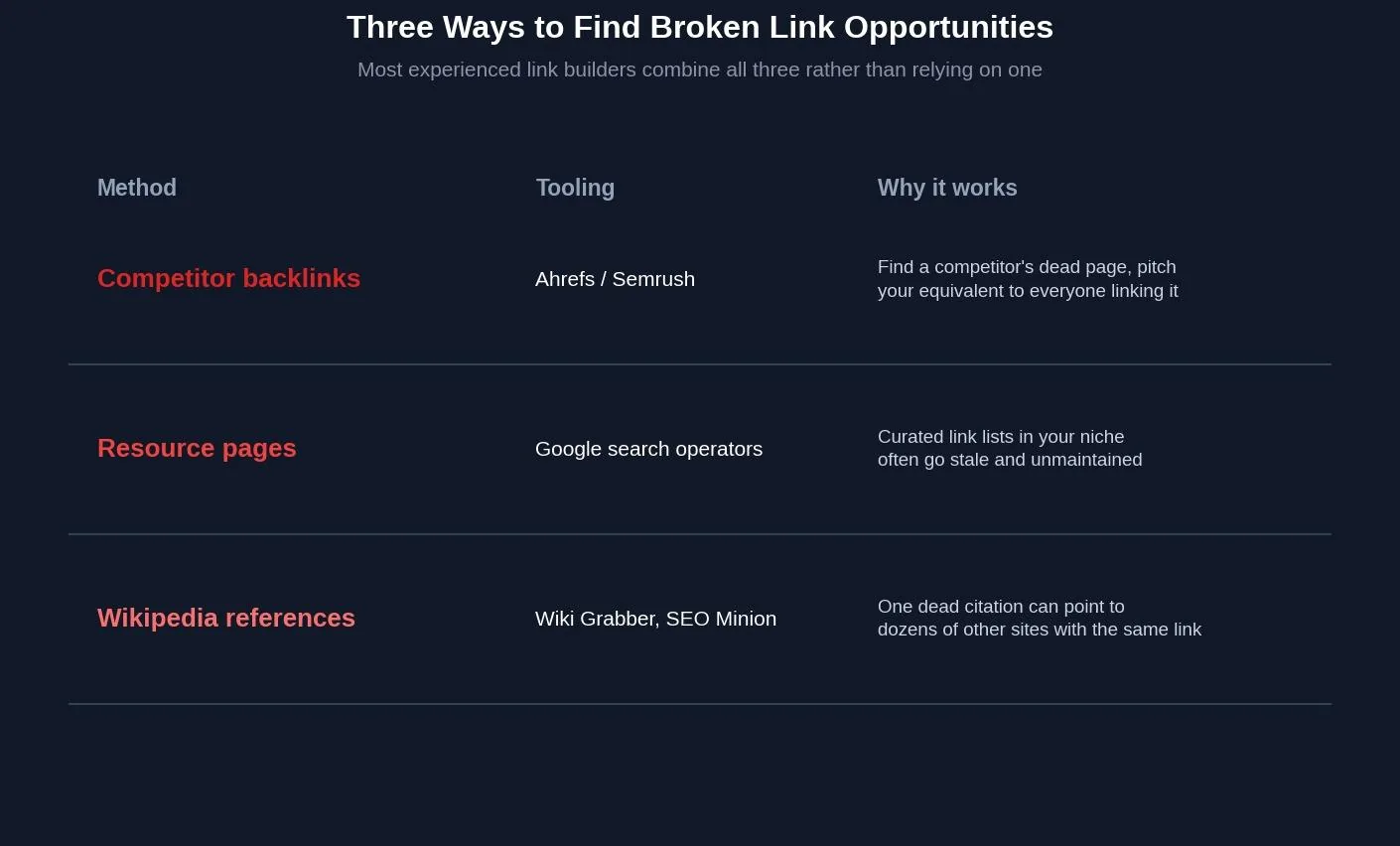
Competitor backlink analysis is often the highest-leverage method: pull a competitor's backlink profile in Ahrefs or Semrush, filter for pages returning a 404, and you get a list of referring domains who have already decided your competitor's topic was worth linking to. Resource pages, curated lists like "best tools for X" or "essential resources for Y," go stale as often as any other page type and are found through simple search operators. Wikipedia deserves special attention: its references section accumulates dead links constantly, and because other sites frequently cite the same sources Wikipedia does, one dead Wikipedia reference can point toward dozens of separate outreach opportunities at once.
Try it: is this opportunity worth pursuing?
Score a broken link opportunity you've found against three quick criteria.
Link building tool
Is this broken link worth pursuing?
Answer three questions about an opportunity you've found.
Verdict
Writing outreach that actually gets a reply
The outreach email is where most broken link building campaigns fall apart, usually because it reads like a mass-sent template instead of a genuine, specific note. An effective message stays short: name the exact page and broken link, state plainly that it's broken, and offer the replacement without demanding anything in return. Leading with the fix, not the ask, is what separates broken link outreach from a typical cold pitch, and it's a large part of why conversion rates for well-executed broken link outreach tend to run higher than cold guest post pitches. If a first email doesn't get a response, a polite follow-up through a different channel often does; site owners are busy, not necessarily uninterested.
Common broken link building mistakes
Pitching a replacement that only loosely matches the original page's topic, instead of its format and intent, gives the site owner an easy reason to ignore the email; a listicle needs a listicle in return, not a single-purpose landing page.
Sending the same generic template to hundreds of prospects treats broken link building like a numbers game, when the tactic's actual advantage is that it doesn't have to be one.
Skipping the Wayback Machine step and guessing at what a dead page covered often produces a replacement that technically fits the topic but misses what made the original page link-worthy.
Treating broken link building as a complete link building strategy on its own, rather than one tactic alongside content marketing, digital PR, and other outreach, leads to an oddly narrow backlink profile over time.
Tools for running a broken link building campaign
The Wayback Machine is free and essential: it's the only reliable way to see what a dead page actually contained before you build or select a replacement. Ahrefs or Semrush expose competitor backlink profiles and let you filter directly for broken backlinks. That's usually the fastest path to a list of qualified prospects for your link building efforts. Wiki Grabber and browser extensions like SEO Minion or Check My Links speed up the process of finding dead links on Wikipedia and resource pages respectively; niche communities on Reddit sometimes surface these same dead-link complaints organically, worth monitoring alongside the more structured search. BuzzStream is a recognized tool in the outreach-management space, alongside Ahrefs and Moz, built for tracking contacts and follow-ups at a scale a spreadsheet stops handling well. Export your prospect list as a CSV from whichever backlink tool you use, so it survives moving between Ahrefs, a spreadsheet, and your outreach platform without manual re-entry.
Once links start landing, track them through Google Search Console and Google Analytics to confirm referral traffic and any movement in domain authority or keyword rankings tied to the linking pages; a digital marketing agency running this at scale for multiple clients will usually want that reporting layer built in from day one rather than bolted on later. It's also worth building replacement content with an eye toward AEO, since a page cited by other sites as an authoritative reference is exactly the kind of content AI answer engines look for when selecting sources to cite. Greg Gifford, a long-time link building educator who has taught a course on the subject, is one of several practitioners worth following for broader link building strategies beyond this single tactic, since broken link building works best as one part of a wider search engine visibility effort rather than the whole plan.
Frequently asked questions
Is broken link building still effective in 2026?
Yes. The underlying supply of broken links hasn't slowed down; domains still expire, sites still restructure, and Pew Research's 2024 analysis found dead links on a meaningful share of news, government, and Wikipedia pages. The tactic works because it offers genuine value to the site owner rather than asking for a favor.
What's the best tool for finding broken links?
There's no single best tool; most experienced link builders combine competitor backlink analysis in Ahrefs or Semrush, resource page searches using Google search operators, and Wikipedia-specific tools like Wiki Grabber, depending on the niche and available time.
How do I know what a dead page used to contain?
Paste the broken URL into the Wayback Machine to view archived snapshots. This shows the original page's structure, depth, and content. That's essential for building a replacement that matches its format and intent rather than just its general topic.
Is broken link building a white-hat SEO tactic?
Yes. The link is editorially given by the site owner because the replacement genuinely solves a problem for them and their readers, not because of payment or manipulation. That puts it squarely within Google's guidelines for earned links.
How long does it take to see results from broken link building?
Individual placements often land within a few weeks of outreach once a site owner reviews and accepts the replacement, but building a meaningful number of quality links this way is an ongoing process, not a single campaign with a fixed end date.
Turning dead links into a durable link building asset
Broken link building holds up in 2026 for the same reason it always has: the web keeps losing pages, and every dead link on a relevant, authoritative page is a real opportunity, not a hypothetical one. The mechanics — finding the link, understanding what it covered, building a genuine replacement, and reaching out like a person instead of a template — are not complicated. What separates a campaign that earns a handful of links worth having from one that gets ignored at scale is treating each opportunity as specific work rather than a volume game.
Ready to turn dead links into earned backlinks?
Finding real broken link opportunities, building replacements worth linking to, and running outreach that gets genuine replies is exactly the kind of patient, detail-heavy work that compounds into a stronger backlink profile over time. Web Tonic's growth marketing team folds link building strategy like this into a broader technical SEO and content practice, so earning links becomes part of an ongoing system rather than a one-off push.
More from Web Tonic: growth marketing services, data & analytics.
Sources: pewresearch.org · shortlist.io · searchlogistics.com · acemindtech.com · outreachmonks.com · learningseo.io