Table of contents
Electrical contractors that invest in link building generate 40–60% lower cost-per-lead than those relying solely on paid channels, yet 94% of all published content earns zero external backlinks. These link building statistics reveal exactly what it costs, what it returns, and how electrical service companies can close the authority gap in 2026.
Key Takeaways
- $509 is the average acceptable cost per quality backlink in 2026 — up from $318 in 2022, reflecting rising competition for editorial placements (BuzzStream).
- 94% of all published content earns zero external backlinks, making strategic outreach essential for electrical contractors competing in local search (Ahrefs).
- Pages with at least one backlink are 77% more likely to rank in Google's top 10 than pages with none (Ahrefs).
- 5–15 quality links per month is realistic for a small contractor, and those links outperform 300 low-quality directory submissions (Codivox).
- Digital PR campaigns deliver 15–50 links per asset vs. one link per guest post, with an average ROI of 312% (BuzzStream).
- Referring domains remain a top-3 Google ranking factor, with position-1 pages averaging 3.8× more backlinks than positions 2–10 (Semrush).
- $1,500–$5,000/month is the typical link building budget for growing electrical service businesses (Link Building Journal).
- Single-location electricians need 20–100 referring domains from DA 30+ sites to build steady local SEO visibility (GitHub/KitchenRemodelingSEO Benchmarks).
Link Building Cost Benchmarks for 2026
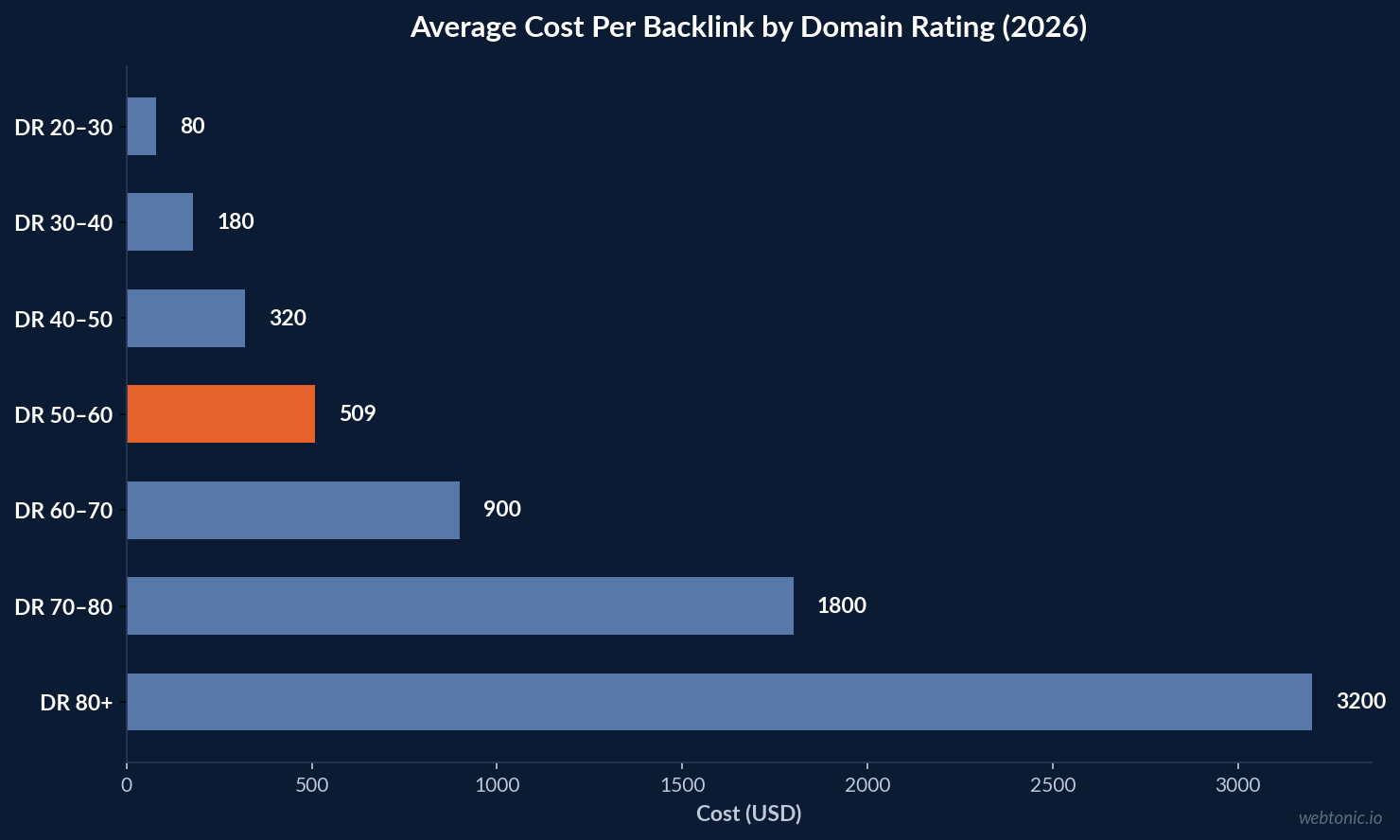
Link building costs have increased significantly over the past four years. The average acceptable price per quality link reached $509 in 2026, up 60% from $318 in 2022 according to BuzzStream's State of Digital PR Report. For electrical contractors competing in local markets, understanding these cost tiers is critical to budgeting effectively.
Average cost per backlink by Domain Rating tier (2026)
| Domain Rating Tier | Average Cost Per Link | Typical Source Type |
|---|---|---|
| DR 20–30 | $80 | Niche directories, small blogs |
| DR 30–40 | $180 | Industry blogs, local publications |
| DR 40–50 | $320 | Guest posts, resource pages |
| DR 50–60 | $509 | Editorial placements, PR coverage |
| DR 60–70 | $900 | High-authority trade publications |
| DR 70–80 | $1,800 | Major media, premium editorial |
| DR 80+ | $3,200+ | Tier-1 national media |
According to the Link Building Journal's 2026 benchmarks, the bottom quartile pays $130–$220 per quality link (DR 40–60), while the top quartile invests $700+ per placement. Electrical contractors typically fall in the $180–$509 range, targeting local and industry-specific publications rather than national media.
Backlink Volume and Authority Requirements
How many backlinks does an electrical contractor actually need? A 2026 WebFX study of 1,462 domains published by Stacker found that the number varies dramatically by keyword competitiveness and market size.
Structured SEO benchmark data compiled by KitchenRemodelingSEO provides contractor-specific referring domain targets:
Referring domain targets by contractor business size
| Business Type | Referring Domains (DA 40+) | DA Target | Expected Outcome |
|---|---|---|---|
| Small Local Electrician | 20–100 | 30+ | Steady local SEO visibility |
| Mid-Sized Regional | 100–300 | 40–50 | 15–30% traffic lift |
| Large / Top Competitor | 300–1,000+ | 50–70 | Major ranking moves |
Watson Co. Marketing's 2026 electrical contractor SEO guide recommends targeting 3–5 new quality backlinks per month as a sustainable acquisition pace. Their research confirms that one link from a local newspaper or trade association outperforms 50 directory links in ranking impact.
Link Building ROI and Business Impact
The return on link building investment is measurable and compelling. BuzzStream's annual survey reports an average 312% ROI from digital PR campaigns, with 85.2% of practitioners seeing measurable results within 6 months and 51.4% within 3–6 months.
For electrical contractors specifically, AuthoritySpecialist's 2026 electrician SEO data shows that organic lead costs run 40–60% lower than pay-per-lead platforms after a 6-month SEO program matures — and link building is the primary driver of that authority growth.
Key ROI metrics from the 2026 research:
- 58.1% of businesses cite link building as a key factor in improving SERP rankings — yet only 44% manage it consistently (DemandSage/Authority Hacker).
- 312% average ROI from digital PR campaigns, the highest-return link building tactic (BuzzStream).
- Pages in position 1 average 3.8× more backlinks than pages in positions 2–10 (Semrush).
- 77% higher likelihood of ranking in Google's top 10 for pages with at least one backlink vs. zero (Ahrefs).
- 10% of in-house marketing budgets is allocated to link building on average (The Frank Agency).
Digital PR vs. Guest Posting: Tactic Comparison
The shift toward digital PR accelerated in 2026. BuzzStream's data shows that 34% of SEOs now rank digital PR as their best-performing link building method, overtaking guest posting as the primary tactic.
Link building tactic comparison (2026 benchmarks)
| Metric | Guest Posting | Digital PR |
|---|---|---|
| Links per campaign | 1 per post | 15–50 per asset |
| Cost per campaign | $350–$600 (DR 50+) | $3,000–$15,000 |
| Cost per link (effective) | $350–$3,000 | $60–$1,000 |
| Acceptance rate | 5–10% of pitches | Varies by newsworthiness |
| Average ROI | Moderate | 312% |
| Time to results | 4–8 weeks | 1–3 months |
For electrical contractors, the most effective digital PR assets include local pricing surveys (e.g., "Average Cost of Electrical Panel Upgrades by City"), safety data studies, and seasonal demand reports. A single well-researched data study can earn 20–50 editorial links over 12 months at a fraction of the per-link cost of manual outreach, according to Codivox's 2026 small business guide.
Contractor-Specific Link Sources and Opportunities
Electrical contractors have natural link building opportunities that many other industries lack. Watson Co. Marketing's research highlights several high-value sources:
- Trade association directories — National Electrical Contractors Association (NECA), state licensing boards, and Better Business Bureau listings provide authoritative, industry-relevant backlinks.
- Supply house partnerships — Electrical supply distributors that list certified installers provide niche-relevant links from established domains.
- General contractor referral pages — Builders and GCs who maintain "preferred subcontractor" pages create natural backlink opportunities from related businesses.
- EV charger and solar partnerships — As EV adoption grows, dealerships and solar companies linking to recommended electricians provide high-intent referral links.
- Local chambers of commerce — Chamber membership pages typically carry DA 40–60 with strong local relevance signals.
The LogosWebDesigns 2026 guide confirms that pages with at least one backlink are 77% more likely to reach Google's top 10, reinforcing that even modest link acquisition from trade-relevant sources can shift rankings materially.
Link Building Budget and Spending Benchmarks
Industry-wide link building spending continues to grow. BuzzStream reports that about 60% of practitioners operate with budgets under $10,000/month, while 25.7% spend less than $5,000/month. The share of teams spending $20,000+/month more than doubled from 4% to 8.8% year-over-year.

For electrical contractors, the recommended spending tiers from Link Building Journal and Codivox are:
- Startup/SME electricians: $1,000–$2,500/month — focus on guest posts, trade directories, and HARO responses for 3–10 links.
- Growing contractors: $2,500–$5,000/month — add resource page outreach and digital PR for 10–20 links.
- Multi-location firms: $5,000–$10,000/month — invest in data studies, PR outreach, and proprietary research for 20–30 links.
- Enterprise contractors: $10,000–$20,000+/month — full digital PR programs with proprietary research for 30+ links.
Content Quality and the Backlink Gap
The link-earning potential of content varies dramatically by format and quality. Ahrefs' ongoing research confirms that 94% of all published content earns zero external backlinks — a statistic that underscores the importance of intentional, research-backed content for electrical contractors.
High-authority sites accept only 5–10% of guest post pitches, and 52% of blogs accept fewer than 1 in 10 proposals (OutreachMonks). The cold outreach response rate averages just 5–15% with personalized pitches, dropping further with template-based approaches.
For electricians, AuthoritySpecialist notes that firms with 20+ indexed service and FAQ pages outrank thinner sites in 78% of head-to-head market comparisons. This content depth creates more internal pages that can earn natural backlinks from industry resources, manufacturers, and local media.
Link Quality Signals and Ranking Correlation
Not all backlinks carry equal weight. A MarketKeep study analyzing referring domain profiles across four contractor markets found that the site with the most backlinks fails to rank first in the majority of cases. In their national analysis, a contractor with 264 referring domains outranked a competitor with 1,523 referring domains — demonstrating that Google evaluates quality, relevance, and page-level authority rather than raw backlink count.
For electrical contractors, this quality-over-quantity principle means focusing on topically relevant links from electrical industry resources, home service directories, and local publications. BuzzStream's data confirms that Ahrefs Domain Rating is used by 93.2% of link building professionals as the primary quality metric, followed by Moz Domain Authority at 83%.
Key quality signals that matter most for electrician websites:
- Topical relevance — links from electrical industry, home improvement, and local business resources carry more weight than generic directories.
- Referring domain diversity — 20–100 unique referring domains from DA 30+ sites builds a more resilient link profile than concentrated links from fewer sources.
- Link velocity consistency — acquiring 3–5 quality links per month signals organic growth patterns to search algorithms.
- Geographic relevance — local newspaper mentions, city chamber listings, and regional trade association links reinforce local search signals.
Link Building Timeline and Expectations
Results from link building are not immediate, but the data shows predictable timelines. BuzzStream's survey reveals that 85.2% of digital PR practitioners see measurable results within 6 months, with 33.8% seeing results in 1–3 months.
Codivox's research on small business link building confirms a 4–12 week window for competitive queries to show ranking improvements from new links. For electrical contractors in suburban markets with fewer competitors, this timeline can compress further. Dense urban metros may require 6–12 months of sustained link building before meaningful ranking movement appears.
The compounding nature of link building makes it fundamentally different from paid advertising. According to AuthoritySpecialist's electrician SEO cost data, most SEO programs for electricians carry 6-month minimum commitments because organic rankings require 90–120 days before measurable traffic shifts appear.
Related reading
- Local Link Building: What It Is & How to Use It
- Broken Link Building Strategy: What It Is & How to Use It
- Digital PR Link Building: What It Is & How to Use It
- Link Building Services services at Web Tonic
Frequently Asked Questions
How much should an electrical contractor spend on link building per month?
Most single-location electrical contractors should budget $1,000–$2,500 per month for link building, focusing on trade directories, guest posts, and local partnership opportunities. Multi-location firms competing in larger metros typically invest $2,500–$5,000/month to acquire 10–20 quality links. The average cost per quality link is $509 in 2026, so budgets should reflect the volume of links needed to compete in your specific market.
How many backlinks does an electrician website need to rank locally?
A small local electrician typically needs 20–100 referring domains with DA 30+ to build steady local visibility. Mid-sized regional contractors targeting multiple service areas need 100–300 referring domains to compete effectively. Quality matters significantly more than quantity — one link from a local newspaper or trade association is worth more than 50 low-quality directory submissions.
What is the ROI of link building for electrical services?
Digital PR campaigns — the highest-performing link building tactic — deliver an average 312% ROI according to BuzzStream's 2026 survey. For electrical contractors, organic lead costs run 40–60% lower than pay-per-lead platforms after 6 months of SEO maturity, with link building as the primary authority driver. The investment compounds over time, unlike paid advertising that stops generating leads when the budget is paused.
What types of backlinks work best for electrical contractors?
The most effective backlinks for electricians come from trade associations (NECA, state licensing boards), local chambers of commerce (DA 40–60), supply house partner pages, and general contractor referral directories. EV charger and solar installation partnerships are an emerging high-value source as electrification adoption grows. Guest posts on DR 50+ industry blogs cost $350–$600 and provide editorially relevant links.
How long does link building take to show results for electricians?
Most link building campaigns show measurable results within 3–6 months, with 85.2% of practitioners reporting results within 6 months. Suburban markets with fewer competitors may see faster gains, while dense urban metros can require 6–12 months of sustained effort. Rankings require 90–120 days before traffic shifts become measurable, which is why most SEO-focused programs carry 6-month minimums.
Sources
BuzzStream — Digital PR Statistics 2026
Link Building Journal — 2026 Industry Benchmarks
Codivox — Link Building for Small Businesses 2026
Stacker / WebFX — 2026 Backlink Study
AuthoritySpecialist — Electrician SEO Statistics 2026
Watson Co. Marketing — Electrical Contractor SEO 2026
Ahrefs — SEO Statistics 2026
LogosWebDesigns — Link Building for Small Business 2026
AuthoritySpecialist — Electrician SEO Cost 2026
KitchenRemodelingSEO — Contractor SEO Benchmarks