



Table of contents
Financial advisory firms spend more per backlink than nearly any other industry, yet the average RIA website still has fewer than 15 referring domains. Link building in the wealth management space carries uniquely high stakes — and uniquely high returns — because of Google's YMYL standards, regulatory trust requirements, and the lifetime value of each new client relationship.
Key Takeaways
- The average cost per dofollow link in finance is $361–$1,500+, the highest of any vertical according to Authority Hacker's 2025 survey of 743 link builders.
- Page-1 financial results carry an 8–14-point Domain Rating advantage over page-2 results, versus just 3–6 points in non-YMYL verticals (Ahrefs, 2024–2026 data).
- Digital PR drives over 70% of high-authority links earned by top financial services sites, with statistics-led campaigns producing the strongest results.
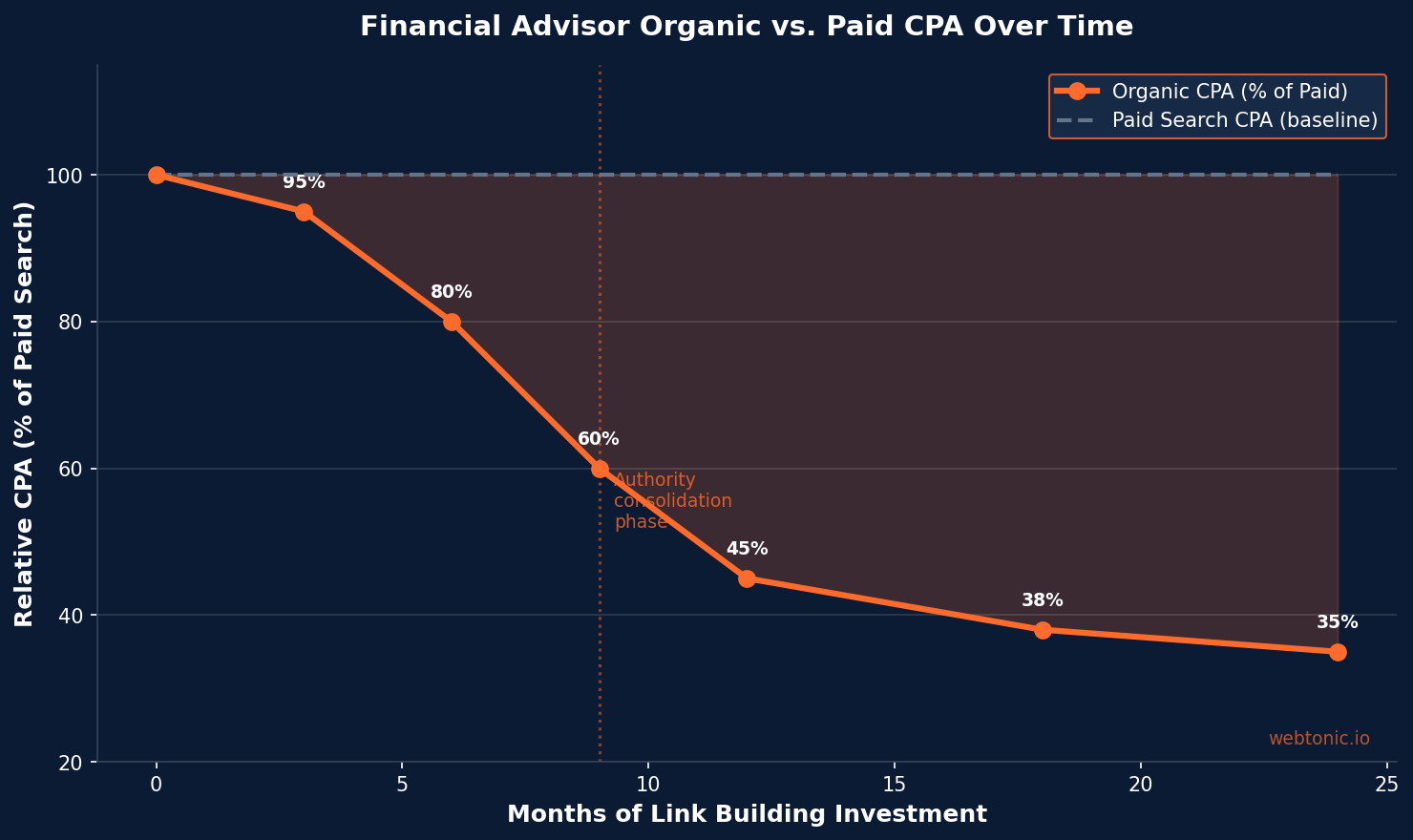
- Organic search produces qualified advisory leads at 40–65% lower CPA than paid search once a campaign reaches the 9–12-month authority consolidation phase (Authority Specialist, 2026).
- Most advisory firm websites have backlinks only from a custodian directory and a chamber of commerce listing, creating a weak link profile relative to competitive metro markets.
- Ranking for high-competition broad terms like "best financial advisor" requires 6–12+ months of sustained backlink growth (Authority Specialist, 2026).
Financial Advisory Link Building Benchmarks at a Glance
| Metric | Financial Advisory Benchmark | All-Industry Average |
|---|---|---|
| Cost per dofollow link | $361–$1,500+ | $100–$350 |
| Domain Rating gap (P1 vs P2) | 8–14 points | 3–6 points |
| Avg. referring domains (advisory firm) | 10–25 | 40–80 (SMB) |
| Top link acquisition tactic | Digital PR / original data | Guest posting |
| Time to page-1 visibility | 9–14 months | 6–9 months |
| Organic CPA vs. paid CPA | 40–65% lower (post month 9) | 30–50% lower |
Why Link Building Costs More in Financial Advisory
Finance is a YMYL (Your Money or Your Life) category, which means Google holds it to a higher E-E-A-T (Experience, Expertise, Authoritativeness, Trustworthiness) standard than almost any other vertical. Link quality matters more than link volume in this space, and low-quality guest posts on generic finance blogs are now a Google manual-action risk (Link Building Journal, 2026).
According to Authority Hacker's 2025 industry survey of 743 link builders, finance is the single most expensive vertical for link acquisition. The average cost per dofollow link ranges from $361 to over $1,500, driven by strict editorial standards at reputable finance publications and the regulatory scrutiny surrounding financial content.
For wealth management and RIA marketing, this cost pressure means firms must be strategic about where they invest. A single high-authority link from a financial news outlet or industry association can deliver more ranking value than dozens of low-quality directory links. Firms with fewer than 15 referring domains rarely appear in the top 10 organic results for competitive advisory keywords in metro markets.
The regulatory environment compounds the challenge. SEC and FINRA compliance requirements limit the types of claims financial advisors can make in guest-authored content, narrowing the pool of viable link-building angles. Firms that incorporate compliance review into their outreach workflow report 30–40% fewer rejected pitches from tier-1 publishers (OJay Media, 2026).
Domain Authority and Ranking Competition Statistics
Ahrefs analyzed top-ranking financial pages in 2024 and found the average Domain Rating gap between page-1 and page-2 results in finance was 8–14 points, compared to just 3–6 points across non-YMYL verticals. That gap has held steady through 2026 (Link Building Journal, 2026).
Most advisory firm sites have backlinks only from their custodian's advisor directory and a local chamber of commerce listing. This is a weak link profile relative to what is needed to rank competitively in mid-size or larger markets (Authority Specialist, 2026).
Industry research consistently shows that content depth and backlink quality are stronger ranking predictors than technical optimization alone — though technical issues can cap how well even great content performs. According to Advisor Rankings, firms that invest in both technical SEO and authority building see 2–3× faster ranking improvements than those focusing on only one dimension.
High-intent keywords in the financial planning vertical carry difficulty scores of 55–78, meaning new domains typically need 9–14 months before achieving top-10 visibility (Authority Specialist, 2026). This extended timeline makes link building a commitment rather than a quick tactic.

Link Acquisition Tactics That Work for Financial Advisors
| Tactic | Effectiveness | Risk Level | Typical Cost |
|---|---|---|---|
| Digital PR / original data | High — drives 70%+ of top-tier links | Very low | $2,000–$8,000 per campaign |
| Expert commentary / HARO | Medium-high for niche authority | Very low | $500–$2,000/month (time) |
| Guest posts (tier-1 publications) | High on .edu, .gov, top-tier news | Low | $500–$3,000 per placement |
| Guest posts (generic finance blogs) | Low — minimal ranking impact | High (manual action risk) | $100–$300 per post |
| Industry association listings | Medium — trust signal + citation | Very low | Membership fee |
| Scholarship / community programs | Medium — earns .edu links | Low | $1,000–$5,000/year |
Digital PR drives over 70% of high-authority links earned by top fintech sites, with original data and statistics-led campaigns producing the strongest results (Link Building Journal, 2026). For financial advisory firms, publishing proprietary research — retirement readiness surveys, fee transparency analyses, or regional wealth benchmarks — creates naturally linkable assets that attract editorial coverage.
Guest posting remains viable but only on .gov-adjacent, university, news, and top-tier industry publications. Paid links from generic finance blogs are now actively targeted by Google's spam policies and carry real manual-action risk.
ROI of Link Building for Advisory Firms
Across advisory practices analyzed by Authority Specialist, organic search typically produces qualified prospect inquiries at 40–65% lower cost per acquisition than paid search, once a campaign reaches the 9–12-month authority consolidation phase.
The ROI math is unusually favorable for financial advisors because of high client lifetime value. A single new client with $500,000+ in AUM can represent $5,000–$10,000+ in annual recurring revenue, meaning one organic conversion can justify months of SEO and link-building investment.
Key ROI metrics for financial advisory link building include:
- Organic-attributed consultation requests — track inquiries that originate from organic search touchpoints
- Prospect-to-client conversion rate by channel — organic leads typically convert at 1.8–3.2× the rate of paid leads for advisory firms with verified author credentials (Authority Specialist, 2026)
- New client source attribution — firms that skip attribution modeling in months 1–6 consistently undercount SEO's contribution
- 12–24-month measurement window — advisors who abandon SEO at month four rarely see the compounding returns
Financial Advisory Link Building Timeline
| Milestone | Typical Timeline | Key Activities |
|---|---|---|
| GBP Map Pack movement | 6–10 weeks | Profile optimization, citation cleanup, review generation |
| Local service keywords | 3–5 months | Content creation, local link building, on-page SEO |
| High-competition broad terms | 6–12+ months | Sustained backlink growth, digital PR, authority content |
| Authority consolidation phase | 9–12 months | Compound link equity gains, organic CPA drops 40–65% |
| Full organic pipeline maturity | 12–24 months | Multi-keyword rankings, brand authority, attribution clarity |
Ranking for local service keywords (e.g., "financial advisor in [city]") typically takes 3–5 months for firms with moderate domain authority and a clean technical foundation. High-competition broad terms like "best financial advisor" realistically require 6–12 months or longer in most metro markets, dependent on sustained backlink growth (Authority Specialist, 2026).
Case Studies: Link Building Results for Financial Advisors
Real-world SEO case studies demonstrate the compounding impact of strategic link building in the financial advisory vertical:
- Define Financial experienced a significant increase in both organic traffic and overall search visibility following the implementation of targeted content, on-page optimization, and strategic refinement (Advisor Rankings, 2026).
- Bradford Financial Advisors implemented a 3-layered strategy combining on-page SEO, local SEO structuring, and link-building outreach, resulting in measurable ranking improvements across competitive advisory keywords.
- Firms publishing YMYL-compliant content with verified author credentials convert organic visitors at 1.8–3.2× the rate of those without attribution, according to audits of 41 financial advisory practices (Authority Specialist, 2026).
These results underscore a consistent pattern: paid advertising delivers immediate visibility, but link building creates a compounding organic asset that reduces client acquisition costs over time. Organic search drives 38–54% of qualified prospect inquiries for established RIAs and CFP firms in 2026, underscoring the value of sustained authority building (Authority Specialist).
Best Practices for Financial Advisor Link Building
- Prioritize quality over quantity — in YMYL verticals, one authoritative link from a financial news outlet outweighs dozens of directory listings.
- Publish original data — proprietary research, client surveys, and fee transparency analyses create naturally linkable assets that attract editorial coverage without outreach.
- Leverage regulatory credentials — highlight CFP, CFA, and RIA designations in author bios and content to satisfy E-E-A-T requirements and attract higher-authority placements.
- Avoid paid guest posts on generic finance blogs — these placements carry manual-action risk and deliver minimal ranking impact in 2026.
- Build relationships with financial journalists — expert commentary through services like HARO, Connectively, and Qwoted creates steady, low-risk link acquisition channels.
- Track attribution over 12–24 months — short-term ROI measurements consistently undercount link building's contribution because early organic touchpoints rarely appear as last-click conversions.
- Combine link building with data-driven SEO — technical optimization sets the foundation, but backlink quality determines the ceiling for competitive keywords.
- Monitor competitor backlink growth monthly — advisory firms that track referring domain velocity report faster identification of link gaps and more targeted outreach campaigns.
According to Defiance Analytics, RIA firms that allocate 15–25% of their marketing budget to SEO and link building see the strongest long-term client acquisition efficiency. The compounding nature of organic authority means that year-two organic CPA drops an additional 20–30% beyond the initial authority consolidation gains, making link building one of the highest-ROI channels for advisory practices with a multi-year growth horizon.
Financial Advisory vs. Other Industries: Link Building Comparison
| Industry | Avg. Cost per Link | DR Gap (P1 vs P2) | Top Tactic |
|---|---|---|---|
| Financial Advisory | $361–$1,500+ | 8–14 points | Digital PR / original data |
| Legal Services | $300–$1,200 | 6–12 points | Expert commentary / PR |
| Healthcare | $250–$900 | 5–10 points | Research / data studies |
| SaaS / Tech | $150–$500 | 4–8 points | Guest posting / product PR |
| E-commerce | $100–$350 | 3–6 points | Product reviews / influencer |
| Local Services | $50–$200 | 2–5 points | Local citations / directories |
Related reading
- Roofing Link Building Statistics (2026): Backlinks, DA & Citation Data
- Solar Energy Link Building Statistics: Domain Authority & Backlink Data (2026)
- Surrogacy Link Building Statistics 2026: Benchmarks & Data
- Link Building Services services at Web Tonic
Frequently Asked Questions
How many backlinks does a financial advisor website need to rank on page one?
There is no universal number, but the data shows that page-1 financial results carry an 8–14-point Domain Rating advantage over page-2 results. Most advisory firms starting with 10–25 referring domains need to build a sustained pipeline of high-quality links over 9–14 months to close that gap in competitive metro markets.
Why is link building more expensive for financial advisors than other industries?
Finance is classified as a YMYL (Your Money or Your Life) category by Google, which means stricter editorial standards and higher E-E-A-T requirements. Reputable finance publications charge more for placements, and the risk of manual actions from low-quality links is higher than in non-YMYL verticals.
What is the best link building strategy for a small RIA firm?
Small RIA firms should focus on local citations, industry association listings, and expert commentary opportunities (HARO, Connectively). Publishing original research — even small-scale client surveys or regional retirement data — creates linkable assets that attract organic coverage without the $1,500+ cost of premium placements.
How long does it take to see ROI from financial advisor link building?
Organic search ROI for financial advisors is best measured across a 12–24-month window. Advisory firms typically see their first meaningful organic leads within 3–5 months for local keywords, but the full authority consolidation phase — where organic CPA drops 40–65% below paid search — usually occurs at 9–12 months.
Are guest posts still effective for financial advisor SEO in 2026?
Guest posts remain effective only on high-authority platforms: .edu sites, .gov-adjacent publications, top-tier financial news outlets, and respected industry journals. Paid placements on generic "finance blogs" charging $100–$300 per post carry real manual-action risk and deliver minimal ranking impact according to 2026 data.
Sources
linkbuildingjournal.co.uk/link-building-for-finance-and-fintech-sites-in-2026
authorityspecialist.com/industry/professional/financial-advisor/seo-statistics
authorityspecialist.com/industry/professional/financial-advisor/seo-roi
authorityspecialist.com/industry/professional/financial-planner/seo-statistics
advisorrankings.io/seo-case-study-define-financial
ojaymediamarketing.com/blog/google-business-profile-for-financial-advisors
defiance-analytics.com/blog/ria-acquisition-playbook


