



Table of contents
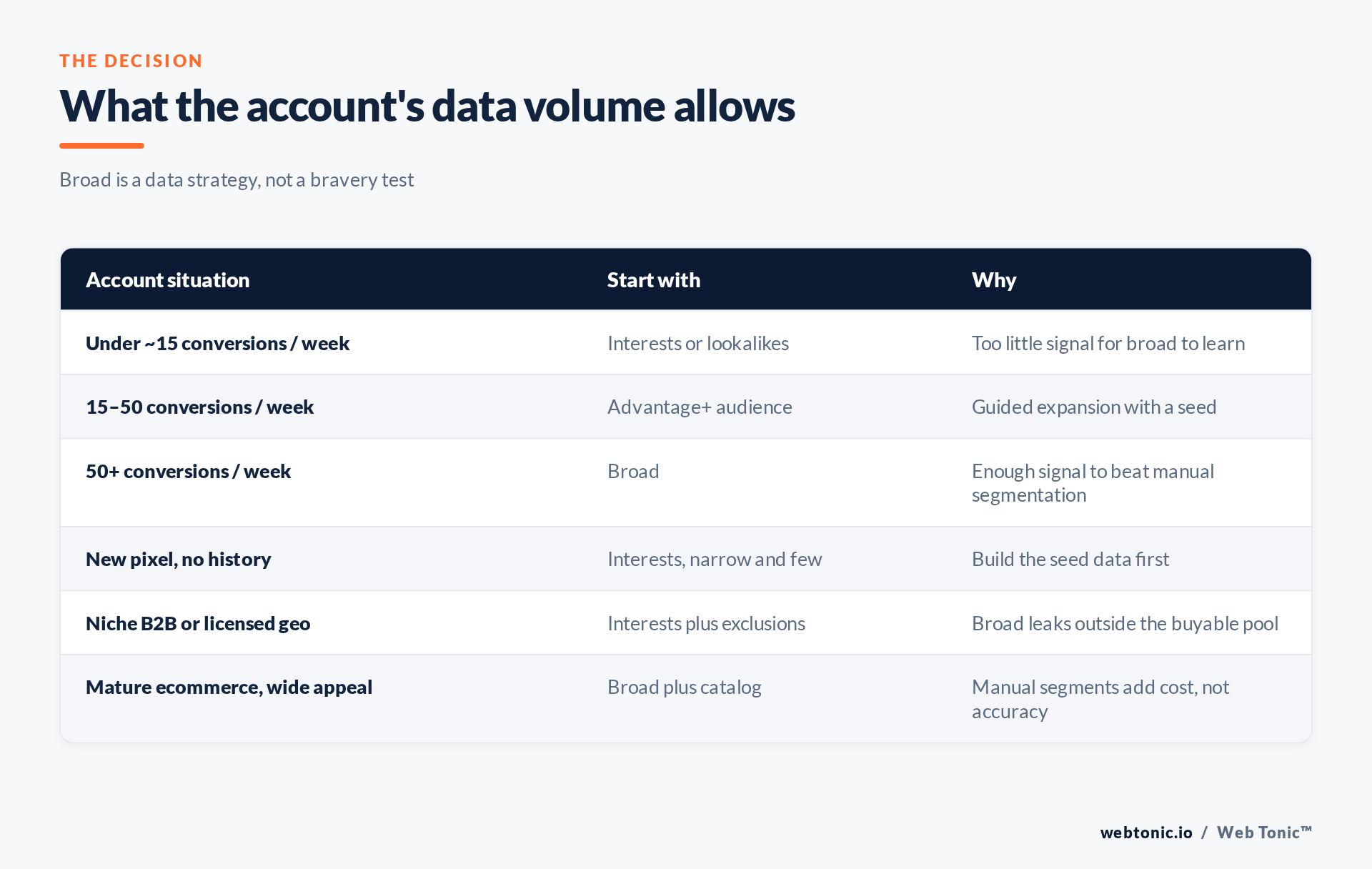
Quick answer: Use interest targeting below roughly 15 conversions a week, Advantage+ audience between 15 and 50, and broad above 50. Broad needs conversion signal to work; it is a data threshold, not a matter of nerve.
Last verified: 2026-08-21
The real question behind the debate
Broad targeting works when the delivery system has enough conversion data to find buyers better than a human can describe them. Interest targeting works when it does not. Everything else in this argument is decoration.
The system is running an exploration-and-exploitation loop close to reinforcement learning: it tries wide, observes who converts, and concentrates. That loop needs a steady stream of conversion events to learn from. Feed it 5 conversions a week and it will spend most of its budget exploring; feed it 50 and it converges quickly on pockets no interest list contains.
Interest targeting is not obsolete — it is a way of donating your prior knowledge to a system that has none of its own yet. The mistake is keeping that donation in place long after the account outgrew it, paying a permanent tax in selection bias: you can only ever buy the customers you already imagined.
Where each option genuinely wins
Broad earns its place in mature accounts with wide addressable demand, strong creative volume and clean conversion tracking. It reaches lower CPMs than heavily filtered audiences and scales without the overlap problems that come from stacking segments.
Advantage+ audience is the sensible middle: you give a seed of interests or a lookalike and the system may go beyond it. For accounts in the 15–50 conversions-a-week band it usually beats both extremes.
Interests and lookalikes stay correct for genuinely narrow markets — licensed professions, single-city service areas, small B2B categories — and for any account whose pixel has not yet accumulated a usable history. In those cases broad does not fail because it is broad; it fails because most of the reachable population cannot buy.
Running the switch as a test
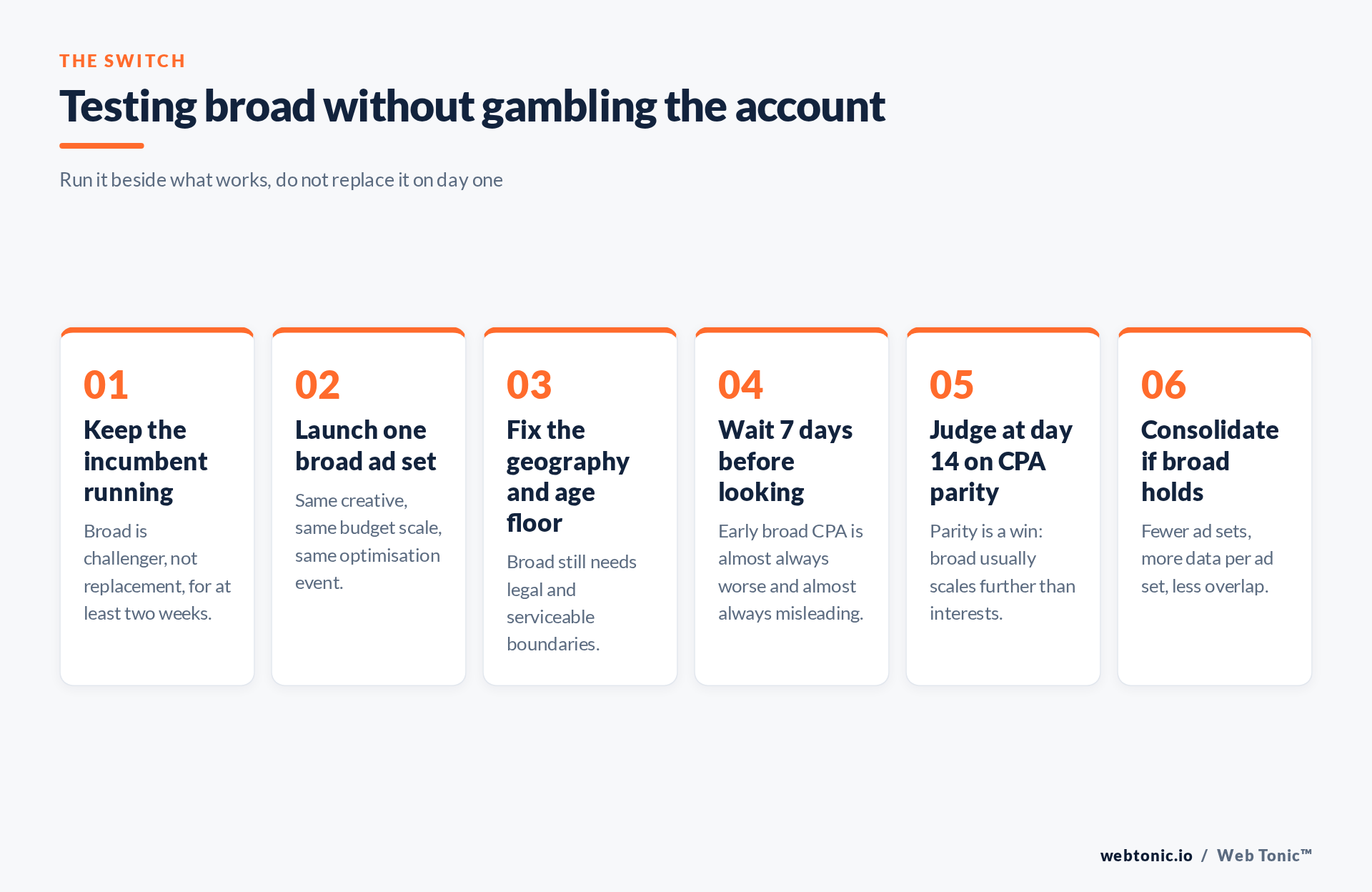
- Do not replace, add. Launch one broad ad set beside the existing structure at a comparable budget, same optimisation event, same creative. Replacing everything at once destroys your only control.
- Keep the boundaries that are real. Country and region, minimum age where the product requires it, and exclusions for existing customers or recent purchasers. Broad means no interest layer, not no rules.
- Expect a bad first week. The new ad set enters a learning period and its early CPA is unrepresentative — the same dynamic described in what triggers a learning phase reset.
- Judge at day 14 on cost per result. Parity with the incumbent counts as a win, because broad typically holds that cost at much higher spend.
- If broad wins, consolidate. Collapse overlapping interest ad sets so each remaining one gets enough events to exit learning — the same consolidation logic covered in CBO vs ABO.
- If broad loses, look at creative before concluding. Broad exposes weak creative faster than a hand-picked audience does; a broad test failing on tired assets tells you about the assets.
| Question | If yes | If no |
|---|---|---|
| Over 50 conversions a week? | Test broad now | Advantage+ or interests |
| Is conversion tracking verified? | Broad can learn | Fix tracking first |
| Is the addressable market wide? | Broad suits it | Interests plus exclusions |
| Do you ship new creative weekly? | Broad will scale | Broad will fatigue fast |
| Are there legal or licensing limits? | Constrain geography and age | Keep targeting minimal |
| Are ad sets fighting for the same people? | Consolidate before testing | Proceed as planned |
Constraints people forget
Privacy rules shape what interest targeting can even do. Behavioural segments derived from personal data sit squarely inside GDPR for European audiences, and guidance from the European Data Protection Board continues to narrow the ground for targeting built on sensitive inferences. Broad targeting sidesteps a category of risk that interest stacks carry.
Restricted categories remove the choice. Housing, employment and credit advertising is limited in how it may be targeted, in line with obligations such as the Fair Housing Act. If your offer falls in one of those categories, the platform will constrain targeting whether or not you wanted broad — see special ad category rejections.
Broad amplifies whatever your tracking says. If events are miscounted the system optimises confidently toward the wrong people, faster than interests ever would. Verify measurement before widening — that is why we treat conversion tracking and the Conversions API as prerequisites to any Meta Ads scaling plan. More on the blog.
Frequently Asked Questions
Is broad targeting always cheaper?
Its CPMs usually are, because no filter is applied. Cost per result is only better once the system has enough conversion data to concentrate delivery, which is the whole condition.
How long before broad is judged?
Fourteen days minimum, with the first week discounted for the learning period. Verdicts at day three reliably reject strategies that would have worked.
Should lookalikes be retired if broad works?
Not immediately. Keep a lookalike ad set running until broad has held for a full month at scale, then consolidate to reduce overlap and give each ad set more data.
Does broad work for local service businesses?
Within a tight geographic radius, often yes, because the geography is already doing the narrowing. Layering interests on top of a small radius usually starves delivery.
What exclusions should stay on a broad ad set?
Existing customers and recent purchasers where repeat purchase is unlikely, plus employees and any audience you are deliberately handling in another campaign. Everything else is best left off.
Sources: reinforcement learning; selection bias; GDPR overview; European Data Protection Board; Fair Housing Act overview. Meta's own audience and Advantage+ documentation was consulted directly. Last verified 2026-08-21.


