



Table of contents

Quick answer: A campaign re-enters learning after a significant edit — optimisation event, targeting, bid strategy, creative or a large budget change. Open the change history, find the edit and its timestamp, then stop editing and let the campaign accumulate conversions before judging it.
Last verified: 2026-08-21
What the learning phase is doing
When a campaign or ad set is new or significantly changed, the delivery system has no reliable model of who converts under those conditions. It spends the early period exploring — trying different audiences, placements and times — and performance is unstable and usually worse than it will settle at. Once enough conversion events have accumulated for the current configuration, delivery stabilises and results become meaningful.
The key phrase is current configuration. Learning is tied to the setup, not the campaign name. Change the setup materially and the accumulated learning no longer applies, so the count restarts. This is the same idea on both major platforms: Google describes it as a Smart Bidding learning period after bid strategy changes, and Meta's learning phase behaves equivalently. We cite Meta's documentation by name rather than by link, because those domains block automated verification and every link here is checked.
The practical consequence is uncomfortable for anyone who likes to optimise daily: frequent small edits are worse than occasional large ones, because a campaign that never exits learning never performs at its potential. Restraint is a technique here, not laziness.
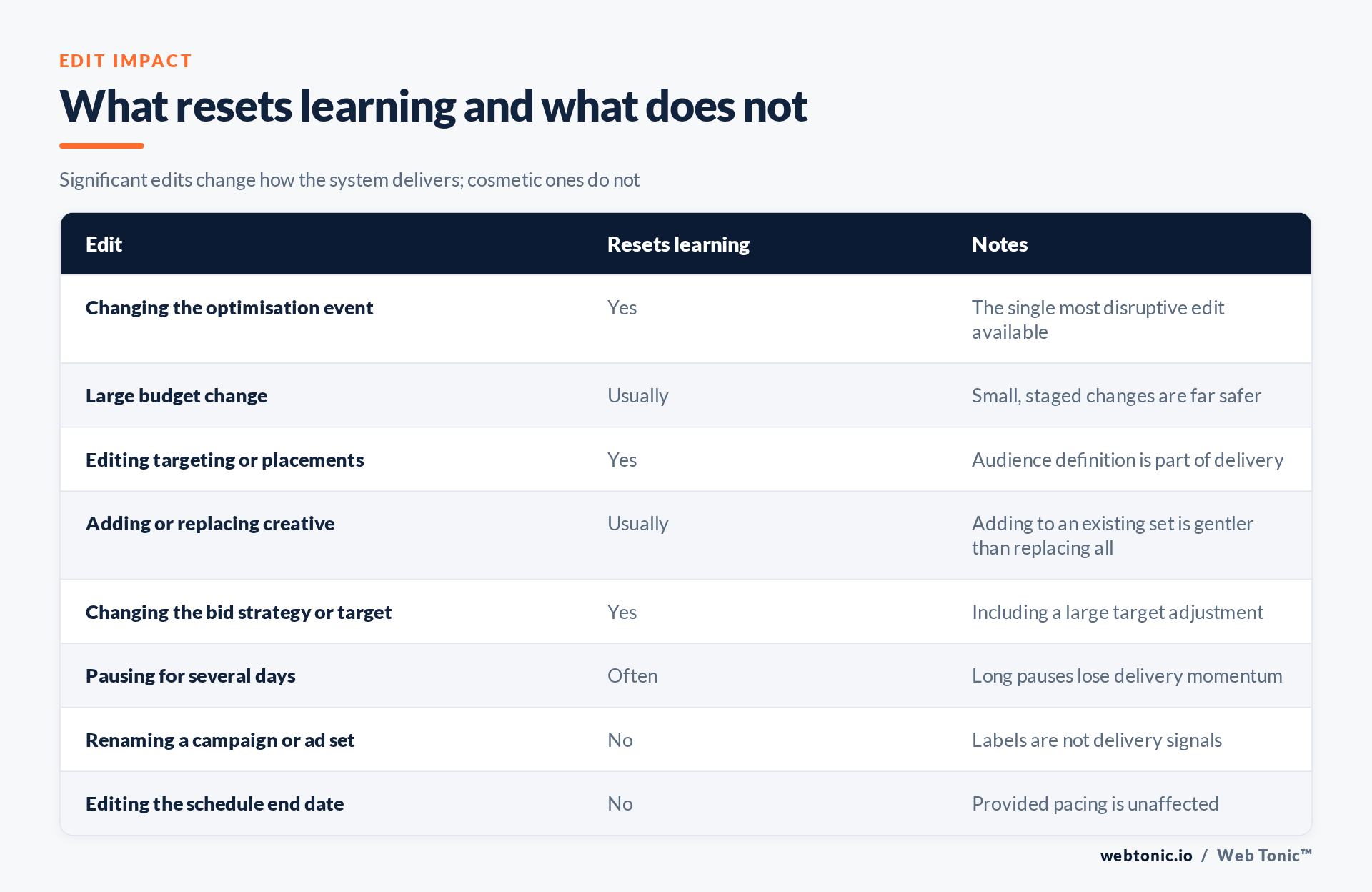
The edits that reset it
Changing the optimisation event
Switching from purchase to add-to-cart, or from lead to qualified lead, is the most disruptive change available. You have asked the system to find a different kind of person, so nothing it learned before transfers. Treat this as a relaunch and plan for a full learning cycle.
Large budget changes
A meaningful budget increase changes how far the system must reach to spend, which changes the audience it delivers to. Doubling a budget overnight typically resets learning; raising it in staged increments with a few days between usually does not. When scaling, treat the pace of the increase as a real setting, because it is.
Targeting, placements and bid strategy
Audience definition and placement mix are delivery parameters, so editing them invalidates the model. Bid strategy changes do the same — including a large adjustment to an existing target. On the Google side, target ROAS and other automated strategies restart their learning period on the same basis, which is why target CPA and target ROAS changes should be made in modest steps rather than dramatic corrections.
| Situation | Do this | Not this |
|---|---|---|
| Scaling a winner | Raise budget in staged steps | Double it overnight |
| Refreshing creative | Add new assets alongside existing ones | Replace the whole set at once |
| Missing the CPA target | Adjust the target in small increments | Cut the target by half |
| Too many thin ad sets | Consolidate so events concentrate | Split further to isolate variables |
| Several planned edits | Batch them into one window | Spread them across the fortnight |
| Weekend pause | Use scheduling where possible | Pause for days and resume cold |
Creative changes
Adding a new asset to an existing ad set is gentler than replacing every creative in it. Replacing everything is effectively a new ad set wearing an old name. If you run a disciplined creative testing cadence, build the reset into the calendar rather than pretending it will not happen.
Long pauses
A campaign paused for several days loses delivery momentum and often resumes in learning. Where the goal is a weekend off, dayparting or scheduling is usually kinder than a full pause.
Finding what actually triggered it
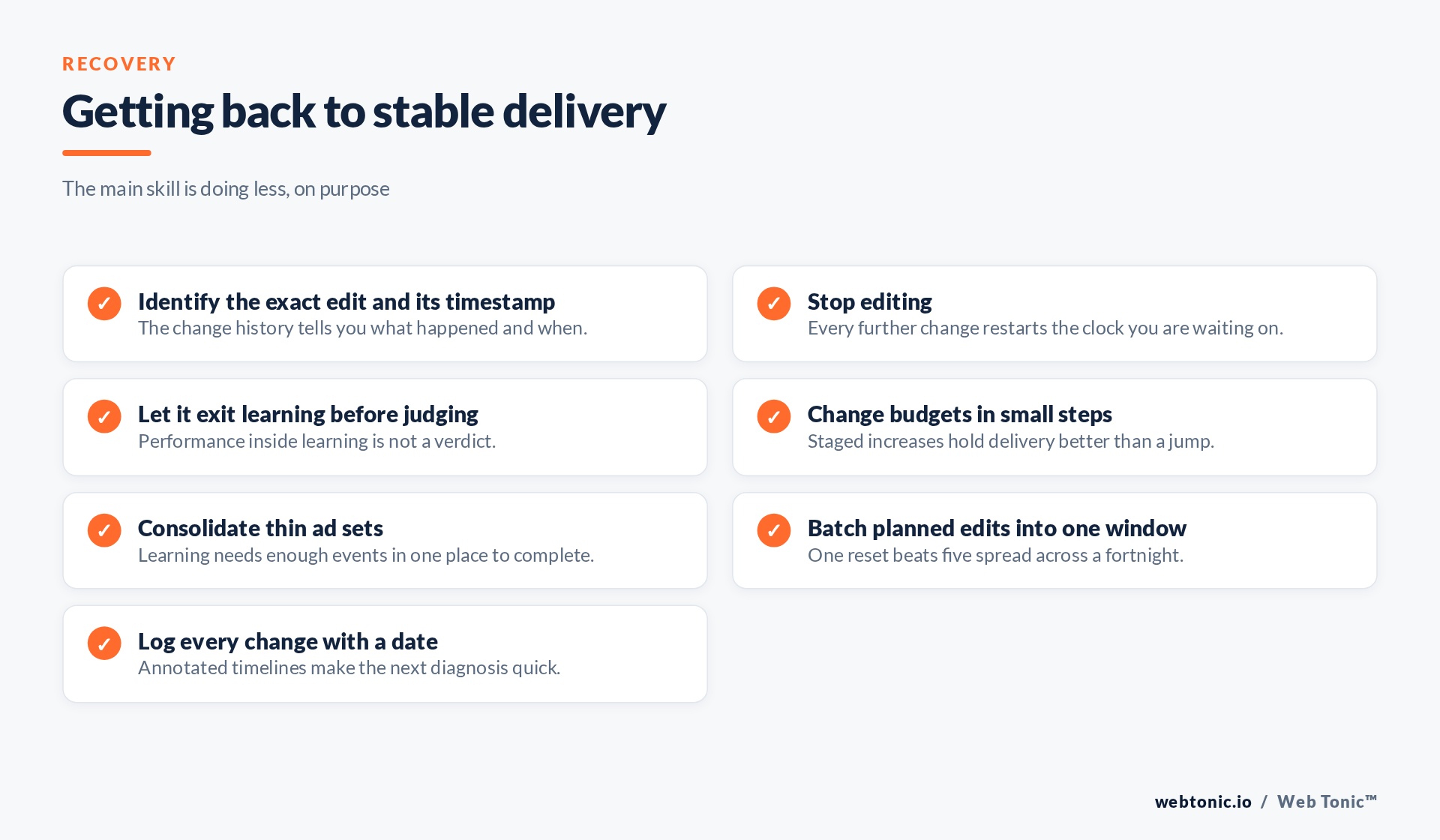
Do not guess. Both platforms keep a change history that lists every edit with a timestamp and the user who made it — Google documents the equivalent view in its Ads Help Center under change history. Line the learning restart up against that log and the cause is usually immediately obvious, and frequently someone else on the team.
Two subtler causes are worth checking when the log looks clean. First, conversion tracking changes: if the event definition, deduplication or tag setup changed, the system is receiving a different signal even though the campaign was untouched. Second, volume collapse: an ad set that no longer receives enough weekly conversions to sustain stable delivery can slip back, which is a structural problem rather than an edit.
If neither the log nor the tracking explains it, look at the account shape. Ad sets that were always marginal on volume drift in and out of learning permanently, and the answer is consolidation, not another edit.
Recovering without making it worse
Once you know the trigger, the discipline is simple and hard: stop editing. Every further change restarts the very clock you are waiting on, and panic edits during a learning period are the most common way a temporary dip becomes a permanent one. Give the campaign the conversion volume it needs before drawing any conclusion.
Report on it honestly in the meantime. Performance inside a learning period is not a verdict on the change, and stakeholders who are told that in advance are far more patient than stakeholders who discover a bad week in a dashboard. Set the expectation at the point of the edit, not afterwards.
Longer term, run a change calendar: batch planned edits into one window, annotate them, and review results on the other side of the reset. That is standard practice in our Meta Ads management, it depends on the signal quality that conversion tracking provides, and it is the kind of operating detail our analytics reporting is built to make visible.
Frequently Asked Questions
How long does the learning phase last?
Until the configuration has accumulated enough conversion events, so it is a volume question rather than a time question. Low-volume ad sets can stay in learning indefinitely.
Does renaming a campaign reset learning?
No. Names and labels are not delivery signals. Only changes that affect how the system delivers will reset the phase.
Can I avoid learning resets entirely?
No, and you should not try. The goal is to make resets deliberate and infrequent by batching edits, rather than accidental and continuous.
Should I pause a campaign that is performing badly in learning?
Usually not. Pausing discards the progress made and a resumed campaign often starts learning again. Give it the volume it needs first.
Is the Google learning period the same as Meta's learning phase?
They are equivalent in spirit rather than identical in mechanics. Both re-explore after significant changes and both reward batching edits over constant tinkering.
Sources: Meta learning phase documentation, cited by name because that domain blocks automated link verification; Google Ads — Smart Bidding; target CPA; target ROAS; Google Ads API reporting; multi-armed bandit exploration. Last verified 2026-08-21.


