



Table of contents

Quick answer: At around $200 a day, use ABO while you are still testing creative, and CBO once you have proven winners and three or more ad sets worth allocating between. The deciding test is conversions per ad set per week, not preference.
Last verified: 2026-08-21
What the choice actually controls
Campaign Budget Optimisation puts one budget at campaign level and lets Meta move it between ad sets each day. Ad Set Budget Optimisation fixes a budget per ad set, so each one gets exactly what you assigned. That is the whole mechanical difference — everything else people argue about is downstream of it.
The trade is allocation efficiency against experimental control. CBO will happily push the majority of spend into its best-performing ad set, which is usually the correct commercial decision and simultaneously fatal to a test, because your test cells no longer received comparable budget. ABO guarantees comparability and accepts that some of your money is knowingly spent on cells that will lose.
At $200 a day this is not an abstract debate. That budget supports roughly two to three meaningful cells at a $25–$40 target CPA, and it is thin enough that the wrong structure shows up as ad sets stuck in limited delivery rather than as a slightly worse CPA.
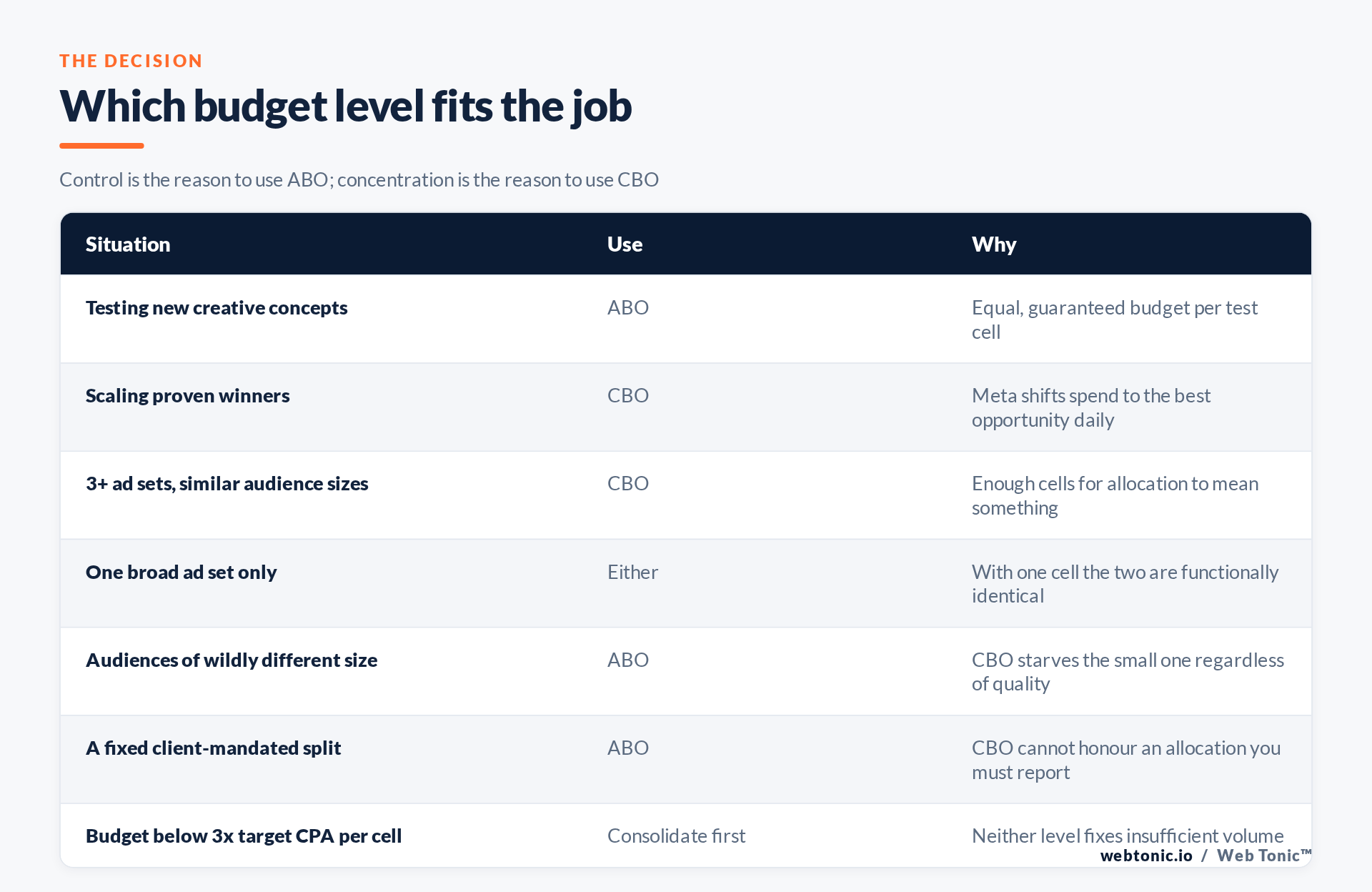
The volume test that decides it
Before choosing a level, work out how many cells your budget can actually feed. Our working floor is 3x target CPA per ad set per day, and 5x where you want stability rather than survival. At a $40 target CPA that is $120 a day minimum per ad set, which means $200 a day supports one serious ad set, or two thin ones — not the five-audience matrix that the structure diagrams on social media imply.
- Divide daily budget by 3x target CPA. That integer is your maximum number of ad sets. If it is one, the CBO/ABO question is moot: run one broad ad set and put your energy into creative.
- Check weekly conversions per ad set. Cells that cannot accumulate enough events to stabilise will drift in and out of learning permanently, whichever budget level you pick.
- Ask what the campaign is for. Testing wants equal budgets; scaling wants concentrated ones. A campaign trying to do both does neither.
- Check audience size symmetry. CBO across a broad audience and a small retargeting pool will starve the small pool almost immediately, which may be right commercially and wrong strategically.
- Check whether anyone must report a fixed split. If a client mandates spend per market, CBO cannot honour it. That is a legitimate reason to keep ABO at any spend level.
| Daily budget | Sensible cells | Structure we would run |
|---|---|---|
| $50–$100 | 1 | One broad ad set, all creative inside it |
| $100–$200 | 1–2 | ABO while testing; single-ad-set CBO once proven |
| $200–$500 | 2–3 | CBO for winners + a small ABO test campaign |
| $500–$2,000 | 3–5 | CBO scaling, ABO testing at ~20–25% of spend |
| $2,000+ | 5+ | CBO winners, ABO testing, plus an automated campaign |
Where each one goes wrong
CBO failure mode: over-concentration
Meta can put most of a campaign budget into a single ad set. If that ad set is your winner, excellent. If it is simply the one that got an early cheap conversion, you have handed the account to a coin flip. The fix is ad set minimum spend floors at roughly 10–20% of campaign budget — used sparingly, because every floor you add takes back the allocation freedom you chose CBO for.
ABO failure mode: fragmentation
ABO tempts people to split. Five ad sets at $40 a day, each below the volume needed to stabilise, produces five permanently learning cells and one confused report. Meta's own delivery model rewards concentration; this is the same logic behind exploration and exploitation in a multi-armed bandit, where too many arms and too little data means you never identify the best one.
Both failure modes: reading noise as signal
At $200 a day a week produces few enough conversions that ad set differences are frequently indistinguishable from chance. Before you rebuild a structure on a 15% CPA gap, check whether the sample supports it — the same discipline as statistical significance and sample size in any experiment. Google makes the equivalent point about automated strategies needing accumulation time in its Smart Bidding documentation.
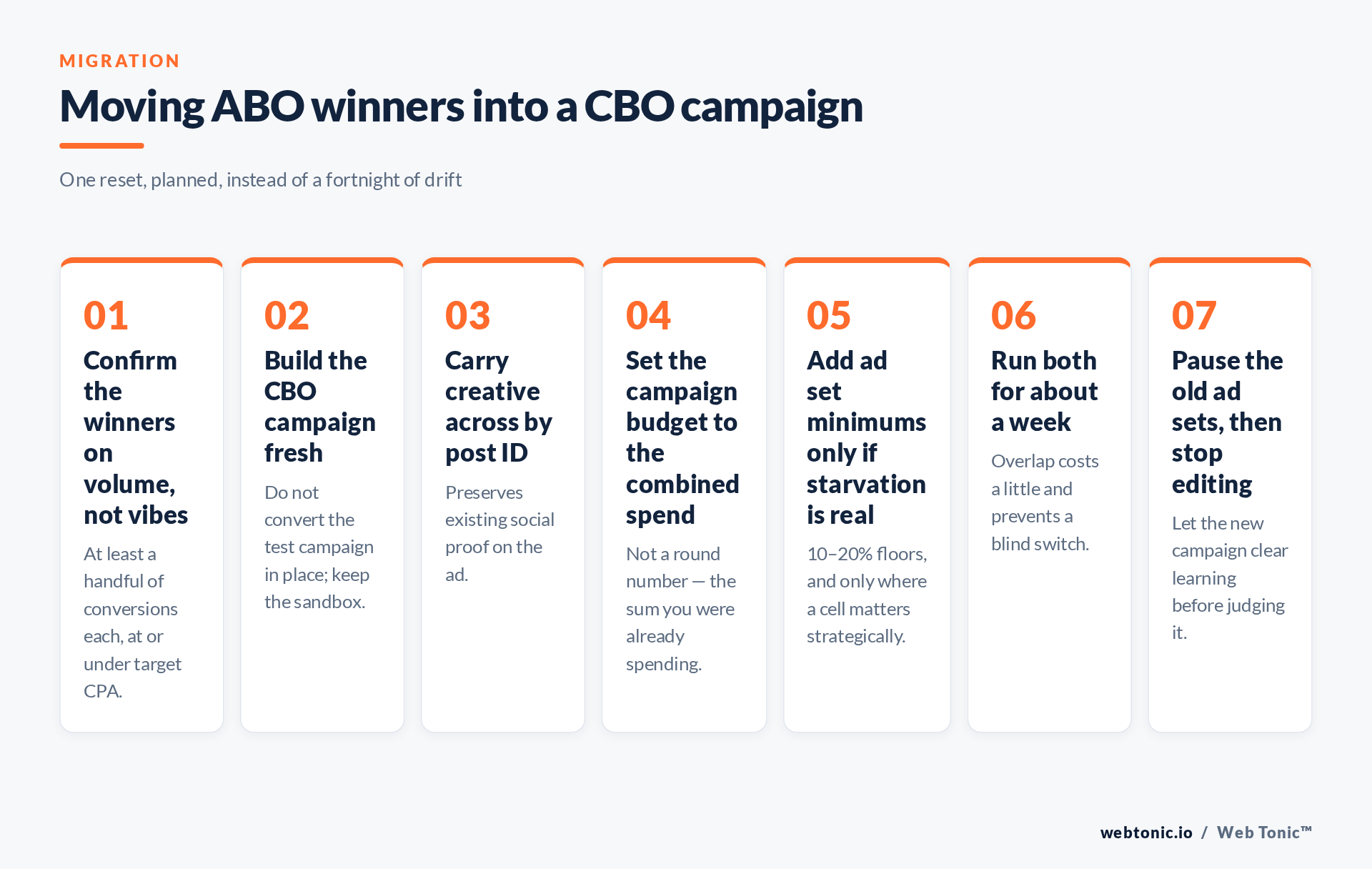
Switching without wrecking delivery
Changing budget level is a significant edit, so plan for a learning reset instead of being surprised by one. Build the CBO campaign new rather than converting the test campaign in place, move winning ads across using their existing post IDs so social proof survives, and set the campaign budget to the combined spend you were already running rather than a rounder, larger number.
Run old and new in parallel for about a week where budget allows. It costs a little in overlap and buys you a comparison instead of a leap of faith. Then pause the old ad sets and — the part everyone skips — stop editing until the new campaign has cleared learning.
Structurally, most accounts land in the same place: a small ABO testing campaign, a CBO campaign holding winners, and an automated campaign once volume justifies it. That is the shape we run in Meta Ads engagements, it depends on trustworthy conversion tracking, and it is judged on the reporting our analytics layer produces. More context sits on our blog.
Frequently Asked Questions
Is CBO always better at higher spend?
Not always, but it is usually right once you have three or more ad sets of similar audience size and proven creative. Below that, CBO has nothing meaningful to allocate between.
Can I test creative inside CBO?
You can test ads against each other inside one ad set, which is fine. What you cannot do reliably is test ad sets against each other, because CBO will not fund them equally.
Does switching CBO to ABO reset learning?
Treat it as a significant edit and expect a reset. Batch it with any other planned changes so you absorb one reset rather than several.
Should I use ad set minimum spend limits in CBO?
Only when starvation of a strategically necessary ad set is actually happening. Every floor reduces the allocation freedom that justified CBO.
How long before I judge a new structure?
Until it has left learning and accumulated enough conversions to be readable — volume, not a fixed number of days.
Sources: Meta budget optimisation and learning phase documentation, cited by name because that domain blocks automated link verification; Google Ads — Smart Bidding; Target CPA bidding; multi-armed bandit; statistical significance; sample size determination; Google Ads API reporting. Last verified 2026-08-21.


