Table of contents
Search engines still drive more brand discovery than AI tools in 2026, by more than double, even as marketers rush to optimize for chatbots. Here is where awareness actually comes from this year, and what it is worth once it converts.
Key Takeaways
- 32.4% of internet users discover brands via search engines, the top single channel.
- TV ads are a close second at 31.2%, ahead of social media ads at 30.1%.
- Only 14.8% discover brands through AI tools like ChatGPT or Perplexity.
- AI tools trail even out-of-home advertising, cited by 16.7% of internet users.
- Search-for-brand-research usage fell from 51.3% to 45.8% in under two years.
- Only 22.1% use AI platforms to research brands, less than half the search share.
- Combined audio and CTV exposure nearly doubles unaided brand recall, to 65%.
- That is a 28-point jump from either format alone, both at 37%.
- Brand awareness has reclaimed the top social media marketing goal, at 58.99%.
- That is up from a three-way tie at 29% a year earlier.
- Social platforms now drive over 60% of product discovery, ahead of Google search.
- 52% of Gen Z trust brand information on social media over Google or AI chatbots.
- High-impact ad formats lift recall up to 3.5 times versus standard placements.
- 89% of consumers respond positively to premium ad formats on first exposure.
- Higher ad recall correlates with a median 12% consideration lift (Kantar).
Where brand discovery actually happens in 2026
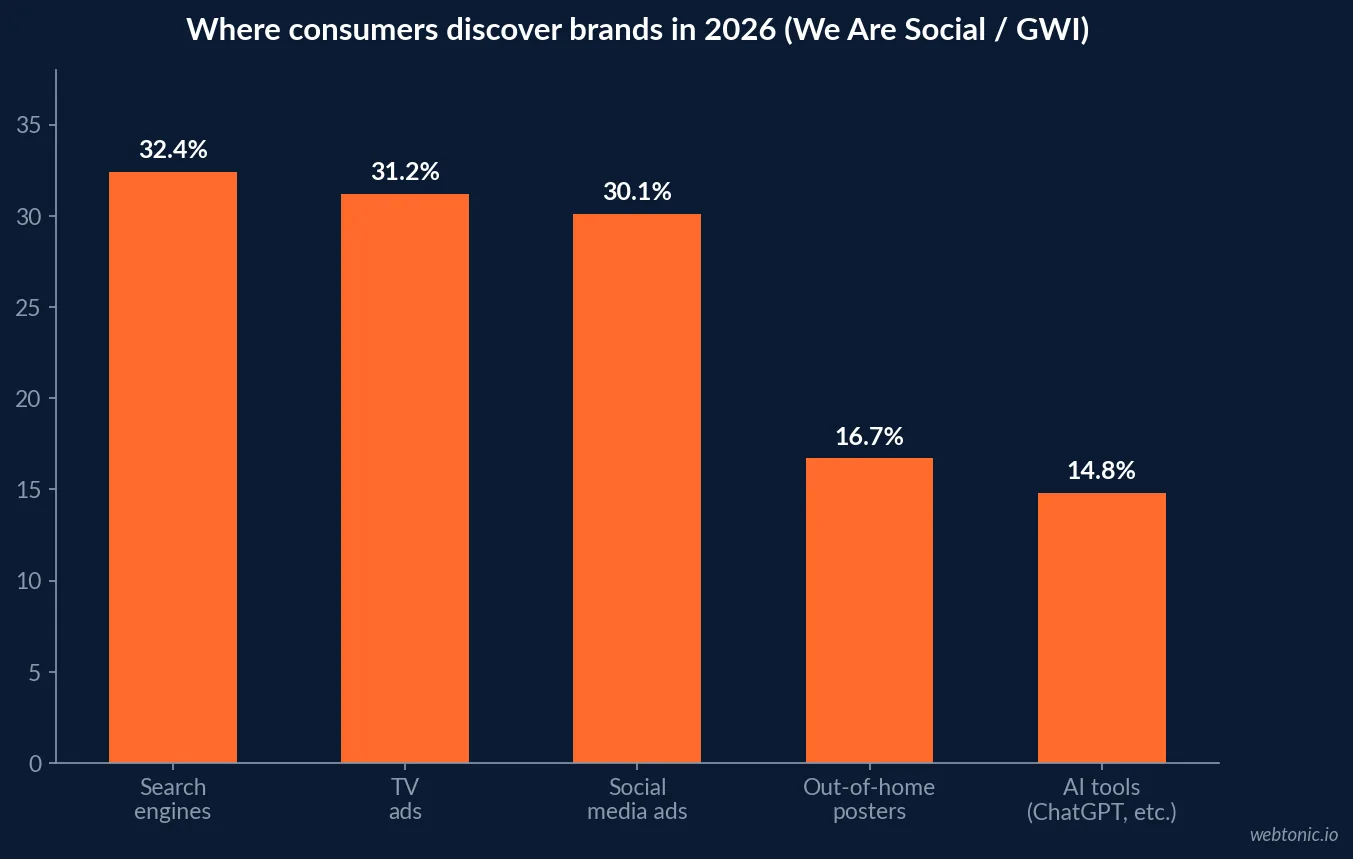
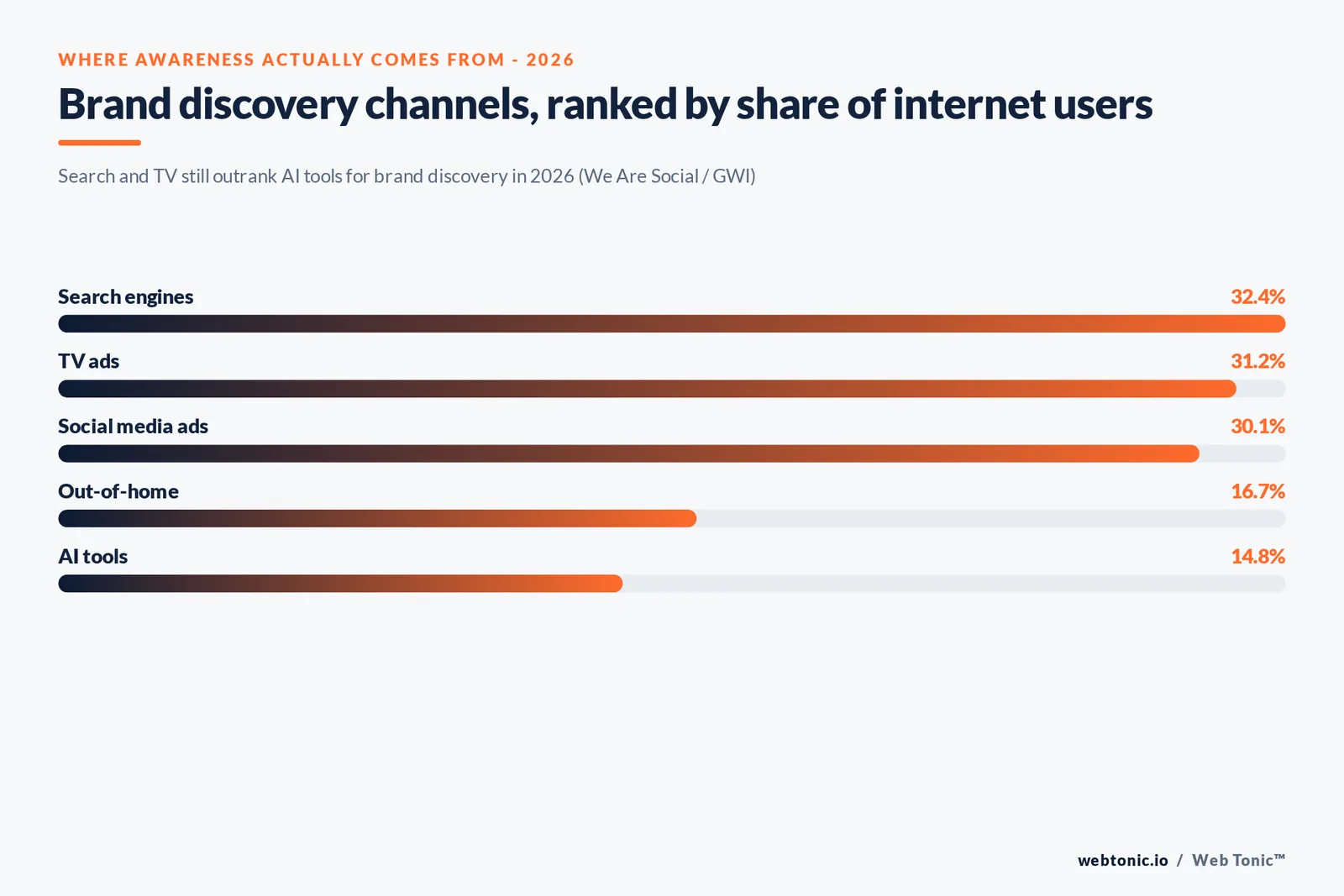
The channel mix behind brand awareness is more balanced than most marketing decks assume. We Are Social's Digital 2026 Mid-Year Global Update, citing GWI survey data, found 32.4% of internet users aged 16-plus say they discover new brands, products and services through search engines like Google. TV ads rank a close second at 31.2%, and social media ads sit third at 30.1%. Out-of-home posters and billboards land at 16.7%, and AI tools such as ChatGPT or Perplexity trail the entire list at 14.8%.
The AI figure is the one worth sitting with: despite intense marketing-press attention on AI-search visibility, AI tools do not yet crack the top five sources of brand discovery for the average internet user.
| Brand discovery channel (2026) | Share of internet users citing it | Source |
|---|---|---|
| Search engines | 32.4% | We Are Social / GWI, Digital 2026 |
| TV ads | 31.2% | We Are Social / GWI, Digital 2026 |
| Social media ads | 30.1% | We Are Social / GWI, Digital 2026 |
| Out-of-home posters and billboards | 16.7% | We Are Social / GWI, Digital 2026 |
| AI tools (ChatGPT, Perplexity, etc.) | 14.8% | We Are Social / GWI, Digital 2026 |
Search is still bigger than AI for brand research too
The same pattern holds once a consumer has already heard of a brand and starts researching it before buying. GWI's quarterly wave data, via We Are Social, shows the share of online adults using search engines to research brands fell from 51.3% in Q2 2024 to 45.8% in the most recent wave - a real decline of more than 10% over 18 months. Even after that decline, search usage for brand research is still more than double the 22.1% who say they use AI services like ChatGPT for the same task.
The trend line matters more than the snapshot: AI-assisted brand research is growing from a small base while search-assisted research is shrinking from a large one. Both statements are true in 2026, and neither means AI has caught up yet.
| Brand research behavior | Q2 2024 | Most recent wave (2026) | Direction |
|---|---|---|---|
| Use search engines to research brands | 51.3% | 45.8% | Down over 10% |
| Use AI platforms to research brands | n/a (small base) | 22.1% | Growing |
What awareness is worth once it converts
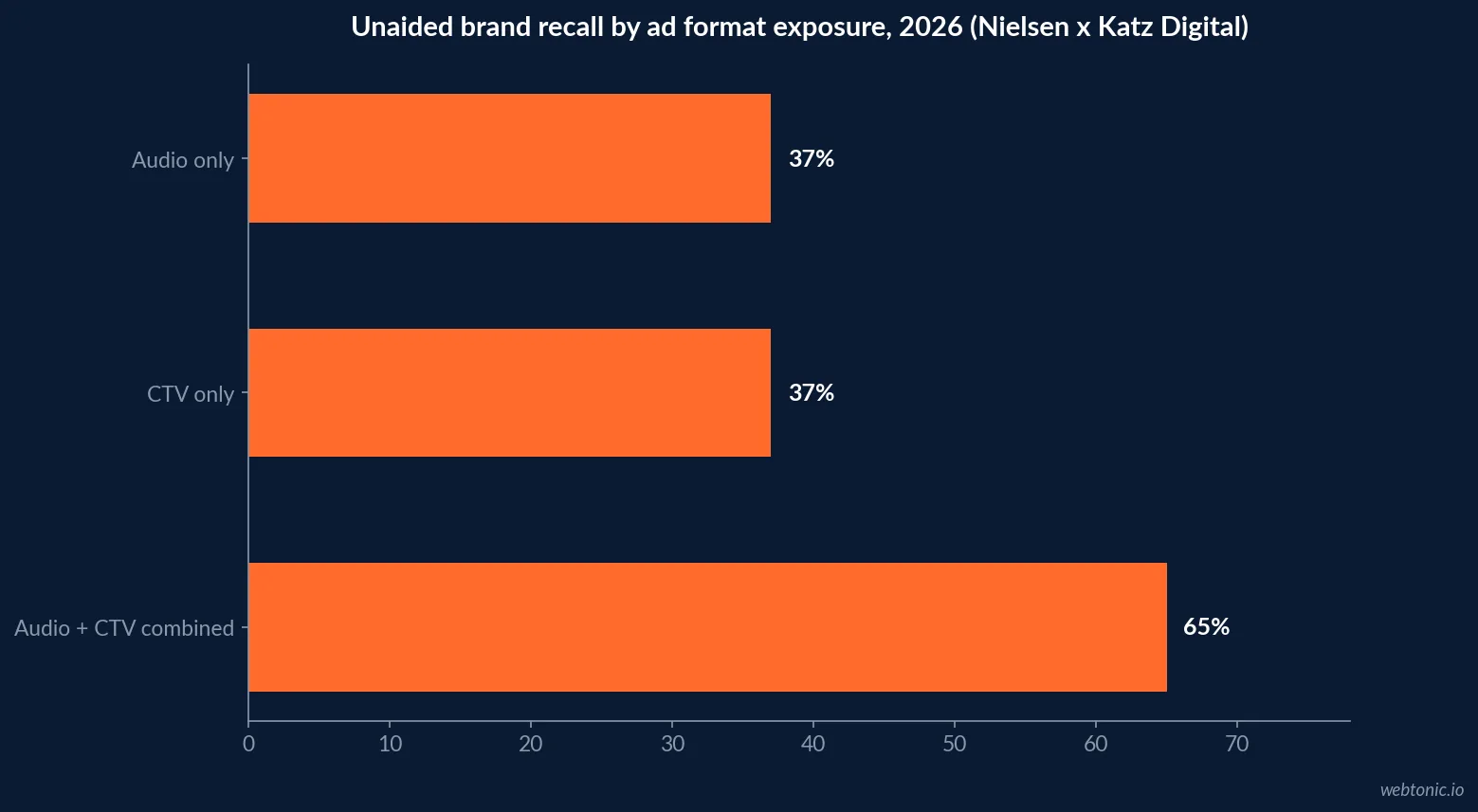
Awareness is a leading indicator, not an end state, and 2026 data quantifies the link. Nielsen's research with Katz Digital, testing digital audio and CTV as awareness vehicles among 600 respondents, found unaided brand recall nearly doubled: 37% for audio-only and 37% for CTV-only exposure, jumping to 65% when respondents experienced both formats together - a 28-point lift over either format alone. Overall awareness rose 12 points versus a control group, with the combined exposure driving the largest gain, at 32% versus 16% in the control.
Separately, Kantar and TikTok's premium-format research found 89% of consumers respond positively to high-impact ad formats on first exposure, and that high-visibility placements deliver up to 3.5 times higher recall lift than standard in-feed ads.
| Awareness lift fact (2026) | Figure | Source |
|---|---|---|
| Unaided recall, single format (audio or CTV) | 37% | Nielsen x Katz Digital, 2026 |
| Unaided recall, combined audio + CTV | 65% | Nielsen x Katz Digital, 2026 |
| Awareness lift vs control, combined exposure | 32% vs 16% | Nielsen x Katz Digital, 2026 |
| Positive response to premium ad formats | 89% | Kantar x TikTok, 2026 |
| Recall lift from high-visibility placements | Up to 3.5x | Kantar x TikTok, 2026 |
Brand awareness has reclaimed the top marketing goal
Marketer priorities shifted measurably this year. HubSpot's 2026 research into social media strategy found brand awareness pulled into the top spot among marketer goals at 58.99%, up from a three-way tie with customer service and retention at 29% each in 2025. Revenue and sales, once a top-three priority, now sits at 39.82%. HubSpot's read is that as tying social activity to revenue gets harder to prove, teams gravitate to the metric they can measure reliably: awareness.
That shift is happening alongside a platform-level change in where discovery lives. Sprout Social's 2026 statistics report platforms like YouTube, TikTok and Instagram now collectively drive over 60% of product discovery, while Google accounts for only 34.5% of total search share in that specific context - and 52% of Gen Z say they trust brand information on social media more than information from Google or AI chatbots.
| Marketer priority / platform fact (2026) | Figure | Source |
|---|---|---|
| Marketers naming brand awareness the top social goal | 58.99% | HubSpot, 2026 |
| Same goal's share one year earlier | 29% (tied) | HubSpot, 2025 comparison |
| Marketers naming revenue/sales the top goal | 39.82% | HubSpot, 2026 |
| Product discovery on YouTube/TikTok/Instagram | 60%+ | Sprout Social, 2026 |
| Gen Z trusting social brand info over Google/AI | 52% | Sprout Social, 2026 |
Paid formats can multiply awareness lift, not just add to it
Format choice compounds rather than just adds to recall. Kantar and TikTok's premium-effectiveness research found a standard in-feed placement already delivers a +35% recall uplift, but pairing it with a high-visibility placement like TopView grows that as much as 3.3 times higher. The same research found premium placements deliver an average +81% lift in Salience - the brand-strength dimension tied most closely to being remembered at the moment of a purchase decision - across the seven markets studied.
The takeaway for a 2026 media plan is not "spend more," it is "stack formats deliberately": the awareness data above shows combined exposure beating single-format exposure by wide, repeatable margins in three independent studies (Nielsen, Kantar, and the search-versus-social data earlier on this page).
| Format-stacking fact (Kantar x TikTok, 2026) | Figure |
|---|---|
| Recall uplift, standard in-feed placement | +35% |
| Recall uplift, in-feed + high-visibility placement | Up to 3.3x higher |
| Average Salience lift from premium placements | +81% |
| Markets studied | 7 |
Awareness matters in B2B too, not just consumer brands
Moburst's review of B2B influencer and ambassador data for 2026 shows brand awareness remains one of the two most common campaign objectives cited by B2B marketers running these programs, alongside credibility. HubSpot's 2026 State of Marketing Report reinforces the same point from the buyer side: as AI floods every channel with generic content, distinctiveness and brand recognition are becoming the growth lever, not just a top-of-funnel vanity metric.
Trust compounds that effect. The 2026 Edelman Trust Barometer found trust now sits alongside quality and price as one of the top factors people weigh before buying, which means an awareness campaign that builds recognition without also building trust is doing only half the job.
How to read brand awareness metrics without overclaiming
Awareness surveys measure stated recall, not verified behavior, so treat every percentage above as directional rather than exact. The more reliable signal is the consistency across independent studies: Kantar, Nielsen, We Are Social and HubSpot, each using different methodologies, all converge on the same conclusion for 2026 - traditional discovery channels remain larger than AI-driven ones, and combined-format exposure beats single-format exposure by a wide, repeatable margin.
Our growth marketing practice builds the multi-touch measurement that separates a real awareness lift from noise, and our guide to building a search strategy around real discovery data applies the same channel-mix thinking to paid search.
What to track if you are building an awareness program in 2026
Start with unaided recall, not just impressions, since Nielsen's data shows format combination moves recall far more than raw frequency inside a single channel. Track discovery-channel mix quarterly rather than annually, since GWI's own data shows an 18-month shift of more than 10% in search-for-research behavior. And treat AI-search visibility as an emerging line item worth monitoring, not yet a channel to fund at the expense of search or social, given it still sits under 15% of stated brand discovery.
Talk to us if you want that tracking built into a reporting cadence rather than pulled from an annual industry report - get in touch or see our data and analytics practice.
Frequently Asked Questions
What channel drives the most brand awareness in 2026?
Search engines still lead. We Are Social's Digital 2026 Mid-Year Global Update, drawing on GWI survey data, found 32.4% of internet users aged 16-plus discover new brands via search engines, ahead of TV ads at 31.2% and social media ads at 30.1%. AI tools like ChatGPT trail at 14.8%, behind even out-of-home advertising at 16.7%.
How much does brand awareness actually affect conversion?
Kantar's brand measurement research reports higher ad recall correlates with a median 12% lift in purchase consideration, and its BrandZ framework consistently finds higher-awareness brands convert more efficiently than unknown ones. Separately, HubSpot's 2026 research on social media goals found brand awareness has reclaimed the top spot among marketer priorities, cited by 58.99% of marketers versus 29% a year earlier.
Is social media or search still the bigger brand discovery channel?
Both matter, and their relative weight is shifting slowly rather than flipping. We Are Social's 2026 data puts search at 32.4% of brand discovery and social media ads at 30.1%, a gap of roughly two points that has narrowed from prior years. Sprout Social separately reports platforms like YouTube, TikTok and Instagram now collectively drive over 60% of product discovery specifically, as distinct from broader brand discovery.
Are AI chatbots replacing search for brand discovery?
Not yet, based on 2026 data. GWI's survey work, reported via We Are Social, found only 14.8% of internet users discover brands through AI tools, and the share of people using search engines to research brands before buying, while it has fallen from 51.3% in Q2 2024 to 45.8% in the most recent wave, is still more than double the 22.1% who say they use AI platforms like ChatGPT for the same task.
What is brand recall and why does it matter for awareness?
Brand recall measures whether someone remembers your brand without being shown it (unaided) or after seeing a name or logo (aided). Nielsen's 2026 research with Katz Digital found unaided recall nearly doubled, from 37% for a single-format exposure to 65% for a combined digital audio plus CTV exposure, showing recall is highly sensitive to how many formats a message runs across, not just how often it runs.
Sources
We Are Social - Digital 2026 Mid-Year Global Update Report
Nielsen - Digital Audio + CTV brand-lift study, 2026
Kantar - TikTok premium-format effectiveness research, 2026
Sprout Social - 120+ Social Media Marketing Statistics for 2026
HubSpot - 11 social media trends every marketer should watch in 2026
Kantar - 10 Charts to Make You a More Effective Marketer, 2026
Moburst - The State of Influencer Marketing for B2B Brands in 2026
HubSpot - 2026 State of Marketing Report
PR Newswire - 2026 Edelman Trust Barometer findings