Table of contents
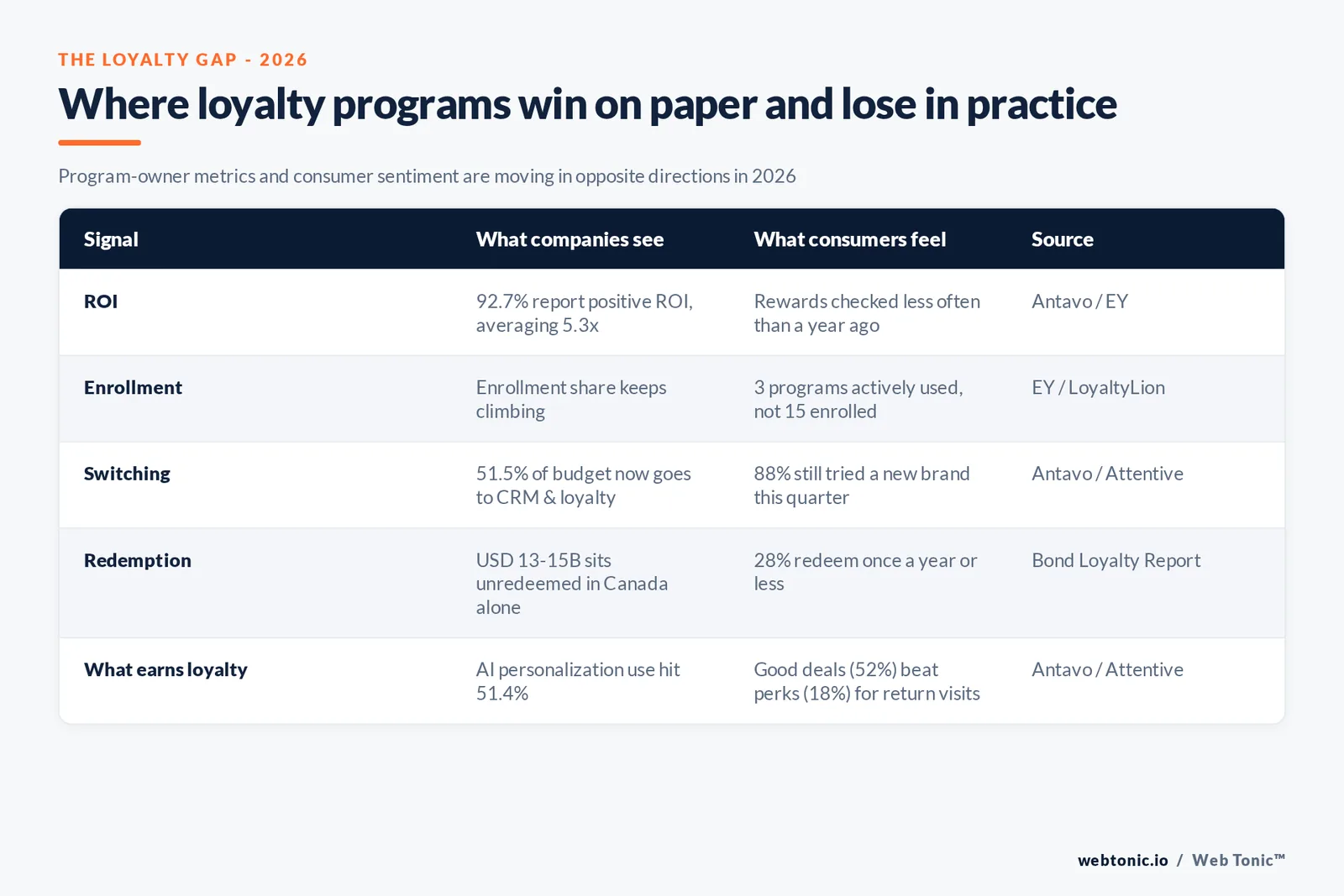
Loyalty programs report their best ROI in three years, yet 88% of shoppers tried a new brand last quarter anyway. Both statistics are true in 2026, and the gap between them is the most useful thing the data says about how brand loyalty actually works today.
Key Takeaways
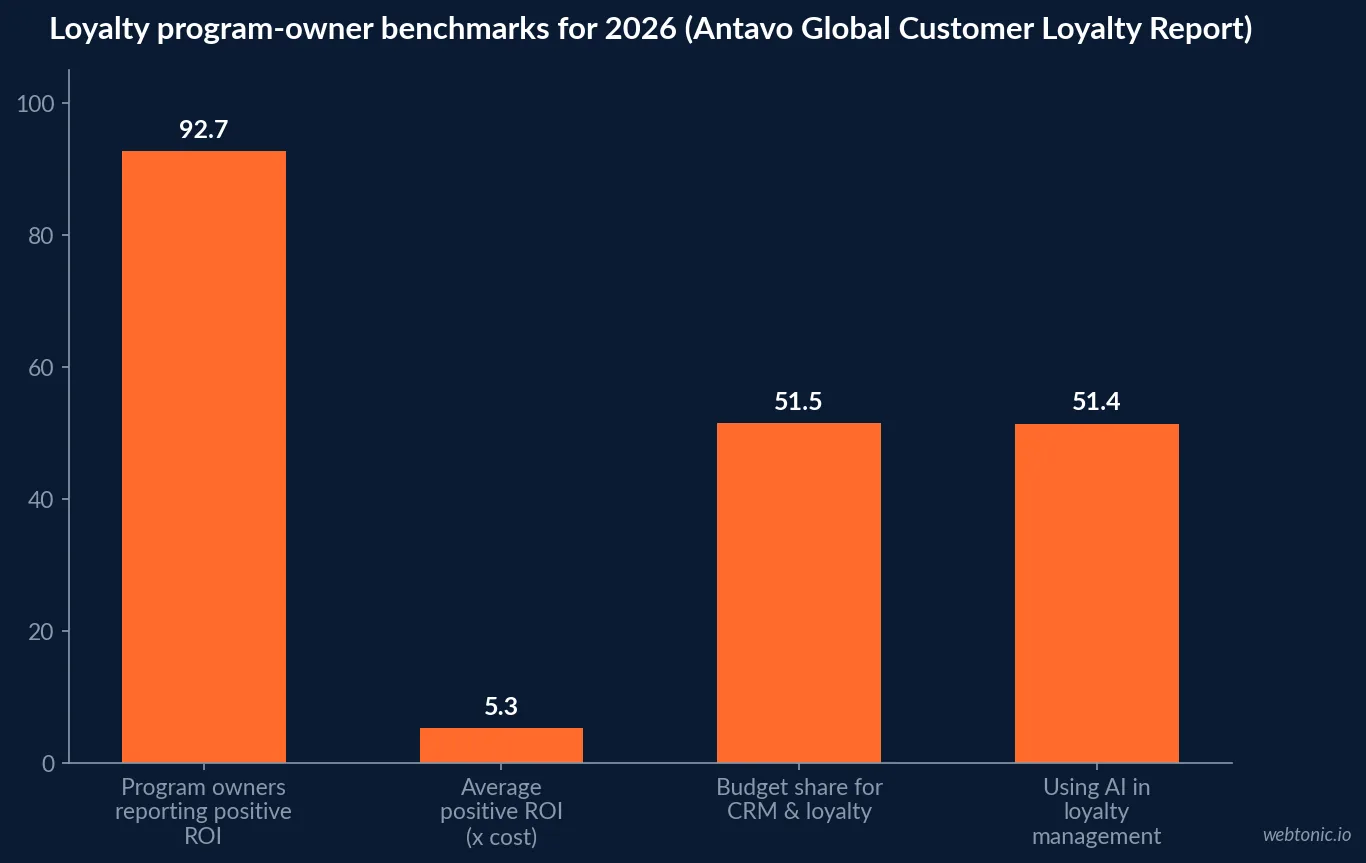
- 92.7% of loyalty program owners who track ROI report a positive return.
- The average positive ROI reported is 5.3x, a third consecutive annual increase.
- Program owners allocate 51.5% of marketing budget to CRM and loyalty combined.
- 51.4% of marketers now use AI in loyalty program management, up from 37.1%.
- 88% of shoppers bought from a new-to-them brand in the past three months.
- Yet 77% of shoppers still shop regularly with five brands or fewer.
- 85% of Gen Z shoppers keep their regular list to five brands or fewer, too.
- 90% say loyalty program membership drives repeat purchases from that brand.
- Consumers now engage with 3 loyalty programs on average, up from 2.8 in 2025.
- Good deals bring shoppers back for 52%, more than any single loyalty perk.
- Exclusive loyalty offers rank sixth among return-shopping reasons, at only 18%.
- More than half of consumers now check rewards less often than a year ago (EY).
- 70% of Gen Z feel emotionally connected to a loyalty brand, versus 41% of Boomers.
- 59% are more likely to sign up for a loyalty program than 12 months ago.
Loyalty programs are reporting their best ROI in years
Antavo's Global Customer Loyalty Report 2026, built from 3,000 surveyed program owners, a 10,000-person consumer panel and 500 million tracked member interactions, found 92.7% of program owners who measure performance report a positive ROI, with the average positive return reaching 5.3x - the third consecutive annual increase. 83.0% of program owners say they are satisfied with their program, up sharply from 69.2% a year earlier and 50.6% in 2022. Program owners now put 51.5% of their marketing budget toward CRM and loyalty combined, and 51.4% already use AI somewhere in loyalty program management, up from 37.1% the year before.
| Loyalty program-owner metric (2026) | Figure | YoY trend | Source |
|---|---|---|---|
| Program owners reporting positive ROI | 92.7% | Up from ~90% | Antavo Global Customer Loyalty Report |
| Average reported positive ROI | 5.3x | Third straight increase | Antavo Global Customer Loyalty Report |
| Program owner satisfaction | 83.0% | Up from 69.2% | Antavo Global Customer Loyalty Report |
| Marketing budget share for CRM + loyalty | 51.5% | n/a | Antavo Global Customer Loyalty Report |
| Marketers using AI in loyalty management | 51.4% | Up from 37.1% | Antavo Global Customer Loyalty Report |
Where the growing gap actually shows up
The same year that loyalty ROI hit a new high, EY's 2026 Loyalty Market Study, now in its third edition, surveyed over 1,400 consumers and roughly 300 corporate loyalty employees and found a widening disconnect: organizational performance metrics like enrollment and revenue contribution keep climbing, but more than half of consumers say they are checking their rewards less frequently than in prior years, shifting from weekly to monthly behavior. Delayed payoff issues, including expiring points and reward thresholds that feel too high, remain a top consumer frustration even as programs get more sophisticated and more AI-driven.
EY's framing is the useful one for strategy: a program can be delivering strong results by every traditional business measure while the customer experiencing it feels progressively less connected to it.
| Consumer sentiment fact (EY 2026) | Figure |
|---|---|
| Consumers checking rewards less often than a year ago | More than half |
| Reward-checking frequency shift | Weekly to monthly |
| Top consumer frustration | Delayed payoff / expiring points |
| Organizational performance trend | Enrollment and ROI both rising |
Loyalty does not stop customers from trying new brands
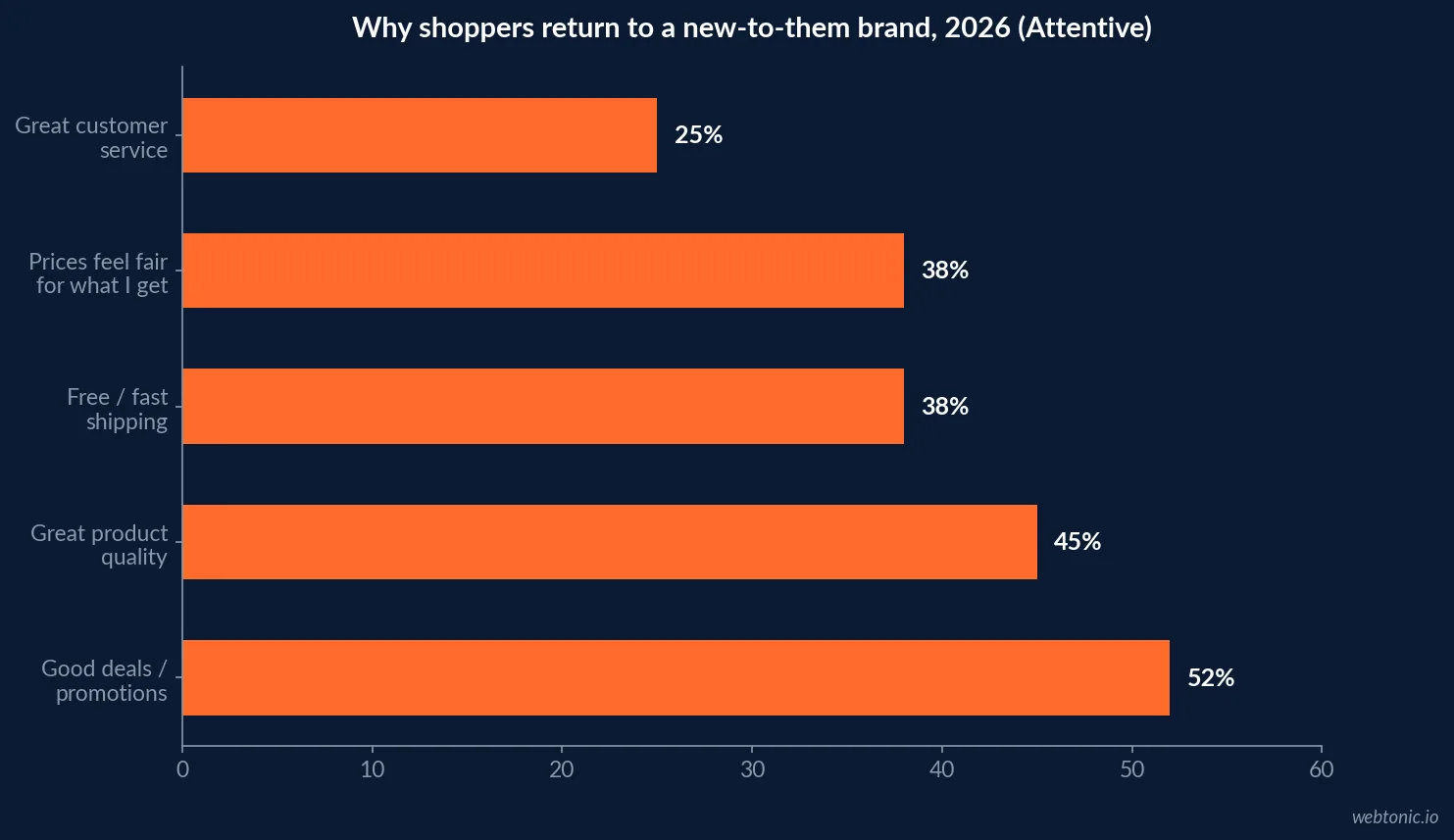
Attentive's 2026 State of Loyalty & Retention survey of 600 US consumers found 88% shopped from a new-to-them brand in the past three months. Despite that, loyalty is not disappearing: 77% of shoppers (and 85% of Gen Z) still say they shop regularly with five brands or fewer. What actually earns a repeat visit skews toward value more than perks: 52% cite good deals or promotions, 45% cite product quality, and 38% cite free or fast shipping - exclusive loyalty program offers rank sixth, cited by only 18%.
| Reason shoppers return to a new brand (Attentive 2026) | % citing it |
|---|---|
| Good deals / promotions | 52% |
| Great product quality | 45% |
| Free / fast shipping options | 38% |
| Prices feel fair for what I get | 38% |
| Great customer service | 25% |
| Exclusive loyalty program offers | 18% |
What does move loyalty behavior
LoyaltyLion's 2026 research finds 90% of shoppers say program membership makes them repeat-purchase from that brand, and 60% are more likely to visit a store where they hold points or rewards to redeem. Consumers are now actively engaged with 3 loyalty programs on average, up from 2.8 in 2025, logging in roughly 10 times a month. Generational splits are sharp: 70% of Gen Z feel more emotionally connected to a brand as a loyalty member, against only 41% of Boomers, and 59% of all consumers say they are more likely to sign up for a loyalty program today than 12 months ago, a shift separate 2026 research attributes partly to inflation pushing shoppers to re-evaluate every subscription and membership they hold.
| Consumer loyalty behavior (2026) | Figure | Source |
|---|---|---|
| Say membership drives repeat purchase | 90% | LoyaltyLion, 2026 |
| More likely to visit stores to redeem points | 60% | LoyaltyLion, 2026 |
| Average programs actively engaged with | 3 | LoyaltyLion, 2026 (up from 2.8) |
| Average program logins per month | 10 | LoyaltyLion, 2026 |
| Gen Z feeling emotionally connected as a member | 70% | LoyaltyLion, 2026 |
| Boomers feeling emotionally connected as a member | 41% | LoyaltyLion, 2026 |
| More likely to sign up than 12 months ago | 59% | LoyaltyLion, 2026 |
The redemption gap: where "earned" loyalty stalls
Early Canadian data from the 2026 Bond Loyalty Report, now in its 16th year and drawing on more than 9,500 consumers across 165-plus programs, found Canadians are sitting on an estimated USD 13 to 15 billion in unredeemed loyalty points. Surveyed members belong to 15 loyalty programs on average, yet 28% redeem just once a year or less - the "earn" side of loyalty is working, the "burn" side is not. Members are noticing the friction too: the importance rating for ease of claiming rewards climbed from 69% in 2025 to 73% in 2026.
Bond's own 2026 Public Executive Summary names this directly as a widening gap between program potential and program delivery - the same disconnect EY's study measures from the consumer-sentiment side. Loyalty partnerships are the one lever both reports agree is working: Bond reports partnership-driven programs see year-over-year lifts of 53% in experience metrics and 49% in spend where the partner ecosystem is strong.
| Redemption-gap fact (Bond 2026 Canadian data) | Figure |
|---|---|
| Estimated unredeemed loyalty points | USD 13-15 billion |
| Average programs belonged to per member | 15 |
| Members redeeming once a year or less | 28% |
| Importance of easy redemption, 2025 vs 2026 | 69% -> 73% |
| Spend lift from strong partner ecosystems | +49% YoY |
What this means for a 2026 loyalty strategy
The data points toward the same conclusion from two different directions. Antavo and EY show loyalty programs are performing better than ever on the metrics companies control - ROI, enrollment, budget share. Attentive and LoyaltyLion show the metrics customers control - how often they check rewards, how many brands they stay loyal to, what actually earns a repeat visit - are flattening or shifting away from perks toward plain value. Building a 2026 loyalty program on the assumption that a points system alone will offset a weaker price or product is not what the consumer-side data supports.
Pair loyalty mechanics with real value signals, not instead of them. Our data and analytics practice builds the enrolled-versus-engaged tracking that catches this kind of gap before it shows up in churn, and our guide to budgeting paid acquisition against retention covers the other half of that trade-off.
Loyalty spend is shifting toward partnerships and AI
Two 2026 studies point the same direction on where new loyalty investment is going. Antavo's data shows 50.9% of program owners already offer AI-driven personalization inside their loyalty program, and self-rated AI readiness sits at 6.3 out of 10 for existing program owners against 5.6 for brands only planning to launch one. Bond's 2026 data shows the other growth lever is partnerships: programs with a strong partner ecosystem see 53% higher experience-metric gains and 49% higher spend year over year than programs without one.
Both levers solve for the same underlying problem this page has tracked throughout: getting customers to actually feel and use the value a loyalty program already generates on paper.
| Where loyalty investment is going (2026) | Figure | Source |
|---|---|---|
| Program owners offering AI-driven personalization | 50.9% | Antavo, 2026 |
| AI-readiness score, existing program owners (of 10) | 6.3 | Antavo, 2026 |
| AI-readiness score, brands planning to launch (of 10) | 5.6 | Antavo, 2026 |
| Experience-metric lift from strong partnerships | +53% YoY | Bond Loyalty Report, 2026 |
| Spend lift from strong partnerships | +49% YoY | Bond Loyalty Report, 2026 |
How to read loyalty ROI claims critically
A 5.3x average ROI is real, but it is an average across programs that measure ROI at all - Antavo's own data implies a meaningful share of programs either do not measure it or do not report a positive number. Before citing an industry-wide loyalty ROI figure internally, confirm your own program's enrolled-to-active ratio first; a high enrollment number with a low active-engagement number, the gap EY's 2026 study specifically flags as growing, will overstate the program's real contribution far more than any single ROI benchmark understates it.
Talk to us if you want that measurement built properly - get in touch or explore our growth marketing services.
Frequently Asked Questions
Are loyalty programs actually working in 2026?
By the metrics companies track, yes. Antavo's Global Customer Loyalty Report 2026, surveying 3,000 program owners plus a 10,000-consumer panel, found 92.7% of program owners who measure ROI reported a positive return, averaging 5.3x, the third straight annual increase. But EY's 2026 Loyalty Market Study found a widening gap: performance metrics keep improving while consumer sentiment toward the same programs is flattening, with more than half of consumers checking rewards less often than a year ago.
How many loyalty programs does the average person belong to?
LoyaltyLion's 2026 research puts it at 3 programs actively engaged with on average, up from 2.8 in 2025, though older industry benchmarks citing Bond Brand Loyalty data put total enrolled memberships much higher, around 17 per person, with only about half actively used. The gap between enrolled and engaged is consistently the more important number for brands to track than raw sign-ups.
Does brand loyalty actually prevent customers from switching?
Not as much as brands would like. Attentive's 2026 State of Loyalty & Retention survey of 600 US consumers found 88% shopped a new-to-them brand in the past three months, and even so, 77% say they shop regularly with five brands or fewer. Loyalty programs narrow the field of brands a customer sticks to; they do not stop customers from trying new ones.
What makes a loyalty program actually change buying behavior?
LoyaltyLion's 2026 data found 90% of shoppers say program membership makes them repeat-purchase from that brand, and 60% are more likely to visit stores where they can redeem points, but the reasons Attentive's survey found bringing shoppers back most often were good deals (52%) and product quality (45%) - exclusive loyalty perks ranked well below both, at 18%. Programs work best layered on genuine value, not as a substitute for it.
Is loyalty program spend increasing in 2026?
Yes on the corporate side. Antavo's 2026 report found program owners now allocate 51.5% of marketing budget to CRM and loyalty combined, and 51.4% of marketers use AI in loyalty program management, up from 37.1% a year earlier. EY's 2026 study separately reports rising enrollment share and a growing share of annual sales now attributed to loyalty members across the sectors it surveyed.
Sources
Antavo - Global Customer Loyalty Report 2026
EY - 2026 Loyalty Market Study
Attentive - 2026 State of Loyalty & Retention
LoyaltyLion - Customer Loyalty in 2026
Doss - The Loyalty Tax: How 2026 Inflation Is Breaking American Brand Loyalty
The Wise Marketer - 2026 Bond Loyalty Report Canadian data
Bond - The 2026 Bond Loyalty Report, Public Executive Summary