Table of contents

Social channel is where consumers discover, research, and increasingly acquire skincare items — making it the most influential acquisition channel in the the category the broader care category sector today. This report compiles the most important digital promotion statistics for the the category and skincare sector in 2026, covering response levels benchmarks, platform shifts, influencer economics, and the explosive expansion of platform-native selling. The data comes from platform-level benchmark studies, earned channel value analyses, and consumer surveys across the United States and global markets. Whether you sell skin care products through your own site or via platform-native selling platforms, these statistics will help you set realistic targets and allocate your digital creative budget where it generates the highest return.
Key Takeaways
- The top 100 cosmetics operators generated $39.9 billion in Earned Media Value in 2025, up 17.1% year-over-year — with the short-video platform overtaking Instagram as the number-one the category platform for the first time (WeArisma).
- the short-video platform generated $18.1 billion in earned value (up 55.6%), while Instagram's share declined — a historic platform shift that is reshaping how labels in the space allocate digital promotion budgets (WeArisma).
- the short-video marketplace recorded $980 million in US beauty sales in Q2 2026 alone, an 82% increase year-over-year — now roughly one-third of Ulta's quarterly revenue (Charm.io).
- 30% of buyers in the category in the United States now purchase skincare products directly through the short-video marketplace (Tinuiti).
- Average the vertical activity rate on the short-video platform dropped to 2.8% (from 3.6%), while Instagram fell to 2.1% (from 2.9%) — but views are up 23% and 26% respectively, showing that reach is growing even as per-post response levels normalizes (Dash Social).
- The global global cosmetics sector is projected to surpass $720 billion in 2026, with digital advertising accounting for 43.7% of total ad spend (Statista).
Beauty Social Media Benchmarks at a Glance (2026)
Before exploring the platform-level statistics, here is how the key digital promotion metrics stack up across the beauty and skincare industry in 2026:
| Metric | 2026 benchmark | YoY change | Source |
|---|---|---|---|
| the short-form app beauty activity rate | 2.8% | ↓ from 3.6% | Dash Social |
| Instagram beauty activity rate | 2.1% | ↓ from 2.9% | Dash Social |
| the short-form app beauty views expansion | +23% YoY | Reach outpaces interaction levels | Dash Social |
| Instagram beauty views growth | +26% YoY | Discovery expanding via Reels | Dash Social |
| YouTube beauty views growth | +128% YoY | Highest growth; avg watch time 102% | Dash Social |
| Total earned value (top 100 brands) | $39.9B | ↑ 17.1% | WeArisma |
| the short-video marketplace beauty GMV (Q2 2026) | $980M | ↑ 82% | Charm.io |
The overarching trend: consumers are watching more beauty creative material than ever (views up across every major platform), but engaging less per post as the market saturates. The brands winning in this environment are the ones that prioritize reach, video content quality, and social selling conversion over vanity engagement statistics.
the short-form app Overtakes Instagram as the Top Beauty Platform
For the first time in the history of digital promotion, the platform has surpassed Instagram as the most influential platform for brands across the sector. The WeArisma Beauty Influence Index 2026 — tracking Earned Media Value across the top 100 cosmetics operators worldwide — confirms the shift (WeArisma):
- the platform generated $18.1 billion in earned value, up 55.6% year-over-year — making it the single biggest source of earned media value for skincare and cosmetics brands globally.
- Instagram's beauty EMV declined for the first time, ceding the top position it held since the platform launched.
- L'Oréal Paris leads all cosmetics operators at $2.8 billion in EMV (up 49% YoY), while Rhode — Hailey Bieber's skincare brand — entered the top 10 with $1 billion in EMV (up 95%).
- K-Beauty nearly doubled overnight, with EMV growth of 90.3%. Medicube posted the biggest brand jump in the index at +293%, driven by precise creator activations rather than broad campaigns.
This platform shift has direct implications for how cosmetics operators allocate their digital creative budgets: labels in the space that are still primarily investing in Instagram-first creative strategies are falling behind competitors that have rebuilt their marketing content workflows around short-form video for the platform.
Social Commerce: How Consumers Buy Skincare Products on Social Media
Social selling is rapidly transforming from a niche purchase channel into a mainstream way that consumers buy cosmetic goods. The statistics for 2026 make the scale unmistakable:
- the short-video marketplace generated $980 million in US beauty GMV in Q2 2026, an 82% increase from the same period last year and 6% above Q1 — equivalent to roughly one-third of Ulta Beauty's quarterly net sales of $3.16 billion (Charm.io).
- In June 2026 alone, beauty sales on the platform Shop reached $330 million, helping push total US the platform Shop sales above $2 billion for the month across all product categories.
- Skincare is TikTok Shop's biggest beauty category, generating $844.1 million over the trailing 12 months and more than doubling year-over-year.
- According to Tinuiti's 2026 Beauty Marketing Study, 30% of buyers in the category in the United States now acquire skin care items directly through TikTok Shop — up from negligible adoption just two years ago (Tinuiti).
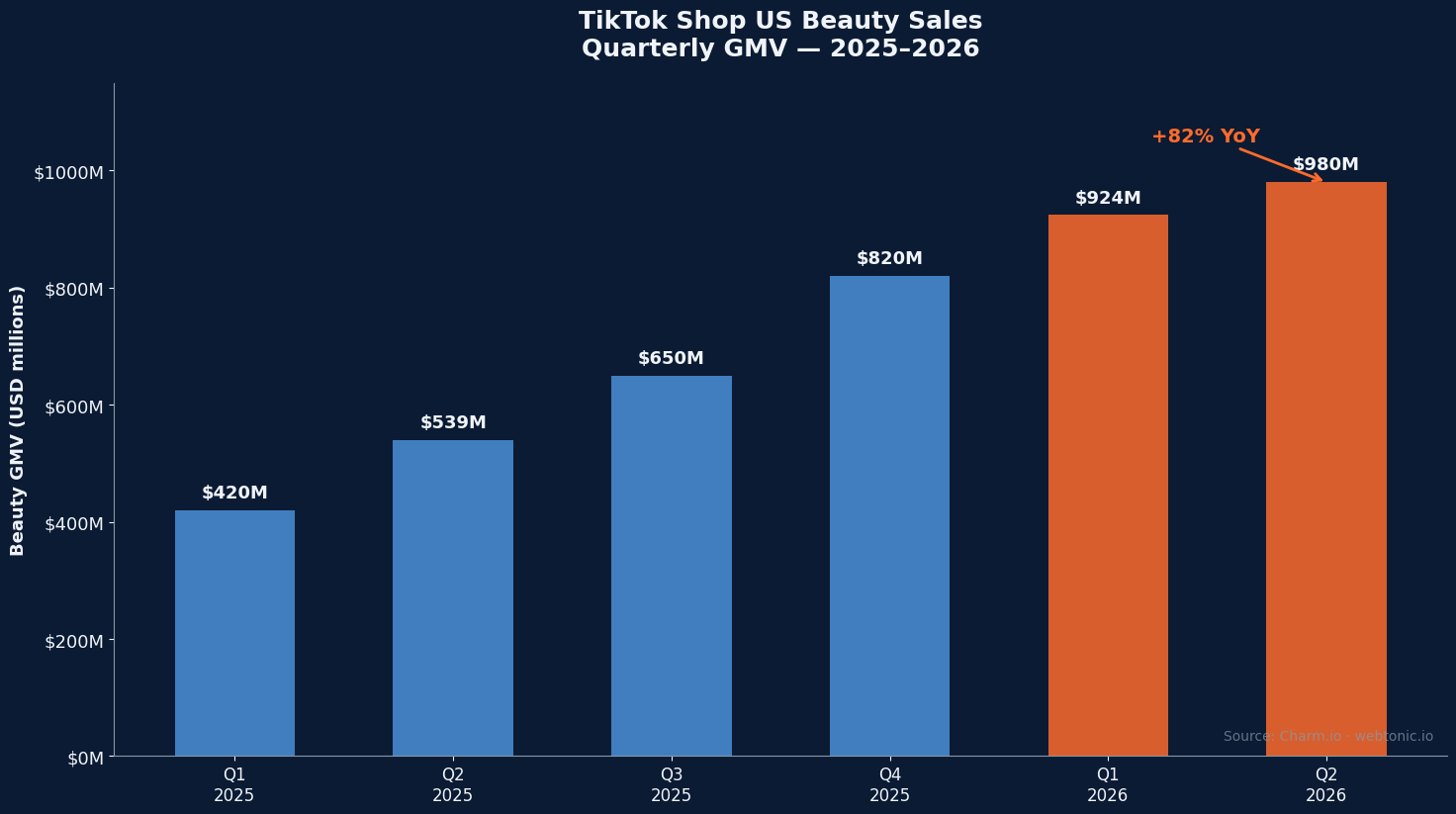
The social commerce statistics challenge a core assumption in beauty marketing: the idea that these channels drives awareness while other channels drive conversion. For a growing share of consumers — especially Gen Z and younger millennials — TikTok is now the entire funnel, from product discovery through skincare routines inspiration to checkout.
Platform Engagement Statistics for Beauty Brands
Dash Social's 2026 the vertical benchmarks provide the most granular view of how skincare and beauty brands perform across each these channels platform (Dash Social):
| Platform | Engagement rate | Views YoY | Key insight |
|---|---|---|---|
| TikTok | 2.8% (↓ from 3.6%) | +23% | Reach outpaces engagement; retention at 23% |
| 2.1% (↓ from 2.9%) | +26% | Discovery expanding; Reels driving new reach | |
| YouTube | — | +128% | High-intent viewing; avg watch time 102% of video length (repeat plays) |
The apparent paradox — interaction rates falling while views surge — actually reflects a maturing market. More consumers are seeing beauty content than ever, but they interact less per post because the volume of skincare content in their feeds has grown enormously. For beauty brands, this means that reach and video views are now more meaningful performance indicators than likes or comments for evaluating these channels marketing effectiveness.

The Skincare Industry Market Context
The these channels statistics sit inside a broader skincare industry that continues to grow at a strong compound annual expansion rate. Key market statistics for context:
- The global beauty the broader care category market is projected to reach $720 billion in total revenue in 2026 (Statista), driven by accelerated growth in skin care across North America, Asia, and the Middle East.
- Digital advertising now accounts for 43.7% of beauty ad spend, up from 34.1% in 2022. The lion's share of that digital budget flows into social media advertising on Meta, TikTok, and YouTube.
- The skincare industry specifically continues to outpace the broader personal care market, with premium skincare products in the United States showing particular strength among consumers aged 25–44 who discover products through digital creative and influencer recommendations.
- Skincare routines have become a content category in their own right — "get ready with me" and "skincare routine" videos are among the highest-performing beauty content formats on TikTok and Instagram, generating billions of views annually.
For brands developing their social media acquisition strategy, the market statistics confirm that beauty and skin care products are uniquely suited to social platforms: they are visual, routine-based, ingredient-driven, and benefit from the trust that creator content builds among consumers researching what to put on their skin.
7 Data-Backed Social Media Best Practices for Beauty and Skincare Brands
- Prioritize TikTok for reach and commerce. TikTok now generates more beauty EMV than Instagram, and TikTok Shop is approaching $1 billion per quarter in beauty sales. Skincare brands should build their creative production around short-form video for TikTok first, then repurpose for Reels and Shorts.
- Invest in creator partnerships over brand-produced content. The K-Beauty surge (+90.3% EMV) was driven by precise creator activations, not broad media campaigns. Micro and mid-tier creators who genuinely use your skincare products generate more trust and social media engagement than polished brand ads.
- Build a social commerce funnel. With 30% of consumers in the United States already buying cosmetic goods on TikTok Shop, labels in the space without a social commerce presence are missing an increasingly large share of consumer purchases. Set up TikTok Shop and track conversion alongside traditional social media marketing metrics.
- Optimize for views and reach, not just engagement. Engagement rates are declining industry-wide (TikTok 2.8%, Instagram 2.1%), but views are surging. Measure content performance by reach and video completion rather than likes alone.
- Create ingredient-education content. Consumers research skincare ingredients (retinol, niacinamide, hyaluronic acid) on digital channels before choosing products. Brands that produce educational content about specific ingredients and skin concerns build authority and capture high-intent audiences.
- Leverage YouTube for high-intent audiences. YouTube beauty views grew 128% with average watch times exceeding 100% of video length (meaning consumers rewatch). Long-form tutorials and skin care routine videos on YouTube attract consumers with deeper purchase intent than short-form platforms.
- Integrate social media with paid and organic search. Social media content feeds both paid acquisition (via Meta Ads and TikTok advertising) and organic search (blog content built from social proof). The most effective beauty marketing strategies pair social content with growth marketing programs that track the full customer journey from social discovery to purchase.
For a deeper look at how paid social fits into your acquisition mix, see our guide to building a strategy that improves ROI across all channels.
Related reading
- Urgent Care and Primary Care Social Media Marketing Benchmarks
- Senior Living Social Media Marketing Data and Older Adult Usage
- Mental Health and Counseling Social Media Marketing Benchmarks for 2026
- Content Marketing services at Web Tonic
FAQ: Beauty and Skincare Social Media Marketing Statistics
What is the average interaction rate for beauty brands on TikTok in 2026?
The average beauty industry engagement rate on TikTok is 2.8%, down from 3.6% in the prior period. Top-performing skincare brands previously achieved 7–9%, but as the platform matures and content volume grows, engagement per post normalizes while total views continue rising (up 23% YoY).
How much revenue does TikTok Shop generate for brands across the sector?
TikTok Shop generated $980 million in US beauty sales during Q2 2026, up 82% year-over-year. Skincare is the largest beauty category on the platform, with $844 million in trailing-12-month sales. For context, TikTok Shop's quarterly beauty GMV is now roughly one-third of Ulta Beauty's quarterly revenue.
Which social media platform is most important for skincare brands in 2026?
TikTok has overtaken Instagram as the number-one social media platform for beauty brands for the first time, generating $18.1 billion in Earned Media Value (up 55.6%) versus declining EMV on Instagram. However, Instagram remains critical for discovery (views up 26%), and YouTube is the fastest-growing beauty platform by views (+128%).
What percentage of consumers buy skincare products through social media?
30% of beauty consumers in the United States now purchase skin care products directly through TikTok Shop, according to Tinuiti's 2026 Beauty Marketing Study. This represents a fundamental shift in the purchase funnel for cosmetic goods, with digital channels serving as both discovery and transaction channels for a growing share of consumers.
How big is the global skincare and beauty market in 2026?
The global beauty personal care market is projected to reach $720 billion in total revenue in 2026, with the skincare industry growing at a compound annual growth rate that outpaces the broader personal care category. Digital advertising now accounts for 43.7% of total beauty ad spend, with digital channels absorbing the largest share of that digital budget.
Sources
Dash Social — 2026 Beauty Industry Social Media Benchmarks
WeArisma — Beauty Influence Index 2026
Charm.io — TikTok Shop Beauty Sales Data Q2 2026
Tinuiti — 2026 Beauty Marketing Study
Pennock — Skincare Advertising Benchmarks 2026
Statista — Beauty & Personal Care Market Outlook