Table of contents

No social platform or research firm tracks urgent care and primary care engagement separately - the closest published data is Hootsuite's healthcare-wide benchmark, current as of April 2025. This page uses that figure honestly, labeled as a healthcare- wide average, and pairs it with Pew's adult platform-use data and a named 2026 patient survey to show where organic and paid social actually earn attention for each clinic type.
Key Takeaways
- Instagram led healthcare-wide engagement at 3.7% as of April 2025, per Hootsuite.
- LinkedIn followed at 3.3%, ahead of Instagram Reels at 2.7%.
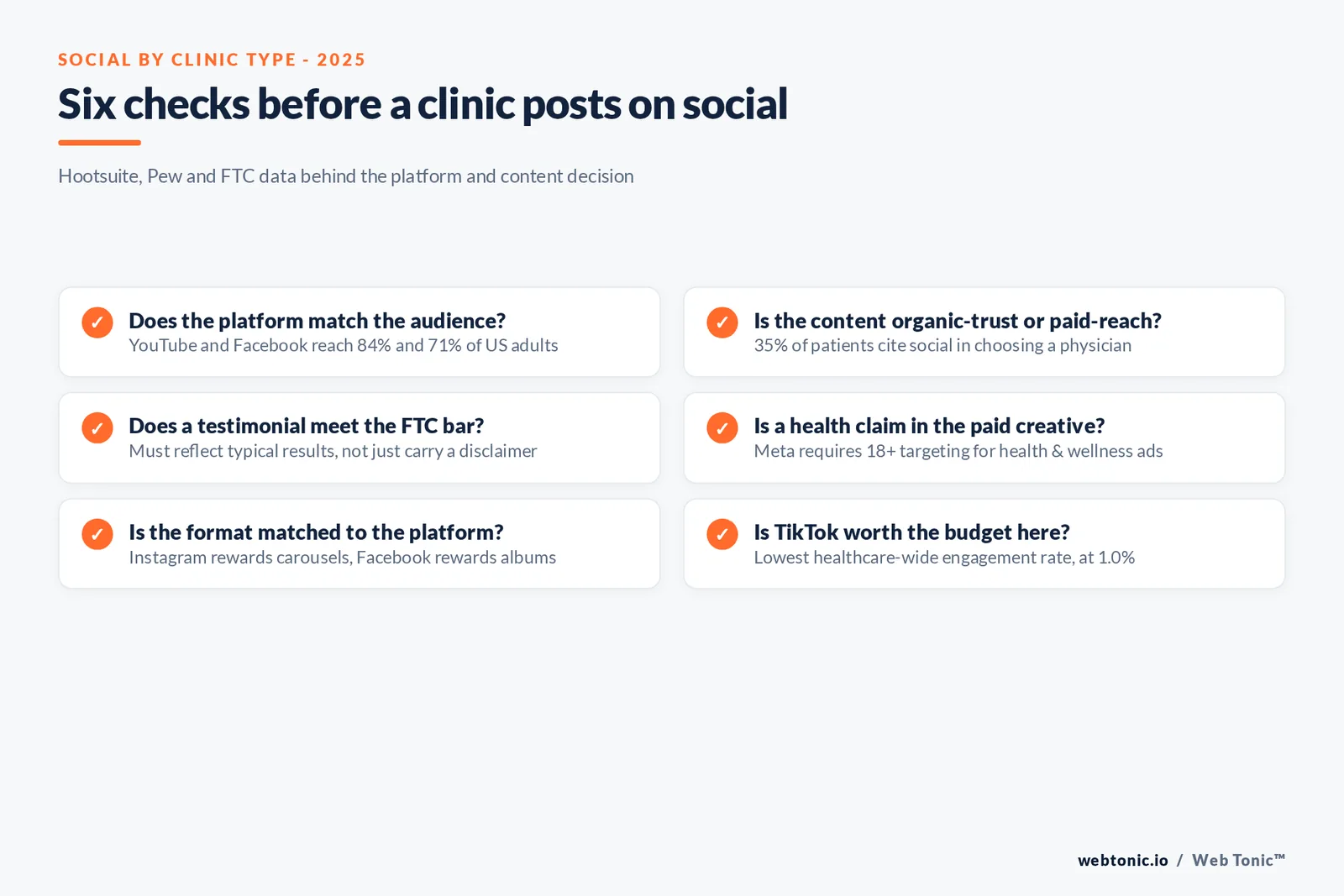
- X (Twitter) engagement sat at 2.3%, Facebook at 1.9%, and TikTok at just 1.0% - the lowest of any platform measured.
- 35% of patients say they chose a physician based on social media presence, per a 2026 survey reported by Medical Economics.
- Nearly a quarter of patients name social platforms among their top influences on physician choice, per the same survey.
- YouTube reaches 84% of US adults and Facebook reaches 71%, per Pew Research's 2025 Americans' Social Media Use report.
- Pew's 2025 survey found growing shares of adults using Instagram, TikTok, WhatsApp and Reddit year over year.
- Meta's Health and Wellness ad standard requires 18+ targeting for paid social promoting health-related services.
- The FTC's Health Products Compliance Guidance requires testimonials to reflect typical results, not just carry a disclaimer.
- Urgent care locations grew from 9,000 to 15,000 between 2016 and 2024, the scale most urgent care social accounts now operate at.
- The AAFP reports up to 48,000 more primary care physicians are needed by 2034, a capacity gap organic social can help manage, not just grow.
Why the benchmark is healthcare-wide, not clinic-specific
Hootsuite's own healthcare, pharma and biotech benchmark research, current as of April 2025, is the most current published engagement-rate data available for the sector - and it blends hospital systems, pharma brands, biotech companies and individual clinics into one average. Neither Hootsuite nor any other platform publisher we found breaks out urgent care or primary care specifically. Every figure below inherits that limitation, and we say so rather than implying a precision the data does not have.

What the healthcare-wide engagement data shows
Hootsuite's April 2025 data ranks Instagram highest for healthcare-wide engagement at 3.7%, ahead of LinkedIn at 3.3% and Instagram Reels at 2.7%. X trailed at 2.3%, Facebook at 1.9%, and TikTok came in lowest at 1.0% - a useful starting point for budget allocation even without a clinic-type split.
The same research found healthcare organizations posting most often on Facebook of any platform, and recommends different posting cadence per network: Instagram rewards at least twice a week before diminishing returns set in, while LinkedIn and X reward either a very light or a very heavy posting schedule, with the middle ground performing worst on both.
| Platform | Healthcare-wide engagement rate (Apr. 2025) | Best-fit clinic use |
|---|---|---|
| 3.7% | Both - photos of facility, staff, community | |
| 3.3% | Primary care - staff recruiting, referral partners | |
| Instagram Reels | 2.7% | Urgent care - quick tips, wait-time updates |
| X (Twitter) | 2.3% | Chain-level urgent care announcements |
| 1.9% | Both - reviews, community updates | |
| TikTok | 1.0% | Lowest priority for both, staff recruiting niche |
Who is actually on each platform
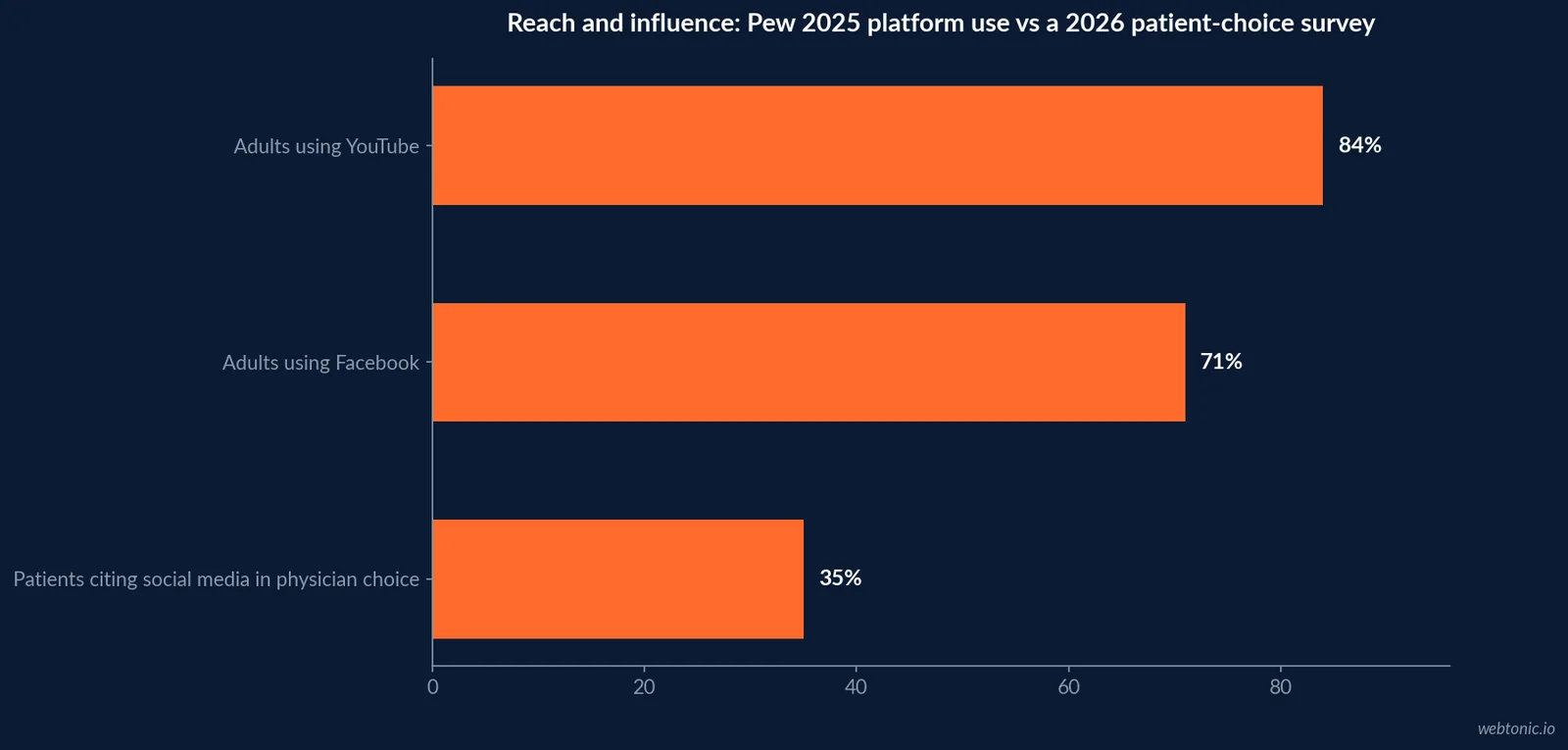
Pew Research Center's 2025 Americans' Social Media Use report, based on a survey of 5,022 US adults, found 84% of adults use YouTube and 71% use Facebook - still the two widest-reach platforms for reaching an adult patient population of any age. Pew also found growing shares of adults using Instagram, TikTok, WhatsApp and Reddit year over year, meaning the audience on newer platforms is real and increasing, just still smaller than Facebook and YouTube's adult reach.
For a primary care practice managing an older or family-oriented patient panel, that reach data argues for keeping Facebook active even though its engagement rate trails Instagram and LinkedIn - reach and engagement are answering different questions.
| Pew 2025 metric | Figure | Relevance to clinic social strategy |
|---|---|---|
| Adults using YouTube | 84% | Widest reach for any age-inclusive content |
| Adults using Facebook | 71% | Best reach for an older patient panel |
| Survey sample | 5,022 US adults | Nationally representative, Feb-Jun 2025 |
| Trend direction | Instagram, TikTok, WhatsApp, Reddit growing | Worth monitoring, not yet leading reach |
The patient-choice evidence for primary care specifically
A 2026 survey reported by Medical Economics found 35% of patients said they had chosen a physician based on social media presence, with nearly a quarter naming social platforms among their top influences on physician choice. That is a materially different finding from the urgent care side, where the decision is driven by distance and hours, not a provider's online presence built up over months - social content for primary care is doing real selection work that urgent care's social content generally is not.
The compliance layer that applies to both
Whatever the platform, a patient testimonial post has to clear the FTC's Health Products Compliance Guidance, which requires the testimonial to reflect the honest experience of the person featured and requires the business to hold competent evidence a typical consumer will see similar results - a disclaimer alone does not satisfy that bar. Paid social promoting health-related services additionally falls under Meta's Health and Wellness ad standard, requiring 18+ targeting and restricting specific health claims in creative. State medical-board rules on before-and-after photography add a third layer that varies by state and should be checked before any procedure- result content goes up on either organic or paid social.
| Content type | Rule | Issuing body |
|---|---|---|
| Patient testimonial | Must reflect typical results, not just carry a disclaimer | FTC |
| Paid health/wellness ad | 18+ targeting required | Meta Transparency Center |
| Before-and-after imagery | Varies by state medical board | State medical board |
| Claims of curing/treating a condition | Prohibited without substantiation | FTC |
Organic versus paid: two different jobs on the same platforms
Engagement rate measures organic reach among people already following an account; it says nothing about how far a paid campaign can extend beyond that base. A clinic with a strong Instagram engagement rate but a small follower count still needs paid social to reach new patients, while a clinic with weak organic engagement but a large existing following can lean on that base for cheaper, review-request-style content. Confusing the two - assuming a good organic engagement rate means paid social is unnecessary, or the reverse - is one of the more common budgeting mistakes in clinic social strategy.
| Goal | Organic social role | Paid social role |
|---|---|---|
| New-patient acquisition | Builds trust before the ad is seen | Extends reach beyond followers |
| Review generation | Primary channel | Rarely used directly |
| Staff recruiting | LinkedIn posts, employee content | Targeted LinkedIn/Meta job ads |
| Same-day urgent care volume | Limited - too slow | Primary lever - location radius targeting |
| Community trust building | Primary channel | Secondary, reinforces organic content |
Content formats worth testing on each platform
Hootsuite's April 2025 research also found format preferences differ by network: Facebook audiences in healthcare respond best to photo albums, followed by standard photos and video; Instagram audiences favor carousel posts over single images or Reels; and LinkedIn audiences respond best to posts carrying a photo or video rather than text alone. None of that changes between urgent care and primary care - the platform's own audience behavior sets the format, while the clinic type sets the subject matter.
| Platform | Best-performing format (healthcare-wide) | Suggested subject by clinic type |
|---|---|---|
| Photo albums, then standard photos, then video | Facility tour, community event | |
| Carousel posts | Multi-slide provider intro or care-tip series | |
| Photo or video posts | Staff spotlight, recruiting, referral-partner content |
What urgent care should actually post
Given the 15,000-center national footprint the Urgent Care Association reports, urgent care social content works best as short, location-relevant updates - current wait times, hours, seasonal illness notices - distributed across Instagram Reels and Facebook where reach is highest among the general adult population. Recruiting content for nurses and physician assistants belongs on LinkedIn even for urgent care chains, since staffing, not patient acquisition, is increasingly the operational bottleneck.
What primary care should actually post
With 35% of patients reporting they chose a physician partly on social presence, primary care's organic content should build visible, sustained trust: provider introductions, patient-education content and community involvement, concentrated on Instagram and LinkedIn where healthcare-wide engagement runs highest. Given the AAFP's 48,000- physician shortfall projection, LinkedIn recruiting content for new providers deserves at least as much attention as patient-facing content in most practices.
Measuring social against the right outcome
Neither engagement rate nor follower count should be the reported KPI on its own. For urgent care, the number that matters is location-page visits or driving-directions requests generated from social referral traffic in the hours after a post goes up - a same-day, trackable action that matches the same-day decision the platform is influencing. For primary care, the number that matters is new-patient form submissions attributable to social referral over a longer 30 to 90 day window, since the 35% of patients citing social as a factor in choosing a physician are rarely converting on the day they first see a post.
Where the budget should go first
Neither clinic type should split budget evenly across every platform Hootsuite measured. Our growth marketing team builds the platform mix around the actual decision being influenced - urgent care's immediate-availability message versus primary care's trust-building content - and our data and analytics practice tracks whether that organic and paid mix is converting into booked visits, not just likes. For the paid-social cost side of this comparison, see our Facebook ads ROI analysis, or talk to us about the clinic-specific plan.
Frequently Asked Questions
Which social platform gets the best engagement for a healthcare page?
Per Hootsuite's healthcare, pharma and biotech benchmark data as of April 2025, Instagram led at 3.7% average engagement rate, followed by LinkedIn at 3.3%, Instagram Reels at 2.7%, X at 2.3%, Facebook at 1.9% and TikTok at 1.0%. These figures blend the entire healthcare sector - there is no published split by urgent care versus primary care specifically.
Do patients actually choose a doctor based on social media?
A growing share do. A 2026 patient survey reported by Medical Economics found more than a third of patients, 35%, said they had chosen a physician based on social media presence, with nearly a quarter naming social platforms among their top influences on physician choice - evidence that organic presence, not just paid reach, now affects the primary care decision specifically.
Is TikTok worth it for either clinic type?
The Hootsuite data puts TikTok's healthcare-wide engagement rate at just 1.0%, the lowest of every platform measured, and Pew's 2025 survey still finds Facebook (71%) and YouTube (84%) reaching far more US adults overall. TikTok skews younger than either clinic type's core decision-maker demographic, so it is a lower-priority platform for both unless the content is specifically aimed at a younger patient population or clinic staff recruiting.
What does the FTC require for a patient testimonial in a social post?
The FTC's Health Products Compliance Guidance requires that a testimonial reflect the honest experience of the person featured and that the business hold competent evidence the typical consumer will get similar results - a disclaimer like "results not typical" placed under an impressive testimonial does not, on its own, satisfy that requirement. State medical-board rules on before-and-after imagery add a second layer clinics need to check before posting.
Should urgent care and primary care post the same content?
No. Hootsuite's data shows engagement responds to different posting cadence and format on each network, and the decision each clinic type is trying to influence is different - urgent care is selling immediate availability, primary care is selling ongoing trust. Content built for one audience reads as either alarmist (symptom content aimed at a same-day decision) or thin (a single wait-time post aimed at a multi-year relationship) when applied to the other.
Sources
Hootsuite - Healthcare social media benchmarks, 2025 research
Pew Research Center - Americans' Social Media Use 2025
Medical Economics - Patients turn to AI, social media when choosing doctors
Federal Trade Commission - Health Products Compliance Guidance
Meta Transparency Center - Health and Wellness ad standard
Urgent Care Association - Urgent care industry data
American Academy of Family Physicians - Match Day 2025